

Cold chain compliance requires food logistics operators to maintain two parallel documentation streams: temperature logs that prove product was transported and stored within specified ranges, and maintenance records that prove the refrigeration equipment delivering those temperatures was serviced, calibrated, and in good working order. Most operators manage these as separate systems — temperature data in a monitoring platform, PM records in a spreadsheet or paper file — which creates the compliance gap that regulators and auditors consistently find. According to FDA FSMA Sanitary Transportation rules, shippers and carriers of refrigerated food must maintain temperature control records and demonstrate that equipment used to maintain temperature is properly designed, maintained, and cleaned. A temperature log without a corresponding maintenance record for the unit that produced it is incomplete compliance — and auditors know it.
This guide covers what cold chain compliance actually requires in maintenance terms, how refrigerated truck PM and DC refrigeration PM differ and why both need managing in the same system, and how a CMMS creates the audit-ready documentation trail that connects temperature performance to maintenance execution.

Cold chain compliance is not purely a temperature monitoring problem — it's a maintenance documentation problem with temperature monitoring as one component. The regulatory frameworks that govern refrigerated food transport and storage — FDA FSMA, EU Regulation 853/2004, ATP (Agreement on the International Carriage of Perishable Foodstuffs), HACCP-based food safety management systems, and retailer-specific codes of practice — all share a common thread: they require operators to demonstrate not just that temperatures were maintained, but that the equipment maintaining those temperatures was properly managed.
In practical terms, this means three categories of maintenance documentation need to exist and be retrievable for any refrigerated asset at any time. First, scheduled preventive maintenance records: evidence that the refrigeration unit, condenser, evaporator, and temperature control system received the service specified by the OEM at the correct intervals. Second, calibration records: evidence that temperature sensors, thermostats, and data loggers were calibrated on a defined cycle and that the readings they produce are accurate against a known reference. Third, corrective maintenance records: evidence that any fault affecting temperature performance — a condenser blockage, a door seal failure, a refrigerant charge loss — was identified, recorded, and resolved in a controlled way, with a documented return-to-service check confirming the unit was back within specification before product was loaded.
The ATP agreement adds a specific layer for refrigerated road transport: ATP-classified vehicles (FRC, FNA, FR, FNA classes) require renewal examinations every 3 to 6 years depending on classification, with examination certificates maintained per vehicle. An ATP certificate that expires during a cross-border shipment creates both a customs compliance issue and a food safety regulatory exposure. The CMMS is the system that ensures ATP renewal examinations are scheduled, executed, and documented before certificates lapse — not after a border check discovers the problem.
Retailer codes of practice add requirements on top of regulatory minima. Major UK grocery retailers, for example, require suppliers and logistics partners to demonstrate HACCP-compliant temperature management with documented pre-load vehicle checks, continuous temperature monitoring during transit, and refrigeration equipment service records available for audit at short notice. Meeting these requirements without a centralised maintenance management system means assembling records from multiple contractors, multiple sites, and multiple paper systems every time an audit is called — a time-consuming, error-prone process that consistently reveals gaps.
Refrigerated trucks and distribution centre refrigeration systems are both cold chain assets, but they have fundamentally different maintenance profiles, compliance requirements, and failure consequences. Treating them as variations of the same maintenance challenge — or worse, managing one well and ignoring the other — creates the compliance gaps that characterise most cold chain operator audit findings.
Refrigerated trucks operate in a mobile, variable environment: ambient temperature swings from -10°C to +40°C across a year, road vibration imposes continuous mechanical stress on compressor mountings and refrigerant connections, diesel fuel quality affects TK (transport refrigeration unit) performance, and door opening cycles during delivery rounds stress evaporator performance in a way that DC refrigeration units don't experience. TRU maintenance is governed by OEM service intervals in operating hours — typically every 1,000 to 2,000 hours depending on the unit — plus annual defrost system checks, refrigerant charge verification, condenser cleaning, and belt inspections. ATP examination requirements sit on top of this OEM schedule and are vehicle-specific rather than fleet-wide.
DC refrigeration systems operate in a fixed, controlled environment but carry higher consequence-per-failure because a DC cold room failure affects product across an entire storage bay rather than a single vehicle load. DC refrigeration plant — ammonia or HFC refrigeration systems, evaporator banks, condenser arrays, chiller plant, and cold room door sealing systems — requires specialist F-Gas or ammonia-competent servicing, pressure system examinations for vessels above threshold pressures, condenser cleaning on a seasonal cycle ahead of summer ambient peaks, and defrost cycle verification across multi-chamber cold stores. Leak detection system testing and refrigerant charge records for F-Gas compliance add a regulatory layer specific to DC refrigeration that doesn't apply to road transport units.
Managing both asset types in the same CMMS — with asset-specific PM schedules, asset-specific compliance documentation requirements, and asset-specific calibration cycles for temperature monitoring equipment — is what gives a cold chain operator a coherent compliance picture rather than two separate and poorly connected programs. Cryotos's asset tracking module supports both mobile assets (vehicles) and fixed assets (DC plant) in the same account, with site assignment updated when vehicles are redeployed between depot locations.
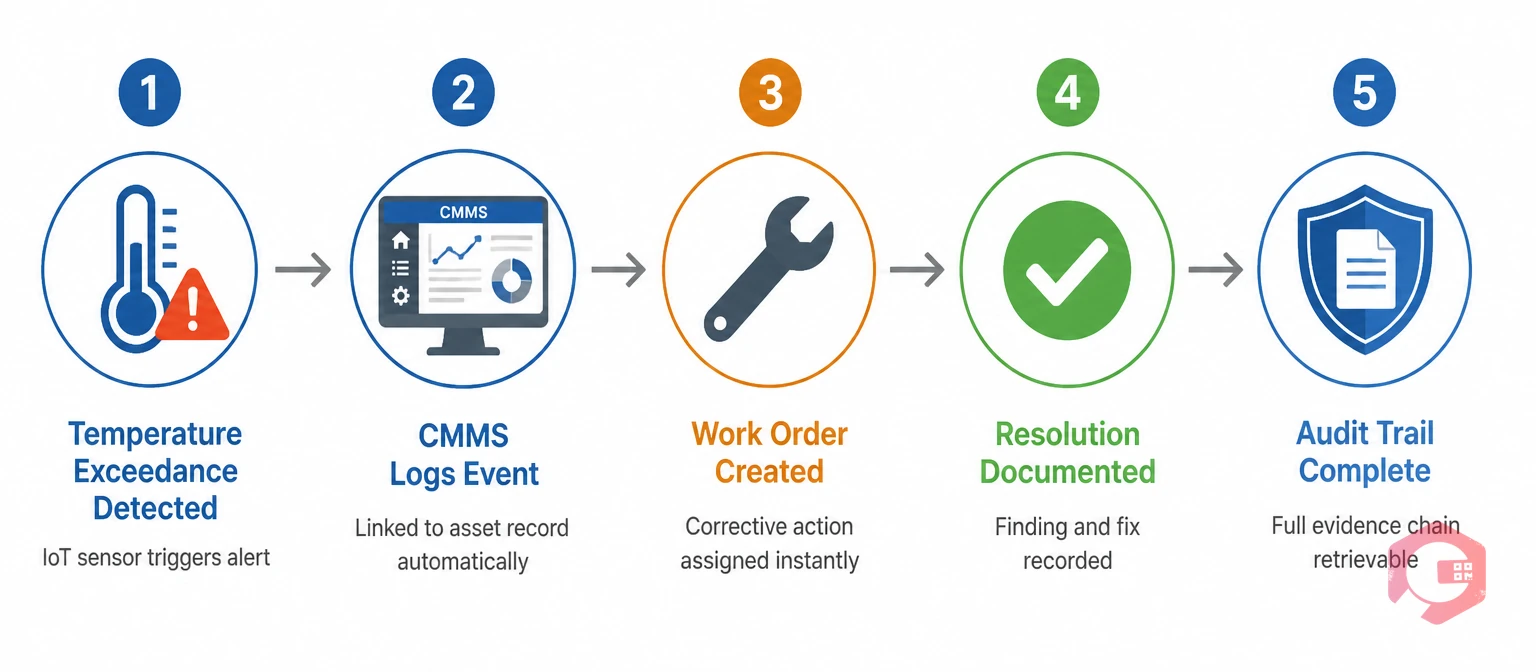
A temperature exceedance event — a vehicle load that went above +5°C during transit, or a cold room that drifted above -18°C overnight — triggers one of two investigative responses depending on whether the maintenance records are connected. With connected records, the investigation takes 20 minutes: pull the temperature log for the event window, pull the maintenance record for the unit, confirm the last service date and calibration record, verify there are no open corrective work orders against the unit at the time of the event. If all records check out, the exceedance may be attributable to operational factors (door opening frequency, loading bay temperature) rather than equipment failure, and the product disposition decision has a documented evidence base.
Without connected records, the same investigation takes days. The temperature log is in the monitoring platform. The vehicle service record is in the transport workshop file. The calibration record for the temperature probe may be on a certificate issued by a calibration lab 8 months ago, in a folder at head office. The corrective work order for the defrost system fault raised three weeks before the event is on a paper sheet in the vehicle's maintenance file at the origin depot. Assembling these into a coherent picture for a customer, a retailer auditor, or a regulatory inspector is both time-consuming and frequently incomplete — because paper-based and disconnected records are never as complete as a system-maintained record.
The IoT meter reading integration in Cryotos connects temperature monitoring data directly to the asset record. When a temperature logger or monitoring system feeds data via API to Cryotos, each temperature reading timestamps against the relevant vehicle or cold room asset. Alert thresholds configured in the CMMS generate corrective work orders automatically when temperature deviates outside the specified range — creating an immediate, documented response to every temperature exceedance rather than a retrospective investigation. The corrective work order captures what was found, what was done, and when the unit returned to specification — all linked to the same asset record that holds the PM history and calibration certificates.
This connection also supports proactive maintenance decisions. A vehicle that has produced three temperature deviations within a month — even minor ones that didn't exceed product specification — is flagging a developing refrigeration system problem before it produces a significant exceedance. Without a CMMS connecting temperature performance data to maintenance history, that pattern is invisible. With it, the BI Dashboard surfaces the pattern and the maintenance planner can schedule an inspection before the unit fails during a delivery.
Different regulatory frameworks impose different documentation requirements for cold chain operators. The table below maps the primary frameworks to the specific maintenance and temperature records they require, giving compliance and maintenance teams a clear reference for what needs to exist and how it needs to be maintained.
| Regulation / Framework | Scope | Maintenance Records Required | Temperature Records Required |
|---|---|---|---|
| FDA FSMA Sanitary Transportation (21 CFR Part 1) | US food transport by road and rail | Equipment design, maintenance, and cleaning records; written procedures for temperature control | Temperature monitoring records per shipment; pre-cooling records where required |
| EU Regulation 853/2004 (Food Hygiene) | EU food business operators | HACCP records demonstrating refrigeration equipment management; corrective action records | Temperature records during transport and storage; continuous monitoring evidence |
| ATP Agreement (International Carriage of Perishables) | Cross-border refrigerated transport | ATP examination certificate per vehicle; renewal every 3-6 years by class; servicing evidence | Temperature performance records during ATP examination; continuous monitoring during transit |
| F-Gas Regulation (EU 517/2014 / UK equivalent) | HFC refrigerant systems above threshold charge | Leak check records at defined intervals; refrigerant charge records; technician F-Gas certification records | Not directly required but leak check records support temperature system compliance |
| HACCP (Codex Alimentarius / GFSI standards) | Food safety management systems globally | CCP monitoring records; corrective action records; equipment calibration records; PM schedules as prerequisite programs | CCP temperature monitoring records; temperature deviation and corrective action records |
| BRC Global Standard for Storage and Distribution | Retailer-audited food logistics operations | Planned maintenance schedules; engineer service records; calibration certificates for temperature monitoring equipment | Continuous temperature monitoring records; alarm response documentation; trend data |
The operational value of a CMMS for cold chain compliance comes from eliminating the gap between temperature monitoring and maintenance management. When both data streams feed into the same system — each linked to the same asset record — the compliance documentation package assembles itself rather than requiring manual assembly before every audit.
For refrigerated trucks, the CMMS asset register holds the full vehicle profile: TRU make and model, refrigerant type and charge, ATP class and certificate expiry date, OEM PM schedule in operating hours, and the service contractor responsible for each service type. The preventive maintenance software generates TRU service work orders automatically at the configured hour interval — fed from either manual hour meter readings logged by the driver or transport manager, or from telematics integration where the vehicle is fitted with TRU telemetry. ATP renewal examination work orders generate ahead of certificate expiry, with configurable lead time to ensure the examination is booked and completed before the certificate lapses.
For DC refrigeration, the same system manages the fixed plant PM schedule: condenser cleaning work orders generated ahead of summer, F-Gas leak check work orders on the regulatory interval (annually for systems above 5 tonnes CO2e, biannually above 50 tonnes), pressure vessel examination work orders ahead of statutory inspection due dates, and quarterly evaporator defrost cycle verification work orders. All service records from contractors attach to the relevant plant asset record in Cryotos's document management module — including engineer service sheets, refrigerant charge records, leak check certificates, and F-Gas technician certification copies.
Temperature monitoring integration completes the picture. IoT meter reading connections to temperature monitoring systems — whether standalone wireless loggers, vehicle-mounted TRU monitoring units, or DC continuous monitoring platforms — feed temperature data into the relevant asset record. Alert thresholds generate corrective work orders automatically when temperature deviates outside specification. WhatsApp alerts via Cryotos WhatsApp integration notify the relevant technician or transport manager immediately — so the response to a temperature alarm starts within minutes rather than when someone checks their email the next morning.
Calibration management runs alongside PM scheduling. Temperature probes, data loggers, and thermostat sensors require calibration on a defined annual or biannual cycle. Calibration work orders generate in Cryotos at the configured interval, route to the calibration contractor, and close with the calibration certificate uploaded against the sensor asset record. The calibration certificate links to every temperature reading produced by that sensor while it was in calibration — creating the chain of evidence that connects a temperature log to a proven, calibrated measurement device.
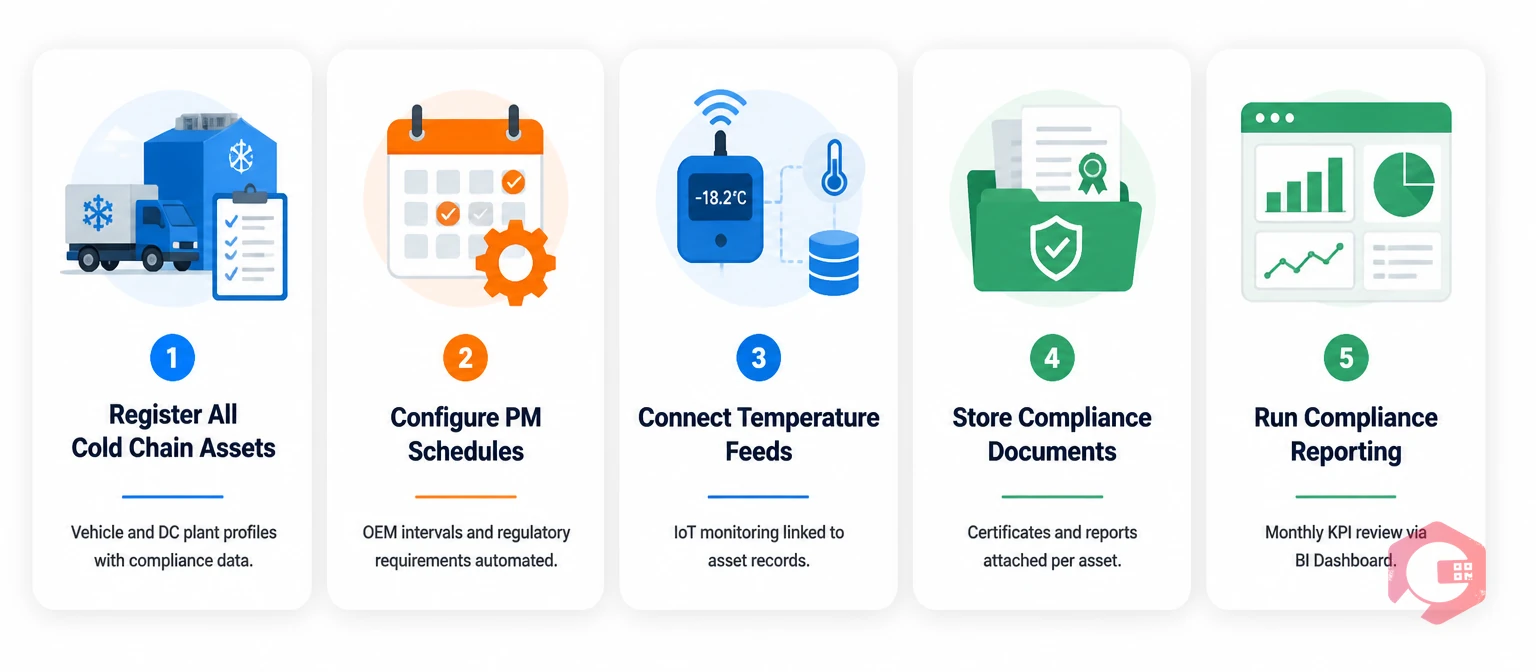
An audit-ready cold chain maintenance program in Cryotos is built in five steps that create the documentation structure before the auditor asks for it — not after.
Step 1 — Register every cold chain asset with its compliance profile. Each refrigerated vehicle gets an asset record: registration, TRU make and model, refrigerant type and charge, ATP class and certificate expiry, and assigned depot. Each DC cold room and refrigeration plant gets an asset record: plant make and model, refrigerant type and total charge, F-Gas charge category (which determines leak check frequency), pressure vessel details if applicable, and responsible contractor. Sub-assets — TRU compressor, evaporator, condenser; DC compressor rack, condenser bank, each cold room evaporator — nest under the parent asset, creating the granular asset register that supports detailed service history retrieval.
Step 2 — Configure PM schedules from OEM specifications and regulatory requirements. TRU PM schedules set at OEM operating hour intervals. ATP renewal examination work orders set with 90-day advance notice before certificate expiry. DC refrigeration PM schedules set for condenser cleaning (spring, ahead of summer peak), F-Gas leak checks at the correct regulatory frequency, pressure vessel examinations at the statutory interval, and seasonal defrost cycle checks. The CMMS generates all of these work orders automatically — compliance obligations become system-driven rather than calendar-dependent.
Step 3 — Connect temperature monitoring feeds to asset records. Configure IoT meter reading connections for temperature data sources across vehicles and DC assets. Set two-tier alert thresholds: a monitoring alert for minor deviations that flags for review, and an automatic corrective work order for exceedances outside product specification. Every temperature exceedance becomes a documented maintenance event, linked to the asset, with a traceable response record.
Step 4 — Store all compliance documentation against the relevant asset record. ATP certificates, F-Gas records, pressure vessel examination reports, calibration certificates, engineer service sheets — every compliance document uploads to the document management module against the relevant asset. The document is retrievable by asset, by document type, or by date range within seconds. An auditor requesting "all maintenance records for Vehicle X in the last 24 months" gets a complete package from a single screen, not a multi-day document assembly exercise.
Step 5 — Run monthly compliance reporting from the BI Dashboard. Use the Cryotos BI Dashboard to review cold chain compliance KPIs monthly: PM completion rates by asset class, overdue work orders by site and contractor, upcoming compliance deadlines in the next 60 days, temperature exceedance frequency by vehicle and cold room, and open corrective work orders with resolution status. Monthly reviews catch compliance gaps before they become audit findings. Annual performance data supports continuous improvement conversations with regulators and retailer audit teams — demonstrating not just current compliance but a trend of improving maintenance performance over time.
Cold chain operators using Cryotos report a 30% reduction in downtime and 25% faster repair times — in a cold chain context, those outcomes translate directly to fewer temperature exceedance events, fewer product loss incidents, and maintenance records that satisfy regulatory and retailer audit requirements without preparation effort. The asset and equipment inspections checklist provides a structured baseline for the initial cold chain asset survey that populates the CMMS register across both vehicle and DC asset categories.
If your cold chain operation is managing temperature logs in one system, PM records in another, and calibration certificates in a filing cabinet, Cryotos CMMS gives you the integrated asset register, PM scheduling, temperature monitoring integration, and document management to maintain a compliant, audit-ready cold chain maintenance program in one platform. Book a demo at cryotos.com to see how the cold chain compliance workflow operates across refrigerated vehicles and DC refrigeration assets.
Cold chain compliance requires three categories of maintenance records. First, preventive maintenance records demonstrating that refrigeration equipment received OEM-specified servicing at the correct intervals — for refrigerated vehicles this includes TRU service records at operating hour milestones, for DC refrigeration it includes condenser cleaning, refrigerant charge checks, and evaporator servicing records. Second, calibration records proving that temperature sensors, data loggers, and thermostats were calibrated on a defined cycle and that temperature readings are accurate against a known reference standard. Third, corrective maintenance records documenting any fault that affected or could have affected temperature performance, the corrective action taken, and confirmation that the unit returned to specification before product was loaded or stored. All three categories of records need to be retrievable quickly and linked to the specific asset they relate to.
The ATP Agreement (Agreement on the International Carriage of Perishable Foodstuffs) is an international treaty governing the equipment standards for refrigerated road transport used in cross-border food shipments. ATP-classified vehicles (refrigerated, insulated, and heated transport units) require renewal examinations every 3 to 6 years depending on their ATP class, with certificates issued per vehicle by approved ATP testing stations. A CMMS manages ATP compliance by scheduling renewal examination work orders with sufficient advance notice before certificate expiry, routing the work order to the approved ATP testing station, and storing the certificate against the vehicle asset record when the examination is complete. Alert notifications fire ahead of the expiry date, preventing the certificate lapses that create customs compliance issues and regulatory exposure during cross-border shipments.
A CMMS with IoT integration connects temperature monitoring feeds — from vehicle TRU monitoring systems, wireless cold room loggers, or building management platforms — directly to the relevant asset records. Each temperature reading timestamps against the specific vehicle or cold room it relates to. Alert thresholds configured in the CMMS generate corrective work orders automatically when temperature deviates outside specification, creating an immediate, documented maintenance response to every exceedance event. The corrective work order captures the finding and resolution, linking it to the same asset record that holds the PM history and calibration certificates. This connected record is what satisfies the regulatory requirement to demonstrate that temperature deviations were identified and actioned through a controlled maintenance process.
Calibration frequency for temperature sensors and data loggers in cold chain operations is typically annual or biannual under most food safety regulatory frameworks and retailer codes of practice, with the specific interval determined by the equipment type, the criticality of the temperature control point, and any specific requirements in the applicable standard (BRC, FSSC 22000, SQF, or retailer code). A CMMS manages calibration schedules by configuring PM work orders for each temperature measurement device at the required interval, routing the work order to the calibration contractor, and storing the calibration certificate against the sensor asset record when the calibration is complete. The certificate then links to every temperature record produced by that sensor during its calibration period, creating the chain of measurement traceability that auditors require.
F-Gas Regulation (EU 517/2014 and the UK equivalent) requires operators of HFC refrigeration systems above a charge threshold of 5 tonnes CO2e equivalent to conduct leak checks at defined intervals: annually for systems between 5 and 50 tonnes CO2e, biannually for systems above 50 tonnes CO2e. Operators must maintain records of every leak check, including the date, the technician's F-Gas certification number, the outcome, and any refrigerant added or recovered. These records must be retained for 5 years and made available to competent authorities on request. A CMMS manages F-Gas compliance by scheduling leak check work orders at the correct regulatory frequency per system, capturing the engineer's certification details and leak check outcome against the work order, and storing leak check certificates in the document management module linked to the relevant refrigeration plant asset record.


Cryotos AI predicts failures, automates work orders, and simplifies maintenance—before problems slow you down.



