

Retail chains cut spare parts costs with min-max inventory thresholds in CMMS by setting precise reorder points for every maintenance part — HVAC filters, lighting tubes, refrigeration gaskets, motor belts — so stores never pay emergency prices for stockouts or tie up capital in excess stock sitting on shelves for months. According to Plant Engineering benchmarking data, facilities without structured inventory controls carry 30 to 50% more spare parts than they need, while simultaneously experiencing stockouts on the parts that matter most. In retail maintenance, both failures cost real money.
This guide explains how min-max thresholds work in a retail CMMS context, how to calculate the right levels for different part categories, and how CMMS automation eliminates the manual effort of tracking stock across dozens or hundreds of store locations.
Walk into a typical retail chain's back-of-house maintenance area and you'll find two problems side by side. In one corner: a shelf of overordered HVAC filters ordered in bulk six months ago because someone panicked after a failure, half of which will expire before they're used. In another: a requisition sheet for an emergency order of fluorescent tube replacements because the store ran out mid-week and now someone is driving to a trade supplier at a marked-up price to keep the trading floor lit.
Both problems stem from the same root cause: inventory managed by memory and reaction rather than data and thresholds. A store manager who experienced an HVAC failure because filters weren't changed on time will overorder filters at the next purchase. A store that runs out of lighting spares during a maintenance round will be caught short again next quarter when the PM schedule repeats and nobody tracked what was consumed last time.
The cost compounds across a multi-store estate. A retail chain running 50 stores, each independently managing maintenance parts without system visibility, is almost certainly duplicating stock across locations, paying different prices from different suppliers, and making procurement decisions based on individual store memory rather than network-level consumption data. Retail facility management software with integrated inventory management replaces that fragmented approach with a single system tracking every part, every store, every consumption event.
Min-max thresholds are the mechanism that makes this work. They define the floor (the minimum stock level that triggers a reorder) and the ceiling (the maximum quantity the system orders back up to) for every part in every store. When the CMMS sees stock drop below the minimum, it generates a purchase requisition automatically. No manual stock count required. No memory needed. No emergency orders because someone forgot.
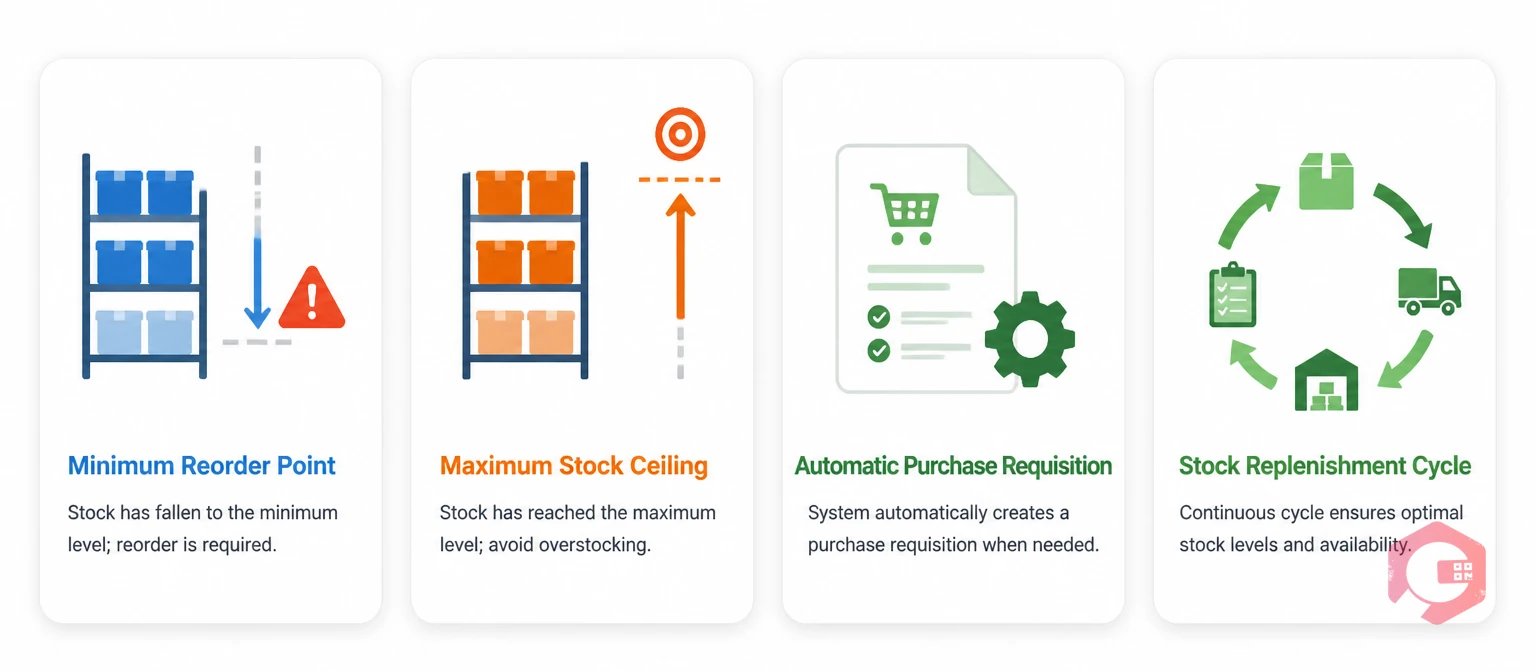
Min-max inventory control is one of the oldest inventory management methods, but in a CMMS it becomes something the traditional definition understates. In a retail maintenance context, min-max thresholds aren't just reorder triggers — they're the boundary conditions that define how much working capital you're willing to commit to any given part, how much operational risk you're willing to carry, and how often you want your procurement team to process purchase orders.
The minimum level (reorder point) is the stock quantity at which a purchase order should be raised. It needs to be high enough that you don't run out before the replenishment order arrives, but not so high that you're effectively holding extra inventory as a buffer. The minimum is a function of two variables: average daily consumption of that part and the supplier lead time in days. A HVAC filter used at a rate of 2 per week with a 5-day supplier lead time needs a minimum of at least 2 (one week's usage) to cover the replenishment window.
The maximum level is the target stock quantity after replenishment. It represents the ceiling of your inventory investment for that part. Set it too high and you're tying up budget in slow-moving stock. Set it too low and you're placing orders too frequently, increasing administrative overhead and potentially missing volume discounts. The maximum is driven by storage constraints, order minimums from suppliers, and your target replenishment frequency.
In Cryotos's inventory management module, min and max levels are configured per part per location. A store with a single HVAC unit has different minimums for the same filter than a store with six units. A store in a high-traffic city centre location goes through lighting tubes faster than a suburban store with lighter trading hours. The CMMS holds location-specific thresholds rather than applying a blanket number across the network — which is where genuine cost control actually happens.
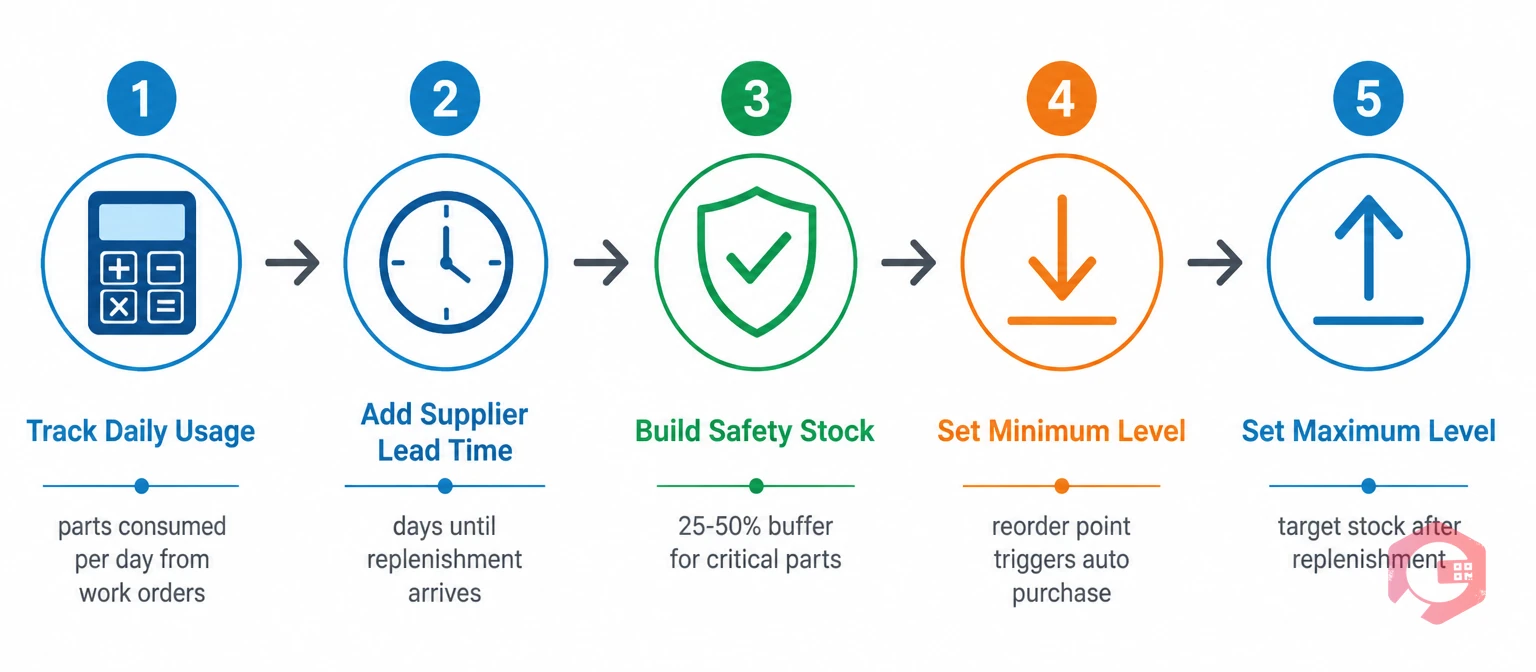
The formula for a minimum level is straightforward: Min = Average Daily Usage × Supplier Lead Time (days) + Safety Stock. Safety stock is the buffer you hold against usage spikes and supplier delays — typically 25 to 50% of the base reorder quantity for critical parts. For non-critical parts with reliable suppliers, safety stock can be zero.
The maximum level formula is: Max = Min + Economic Order Quantity (EOQ). EOQ is the mathematically optimal order size that balances the cost of ordering (purchase order processing, delivery charges) against the cost of holding inventory (storage space, capital tied up, obsolescence risk). For most retail maintenance parts, EOQ tends to land at 4 to 8 weeks of average usage — enough to make each order worthwhile without holding excessive stock.
Working through a real example makes this concrete. A supermarket runs 4 HVAC rooftop units. Each unit uses one set of filters per month. Supplier lead time is 7 days. Safety stock is set at one month's supply for this critical part.
When HVAC filter stock at that store drops to 5, Cryotos generates a purchase requisition for 8 filter sets automatically — bringing stock back to 13. No store manager has to check the shelf. No maintenance planner has to remember the reorder cycle. The spare parts inventory software handles it.
For parts with more variable consumption — lighting tubes that get consumed more in winter, refrigeration gaskets that spike during equipment changeovers — the min and max levels should be reviewed quarterly and adjusted based on actual CMMS consumption data rather than estimates. Cryotos tracks every parts issue against the work order that consumed it, giving you the consumption history needed to refine thresholds over time without guesswork.
The cost of incorrect min-max thresholds shows up in two directions. Both are real, but they're often invisible until someone runs the numbers. The table below compares what happens at each extreme across the part categories retail chains maintain most actively.
| Part Category | Overstock Consequence | Stockout Consequence | Correct Min-Max Outcome |
|---|---|---|---|
| HVAC filters | Expired filters, capital locked in shelf stock, storage consumed | Overdue PM, increased energy consumption, unit failure risk | PM completed on schedule, unit efficiency maintained |
| Lighting tubes / LEDs | Obsolescence risk as lamp technology changes, excess SKUs to manage | Failed fixtures on trading floor, lost sales in targeted display zones | Fault response within same shift, trading floor presentation maintained |
| Refrigeration gaskets / seals | Degradation over time, cash tied up in slow-moving parts | Open display case failure, product loss, food safety risk | Fast corrective repair, no product spoilage |
| Motor belts (HVAC / conveyor) | Belt hardening from long shelf storage, wasted procurement budget | Equipment failure, emergency courier cost, extended downtime | Planned replacement at correct PM interval |
| Electrical components (fuses, RCDs) | Minimal — low cost, long shelf life, low risk of overstock | Electrical fault unresolvable on shift, compliance risk if inspection overdue | Same-shift fault resolution, compliance records maintained |

The manual version of min-max inventory management — someone physically counting shelves and raising purchase orders — breaks down at scale. A retail facilities manager responsible for 20 stores cannot realistically track stock levels at each location manually. By the time they've reviewed store 20, store 1's count is already stale. The whole point of min-max thresholds is that the system watches the inventory so the facilities team doesn't have to.
In Cryotos, the automation works through the connection between work orders and inventory. Every time a technician issues a part against a work order — an HVAC filter logged to a PM work order, a lighting tube logged to a corrective fault job — the stock level in that store's inventory record decrements automatically. The CMMS compares the updated stock level against the configured minimum for that part at that location. If the new level is at or below the minimum, a purchase requisition generates automatically, routed to whoever is responsible for parts procurement at that location or at a central purchasing function.
For retail chains with centralised procurement, this creates a consolidated purchasing picture across the whole estate. Instead of 50 stores independently calling suppliers for the same parts, the CMMS aggregates reorder triggers across all locations. A procurement manager can see that 12 stores need the same HVAC filter replenished this week, negotiate a volume order with the supplier, and distribute stock from a central location rather than paying 12 individual delivery charges. This network-level visibility is where warehouse management integration in Cryotos adds direct cost reduction — typically 15 to 25% off parts costs through consolidated purchasing versus store-by-store buying.
Stock transfers between stores become visible and manageable too. If Store A has 8 HVAC filters above its maximum threshold and Store B has just triggered a reorder, the CMMS surfaces that surplus before an external order is placed. A stock transfer from Store A to Store B costs nothing beyond internal logistics — and avoids a purchase order, delivery charge, and lead time wait at Store B. Without system visibility across the estate, this kind of inter-store stock management is practically impossible.
The BI Dashboard gives retail facilities directors a live view of inventory health across the network: which stores are below minimum on which parts, which parts are above maximum and should be managed down before the next order cycle, which suppliers are consistently hitting lead times, and what the total inventory value is across the estate at any point. This reporting closes the loop — min-max thresholds aren't set once and forgotten, they're refined continuously based on actual consumption data.
Retail maintenance spare parts split naturally into three categories that warrant different threshold approaches. Getting this categorisation right before configuring thresholds saves significant rework later.
Critical consumables are parts used on a regular PM cycle with direct consequences if unavailable: HVAC filters, lighting tubes, refrigeration door gaskets, UV lamp assemblies in food preparation areas. These need safety stock built into the minimum — the consequences of a stockout (failed PM, compliance gap, product loss) outweigh the cost of holding a few extra units. Set minimums to cover one full PM cycle's consumption above the lead time demand. Review thresholds quarterly against actual consumption from the CMMS work order history.
Corrective spare parts are parts consumed unpredictably in response to faults: motor start capacitors, belt drives, bearing assemblies, terminal blocks, specific fluorescent ballasts. These are harder to set thresholds for because consumption is driven by failure rates rather than PM schedules. The right approach is to pull 12 months of work order consumption data from the CMMS — Cryotos's report builder surfaces parts consumption by SKU across any date range — and calculate average monthly usage. Then set minimums at 2× the average monthly usage to cover usage spikes, with maximums at 4 to 6 months of average consumption. For low-use parts (one failure per year), consider network-level stocking at a central location rather than holding units at every store.
Long-lead or high-cost parts are components where stockout risk is severe but holding cost is also significant: compressor units, variable speed drives, large motor assemblies, custom-specification control panels. These don't suit a standard min-max model. Instead, use a criticality-based approach: assess the consequence of failure (financial impact, safety risk, lead time to replace), hold buffer stock at a regional level rather than per-store, and set CMMS alerts when any unit is issued so the regional stock is replenished before the buffer is exhausted.
Retail facilities teams using Cryotos report a 30% reduction in downtime and 25% faster repair times — much of that improvement traces directly to having the right parts on hand when a work order is raised, rather than waiting on emergency procurement. The MRO inventory checklist gives your team a structured framework for auditing current stock levels, identifying parts without thresholds, and prioritising which categories to configure first in the CMMS.
If your retail chain is still managing maintenance parts on spreadsheets, store-level buying decisions, and memory-based reorders, min-max thresholds in a CMMS are the most direct route to reducing parts costs while improving maintenance response times. Cryotos CMMS connects your parts inventory to your work orders, your PM schedules, and your procurement workflow — so every part is tracked from purchase to issue, every threshold triggers an automatic reorder, and every store operates from the same inventory logic. Book a demo at cryotos.com to see how the inventory management module works across a multi-store retail estate.
A min-max inventory threshold is a two-level stock control setting that tells the CMMS when to reorder a part (the minimum, or reorder point) and how much to order back up to (the maximum). When stock falls to the minimum level, the CMMS generates a purchase requisition automatically. When the order arrives, stock returns to the maximum level. The system repeats this cycle continuously without requiring manual stock counts or procurement decisions — the thresholds do the work.
The minimum level equals average daily consumption multiplied by supplier lead time in days, plus safety stock. Safety stock is typically 25 to 50% of lead time demand for critical parts, and zero for non-critical parts with reliable short lead times. Pull average daily consumption from your CMMS work order history — parts issued against completed work orders give you actual usage data rather than estimates. If you're setting up a new system without historical data, use 3 months of manual records or supplier recommendations as a starting point and refine after 90 days of live CMMS data.
Yes — this is one of the primary use cases for retail CMMS inventory management. Cryotos holds separate stock records, separate min-max thresholds, and separate consumption histories for each store location. The same part can have a minimum of 5 at a high-traffic flagship store and a minimum of 2 at a smaller neighbourhood store, based on that location's actual usage. A central management view across all stores shows the network inventory position, enables stock transfers between locations, and supports consolidated purchasing where multiple stores need the same replenishment.
Start with parts consumed on a regular PM cycle — HVAC filters, lighting consumables, refrigeration seals — because these have predictable consumption patterns that make threshold calculation straightforward. Next, configure thresholds for parts where a stockout directly causes a compliance gap or trading floor failure — emergency lighting components, refrigeration parts in food retail environments. Finally, address corrective spare parts for your highest-criticality equipment using 12 months of actual consumption data from your CMMS work order history to set accurate minimums and maximums.
CMMS inventory management with min-max thresholds reduces spare parts costs in four ways. It eliminates overstock by capping maximum levels so stores don't accumulate excess parts beyond what thresholds allow. It prevents emergency orders by maintaining minimum levels above stockout risk, so parts are always available for planned PMs and fault responses without premium-rate emergency procurement. It supports consolidated purchasing by aggregating reorder triggers across the store network, enabling volume pricing from suppliers. And it surfaces inter-store stock transfers so surplus at one location covers a deficit at another before an external purchase order is needed.


Cryotos AI predicts failures, automates work orders, and simplifies maintenance—before problems slow you down.



