

Planned maintenance and emergency call-outs represent two fundamentally different ways of running retail facility maintenance — and the ratio between them determines how much you spend, how predictable your operations are, and how often your customers notice a problem before you do. Most retail chains default to a reactive posture: systems fail, a call-out gets logged, a contractor arrives at premium rates, and the store limps through until the repair is done. According to Reliable Plant benchmarking data, reactive emergency repairs cost three to five times more per event than the same work performed on a planned schedule. In retail, those extra costs compound across every store and every quarter.
This guide covers why the emergency-heavy default happens, what an achievable planned maintenance ratio looks like for retail facilities, and the specific CMMS workflows that move the ratio in the right direction — without requiring a larger maintenance team.

The drift toward reactive maintenance in retail isn't accidental — it's the path of least resistance for every organisation without a structured system. A busy store manager doesn't have time to track PM schedules across 40 assets. A regional facilities coordinator covering 20 stores can't manually follow up on every contractor visit. A maintenance team managing a network of locations without shared visibility has no reliable way to know which PMs are overdue until something fails.
So the default becomes: wait for the failure, raise a call-out, pay contractor emergency rates, resolve the immediate problem, repeat. Each cycle feels like operations running normally because the store stays open. But the financial reality is different. An emergency HVAC call-out on a Saturday afternoon — outside standard hours, with contractor overtime rates, and potentially parts sourced at premium from a local supplier rather than a negotiated account — costs two to four times the same repair booked as a scheduled visit during the weekly maintenance window. Multiply that across a retail chain running 50 stores with HVAC, refrigeration, lighting, and electrical systems in each, and the reactive premium becomes a significant annual budget line.
There's a second cost that's harder to see on a purchase order: the operational disruption during the emergency repair window. A contractor working on an HVAC unit mid-trading creates noise, access restrictions, and customer experience issues that a planned repair during an early-morning maintenance window avoids entirely. Emergency electrical work requires isolating circuits that may affect trading floor systems. Reactive refrigeration repairs in food retail risk product temperature exceedance and potential product loss. None of these costs appear on the maintenance invoice, but they're real.
The third cost is structural. Every emergency call-out that gets resolved without addressing the underlying cause creates the conditions for the next emergency. A reactive organisation tends to fix symptoms rather than root causes because the pressure is to restore service quickly, not to investigate properly. The result is a maintenance program that looks busy but doesn't improve — the same assets fail repeatedly, the same contractors bill emergency rates repeatedly, and the ratio never shifts.
The cost gap between planned and emergency maintenance is well-documented across industry benchmarks, but the retail context adds specific multipliers that make the gap wider than the general industrial figures suggest.
Contractor rate differentials are the most visible. Most facility management contractors offer standard rates for scheduled work and emergency rates — typically 1.5× to 2.5× — for reactive call-outs outside agreed PM windows. For specialist contractors (refrigeration engineers, electrical contractors with specific certifications, elevator maintenance technicians), emergency premiums can reach 3× the scheduled rate when call-outs happen outside business hours. A retail estate with a high reactive ratio is effectively paying premium contractor rates for a large proportion of its total maintenance spend.
Parts premiums compound the rate differential. A planned repair uses parts sourced from a preferred supplier at negotiated pricing with standard delivery lead times. An emergency repair uses whatever the contractor has on the van or sources urgently from a local trade counter at full retail pricing. For common components, the difference is 20 to 40%. For specialist parts, it can be 100% or more when same-day availability demands emergency procurement.
Administrative overhead is the third cost layer. Every emergency call-out generates an unplanned purchase order, an invoice reconciliation, a contractor communication thread, and a store manager approval chain that wasn't in the week's plan. A planned maintenance visit generates a scheduled work order that gets processed in a standard administrative cycle. The labour cost of processing an unplanned emergency purchase order is typically two to three times higher than a planned one, across approval, invoice matching, and reconciliation steps. In a retail chain processing hundreds of maintenance events per month, that overhead adds up.
The aggregate impact is significant. McKinsey research on maintenance operations consistently finds that organisations operating with more than 30% reactive maintenance spend 25 to 40% more on total maintenance costs than comparable facilities running structured planned programs. For a retail estate spending £2 million per year on facilities maintenance, shifting from 60% reactive to 80% planned represents a potential saving of £300,000 to £500,000 annually — without cutting any maintenance activity.
The industry benchmark for a mature maintenance program is 80% planned, 20% reactive — meaning 8 out of every 10 maintenance events are scheduled and controlled, and only 2 are unplanned fault responses. That ratio reflects a program where most failures are anticipated and prevented, and only genuine unpredictable faults trigger reactive responses.
For retail facilities specifically, the starting position is often worse than the general industrial average. A typical retail chain without structured CMMS support operates at 40 to 60% planned maintenance — meaning roughly half of all maintenance activity is reactive. The good news is that retail has characteristics that make the ratio moveable relatively quickly, because the dominant failure modes in retail (HVAC, lighting, refrigeration) are well-understood and highly amenable to scheduled PM programs. These aren't complex industrial processes with unpredictable failure modes — they're mechanical and electrical systems with known service intervals and predictable wear patterns.
A realistic target for a retail facilities program with CMMS support is 70 to 80% planned within 12 to 18 months of implementation. The path to that target goes through three milestones. First, getting every asset into the CMMS with a PM schedule — so the system knows what needs to be done and when, rather than relying on memory or spreadsheets. Second, achieving consistent PM work order completion — scheduled jobs actually getting closed on time, not rescheduled repeatedly until they become overdue. Third, using work order closure data to identify which assets are still generating reactive call-outs despite scheduled PM and addressing the root cause — whether that's a PM interval that's too long, a parts availability problem, or a contractor reliability issue.
Tracking the ratio matters as much as moving it. The BI Dashboard in Cryotos shows planned versus reactive maintenance ratios by store, by asset category, and by contractor — giving retail facilities directors the visibility to see where the ratio is healthy and where it needs intervention, without manually compiling reports from multiple sources.
The differences between planned and emergency maintenance show up across cost, quality, disruption, and risk dimensions. This comparison covers the specific dimensions that matter most in a retail operating environment.
| Dimension | Planned Maintenance | Emergency Call-Out |
|---|---|---|
| Contractor rate | Standard agreed rate; scheduled visit | Emergency premium: 1.5× to 3× standard rate |
| Parts cost | Preferred supplier pricing; advance ordering | Trade counter or van stock; 20–100% premium |
| Timing control | Scheduled during low-impact window (early morning, overnight) | Happens when the fault occurs, often during trading hours |
| Repair quality | Full scope completed; root cause addressed | Restoration focus; root cause often deferred |
| Customer impact | Minimal — work done before store opens | Noise, disruption, restricted access during trading |
| Compliance documentation | Pre-planned checklist; record created automatically | Informal response; documentation often incomplete |
| Admin overhead | Standard purchase order cycle | Unplanned PO; expedited approval; 2–3× admin cost |
| Repeat failure risk | Low — PM addresses wear before failure | High — same failure recurs if root cause not fixed |
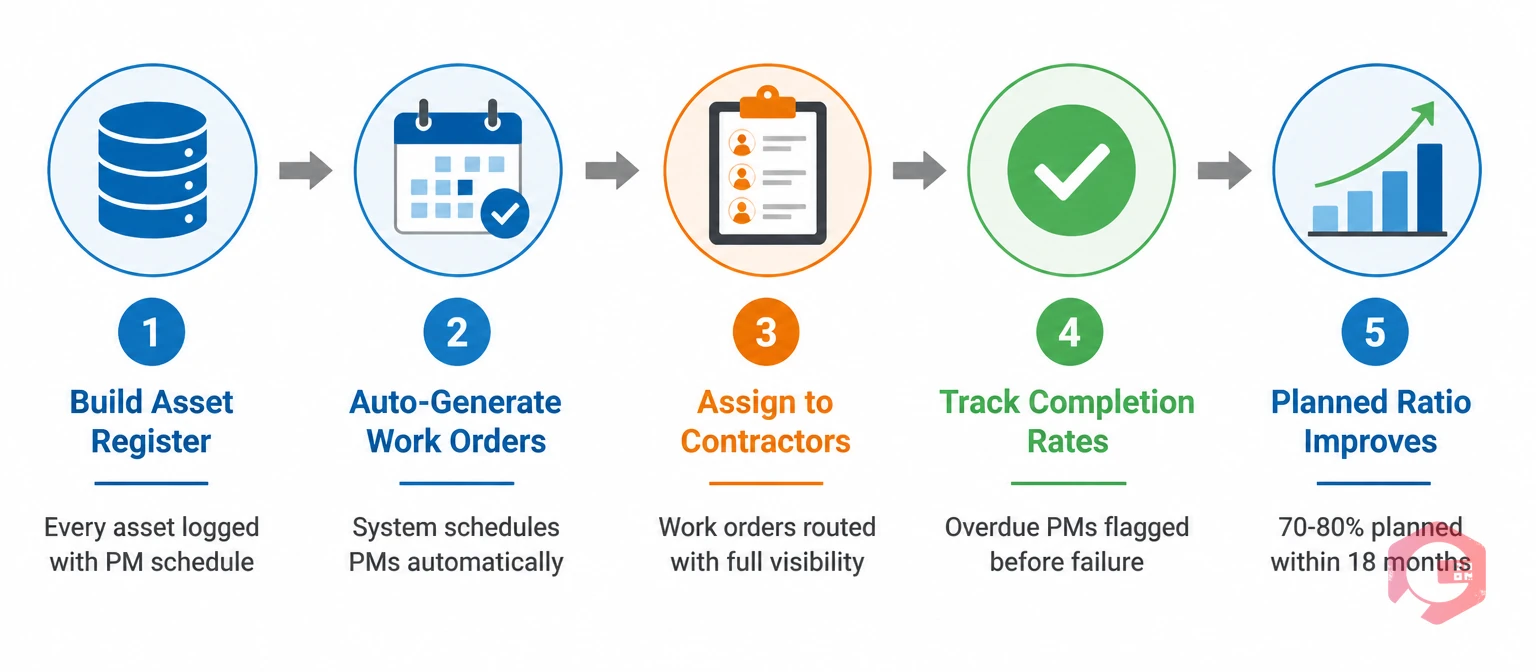
A CMMS shifts the planned-to-reactive ratio by replacing the memory-based, reactive default with a system-driven, proactive default. Instead of maintenance happening when something breaks or someone remembers to book a contractor, maintenance happens because the system schedules it, assigns it, tracks it, and reports on whether it was completed on time.
The mechanism starts with the asset register. Every asset in every store — HVAC units, lighting circuits, refrigeration cases, electrical panels, automatic doors — gets a record in Cryotos with its location, specifications, service history, and PM schedule. The CMMS generates preventive maintenance work orders automatically at the configured interval: quarterly HVAC filter changes, monthly emergency lighting tests, annual electrical panel inspections, biannual refrigeration service visits. These work orders appear in the maintenance calendar whether or not anyone actively schedules them — the system owns the schedule.
PM work order completion is where the ratio actually moves. A work order that generates but doesn't get completed on time is a PM that failed — and likely becomes a reactive call-out within the next service interval. Cryotos tracks PM completion rates by store, by contractor, and by asset category, surfacing overdue work orders before they become failures. A store with a PM completion rate below 80% is a store accumulating deferred maintenance that will eventually appear as emergency call-outs. That visibility lets a regional facilities manager intervene — chasing the contractor, rescheduling the visit, or addressing the underlying barrier — before the failure happens.
Work order closure data also drives continuous improvement. Every completed work order in Cryotos records what was found, what was done, and what parts were used. Over time, this history shows which assets generate recurring corrective faults despite scheduled PM — the repeat offenders that need a different maintenance strategy, a PM interval adjustment, or a capital replacement decision. Without that data, the reactive cycle continues indefinitely because no one has visibility of the pattern. With it, a facilities manager can present a data-backed case for replacing an HVAC unit that's generating quarterly emergency call-outs rather than continuing to pay emergency rates for a failing asset.
Contractor management through the CMMS also tightens PM execution. When planned work orders route to contractors via Cryotos's work order management system, completion status is tracked in real time. A contractor who closes a work order without completing all checklist items, or who consistently reschedules PM visits, creates a visible pattern in the system. That accountability — contractors knowing their performance is tracked — materially improves PM completion rates compared to a verbal booking and invoice process with no systematic follow-up.

Moving from a reactive to a planned maintenance posture in retail doesn't happen from a single action. It happens from pulling five specific levers consistently over 12 to 18 months. Each lever is enabled by CMMS capability, but the shift is operational rather than just technological.
Retail facilities teams using Cryotos report a 30% reduction in downtime and 25% faster repair times — both outcomes that follow directly from shifting the planned-to-reactive ratio. When most maintenance is planned, repair times fall because the right contractor, right parts, and right access window are all arranged in advance. Downtime falls because fewer systems fail unexpectedly. The ratio shift is not just a cost reduction — it's a qualitative improvement in how the maintenance program feels to operate, and how visible it is to the stores that depend on it. The facility inspection checklist gives your team a consistent store-level audit framework that complements the CMMS PM program, catching asset condition issues before they become reactive call-outs.
If your retail estate is still running more emergency call-outs than planned visits, Cryotos CMMS gives you the asset register, PM scheduling, contractor work order management, and reporting tools to shift that ratio systematically. Book a demo at cryotos.com to see how the planned maintenance program and reporting suite work for a retail estate at your scale.
Planned maintenance is maintenance work scheduled in advance — a contractor booked to service an HVAC unit on a quarterly cycle, emergency lighting tested on a monthly schedule, an electrical panel inspected annually. Emergency call-outs are unplanned reactive responses to failures that have already occurred. The difference in cost between the two is significant: emergency call-outs typically cost two to five times more per event due to contractor emergency rates, parts premiums, and unplanned procurement overhead. In retail, emergency call-outs also carry a customer experience and trading disruption cost that planned maintenance avoids by scheduling work outside trading hours.
The industry benchmark for a mature maintenance program is 80% planned, 20% reactive. For retail facilities specifically, a realistic starting point after CMMS implementation is 60 to 70% planned, rising to 75 to 80% within 12 to 18 months as the PM schedule establishes itself and PM completion rates improve. Anything below 50% planned means the maintenance program is predominantly reactive — which carries both a cost premium and an operational risk that compounds over time as deferred maintenance accumulates.
A CMMS improves planned maintenance compliance by automatically generating PM work orders at the configured interval and tracking whether those work orders are completed on time. Without a CMMS, PM compliance depends on someone remembering to book each service visit — a system that breaks down under operational pressure. With a CMMS, PM work orders appear in the system whether or not anyone actively schedules them, overdue PMs are visible before they become failures, and PM completion rates are reported at store and contractor level so accountability is clear and measurable.
Retail stores default to reactive maintenance when there's no system driving planned activity. Store managers are focused on trading operations, not maintenance scheduling. Regional facilities teams covering multiple locations can't manually track PM due dates across dozens or hundreds of assets. Without a CMMS creating scheduled work orders and reporting on completion rates, the default becomes: wait for failure, raise call-out, resolve, repeat. The reactive default isn't a management failure — it's what happens when maintenance is managed by memory rather than system.
Most retail chains using CMMS software see a measurable improvement in their planned-to-reactive ratio within 6 to 12 months of implementation. The first 3 months focus on getting assets registered and PM schedules built. Months 4 to 6 focus on PM completion rate — making sure scheduled work orders are being executed and closed. Months 7 to 12 use work order data to identify and address the recurring failures that are still generating reactive call-outs. By 12 to 18 months, a retail facilities team with consistent CMMS use typically achieves and sustains a 70 to 80% planned maintenance ratio.


Cryotos AI predicts failures, automates work orders, and simplifies maintenance—before problems slow you down.



