
To find compressed air leaks using ultrasonic detection, you walk the system with a handheld ultrasonic scanner set to the 38–40 kHz range, listen for the high-frequency turbulent flow signature that every pressurised leak produces, and tag each location before prioritising repairs. Unlike soap-bubble or chemical spray methods, ultrasonic detection works in running, noisy production environments — and it can locate leaks up to several metres from the instrument. According to the US Department of Energy, compressed air leaks account for 20–30% of total compressed air output in a typical manufacturing facility. For a plant spending £100,000 per year on compressed air energy, that is £20,000–£30,000 leaving through fittings and joints every year. This guide gives you the step-by-step survey process, a severity matrix for prioritising repairs, and a structured programme approach to make the savings permanent.
Key Takeaways

A compressed air leak is an unintended release of pressurised air from the distribution system through a fault in a fitting, seal, hose, or pipework joint. Even small leaks running continuously represent significant wasted energy because compressed air costs approximately 7–8 times more per unit of work delivered than direct electricity.
Compressed air is the most expensive utility in most manufacturing plants — and leaks are its biggest single source of waste. Most energy managers accept a 5–10% compressed air leak rate as normal. In practice, unmanaged systems routinely run at 25–30%, and the losses are silent, invisible, and continuous: 24 hours a day, every day the compressor runs.
The formula is straightforward. Annual cost of a single leak (£) = flow rate (L/min) × 60 × operating hours ÷ 1,000 × compressor specific power (kWh/m³) × energy cost (£/kWh). For a moderate 10 L/min leak at a plant running 6,000 hours per year with an energy cost of £0.15/kWh, that is roughly £54 per year. Across 50 moderate leaks of similar size, that total approaches £2,700 annually — before counting the Level 3 and Level 4 leaks that can cost £1,000–£3,000 each.
ISO 11011, the international standard for compressed air system audits, provides a formal methodology for quantifying this loss. Most plants that complete a first-ever ultrasonic survey find 40–80 leaks and recover a total flow of 100–300 L/min — equivalent to running a whole compressor unnecessarily.
Soap-bubble leak testing is a contact method — it requires the operator to physically apply liquid to every fitting, joint, and seal in the system. In a large plant, that is impractical at scale. In a noisy production environment, it is unreliable because the background noise that masks audible leaks also distracts operators from small bubble formations. Ultrasonic detection overcomes both limitations: the scanner converts the high-frequency leak signature into an audible tone in the operator's headphones and a bar-graph reading on the display, allowing standoff detection from 1–5 metres. The Carbon Trust recommends ultrasonic detection as the primary method for any industrial compressed air leak survey precisely because it works in real operating conditions.
Ultrasonic leak detection is a non-contact inspection method that locates pressurised gas escaping from a compressed air system by converting high-frequency turbulent flow into an audible signal. The US DOE and the Carbon Trust recommend it as the primary method for industrial compressed air surveys because it works in running, noisy plant environments without stopping production.
Ultrasonic leak detection works because pressurised gas escaping through a small orifice creates turbulent flow, and turbulent flow generates broadband noise with a strong component in the 38–40 kHz ultrasonic range. Standard industrial noise from machinery operates primarily in the audible frequency range (20 Hz–20 kHz), so the ultrasonic band is relatively quiet in even a loud plant — which is why the method is selective even in high-noise environments.
When compressed air passes through a leak point, it accelerates rapidly from high to low pressure. This acceleration creates turbulence — random, chaotic flow — that produces white-noise acoustic energy across a wide frequency spectrum including ultrasonic frequencies. The ultrasonic instrument down-converts this high-frequency energy into a signal audible through headphones, while the directional sensor on the probe allows the operator to locate the source by rotating the instrument toward the maximum signal.
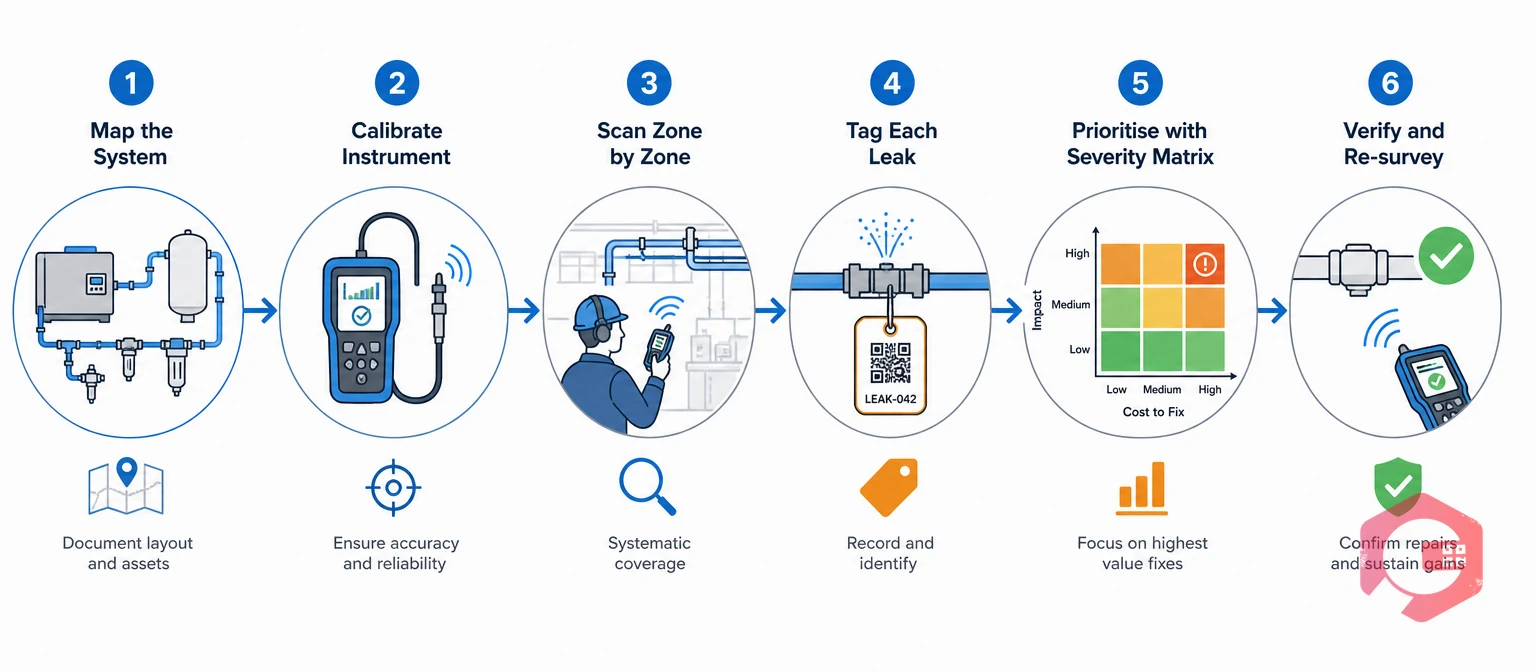
A structured compressed air leak survey follows a consistent sequence from preparation through repair verification. Skipping steps — particularly Steps 1 and 4 — produces a list of found leaks with no repair priority and no baseline for proving savings.
Before picking up the scanner, obtain or draw a schematic of the compressed air distribution system: compressor room, header pipes, distribution branches, and end-user connections by zone. Divide the system into survey zones that match the physical layout — typically by production area, floor, or building section. Number the zones. The survey will proceed zone by zone, and each leak tag will reference a zone number and a location description within that zone. Without this map, you have no way to ensure coverage or assign repair responsibility by area.
Set the instrument's frequency to 38–40 kHz and calibrate against a known leak source (most manufacturers provide a calibration adaptor). Adjust the sensitivity threshold so that the background noise floor is clearly separated from leak signals — too high a threshold misses small leaks; too low a threshold produces false readings from machinery noise. Record the sensitivity setting used. The same setting must be used on all subsequent re-surveys for the results to be comparable.
Start every scan at the highest-pressure point in the zone — the main header — and work downstream toward the end users. Scan each fitting, valve, regulator, filter housing, hose connection, push-in fitting, and condensate drain in sequence. Hold the probe at 30–90 cm from the target, rotate slowly, and listen for the characteristic rushing or hissing tone in the headphones. Mark any location where the display rises significantly above the baseline as a candidate leak for closer inspection.
For every confirmed leak, apply a physical numbered tag to the leak location and record: tag number, zone, equipment description, estimated severity level (1–4), photo, and whether the system can be isolated for repair or requires a planned shutdown. Use the Cryotos work requests module on mobile to log each tagged leak directly into the CMMS at the point of detection — no paper sheets, no transcription lag, no lost findings.
Not every leak warrants the same urgency. The following severity matrix, based on US DOE Compressed Air Challenge guidelines, translates scan readings into repair priorities:
| Severity Level | Estimated Flow Rate | Annual Energy Cost (est.) | Repair Priority |
|---|---|---|---|
| Level 1 — Minor | < 5 L/min | £100–£250 per leak | Schedule at next planned shutdown |
| Level 2 — Moderate | 5–20 L/min | £250–£1,000 per leak | Within 4 weeks |
| Level 3 — Significant | 20–60 L/min | £1,000–£3,000 per leak | Within 1 week |
| Level 4 — Critical | > 60 L/min | > £3,000 per leak | Immediate — same shift if possible |
Cost estimates assume £0.15/kWh, compressor specific power of 0.1 kWh/L/min, and 6,000 operating hours per year. Adjust these values using your actual site tariff and compressor efficiency data.
Every compressed air leak repair must be verified by re-scanning the tagged location after the fix is complete and the system is re-pressurised. A repair that eliminates the ultrasonic signal is a confirmed fix; a reduced but still-present signal indicates a partial repair that needs rework. Record the post-repair scan result against the original work order. After 90 days, repeat the full zone survey — new compressed air leaks develop continuously in dynamic industrial systems, and the 90-day re-survey catches them before the recovery from the initial survey has been fully eroded.
Use Cryotos maintenance checklists to standardise the compressed air leak survey zone scan sequence, tag data capture, and repair verification steps so every technician follows the same protocol on every survey cycle.
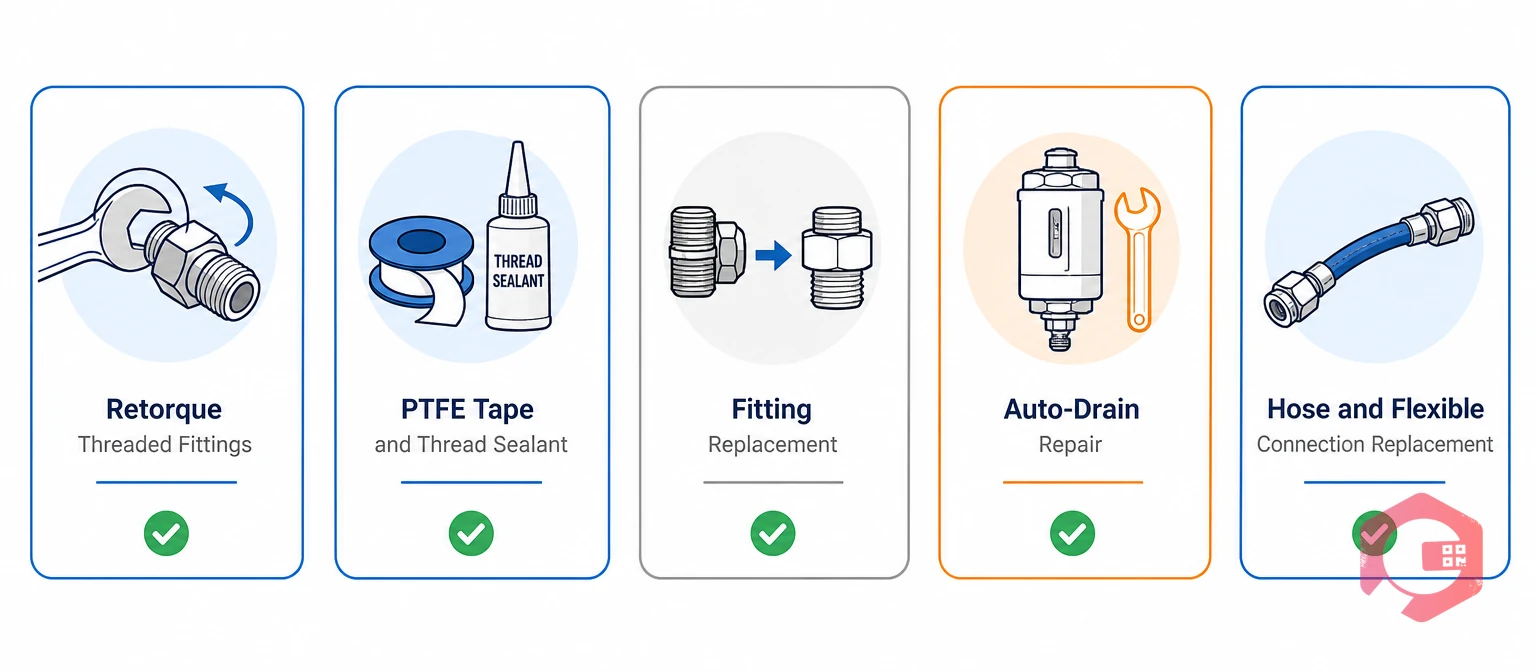
The right repair type for compressed air leaks depends on the leak source and the operational context. Maintenance teams that apply a blanket PTFE-tape approach to every leak will find many of those leaks returning within weeks.
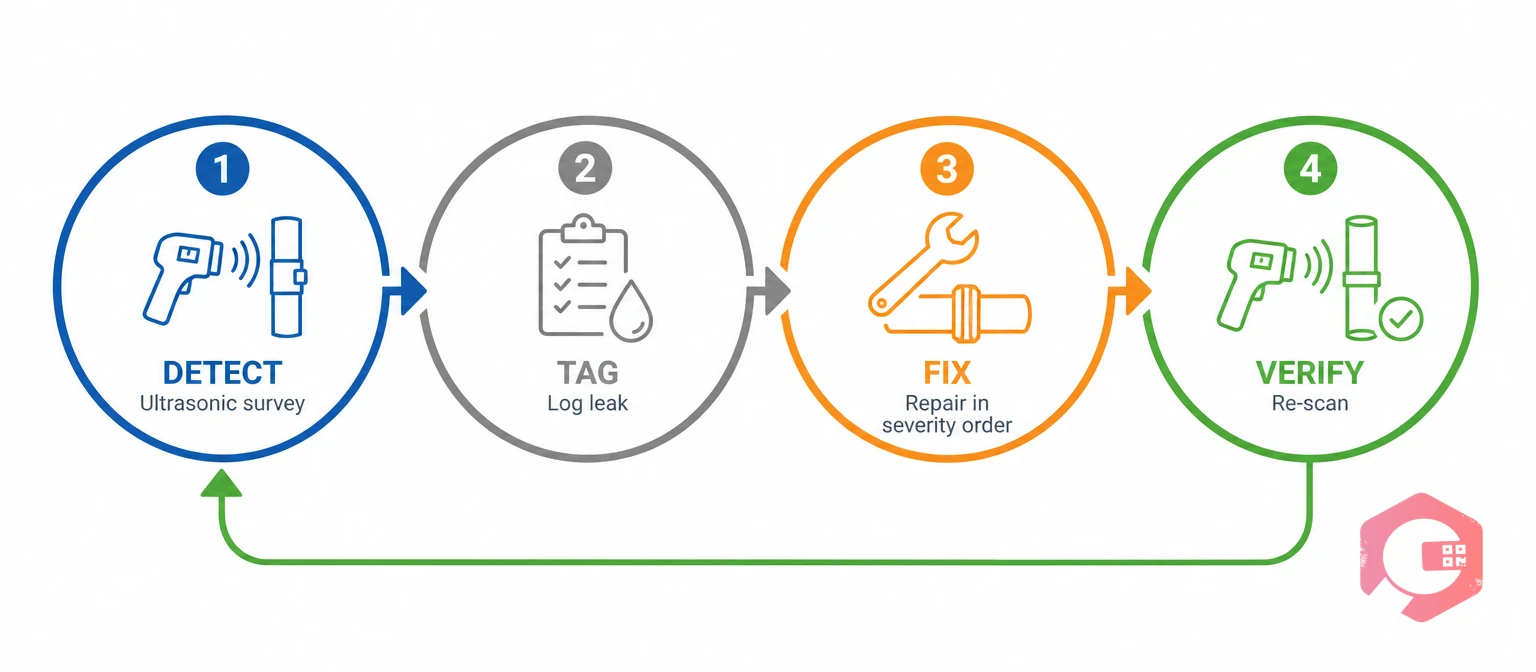
A single compressed air leaks survey recovers energy; a repeating DETECT-TAG-FIX-VERIFY loop sustains that recovery and compounds the savings over time. Most plants that complete a survey without a follow-up programme see their leak rate return to pre-survey levels within 12–18 months as new leaks develop and unverified repairs fail. The loop converts the survey into an ongoing maintenance discipline.
The DETECT-TAG-FIX-VERIFY Loop:
Maintenance teams using Cryotos have reported up to 30% reduction in unplanned downtime and 25% faster repair turnaround — outcomes that extend directly to compressed air programmes where repair delays allow significant flow losses to compound between survey cycles.
A spreadsheet can record a leak list from one survey. A Computerized Maintenance Management System does everything the programme needs over time: generates the recurring survey task, captures leak findings as tagged work requests from mobile at the point of detection, converts them to work orders assigned by skill and severity SLA, tracks repair completion and post-repair verification, and reports programme KPIs across every survey cycle.
The Cryotos work order management module enforces the repair sequence by severity — Level 4 and Level 3 leaks generate high-priority work orders that cannot be deferred past their SLA without an escalation flag. The maintenance KPI dashboard tracks total open leaks by severity, repair completion rate, estimated flow recovered, and energy cost saving year-to-date — the metrics that justify the programme investment to plant management and feed ISO 50001 performance improvement evidence. The Report Builder generates the survey report in the format needed for management review: tag list, severity breakdown, cost estimates, repair status, and before/after flow comparison.
For plants managing compressed air across multiple sites, Cryotos provides a single programme view across all locations — so a group energy manager can see which sites are running high leak rates, which repairs are overdue, and where the biggest remaining savings opportunity sits, without pulling site-level reports manually.
The ISO 11011 compressed air audit standard recommends surveys at least annually for maintained systems and quarterly for plants with higher-than-average leak rates or systems not yet under a formal management programme. In practice, most maintenance teams running a DETECT-TAG-FIX-VERIFY programme find that quarterly surveys produce the best results: the 90-day interval catches new leaks before they compound significantly, and the data from four annual surveys provides a clear trend line for programme reporting. After the first two surveys have reduced the leak population significantly, six-monthly surveys are usually sufficient to hold the gains.
Most plants recover the cost of ultrasonic survey equipment and the first survey's labour within 3–6 months through energy savings alone. A typical medium-sized manufacturing facility (200–500 employees) running at 25% leak rate and spending £150,000 per year on compressed air can recover £30,000–£40,000 per year in energy costs after a successful first survey. Equipment purchase cost for a professional-grade ultrasonic detector is typically £2,000–£5,000. Even with labour, the payback period rarely exceeds 6 months, and the savings recur every year the programme is maintained.
Yes — this is one of the key operational advantages of ultrasonic detection over alternative methods. Because the instrument detects ultrasonic frequencies (38–40 kHz) that are above the audible range of industrial machinery noise (which peaks below 20 kHz), the method is selective even in high-noise environments. The operator wears headphones and monitors the display reading while scanning, and the directional sensor allows the source of a detected signal to be pinpointed even with background machine noise. The only limitation is that very high-frequency machinery noise (some high-speed rotating equipment) can occasionally interfere with detection at close range — in these cases, scanning from slightly greater standoff distance resolves most false positives.
A complete survey report includes: total number of leaks found, broken down by severity level; estimated total flow rate lost (L/min); estimated annual energy cost at current tariff; tag-level detail for every leak found (tag ID, location, severity, flow estimate, repair type, repair priority date); total estimated savings achievable if all leaks are repaired; comparison with the previous survey results (if available) showing leak count trend and flow recovered; and repair completion status at the time of report issue. Most CMMS Report Builder modules can generate this in a scheduled format after each survey cycle, eliminating the manual compilation step that makes reporting a barrier for many teams.
Compressed air leak management is one of the highest-return maintenance programmes available to any manufacturing plant — the savings are immediate, quantifiable, and compound with each survey cycle. Schedule a free demo to see how Cryotos turns your ultrasonic survey findings into tracked work orders, verified repairs, and a dashboard that proves the programme's value to plant leadership.



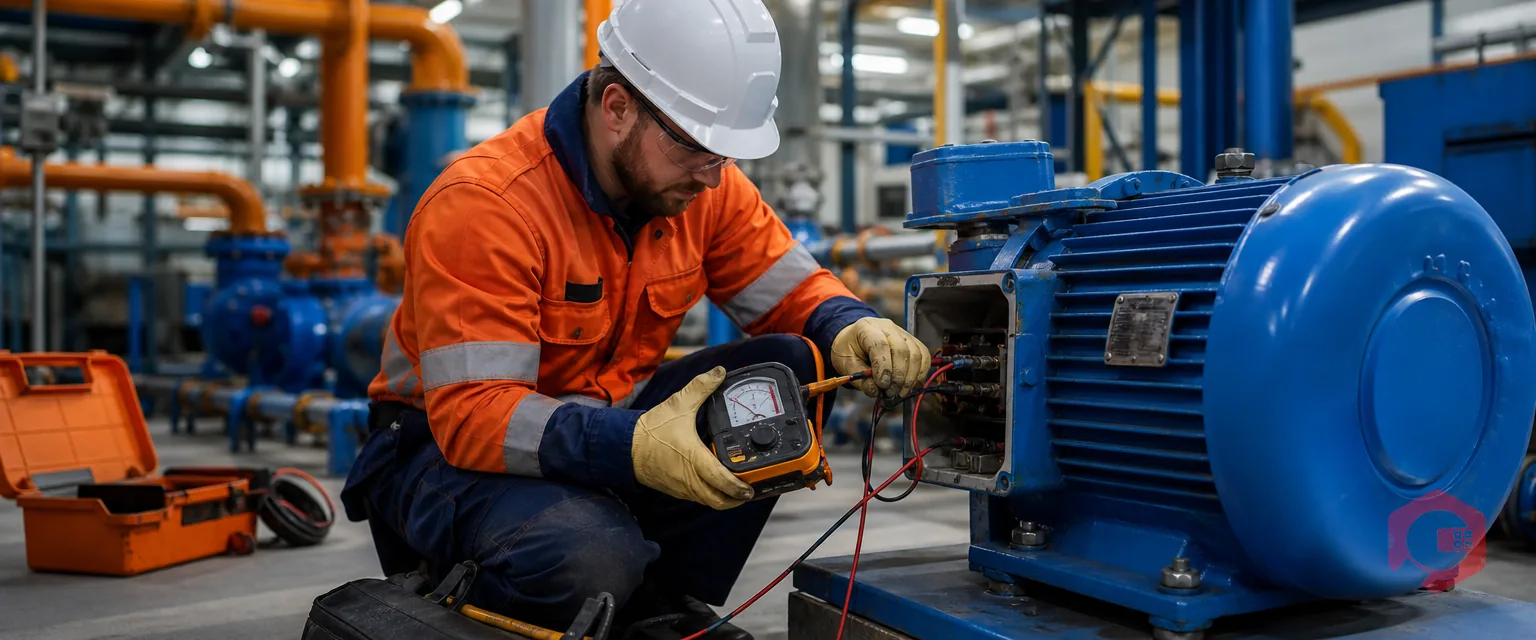
Cryotos AI predicts failures, automates work orders, and simplifies maintenance—before problems slow you down.