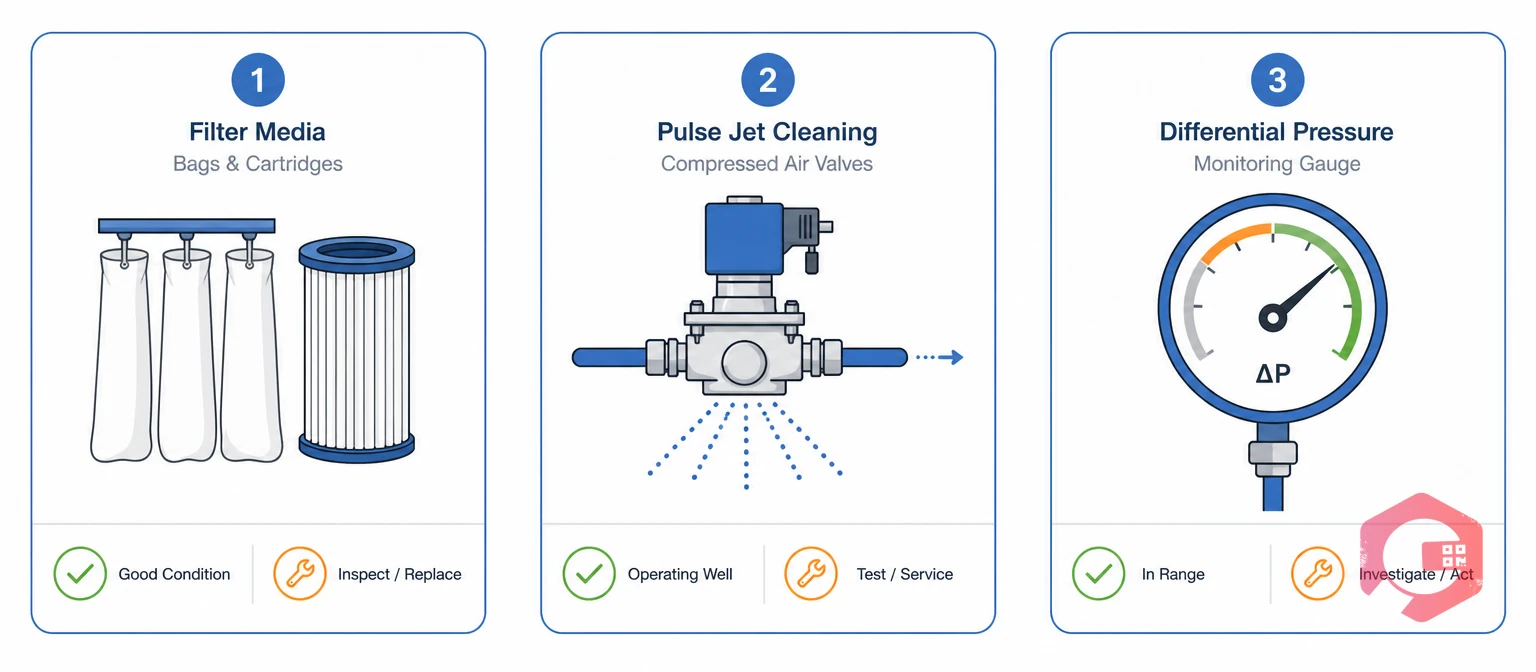
A dust collector maintenance checklist is a structured programme covering three interdependent subsystems: filter media condition, pulse jet cleaning system function, and differential pressure (DP) monitoring. When any subsystem in your dust collector maintenance checklist fails, the others follow — a blinded filter raises DP, a faulty pulse valve accelerates filter blinding, and a drifting DP reading is often the first sign that both have degraded. OSHA 29 CFR 1910.94 requires written maintenance procedures for industrial ventilation systems, and NFPA 654 mandates a documented inspection and maintenance programme for any dust collection system handling combustible dust. This complete dust collector maintenance checklist gives you the diagnostic logic behind each task, and the framework to keep your programme running.
Key Takeaways
Dust collectors serve two functions at the same time: protecting worker health by capturing airborne particulate and preventing combustible dust fires and explosions by keeping accumulations below ignition thresholds. When maintenance is reactive — replacing filters only after equipment shuts down or investigating pulse valves only after DP alarms — both functions degrade in parallel.
OSHA 29 CFR 1910.94 requires employers to maintain industrial ventilation systems in a condition that controls airborne contaminants at or below permissible exposure limits. For facilities handling combustible dust, NFPA 654 Section 10.2 goes further: it explicitly requires a written inspection and maintenance programme for dust collection equipment, and specifies that dust accumulations exceeding 1/8 inch on horizontal surfaces — including internal surfaces of the collector — constitute a trigger for housekeeping action.
The consequence of non-compliance is not just a citation. A failed dust collector at a facility handling wood dust, grain, or metal powder is a direct fire and explosion risk. Structured, scheduled maintenance is not a best practice in these environments — it is the regulatory minimum. Build your dust collector maintenance checklist programme into preventive maintenance software so tasks generate automatically and compliance evidence is captured in every work order.
Every dust collector maintenance failure traces back to one or more of these three subsystems:
The dust collector maintenance checklist below covers the full maintenance cycle from daily monitoring through annual tasks. Use the Pass Criteria column to train operators on the difference between normal and abnormal conditions — not just what to check, but what a correct result looks like.
| Task | Frequency | Responsible | Method | Pass Criteria |
|---|---|---|---|---|
| Differential pressure reading and log | Daily / per shift | Operator | Read gauge; log in CMMS | DP within 3–6 inWC operating range |
| Visual inspection — exterior leaks, duct connections | Daily | Operator | Walk-around visual | No visible leaks or damaged ductwork |
| Hopper level check and rotary valve operation | Daily | Operator | Level indicator; actuate valve | Hopper <50% full; valve operating smoothly |
| Compressed air supply pressure to pulse system | Daily | Maintenance tech | Gauge at inlet manifold | 90–100 psig; no moisture in line |
| Pulse cleaning cycle — observe all valves firing | Weekly | Maintenance tech | Listen during cleaning cycle | All valves firing in sequence; audible pulse each |
| Solenoid valve indicator / fault code check | Weekly | Maintenance tech | Controller display | No fault codes; all valves showing active |
| Filter bag / cartridge visual inspection (access door) | Monthly | Maintenance tech | Open inspection door; visual | No visible tears, holes, or seam failures |
| Pulse valve diaphragm inspection (10% sample) | Monthly | Qualified tech | Remove and inspect diaphragm | No cracks, hardening, or deformation |
| Compressed air dryer and coalescing filter check | Monthly | Maintenance tech | Visual; drain check | Dryer operating; filter bowl clear |
| DP sensor / magnehelic gauge calibration check | Quarterly | Instrument tech | Zero and span check | Reading within ±0.25 inWC of reference |
| Ductwork internal visual — wear, corrosion, blockage | Quarterly | Maintenance tech | Internal visual with torch | No wear holes; no dust packing at elbows |
| Explosion vent condition (combustible dust units) | Quarterly | Qualified tech / HSE | Visual of burst disc / vent panel | No damage, corrosion, or obstruction |
| Full filter bag / cartridge sample inspection | Semi-annual | Maintenance team | Remove and inspect sample rows | No breakthrough; filter life confirmed by DP trend |
| Tube sheet and clean-air plenum inspection | Annual | Qualified tech | Enter plenum (confined space permit); visual | No cracked welds; no bypass paths at tube sheet |
| Fan / blower bearing lubrication and impeller check | Annual | Mechanical tech | OEM procedure; vibration check | Bearings within limits; impeller clean |
Run your dust collector maintenance checklist digitally using Cryotos maintenance checklists — technicians complete tasks on mobile with photo capture and pass/fail fields, and findings auto-generate corrective work requests at the point of inspection.
Filter inspection is the single highest-value maintenance activity in any dust collector programme because filter condition determines both air quality compliance and system energy consumption. A blinded filter bank raises static pressure, increases fan energy draw, and reduces capture velocity at every connected hood. A breached filter passes collected dust into the clean air plenum and potentially out the stack — a regulatory event and a safety hazard simultaneously.
When you open the access door for a monthly filter inspection, look for these conditions:
Not every elevated DP reading means filters need replacement. If DP rises and the pulse cleaning system is functioning correctly, schedule a compressed air purge — manual pulse cleaning at higher frequency for 24 hours — and monitor whether DP recovers. If DP returns to 3–6 inWC after purging, the filters are still serviceable. If DP remains elevated after purging, or if the pulse system is confirmed functioning but DP still creeps upward over weeks, the filters have reached end-of-life and replacement is required.
The pulse jet cleaning system is the mechanism that extends filter life from weeks to years. A compressed air pulse — typically 100–150 milliseconds at 90–100 psig — fired through each filter row dislodges the accumulated dust cake into the hopper. When the pulse system underperforms, filters blind faster, DP rises, airflow drops, and filter replacement intervals shorten from years to months.
Solenoid valves are the most common pulse system failure point. Each valve controls one pulse, and a stuck-open valve wastes compressed air continuously while a stuck-closed valve means one filter row never gets cleaned. Inspect 10% of diaphragms monthly — look for cracks, hardening (from age or oil contamination), and deformation. A diaphragm that doesn’t seat correctly against the valve body leaks continuously. Replace the full valve set at the interval specified by your OEM, typically every 2–4 years depending on pulse frequency and air quality.
Pulse cleaning effectiveness depends entirely on air quality and pressure. Compressed air entering the pulse manifold must be at 90–100 psig — below 80 psig, the pulse energy is insufficient to fully dislodge the dust cake. Check the coalescing filter upstream of the pulse manifold monthly; oil and moisture carryover into the pulse air contaminates filter media and causes diaphragm degradation. Verify pulse timing controller settings quarterly — pulse duration (100–150 ms) and interval (10–60 seconds depending on dust loading) should match the commissioning record. A controller that has been manually adjusted to run longer or more frequent pulses may be masking a filter problem rather than solving it.
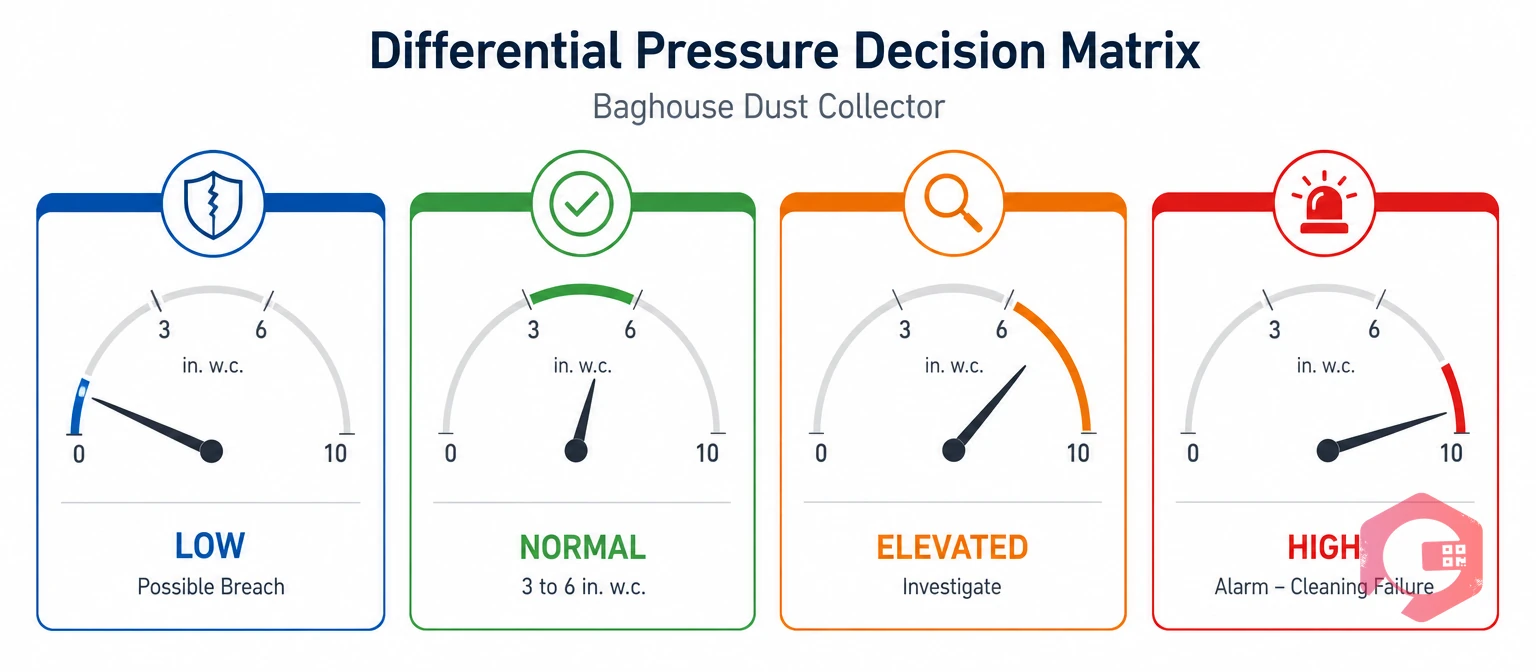
Differential pressure is the most important single number in dust collector operations, and reading it correctly requires knowing what each state means — not just whether it is high or low. Many maintenance teams treat DP as a simple alarm threshold: below threshold, everything is fine; above threshold, replace filters. That approach misses two critical failure modes: a sudden DP drop (filter breach) and a slow DP rise from a failing pulse system rather than aging filters.
| DP Reading (inWC) | Condition | Likely Cause | Required Action |
|---|---|---|---|
| < 1.0 inWC | Critical — possible breach | Filter bag tear, bypass at tube sheet, damper open | Stop. LOTO. Inspect full filter bank for breach. |
| 1.0–2.5 inWC | Normal — new or clean filters | Recently replaced or thoroughly cleaned | Normal operation. Log and continue. |
| 2.5–6.0 inWC | Normal — operating range | Typical dust cake; pulse cleaning maintaining balance | Normal operation. Log daily. |
| 6.0–8.0 inWC | Elevated — investigate | Dust cake accumulating; partial pulse valve failure; high loading | Check pulse system. Verify compressed air pressure. Inspect accessible valves. |
| > 8.0 inWC | Alarm — cleaning failure | Multiple pulse valve failures; severe filter blinding | Corrective maintenance required. Consider shutdown. LOTO for filter access. |
| Sudden drop from stable high DP | Critical — filter breach | Filter bag torn under pressure; seam failure | Stop immediately. LOTO. Full filter inspection required. |
Connect your DP sensor to IoT meter reading in Cryotos to log readings automatically and trigger corrective work requests when DP crosses your upper or lower threshold — without waiting for an operator to notice the gauge has moved.

The FILTER-CLEAN-MONITOR-VERIFY framework turns a one-time dust collector maintenance checklist into a closed-loop programme with measurable outcomes. Most maintenance teams run a checklist once and respond reactively when something fails. The framework connects each task category to an output metric, so the programme proves its own value over time.
The FILTER-CLEAN-MONITOR-VERIFY Framework:
Maintenance teams using Cryotos to run their dust collector maintenance checklist have reported up to 30% reduction in unplanned downtime and 25% faster repair turnaround — outcomes that are especially significant in dust collector programmes where unplanned filter failure during production creates both operational and regulatory exposure.
A Computerized Maintenance Management System converts a dust collector maintenance checklist programme that runs without tracked records, missed tasks, and no link between DP data and corrective actions leaves both your equipment and your compliance position exposed. Cryotos converts your checklist into an automated programme: PM tasks generate on schedule, inspection findings raise work requests at the point of discovery, and DP data feeds the compliance evidence trail automatically.
Filter bag replacement intervals depend on dust type, loading rate, and pulse cleaning effectiveness — not a fixed calendar schedule. In clean, controlled environments with light dust loading and a well-maintained pulse system, filter bags typically last 2–5 years. Use your dust collector maintenance checklist to track filter replacement history against this baseline. In high-loading, abrasive, or chemically aggressive applications, 6–18 months is common. The correct trigger is DP behaviour: if DP rises consistently above your upper threshold despite a functioning pulse system, and does not recover after a manual purge cycle, the filters have reached end-of-life.
Normal operating DP for a pulse-jet baghouse is typically 3–6 inches of water column (inWC), though the specific range depends on your OEM design specification, filter media type, and dust characteristics. New filters immediately after installation read 1.0–2.5 inWC and rise to the 3–6 inWC operating band as a residual dust cake develops. Establish your site-specific normal range at commissioning and document it in your O&M manual — the values above are indicative for standard woven polyester filter bags and will differ for pleated cartridges, membrane-coated media, or PTFE laminate.
Three indicators confirm pulse system health. First, audible pulse: stand next to the collector during a cleaning cycle and listen for a distinct, audible “thump” at each valve in sequence — a valve with a failed diaphragm sounds muffled or produces no sound. Second, compressed air pressure at the inlet manifold should hold at 90–100 psig before each pulse and recover promptly — pressure that drops and stays low indicates undersized supply or a significant leak. Third, and most reliably, DP stability: a pulse system working correctly keeps DP within a stable band. DP that creeps steadily upward despite apparent valve operation suggests diaphragm degradation.
NFPA 654 requires facilities to maintain dust collection systems in a condition that prevents combustible dust accumulations from reaching hazardous levels. Section 10.2 specifically requires a written inspection and maintenance programme for dust collection equipment. NFPA 654 also sets a 1/8 inch (3 mm) maximum dust accumulation depth on horizontal surfaces — including internal surfaces of the collector — as a housekeeping trigger. For systems handling combustible dust, explosion venting, spark detection, and suppression systems must also be maintained and function-tested at intervals specified by the equipment OEM and NFPA 68/69.
A dust collector maintenance checklist programme that runs without tracked records, missed tasks, and no link between DP data and corrective actions leaves both your equipment and your compliance position exposed. Schedule a free demo to see how Cryotos manages your dust collector maintenance checklist end-to-end — from automated task generation to DP-triggered work orders and NFPA 654 compliance documentation.


Cryotos AI predicts failures, automates work orders, and simplifies maintenance—before problems slow you down.