8D problem solving is a team-based method that uses eight disciplines, or steps, to contain a problem, find its root cause, and stop it from coming back. Maintenance teams use it when the same equipment failure keeps returning after every repair. Each step has a clear output, so the team cannot jump from symptom to fix without proof.
Most repeat breakdowns are not bad luck. They come from a cause that the last repair never touched. This guide explains each 8D step in plain terms, shows a full worked example on a conveyor bearing that failed four times in six months, and gives you a simple rule for deciding when a failure deserves an 8D.
Key Takeaways
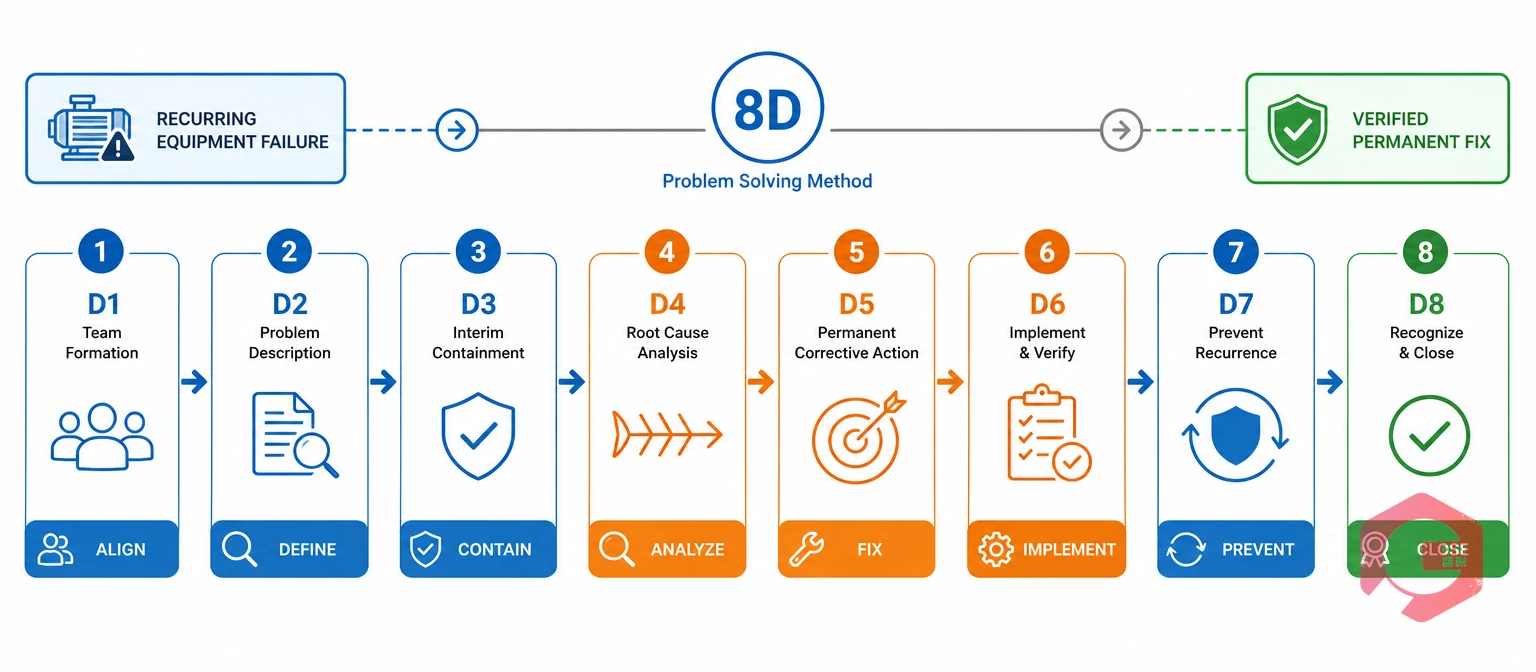
The 8D process is a structured method with eight steps plus a planning step. The steps are labeled D1 to D8, with D0 for planning, and they guide a small team from the first report of a problem to a verified, permanent fix.
Ford Motor Company published the method in 1987 as Team Oriented Problem Solving. The eight disciplines approach spread quickly through the automotive supply chain. Today, suppliers working to IATF 16949 are often asked by customers to submit an 8D report, and the method fits the corrective action clause (10.2) of ISO 9001.
In maintenance, 8D problem solving turns a repeat breakdown into a short, owned project with a start, a finish, and proof that the fix held.
8D problem solving works for repeat failures because it forces the team to find two causes: why the failure happened, and why the system let it happen again. Most repair work stops at the first cause, which is why the same asset keeps coming back on the breakdown list.
A repeat equipment failure is the same failure mode coming back on an asset after a repair. It can also show up across a group of similar assets, and it signals that the repair treated a symptom.
The outcome is fewer repeat work orders on your top bad actors, which is where most avoidable downtime hides.
Launch an 8D when a failure is repeating, costly, or risky enough that a normal repair is no longer good enough. Not every breakdown needs eight steps, and running 8D on minor faults wastes the team's time.
The Three-Strike 8D Trigger System:
Any one rule is enough to open an 8D. Your work order history makes the strike rule easy to check if technicians log a failure code on every corrective job. Tracking mean time between failures (MTBF) for each bad actor also shows when an asset is getting worse.
Not sure which assets qualify? Run your top breakdown assets through the free MTBF calculator and start with the lowest values.
Failures that do not meet a trigger still deserve a quick look. A technician can run a short 5 Whys on the work order and record a cause code. If the same cause shows up again, the failure moves closer to the strike rule, and the 8D opens with a head start.
A clear trigger rule stops 8D from becoming either a rare event or a paperwork habit.
Each of the 8D problem solving steps below has a goal, the key actions, and the output the team should show before moving on. Most maintenance 8Ds take two to six weeks, with D6 and D7 running longer while results are confirmed.

D0 decides whether an 8D is needed and keeps people and equipment safe right now. The team restores the asset, secures the area, and checks the trigger rules.
Keep the team to four to six people with direct knowledge of the asset and process. A technician who has repaired the asset is the most valuable member.
A clear problem statement prevents the team from solving the wrong problem. Use the "is and is not" method: where the failure happens and where it does not, when it started and when it did not happen.
Containment protects production until the permanent fix is in place. It is temporary by design, and the team must remove it later.
D4 has two parts. The root cause explains why the failure happened. The escape point explains why your maintenance system did not catch it first.
Teams can follow a standard root cause analysis investigation checklist, so no evidence step is skipped.
A useful test for any proposed root cause is simple: can you turn the failure on and off with it? If the team can explain why the failure hits one asset and not its identical neighbors, and why it started when it did, the cause is usually real.
For each verified cause, pick the action that removes it, not one that works around it. Where possible, choose error-proofing, or poka-yoke, so the mistake cannot happen at all.
Put the actions in place, remove containment, and watch the asset. Validation needs enough run time to cover at least two or three of the old failure intervals.
D7 spreads the fix beyond the asset that failed. It updates the systems, standards, and procedures that allowed the problem in the first place.
Close the 8D formally and thank the team in public. Recognition keeps people willing to join the next one.
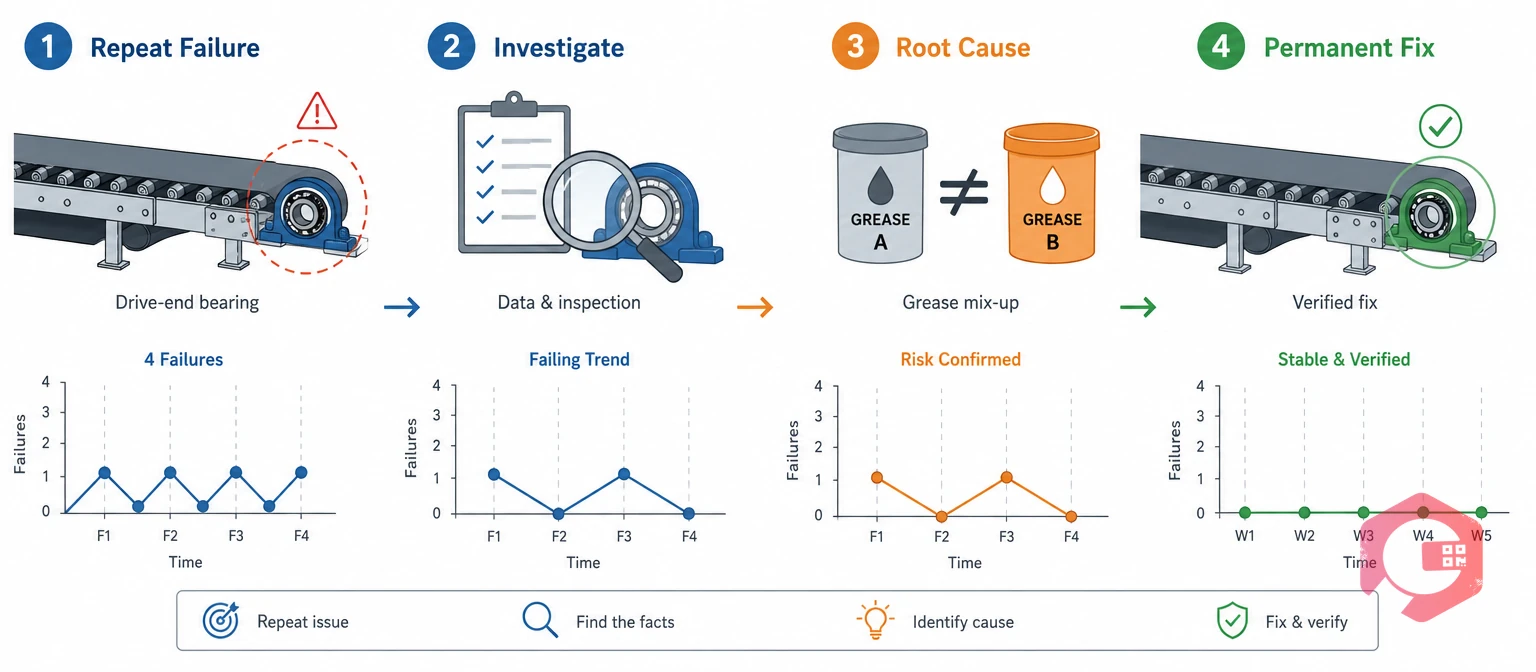
A worked example shows how 8D problem solving finds a cause that repeat repairs missed. A packaging plant had a drive-end bearing on conveyor C3 seize four times in six months. Each failure stopped the line for about five hours, and each repair was a bearing swap.
| Step | What the Team Found or Did | Evidence or Output | Owner |
|---|---|---|---|
| D0 | Replaced bearing, restarted line, opened an 8D under the strike rule | Fourth failure in 26 weeks; 20 hours lost in total | Maintenance supervisor |
| D1 | Formed a five-person team | Technician, operator, reliability engineer, planner, storeroom lead | Reliability engineer (leader) |
| D2 | C3 drive-end bearing fails every 5 to 7 weeks; C2 and C4, same design, do not fail; problem started in March | Work order history, failure codes, run hours | Planner |
| D3 | Added a twice-weekly vibration check on C3 and staged a spare bearing kit | Vibration readings logged; no unplanned stop during the 8D | Technician |
| D4 | Root cause: two grease types mixed after a supplier change in March. Escape point: the PM task did not name a grease, and the storeroom swapped in a substitute | Failed bearing showed broken-down grease; purchase records confirmed the switch | Reliability engineer |
| D5 | Purge and relube with one approved grease; color-coded grease fittings and guns; grease type written into the PM task | Trial on C3 for two cycles with stable vibration | Technician |
| D6 | Fix applied; extra vibration route removed after 18 weeks | No failures in 26 weeks; vibration trend flat | Maintenance supervisor |
| D7 | Lube standard updated for all 14 conveyors; storeroom rule blocks unapproved grease substitutes | Updated PM tasks, item master change, technician briefing | Planner and storeroom lead |
| D8 | Results shared at the monthly review; 8D filed with the asset record | About 40 hours of line downtime avoided per year | Plant manager |
The bearing was never the real problem. The repeat repairs fixed the part each time, while the cause sat in the lubrication process and the storeroom rules.
The 8D took about five weeks from opening to D5, with a few hours of team time each week. That effort was small next to 40 hours a year of lost packaging output, plus the repair labor and parts for each bearing swap.
8D is the heaviest of the common problem-solving methods, so it suits repeat, costly, or risky failures. Lighter methods work well for simpler problems. The table shows how they line up.
| Attribute | 5 Whys | A3 Problem Solving | 8D Problem Solving |
|---|---|---|---|
| Best fit | Simple, single-cause faults | Improvement problems and process gaps | Repeat, costly, or safety-related failures |
| Team size | One to two people | Small team led by an owner | Four to six people with a champion |
| Containment step | No | Not formal | Yes (D3) |
| Escape point analysis | No | Rarely | Yes (D4) |
| Verification of fix | Informal | Follow-up section | Formal (D5 and D6) |
| System-wide prevention | No | Sometimes | Yes (D7) |
| Typical time | Under an hour | One to four weeks | Two to six weeks |
Many teams use these together. The root cause analysis tools inside 8D, such as fishbone diagrams and 5 Whys, are the same ones used on their own for smaller faults.
Match the method to the problem: small faults get 5 Whys, while repeat bad actors get a full 8D.
8D problem solving and FMEA work as a pair. FMEA looks ahead at failures that could happen, while 8D looks back at a failure that already did.
This loop matches the idea of corrective and preventive action (CAPA) used in quality systems. The 8D corrects the current problem, and the FMEA and PM updates prevent the next one.
When each closed 8D updates the FMEA and the PM plan, your maintenance program gets smarter with every failure.
An 8D report is the single record of the problem, the evidence, and the fix. A good report is short enough to read in five minutes and complete enough that someone outside the team can follow the logic.
Attach photos of the failed part, trend charts, and links to the related work orders. Evidence makes the 8D useful long after the team has moved on.
A complete 8D problem solving report is also your best audit record, because it shows the problem was found, fixed, and proven in one place.
The best first 8D is a visible, painful repeat failure with good work order history. A quick, clear win builds trust in the method faster than any training session.
After two or three projects, most maintenance teams can run 8D problem solving as a normal part of the reliability program rather than a special event.
Most 8Ds that fail do so because the team rushes or skips a step, not because the method is wrong. Teams that successfully use 8D problem solving watch for these traps:
Most facilities improve their 8D results by enforcing one rule: no step closes without its output and evidence attached.
A Computerized Maintenance Management System supports 8D problem solving by supplying the data for D2, the evidence for D4, and the follow-through for D6 and D7. Without that record, teams argue from memory.

This is where the payback shows. Maintenance teams using Cryotos have reported up to 30% reduction in unplanned downtime and 25% faster repair turnaround. Much of that comes from fixing repeat failures once instead of repairing them again and again.
When every 8D lives on the asset record, the next technician who sees the same symptom can find the answer in minutes.
8D stands for eight disciplines. Each discipline is a step in the process, from forming a team (D1) to recognizing the team and closing the problem (D8). Most versions today also include a D0 planning step.
A typical maintenance 8D takes two to six weeks of active work. Validation in D6 can run longer, because the team needs enough run time to prove the failure has stopped. Simple problems may close faster.
A reliability engineer, maintenance engineer, or experienced planner usually leads the team. A manager acts as champion to clear time and budget. The technician who knows the asset best should always be on the team.
No. Ford created 8D for automotive work, but it is now used in food, pharmaceuticals, energy, aerospace, and facility maintenance. Any team facing repeat or high-impact failures can apply it.
Root cause analysis is one part of 8D, done in D4. 8D wraps that analysis with a team, containment, verification, and system-wide prevention, so the fix is proven and spread to other assets.
The most common tools are the is and is not analysis in D2, fishbone diagrams and 5 Whys in D4, and Pareto charts to rank failure causes. Teams also use failed part analysis, trend charts, and simple trials to prove that a cause and a fix are real before closing the 8D.
No. Most breakdowns are simple and only need a normal repair and a failure code. Save 8D for repeat, severe, or costly failures, using clear trigger rules, so the team focuses its time where it pays back.
Yes. A small team can run 8D with three or four people and a simple template. Keep the trigger rules strict, so the team only opens an 8D for failures that are worth the effort.
Containment (D3) is a temporary step that protects production while the team investigates. Corrective action (D5 and D6) removes the root cause for good. Containment should be removed once the corrective action is proven.
8D problem solving turns your worst repeat failures into closed, proven fixes that spread across every similar asset. Schedule a free demo to see how Cryotos links failure codes, 5 Whys records, and downtime data to every 8D on the asset record.


Cryotos AI predicts failures, automates work orders, and simplifies maintenance—before problems slow you down.