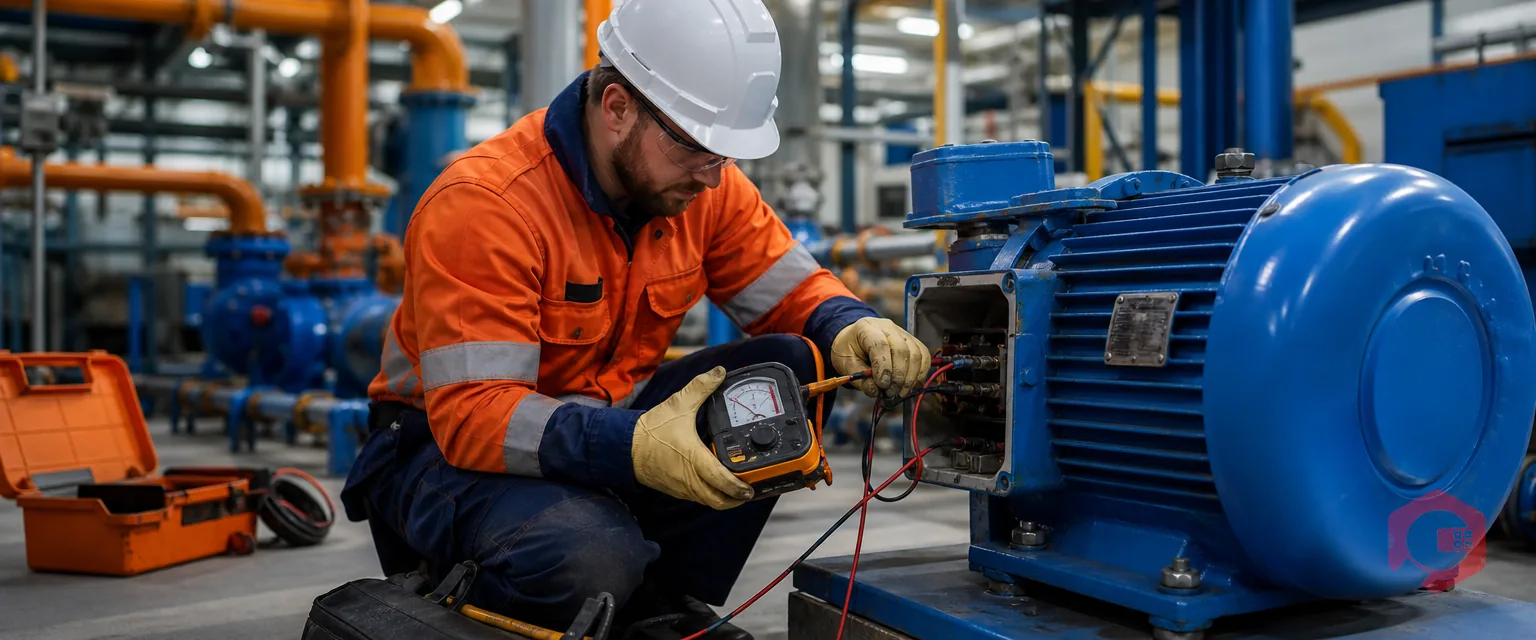
Electric motor testing is the set of electrical, mechanical, and thermal checks that show whether a motor can keep running. The right test depends on the symptom, the motor's role, and whether you can shut it down safely.
This guide covers which tests to run, when to run them, and what the results mean. It draws on IEEE 43, ISO 20816, and OSHA lockout rules. It also shows how a Computerized Maintenance Management System (CMMS) turns scattered readings into a trend you can act on.
Key Takeaways

Electric motor testing is the process of measuring a motor's insulation, windings, and mechanical condition. It separates a motor that needs a rewind from one that needs only a new connection, drive, or coupling.
Most plants run on induction motors. Surveys by IEEE and EPRI found that bearings and stator windings cause about three quarters of their failures. Most maintenance teams test only after a trip, and by then insulation decay is already a ground fault. Three standards frame sound practice:
Regular electric motor testing costs far less than an unplanned rewind and the line stoppage that follows.

Run motor tests in three tiers. Move up a tier only when the data raises a question.
The Three-Tier Motor Test Ladder:
Start with the supply, because a motor often takes the blame for a power problem. Current unbalance is typically six to ten times the voltage unbalance. A small supply imbalance can overheat one winding. Sound equipment troubleshooting rules out supply, drive, and load before it condemns the motor.
Add vibration analysis and thermography of bearings and terminal boxes.
Apply lockout, prove zero voltage, and disconnect the motor from any drive. Megohmmeter voltage can damage drive electronics.
Each tier answers a different question. Skipping to Tier 3 wastes time and risks the insulation.
Not sure how often your motors fail? The MTBF calculator turns failure history into a starting point for test intervals.
Most plants test critical motors every few months and routine motors every one to three years. They add tests after any trip, rewind, or long storage period.
| Test | Motor state | Typical interval | Also run when |
|---|---|---|---|
| Thermography | Running | Quarterly to annually | After repairs or load changes |
| Vibration analysis | Running | Monthly to quarterly | New noise or after a bearing change |
| Current signature analysis | Running, loaded | Quarterly to twice a year | A rotor fault is suspected |
| Insulation resistance and PI | Locked out | Yearly; twice a year in damp or dirty areas | After a trip, flooding, or long storage |
| Winding resistance | Locked out | Yearly, with insulation tests | After lead or terminal work |
| Surge test or motor circuit analysis | Locked out | Every 1 to 3 years on critical motors | Before and after a rewind |
| High-potential test | Locked out | Not routine | After a rewind or major repair |
These intervals are starting points, not rules. Adjust them for criticality, duty cycle, environment, and the maker's guidance.
Test a tripped motor only after it is locked out and cooled. Warm windings read low and distort the trend. Compare readings taken at the same temperature and test voltage.

Read every result against three references: the standard limit, the motor's own baseline, and the previous test.
| Test | Healthy result | Warning sign | Likely cause and next step |
|---|---|---|---|
| Insulation resistance (1 min, at 40°C) | At or above the IEEE 43 minimum: 5 MΩ for random-wound coils under 1 kV, 100 MΩ for form-wound coils above 1 kV | Below the minimum, or a sharp fall since the last test | Moisture or contamination: clean, dry, and retest |
| Polarization index | 2.0 or higher | Below 2.0, or close to 1.0 | Wet or aged insulation: dry, retest, plan a rewind |
| Winding resistance | Phases balanced and close to baseline at the same temperature | One phase differs by more than about 2 to 5 percent | Loose lead or broken strand: check connections, then run a surge test |
| Surge test | Matching waveforms on all three phases | Waveforms shift or separate | Turn-to-turn insulation fault: plan a rewind |
| Vibration (ISO 20816-3) | Zone A or B | Zone C or D | Unbalance, misalignment, looseness, or bearing wear: correct and recheck |
| Thermography | Even heat pattern, similar to peers and the last scan | Hot spot at a bearing, terminal box, or one phase | Friction or loose connection: tighten, lubricate, rescan |
Correct insulation resistance to 40°C before you compare it. The reading roughly halves for every 10°C rise in winding temperature. Skip the polarization index when the one-minute reading tops 5,000 MΩ, because IEEE 43 treats it as not meaningful at that level.
The trend matters as much as the limit. A motor that falls from 400 MΩ to 40 MΩ over three tests still passes the 5 MΩ minimum. Yet it has lost 90 percent of its margin.
Most electric motor testing errors come from habit, not from the instruments.
Fixing these habits improves the data at no extra cost.
The biggest challenge in electric motor testing is keeping results comparable and visible from one test to the next.
Consider an illustrative scenario, a composite of patterns common in process plants rather than a named customer. A site with about 150 motors relied on a contractor for an annual insulation test. Technician notebooks covered everything else.
A 55 kW cooling water pump motor then tripped on a ground fault. Equipment troubleshooting began with the drive and cables and took most of a shift. Nobody tested the motor until the end. Its three annual reports showed insulation resistance falling from 400 to 40 MΩ. Each one passed the 5 MΩ minimum, so nobody acted.
The data existed, but nothing tied it to a schedule, a trend, or the next repair.
Cryotos solved the visibility problem by tying every motor test to the asset record, a recurring schedule, and a work order.
In the same illustrative plant, the team loaded test checklists and fixed a 500 V test with a temperature correction step. They scheduled yearly and twice-yearly tasks by criticality. When the next pump motor drifted down, the trend triggered a planned rewind instead of a trip.
Maintenance teams using Cryotos have reported up to 30% reduction in unplanned downtime and 25% faster repair turnaround. Results vary with how consistently technicians record readings.
Lock out, then check the supply, drive, cables, and load. Next, run insulation resistance and winding resistance tests. This order saves time in equipment troubleshooting because a drive fault, loose cable, or jammed load can look like a failed motor.
A common starting point is insulation tests every six to twelve months and vibration checks monthly or quarterly on critical motors. Routine motors often run every one to three years. Adjust for failure history and environment.
It is a value above the IEEE 43 minimum, corrected to 40°C, and steady against the last test. A falling trend matters even when the number still passes.
No. Disconnect the motor leads from the variable frequency drive first. The test voltage can damage its power electronics. Test the cable and motor together, then separately if the reading is low.
No. It checks insulation to ground only. It cannot find turn-to-turn shorts, rotor bar damage, or bearing wear. Those need surge, current signature, and vibration tests.
Reliable electric motor testing depends on results you can compare year after year. Schedule a free demo to see how Cryotos keeps motor tests, trends, and repairs on one asset record.



Cryotos AI predicts failures, automates work orders, and simplifies maintenance—before problems slow you down.