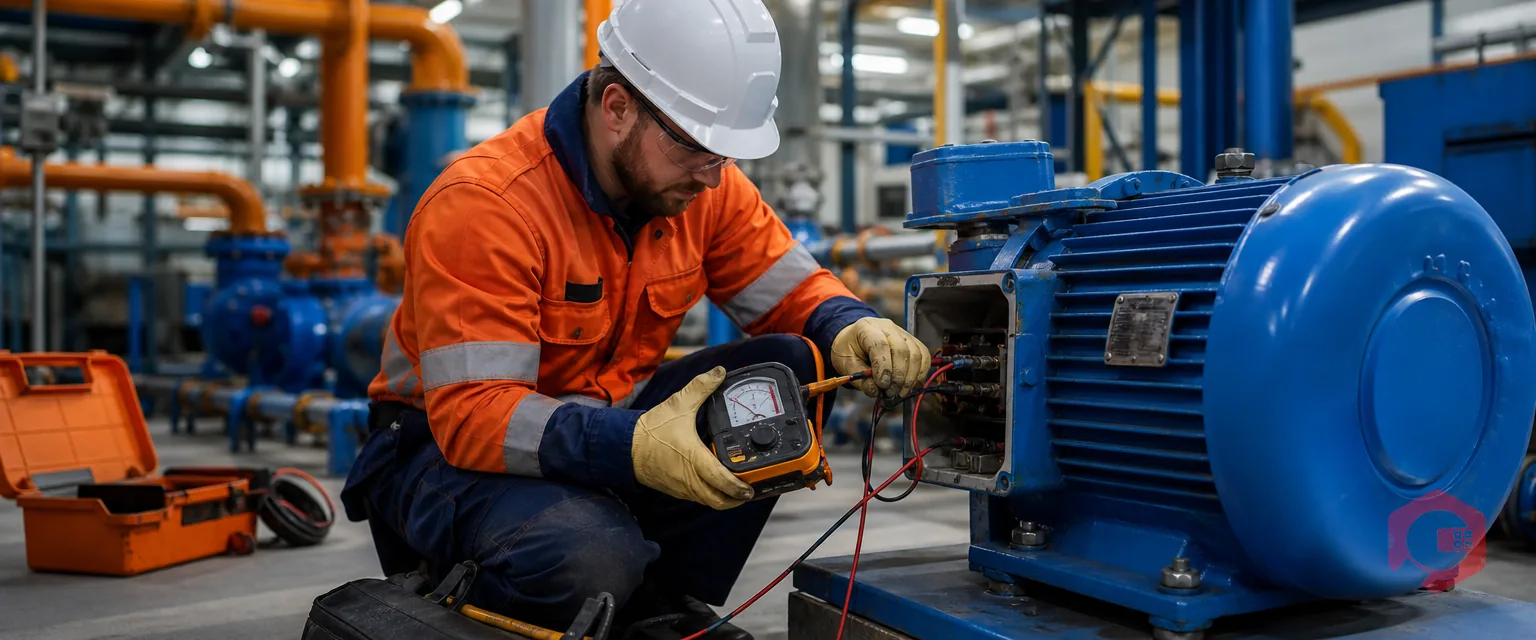
Transformer Maintenance Checklist for Industrial Facilities

Calendar
Duration:
12 min
calendar today
Published on
October 23, 2026
Featured Image

A transformer maintenance checklist is a scheduled list of inspections and tests that keeps a transformer safe and in service. It includes oil tests and electrical tests, and it covers the tank, bushings, cooling system, gauges, protective devices, insulating oil, and windings. Transformers rarely fail without warning. A good checklist catches heat, moisture, and insulation damage early. That leaves time to plan a repair.

In most industrial facilities, one transformer failure can stop an entire plant. Replacement units can take months to arrive. This guide gives you a full transformer maintenance checklist for oil-filled and dry-type units. It also covers a schedule, the key oil and electrical tests, and the safety rules for every job.

Key Takeaways
  • Three layers of care: A transformer maintenance checklist combines visual inspections, oil sampling, and outage-based electrical tests.
  • Oil tells the story: For oil-filled units, oil quality tests and gas analysis are the best early warning of internal problems.
  • Trend, do not snapshot: Comparing every result with past tests and factory baselines shows problems while there is time to plan.
  • Safety first: De-energize, lock out, and ground before any contact work, and follow NFPA 70E for energized checks.

What Is Transformer Maintenance?

What transformer maintenance protects against heat, moisture, oxygen and electrical stress | Cryotos

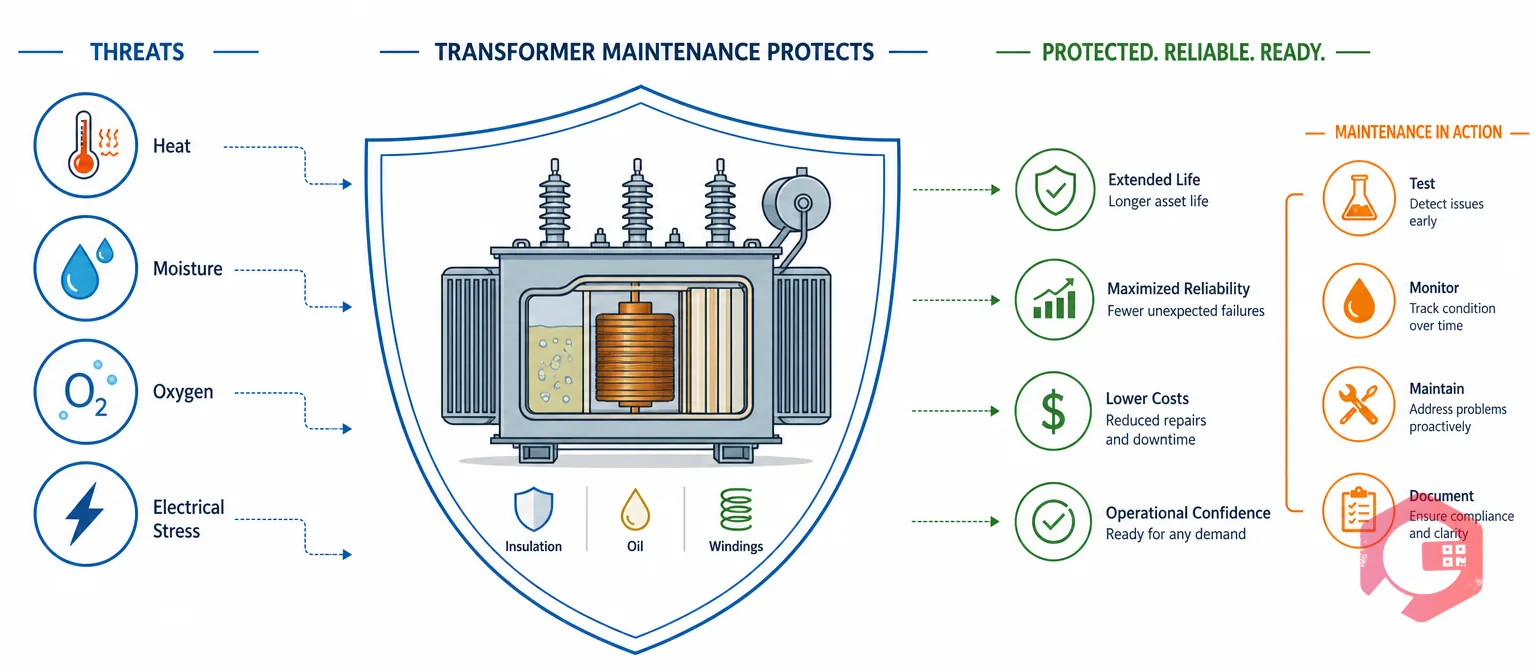
Transformer maintenance is the planned inspection, testing, and servicing that protects a transformer's insulation. Good maintenance also extends the unit's life. Most transformer failures start with the insulation. Heat, moisture, oxygen, and electrical stress wear it down over many years.

Several standards shape transformer programs. The first is NFPA 70B, the Standard for Electrical Equipment Maintenance. It comes from the National Fire Protection Association, and it sets out how to build an electrical maintenance program. The 2023 edition uses mandatory language. It ties task intervals to equipment condition. IEEE guides add detail, such as C57.106 for insulating oil and C57.104 for gas analysis. The ANSI/NETA maintenance testing specifications also give test methods and limits.

What Shortens the Life of a Transformer

  • Heat: Overloading, blocked cooling, and hot connections age insulation faster.
  • Moisture: Water in oil or paper lowers dielectric strength and speeds up aging.
  • Oxygen: Oxidation forms acids and sludge that attack the windings.
  • Electrical stress: Surges, partial discharge, and through-faults damage insulation.
  • Contamination: Dust and dirt on dry-type units block cooling and cause tracking.

A transformer maintenance checklist is built to find each of these problems early, long before they cause a failure.

Oil-Filled vs Dry-Type Transformer Maintenance

Maintenance depends heavily on the type of transformer. Oil-filled units need oil care and gas monitoring, while dry-type units need cleaning and airflow checks.

AttributeOil-Filled TransformerDry-Type Transformer
Insulation and coolingMineral oil or other insulating liquid plus paper insulation.Air and solid insulation such as resin or varnish.
Typical locationOutdoor substations and large plant feeders.Indoor electrical rooms and buildings.
Key routine checksOil level, temperature, leaks, breather, gauges.Dust, ventilation, enclosure temperature, noise.
Main condition testOil testing and dissolved gas analysis.Thermography and insulation resistance.
Common failure causesMoisture, oil aging, overheating, gassing faults.Dust buildup, overheating, moisture during shutdown.
Fire riskHigher, so containment and clearances matter.Lower, but still needs clear ventilation.

Many sites run both types, so build separate checklist templates for each one.

How the Transformer Maintenance Checklist Is Organized

Every task on a transformer maintenance checklist fits into one of three layers, from quick checks that need no outage to detailed tests that do.
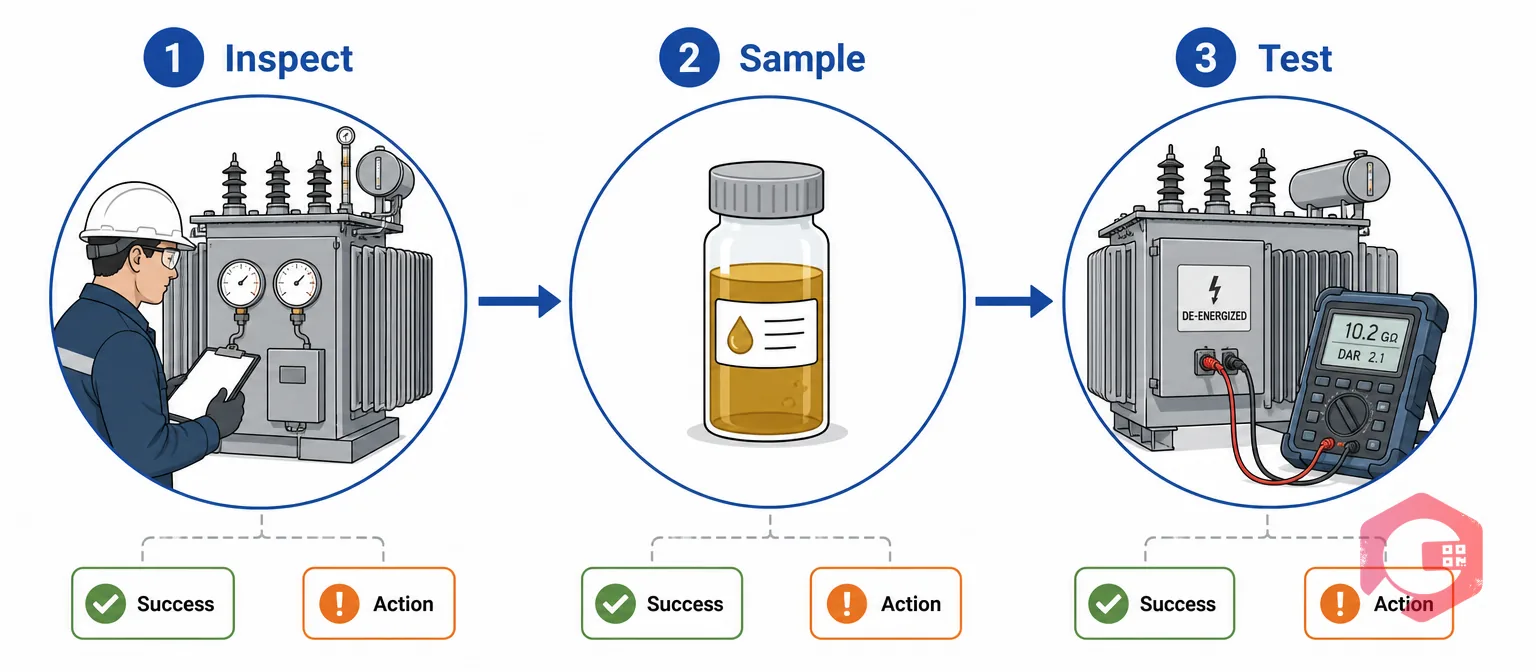
Three-layer transformer care method: inspect, sample, test | Cryotos

The Three-Layer Transformer Care Method:

  • Layer 1, Inspect: Visual checks and gauge readings done while the transformer is energized, from a safe distance.
  • Layer 2, Sample: Oil samples for laboratory testing and gas analysis, usually taken while in service by trained staff.
  • Layer 3, Test: Electrical tests and internal checks that need the transformer de-energized, locked out, and grounded.

Layer 1 catches visible problems, Layer 2 shows what is happening inside the tank, and Layer 3 confirms the condition of the windings and insulation.

Want each layer scheduled automatically? Cryotos maintenance checklists turn every task into a mobile form with readings, photos, and pass or fail fields.

Layer 1: Visual and Gauge Inspection Checklist

Visual inspections are the most frequent part of a transformer maintenance checklist. Many plants do them monthly, and some do quick weekly walk-bys on critical units.

Tank, Bushings, and Surroundings to Inspect

  • Leaks: Look for oil at gaskets, valves, radiators, and the base.
  • Bushings: Check for cracks, chips, dirt, and signs of tracking or flashover.
  • Tank and paint: Look for rust, dents, and damaged paint.
  • Grounding: Confirm ground connections are tight and undamaged.
  • Area: Keep the yard or room clean, fenced or locked, and free of stored material.

Gauges and Protective Devices to Read

  • Oil level: Record the level and compare it with the temperature curve on the gauge.
  • Oil and winding temperature: Record current and maximum readings, then reset the drag pointers.
  • Pressure or vacuum gauge: On sealed tanks, record pressure and compare it with past readings.
  • Breather: On conservator units, check the desiccant color and replace it before it is fully saturated.
  • Protective relays: Check that gas relays, pressure relief devices, and sudden pressure relays show no operation or alarm.

Cooling System Checks for Every Inspection

  • Radiators: Keep fins clean and check for leaks and blocked airflow.
  • Fans and pumps: Confirm they run when called for and listen for bearing noise.
  • Dry-type ventilation: Check that louvers and filters are clean and room temperature is within limits.

Log every reading. A steady rise in temperature or a falling oil level often appears months before an alarm.

Layer 2: Transformer Oil Testing Checklist

For oil-filled units, oil testing is the most useful item on the transformer maintenance checklist. The oil touches every part inside the tank. A small sample shows the health of the whole unit.
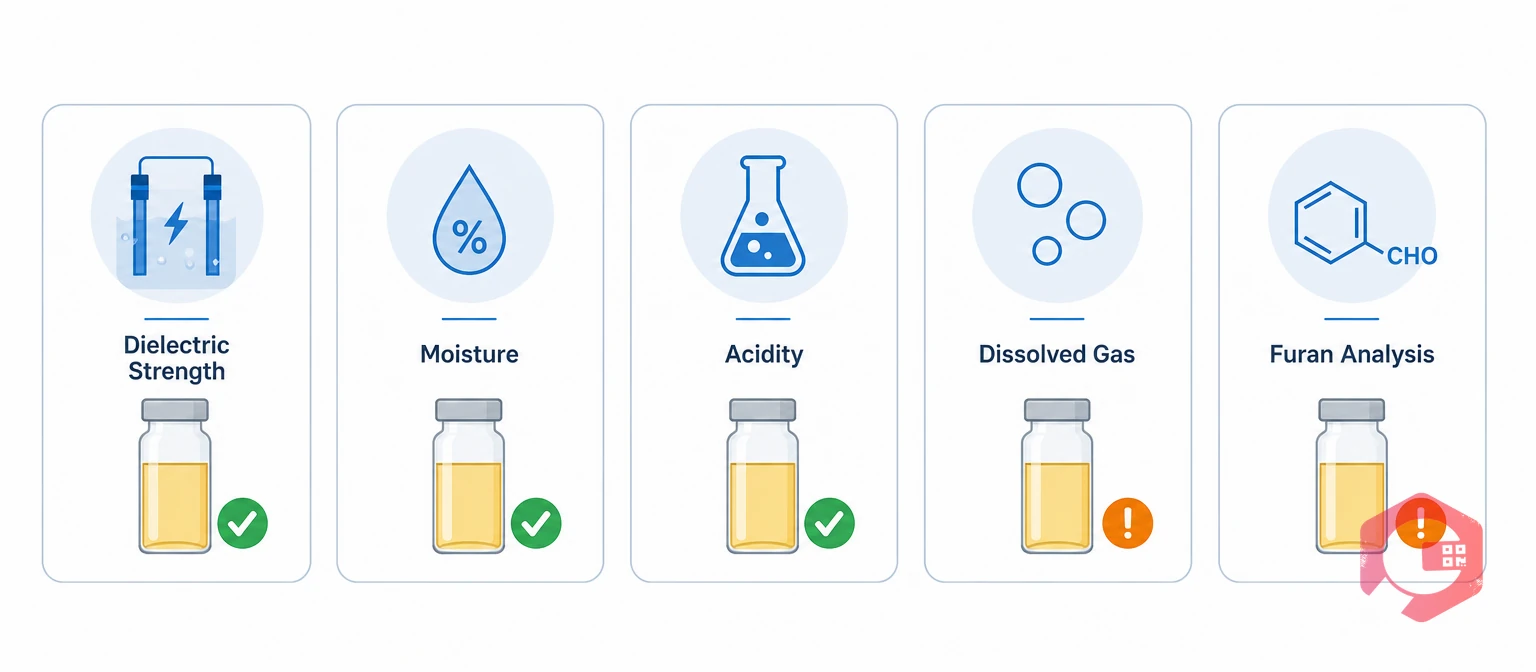
Transformer oil testing checklist: dielectric strength, moisture, acidity, dissolved gas, furan analysis | Cryotos

Most facilities sample critical units at least once a year, and more often when results start to change. Tests usually follow ASTM methods and IEEE C57.106 guidance.

Standard Oil Quality Tests to Request

  • Dielectric breakdown voltage: Shows how well the oil resists electrical stress.
  • Moisture content: Measured in parts per million, since water lowers dielectric strength and ages paper.
  • Acidity (neutralization number): Rising acid shows oxidation and sludge risk.
  • Interfacial tension: Falling values show oil breakdown products and contamination.
  • Power factor or dissipation factor: Shows contamination and oil aging.
  • Color and visual check: Darkening or particles point to aging or contamination.

Gas and Insulation Aging Tests to Add

  • Dissolved gas analysis: Dissolved gas analysis measures gases such as hydrogen, methane, ethylene, and acetylene that form when faults heat or arc inside the tank.
  • Furan analysis: Measures compounds released as paper insulation ages, which helps estimate remaining life.

Trend results over time rather than reading one sample alone. A rising trend matters more than a single high value.

Layer 3: Electrical Testing Checklist

Electrical tests check the windings, core, and insulation. Most need the transformer switched off. Plan them for scheduled outages, often every one to three years.

  • Insulation resistance: A megohmmeter test between windings and to ground. A polarization index is often added to show moisture.
  • Turns ratio: Confirms the winding ratio on each tap matches the nameplate, which reveals shorted turns.
  • Winding resistance: Finds loose connections, broken strands, and tap changer contact problems.
  • Power factor or tan delta: Measures insulation quality in windings and bushings.
  • Excitation current: Helps find core and winding problems.
  • Frequency response analysis: Compares the windings with a baseline to find movement after faults or transport.

Always compare results with the factory test report and earlier tests on the same unit. A change from baseline is the clearest warning sign.

Infrared Thermography for Transformers

Thermography finds hot spots that a visual check cannot see. Scans are done with the transformer energized and under load, usually once a year.

  • Connections: Scan bushing terminals, cable lugs, and bus connections for hot joints.
  • Tank and radiators: Look for uneven heating that points to blocked cooling or low oil.
  • Dry-type windings: Compare phases for uneven temperatures.
  • Tap changers and cabinets: Check control cabinets and tap changer compartments.

Record each scan against the asset and compare it with the last one, so slow changes show up clearly.

Tap Changer and Accessory Maintenance

Tap changers are among the most active parts of a transformer, so they need their own checks on the transformer maintenance checklist.

  • De-energized tap changers: Operate through all positions during outages to clean contacts, then return to the correct tap.
  • On-load tap changers: Follow the maker's operation count for inspection, and test the diverter oil where fitted.
  • Control wiring: Check cabinets for moisture, heaters, and loose wiring.
  • Alarms and trips: Test temperature alarms, gas relay trips, and pressure relief device contacts during outages.

Protective devices only help if they work, so test their contacts and wiring on a regular schedule.

Dry-Type Transformer Maintenance Checklist

Dry-type units skip oil testing but need careful cleaning and airflow checks. Dust buildup is the main enemy.

  • Cleaning: With the unit de-energized and locked out, vacuum or blow out dust from windings and vents with dry, low-pressure air.
  • Connections: Check and torque terminal connections to the maker's values.
  • Ventilation: Keep louvers, filters, and room fans clean and working.
  • Insulation resistance: Test during planned outages, and dry the unit before energizing if it has been off for a long time in damp conditions.
  • Temperature monitors: Check winding temperature controllers and fan controls.

Dry-type transformers in dusty plants may need cleaning much more often than those in clean electrical rooms.

Transformer Maintenance Schedule by Frequency

Use this schedule as a starting point for your transformer maintenance checklist. NFPA 70B ties intervals to the condition of each unit. Adjust them using your own test results and the maker's guidance.

FrequencyOil-Filled UnitsDry-Type Units
MonthlyVisual inspection, oil level, temperatures, leaks, breather, cooling fans.Visual inspection, room temperature, ventilation, noise.
AnnuallyOil quality tests, dissolved gas analysis, infrared scan, gauge and alarm check.Infrared scan, cleaning, connection check where accessible.
Every 1 to 3 yearsElectrical tests, protective device tests, tap changer operation.Insulation resistance, torque checks, temperature controller test.
As neededResample or retest when trends change, after faults, or after major work.Retest after faults, flooding, or long shutdowns.

Critical units, aging units, and units with poor test results should move to shorter intervals.

Safety Rules for Transformer Maintenance

Transformer work carries serious electrical and fire risks. Maintenance teams that successfully avoid incidents follow these rules on every job:

  • Energy isolation: De-energize, lock out, tag out, and test for absence of voltage before any internal or contact work.
  • Grounding: Apply safety grounds before touching windings, and ground windings again after electrical tests.
  • Arc flash: Follow NFPA 70E for energized inspections, and wear protective equipment rated for the hazard.
  • Clearances: Keep a safe distance during energized visual checks and thermography.
  • Oil handling: Use spill kits and containment, and follow local rules for oil disposal.
  • Confined space: Treat tank entry as a permitted confined space job.

Build these controls into each work order, so the technician sees them before starting.

Common Transformer Maintenance Mistakes

Most transformer failures follow missed warning signs rather than sudden events. Watch for these mistakes:

  • No oil testing: Units go years without a sample, so moisture and gassing go unnoticed.
  • Single readings: Results are filed but never trended, so slow changes are missed.
  • Ignored breathers: Saturated desiccant lets moist air into the conservator.
  • Untested alarms: Protective devices are never function-tested.
  • No baseline: Factory test reports are lost, so later results have nothing to compare against.
  • Dusty dry-types: Dry-type units in dirty areas are cleaned only after they overheat.

Each of these is cheap to fix and greatly lowers the risk of a long, costly outage.

How a CMMS Supports Your Transformer Maintenance Checklist

A Computerized Maintenance Management System keeps every transformer task on schedule. It also records every reading and links each result to the right unit.

How a CMMS supports a transformer maintenance checklist with scheduling, IoT readings, work orders and trend history | Cryotos
  • Scheduled tasks: Preventive maintenance software creates monthly inspections, annual oil sampling, and outage-based electrical tests on time.
  • Live readings: IoT meter reading pulls temperatures, load, and online gas monitor data into the asset record and raises alerts.
  • Fast follow-up: A failed check or poor oil result creates a work order with the report attached.
  • Spares: Inventory management tracks gaskets, desiccant, bushings, and fans.
  • Trend history: Oil results, test data, and scans stay on one asset record for condition monitoring and audits.

Clear records lead to faster decisions. Maintenance teams using Cryotos have reported up to 30% reduction in unplanned downtime and 25% faster repair turnaround. For transformers, that means problems are found and fixed during planned outages instead of during a failure. Asset programs built on ISO 55000 rely on this kind of condition history to plan transformer replacement.

Frequently Asked Questions

How often should an industrial transformer be inspected?

Most facilities do a visual inspection monthly, oil testing and infrared scans once a year, and electrical tests every one to three years. Critical or aging units, and those with poor results, need shorter intervals.

What tests are included in transformer oil testing?

Common tests include dielectric breakdown voltage, moisture content, acidity, interfacial tension, power factor, and color. Dissolved gas analysis and furan analysis are often added to find internal faults and paper aging.

Do dry-type transformers need maintenance?

Yes. Dry-type transformers need regular cleaning, ventilation checks, infrared scans, connection checks, and insulation resistance testing. Dust is the main cause of overheating in dry-type units.

What does NFPA 70B require for transformer maintenance?

NFPA 70B requires a written electrical maintenance program and ties task intervals to the condition and criticality of each piece of equipment. Check the current edition and your local adoption for exact requirements.

Can transformer oil testing be done while the unit is energized?

Yes. Oil samples are usually taken while the transformer is in service, using proper procedures and safe access to the sampling valve. Electrical tests on windings require a full shutdown.

What are the warning signs of transformer failure?

Common signs include rising oil or winding temperature, falling oil level, leaks, unusual noise, rising combustible gases, poor oil test results, and hot spots on infrared scans.

A complete transformer maintenance checklist protects the equipment that keeps your whole facility running. Schedule a free demo to see how Cryotos schedules transformer inspections, stores oil and test results, and turns every warning sign into tracked work.


Want to Try Cryotos CMMS Today?

Get Free Demo

Let AI Take Control of Your Maintenance

Cryotos AI predicts failures, automates work orders, and simplifies maintenance—before problems slow you down.

Try AI-Powered CMMS
🡢