Condition-based maintenance and time-based maintenance are the two most widely used proactive maintenance strategies in industrial operations — and choosing the right one for each asset is one of the most consequential decisions a maintenance team makes. Time-based maintenance (TBM) schedules work at fixed calendar or usage intervals regardless of actual asset condition. Condition-based maintenance (CBM) triggers work only when sensor readings, inspections, or data analysis indicate that a fault is developing.
According to a McKinsey analysis of maintenance practices, facilities that match their maintenance strategy to individual asset characteristics reduce total maintenance costs by 20–30% compared to plants applying a single strategy uniformly. This guide breaks down how each approach works, where each performs best, and how modern CMMS tools like Cryotos help maintenance teams apply both strategies at the right time on the right assets.
Time-based maintenance — also called scheduled maintenance or preventive maintenance — is a strategy in which maintenance tasks are performed at predetermined intervals, whether measured in calendar time (daily, weekly, monthly, annually) or in usage units (operating hours, production cycles, kilometres driven). The core assumption is that an asset’s probability of failure increases with age or accumulated use, so servicing it before it reaches a critical threshold prevents failure.
TBM is the dominant maintenance strategy in most manufacturing, facility management, and transportation organizations because it is straightforward to plan and execute. A pump receives an oil change every 2,000 hours. A conveyor belt receives a tension check every month. An HVAC system receives a filter replacement every quarter.
The typical TBM workflow starts with OEM recommendations. Maintenance teams load these intervals into their CMMS, which generates work orders automatically when the due date or usage threshold is reached. TBM works most reliably when two conditions are met: the failure mode is age-related, and the cost of unplanned failure significantly exceeds the cost of scheduled replacement.
Condition-based maintenance (CBM) triggers maintenance only when monitoring data indicates that an asset’s condition is deteriorating toward a failure threshold. Rather than servicing a machine on a fixed schedule, CBM continuously monitors parameters such as vibration amplitude, temperature, oil particle count, noise levels, or electrical current draw.

CBM relies on one or more monitoring technologies chosen for the specific failure modes of each asset:

The fundamental difference between the two strategies lies in what triggers the maintenance event. In TBM, the trigger is time or usage. In CBM, the trigger is data. TBM is simpler to implement; CBM is more precise and avoids unnecessary maintenance on healthy assets.
TBM is simple to implement, plan, and communicate. Maintenance schedules are transparent, parts can be ordered in advance, and compliance with manufacturer warranties is straightforward to document.
The core weakness of TBM is that it ignores actual asset condition. Industry research consistently shows that 30–40% of components replaced on a fixed schedule are still fully functional — representing wasted maintenance spend.
CBM eliminates unnecessary maintenance by aligning work with actual need. A Reliable Plant benchmark study found that facilities with mature CBM programs reduced unplanned downtime by up to 45% compared to TBM-only programs.
CBM requires sensors, wireless networks, data collection platforms, and analyst expertise. For assets where failures are sudden with no P-F interval, CBM provides limited protection.
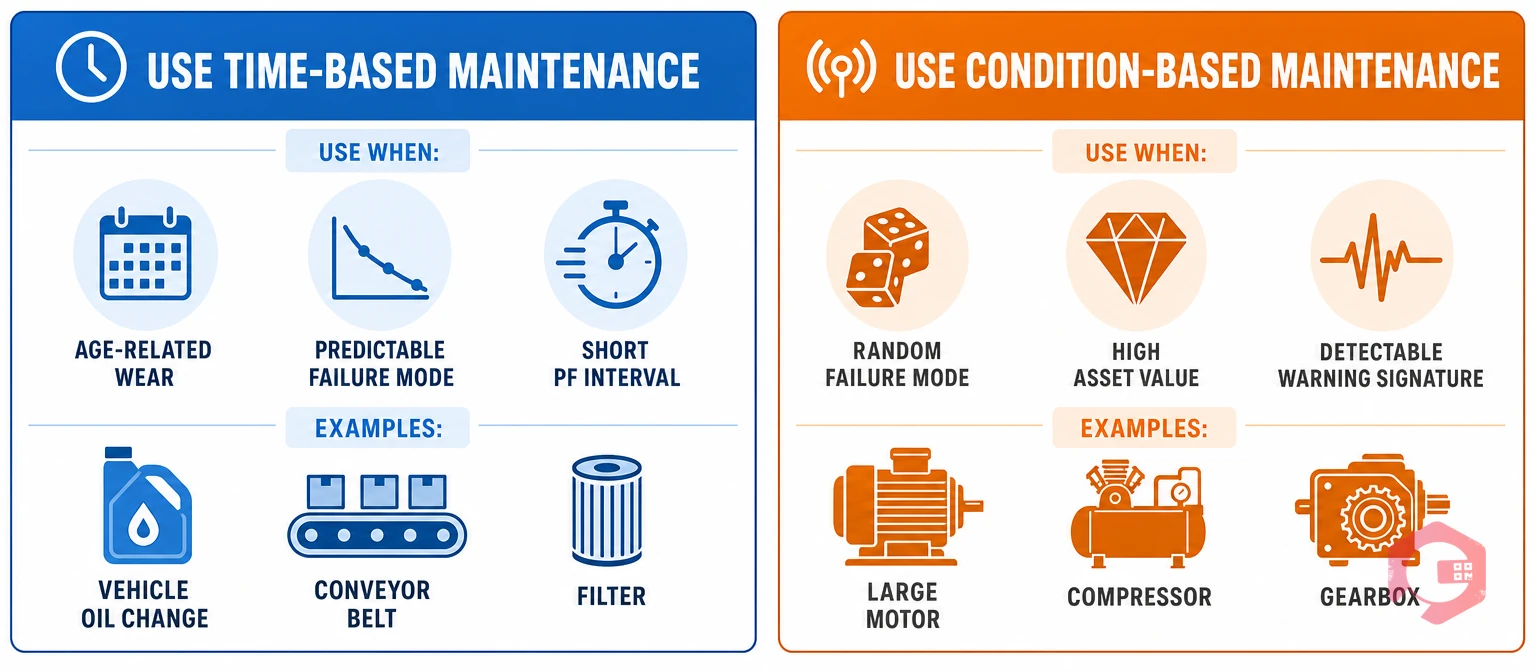
TBM is the right choice when the failure mode is age or usage-related, the cost of unplanned failure significantly exceeds the cost of scheduled replacement, and the P-F interval is too short for monitoring technology to provide useful advance warning.
CBM is the right choice when failure modes are not strictly age-related, when the cost of unplanned failure is high, and when a detectable P-F interval exists. High-value rotating equipment, electrical systems with intermittent load profiles, and complex mechanical assemblies all suit CBM well.

In a mature maintenance program, TBM and CBM are complementary layers applied to different assets based on their failure characteristics and monitoring economics. High-criticality assets receive CBM monitoring backed by TBM as a safety net. Medium-criticality assets receive structured TBM. Low-criticality assets may receive run-to-failure treatment. Facilities applying this blended strategy consistently achieve 25–35% lower unplanned downtime rates and 15–20% lower total maintenance costs per unit of output.
Cryotos CMMS is built to execute both time-based and condition-based maintenance within a single platform. For TBM, Cryotos supports both static and dynamic scheduling through its preventive maintenance module. For CBM, Cryotos integrates directly with IoT sensors, SCADA systems, and PLC outputs through its IoT meter reading integration. The downtime tracking module captures every breakdown event, automatically calculating MTTR and MTBF over time. Explore Cryotos CMMS to see how leading maintenance teams apply TBM and CBM together to maximize reliability and reduce costs.
Time-based maintenance triggers work at fixed intervals regardless of actual asset condition. Condition-based maintenance triggers work only when monitoring data indicates a fault is developing. TBM is simpler to plan; CBM is more precise and avoids unnecessary maintenance on healthy assets.
CBM typically delivers lower total maintenance cost for high-value assets with detectable failure signatures. TBM is more cost-effective for low-value assets with purely age-related failures. Most optimized programs use both, applied based on asset criticality and failure characteristics.
Yes — and in many cases this is best practice. A critical motor might receive continuous vibration monitoring (CBM) while also receiving scheduled oil changes on a fixed interval (TBM). Using both strategies adds a safety layer.
A modern CMMS like Cryotos manages both TBM and CBM within a single platform — auto-generating work orders on schedules for TBM, and integrating with IoT sensors to generate work orders when condition thresholds are crossed for CBM.




Cryotos AI predicts failures, automates work orders, and simplifies maintenance—before problems slow you down.