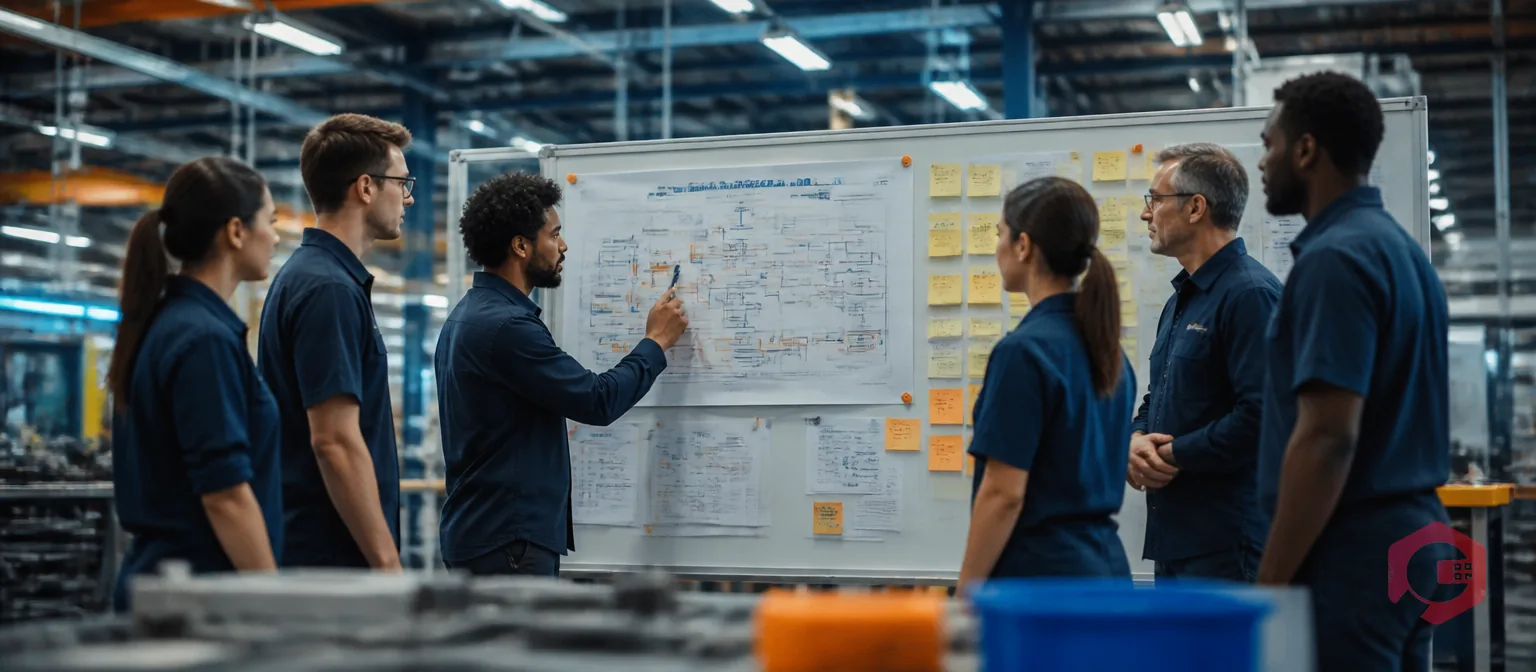
A Kaizen event is a focused 3–5 day improvement sprint where a team targets one specific process and implements measurable changes before the event ends. Unlike open-ended continuous improvement programs, a Kaizen blitz has a fixed start date, a fixed end date, and a defined deliverable — making it one of the most effective tools in a lean maintenance program.
Key Takeaways

A Kaizen event is a short, intensive improvement workshop where a dedicated team analyzes a specific workflow and implements changes within days rather than months. The term comes from the Japanese words "kai" (change) and "zen" (good), and it sits at the center of lean manufacturing and continuous improvement methodology.
Kaizen events differ from everyday process improvement in one important way: they have a hard deadline. A maintenance team might spend months gradually refining a procedure, but a Kaizen blitz compresses that timeline into a single focused week. The American Society for Quality (ASQ) defines Kaizen as part of the broader lean toolkit that also includes 5S methodology, value stream mapping, and the PDCA cycle.
Most Kaizen events follow a similar arc: a planning phase before the event, an intensive workshop where the team observes and redesigns the process, and a follow-up period where the team verifies the changes held. Maintenance teams running structured Kaizen events typically see faster results than open-ended improvement initiatives because the compressed timeline forces decisions instead of endless analysis.

Maintenance organizations run Kaizen events to eliminate recurring equipment failures, reduce changeover time, and close the gap between what a process is supposed to do and what it actually does on the floor. A Gemba walk almost always surfaces the same pattern: small inefficiencies that nobody has had the bandwidth to fix.
Maintenance teams that run regular Kaizen events report a noticeable shift in how problems get handled — issues get fixed at the source instead of patched repeatedly. That shift only holds if the fixes get documented and scheduled, which is where most events break down without a system behind them.
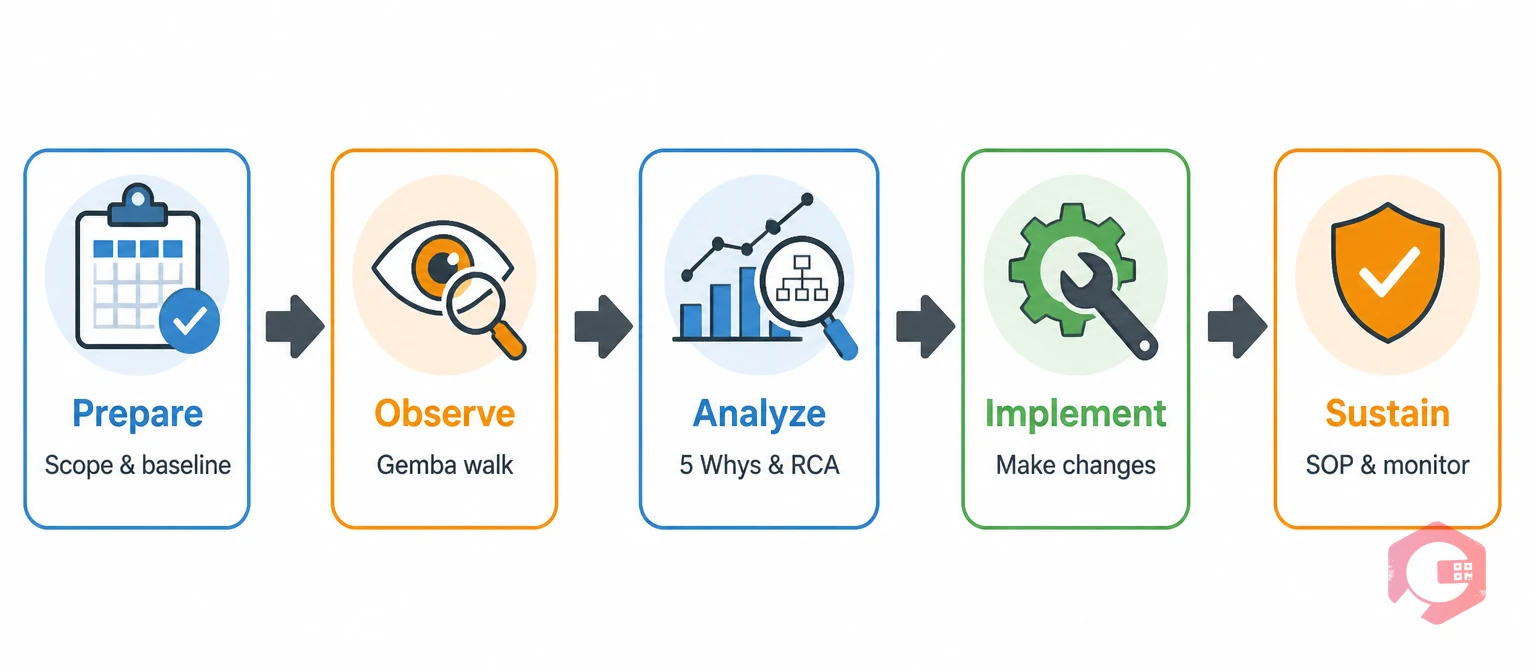
Running a Kaizen event follows five distinct phases: prepare, observe, analyze, implement, and sustain. Each phase has a specific output, and skipping any one of them is the most common reason a Kaizen blitz fails to produce lasting change.
Pick one process, one line, or one machine — never an entire facility. A Kaizen event that tries to fix "maintenance" in general will run out of time before it produces anything concrete. Pull together a cross-functional team: a maintenance technician who works the equipment daily, a supervisor, an operator, and someone from quality or engineering if the process touches either.
Set a clear, measurable target before day one. "Reduce changeover time on Line 3 by 30%" gives the team something to aim at. "Improve Line 3" does not.
A Gemba walk is a direct, on-site observation of a process to see how work is actually performed versus how it is documented. The team observes the actual process where the work happens, not a description of it in a meeting room. This step exposes the gap between the standard operating procedure on paper and what technicians do in practice.
Document everything: cycle times, walking distances, wait times, and points where the operator has to search for tools or parts. Photos and time-stamped notes work better than memory once the team moves into the analysis phase.
Root cause analysis (RCA) is a structured method for identifying the underlying cause of a problem rather than just its symptoms. The 5 Whys technique — asking "why" five times in sequence — is the standard tool for Kaizen teams because it's fast and doesn't require statistical training to apply correctly.
For recurring equipment failures specifically, teams sometimes pair the 5 Whys with a simple FMEA-style review to rank failure modes by severity and frequency. The goal is the same: stop fixing symptoms and start eliminating the cause. According to the Lean Enterprise Institute, structured root cause analysis during a Kaizen event is one of the key differentiators between events that produce lasting change and those that revert within weeks.
This is where most of the physical work happens — reorganizing a workstation using 5S principles, redesigning a checklist, relocating tools, or adjusting a maintenance schedule. The team should make changes during the event itself, not draft a list of recommendations for someone else to implement later. A Kaizen blitz that ends with a to-do list instead of a completed change has already lost most of its momentum.
Improvements identified during this phase need to become trackable tasks immediately. Teams running Kaizen events with work order management software can convert each fix into an assigned task with an owner and a due date before the team disbands, which removes the ambiguity of "who's handling this."
Standard operating procedures (SOPs) are documented step-by-step instructions that ensure a task is performed consistently regardless of who is doing it. The sustain phase is where new procedures get written into SOPs and where any process change gets locked in with preventive maintenance software scheduling so it doesn't quietly drift back to the old way of working within a few months.
Schedule a 30-day and 90-day follow-up review to confirm the changes held. If a metric slips back toward baseline, that's a signal the standardization step needs reinforcement, not a signal to abandon the change.

A Kaizen event produces a burst of ideas and fixes in a short window, and the biggest risk after the event ends is losing track of who owns what. Cryotos addresses this with a structured approach to capturing, assigning, and verifying every action that comes out of the blitz.
Maintenance teams running Kaizen events through a structured Computerized Maintenance Management System can move from observation to assigned action in the same shift the problem was found, instead of waiting for someone to write it up after the fact. That speed matters — Kaizen momentum drops fast once a team leaves the floor.
Most Kaizen events surface at least one finding that points to a maintenance gap — a lubrication interval that's too long, an inspection step that got skipped, or a part that fails before its rated life. These findings only create lasting value if they get built into a recurring PM task rather than staying as a one-time fix.
Static and dynamic PM scheduling lets teams set intervals by calendar date or by actual usage hours and mileage, which matters for Kaizen events focused on equipment that runs on variable schedules. Tracking MTBF before and after the event gives a concrete number to report back to leadership on whether the change worked.

A Kaizen event's success gets measured by comparing baseline KPIs captured before the event against the same metrics 30 and 90 days after implementation. Without a before-and-after comparison, it's impossible to say whether the improvement actually held or whether normal operational variation masked the result.
OEE (Overall Equipment Effectiveness) is a manufacturing metric that combines equipment availability, performance, and quality into a single percentage score. It's the standard benchmark for measuring whether a Kaizen event actually moved the needle on machine performance.
Per Cryotos customer data, maintenance teams have reported up to 30% reduction in unplanned downtime and 25% faster repair turnaround when Kaizen findings get converted into tracked work orders and PM schedules instead of staying as informal notes. A BI dashboard that pulls these numbers automatically removes the manual spreadsheet work that often causes post-event reporting to slip.
Most Kaizen events that lose momentum do so because of preparation gaps, not execution mistakes during the event itself. Confirm these items are in place before the team walks onto the floor.
The same handful of mistakes show up across most failed Kaizen events, and nearly all of them are preventable with better preparation or follow-through. Scope creep tops the list — a team that starts with "reduce changeover time" but ends up trying to redesign the entire production line runs out of time before finishing anything.
The second most common failure is skipping the sustain phase. A team implements a fix during the event, everyone goes back to their regular jobs, and within six weeks the old habit creeps back because nobody locked the new procedure into a documented SOP or a recurring maintenance schedule. The third failure is treating the Kaizen event as a one-time activity instead of part of an ongoing lean maintenance program — the Society for Maintenance and Reliability Professionals (SMRP) notes that facilities running Kaizen events on a recurring cadence consistently outperform those using them as isolated firefighting exercises.
Most Kaizen events run between 3 and 5 days, though some focused events on a single workstation can be completed in a single day. The defining feature isn't the exact duration — it's that the event has a fixed start and end date with implementation happening within that window.
Continuous improvement is an ongoing, open-ended philosophy of incremental change applied across an organization over time. A Kaizen event is a time-boxed, intensive sprint that targets one specific process and delivers a concrete result within days. Kaizen events are one tool within a broader continuous improvement program.
An effective Kaizen team includes the people who actually do the work — technicians and operators — along with a supervisor, a facilitator to keep the event on track, and anyone from quality or engineering whose function intersects with the targeted process. Teams of 5 to 8 people tend to work best; larger groups slow down decision-making.
Improvements stick when they get converted into a documented standard operating procedure and a recurring task that someone is accountable for — whether that's a preventive maintenance schedule, an updated checklist, or a revised work instruction. Improvements that only exist as a memory from the event week almost always revert within a few months.
A CMMS is most valuable during the capture and sustain phases — logging findings in real time during the Gemba walk via mobile app, assigning corrective action work orders before the team disbands, and converting process changes into recurring preventive maintenance tasks. It doesn't replace the facilitation and problem-solving work of the event itself, but it removes the administrative gap that causes good ideas to get lost afterward.
Running a Kaizen event takes real planning, but the gains only last if every fix gets tracked, scheduled, and verified after the team leaves the floor. Schedule a free demo to see how Cryotos turns Kaizen findings into work orders, preventive maintenance schedules, and measurable KPI dashboards your team can act on immediately.



Cryotos AI predicts failures, automates work orders, and simplifies maintenance—before problems slow you down.