

Kaizen means making small, continuous improvements that compound into major gains over time. Kaikaku means making a sudden, radical change that resets how a process or plant operates. Maintenance and operations leaders need both: Kaizen keeps equipment reliable day to day, and Kaikaku steps in when a process is broken in a way small fixes can't reach.

A Kaizen improvement program is a series of small, ongoing process refinements applied continuously to improve reliability without major disruption. The word translates roughly to "change for the better." In maintenance, it shows up as a steady stream of minor adjustments to how work orders, PM tasks, and inspections get done — not a single large overhaul.
A maintenance team practicing Kaizen doesn't wait for a major equipment failure to act. Instead, they look for small inefficiencies — a checklist step that gets skipped, a part that's always out of stock, a PM interval that's off. They fix these one at a time. A supervisor who adjusts the PM interval on a valve that keeps getting flagged is practicing Kaizen. A technician who adds a photo step to a work order so the next shift can see what was repaired is practicing Kaizen.
Kaizen pairs naturally with preventive maintenance software, since PM programs benefit from steady, small refinements rather than a full redesign. The American Society for Quality (ASQ) notes that Kaizen's strength is in lowering the barrier to change. Nobody needs a budget approval or a project charter to tighten a checklist.
The trade-off is speed. Kaizen rarely fixes a deeply broken process quickly — it's designed to move in small steps. If a plant's maintenance backlog has grown for two years, minor checklist tweaks won't close that gap. That's a signal the team needs a Kaikaku-style reset instead.

A Kaikaku transformation is a fast, structural overhaul that replaces an existing process or system rather than refining it in small steps. The term is sometimes translated as "radical change" or "reform," and it's used when incremental tweaks won't close the gap between current performance and what the business needs.
In a maintenance context, Kaikaku looks like moving a plant from paper-based work orders to a digital CMMS in one rollout. It can also mean installing IoT sensors across a production line, or restructuring the maintenance department's KPIs in a single quarter. The Lean Enterprise Institute describes Kaikaku as a deliberate, leadership-driven transformation. It is distinct from the gradual, bottom-up nature of Kaizen.
This is where IoT integration and predictive maintenance tend to enter the picture. They're rarely a small tweak — they're a structural change to how maintenance decisions get made. Kaikaku carries more risk because it touches more of the organization at once. A digital CMMS rollout changes how technicians log work orders, how supervisors approve them, how purchasing orders spare parts, and how leadership reads performance reports.
The payoff is also bigger. A plant that successfully executes a Kaikaku transformation often sees downtime and repair costs drop by a margin that years of Kaizen tweaks couldn't reach on the old process.
The table below compares the two approaches across the factors that matter most to maintenance and operations leaders deciding which one fits a given problem.
| Factor | Kaizen (Continuous) | Kaikaku (Radical) |
|---|---|---|
| Pace of change | Gradual, ongoing | Fast, one-time |
| Scope | Small, localized improvements | Large-scale, structural change |
| Risk level | Low — easy to reverse | Higher — harder to reverse |
| Who drives it | Frontline teams and supervisors | Leadership and project sponsors |
| Investment | Minimal, often no capital spend | Significant capital or system investment |
| Typical trigger | Recurring small inefficiency | Major performance gap or new technology |
| Example in maintenance | Refining a PM checklist monthly | Switching the plant to a digital CMMS |
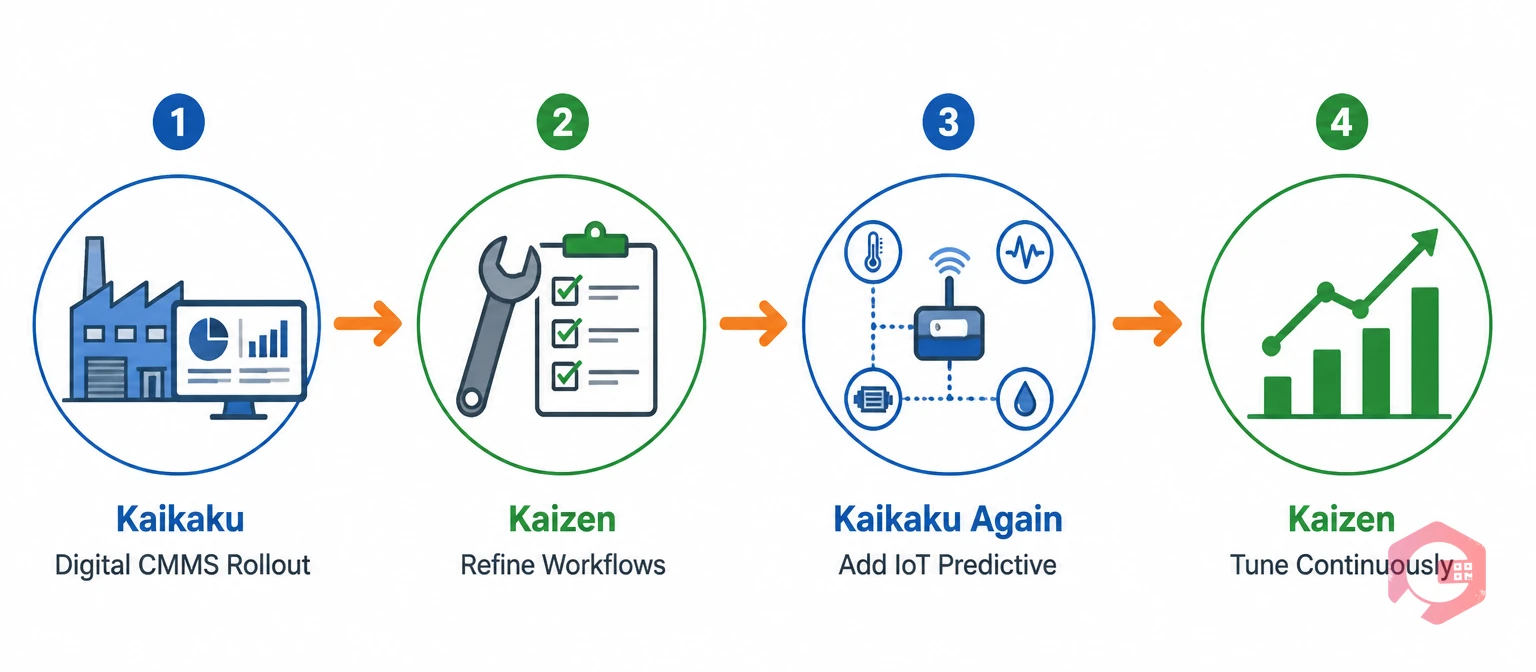
Treating Kaizen and Kaikaku as competing philosophies misses how they actually work together. Kaikaku creates the new baseline — a digital CMMS, a new PM schedule, an IoT-enabled production line — and Kaizen is what keeps that baseline improving afterward.
A plant that only does Kaikaku ends up making big changes every few years without refining what's already in place. A plant that only does Kaizen risks optimizing an outdated process instead of replacing it when that's what's actually needed.
Plants that adopt this sequence tend to outperform those that pick one philosophy and stick with it. Treating a CMMS rollout as a one-time project rather than the start of an improvement cycle is one of the most common reasons digital transformations underdeliver. The Society for Maintenance and Reliability Professionals (SMRP) consistently points to sustained improvement cycles — not one-off changes — as the differentiator for top-performing maintenance operations.

A maintenance CMMS platform is most valuable when it supports both incremental Kaizen tuning and structural Kaikaku transformation on the same data. Cryotos is built to do exactly that — small adjustments and large-scale rollouts both depend on accurate, real-time data about how equipment and maintenance teams are actually performing.
Cryotos gives maintenance teams the tools to make small adjustments constantly, without waiting for a major system overhaul.
When the goal is a bigger leap, Cryotos provides the infrastructure for transformation projects rather than incremental tuning.
Because both improvement modes run on the same platform, teams don't have to rebuild reporting or retrain staff when they shift between continuous tuning and a larger transformation project. The downtime tracking and BI reporting that support a monthly Kaizen review are the same tools that justify a Kaikaku capital investment to leadership.
There's no universal answer to whether a given problem calls for Kaizen or Kaikaku — the right choice depends on the size of the gap, the available budget, and how much disruption the operation can absorb right now.
As a rule of thumb: if the fix can happen this week with the team already in place, it's Kaizen. If it requires new budget, new technology, or a redesign of how work flows through the department, it's Kaikaku.
No. Kaizen is lower-risk and easier to sustain, but it can't close a large performance gap on its own. When a maintenance operation is fundamentally outdated — still running on paper, for example — Kaikaku is the faster and often cheaper path to a workable baseline.
Yes. A platform like Cryotos can run Kaizen-style adjustments — tweaking PM schedules, refining checklists — on the same system handling a Kaikaku-style IoT rollout. Both rely on the same maintenance data foundation.
Look at the size of the gap and the urgency. Small, recurring inefficiencies that the current team can fix without new budget point to Kaizen. Large structural problems that require new technology, new budget, or a redesigned process point to Kaikaku.
Not necessarily, but in maintenance management it usually does. Most radical maintenance transformations — moving off paper, adding predictive sensors, integrating with an ERP — depend on a new digital system to make the change stick long term.
Whether your maintenance team is fine-tuning PM schedules or planning a full digital transformation, Cryotos gives you the work order management, preventive maintenance, and IoT tools to run both strategies on one platform. Schedule a free demo to see how it fits your operation.


Cryotos AI predicts failures, automates work orders, and simplifies maintenance—before problems slow you down.



