
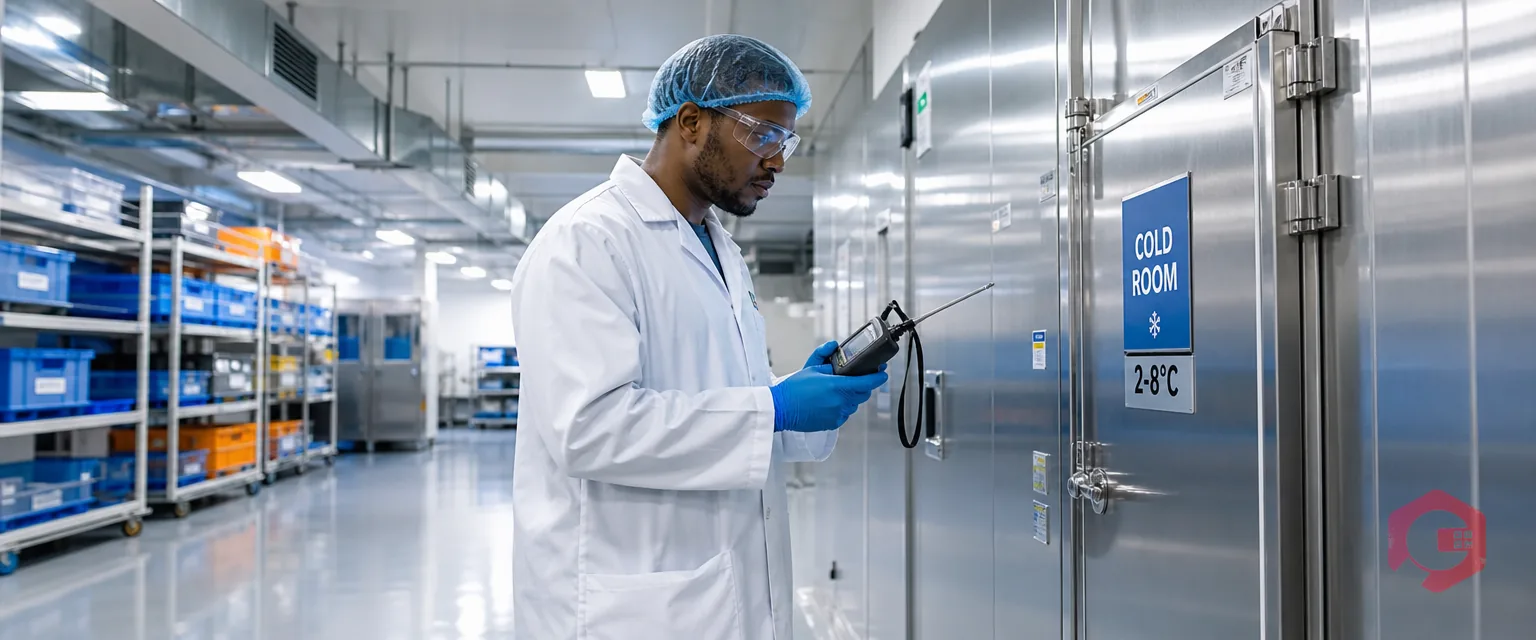
Continuous temperature monitoring in a GMP facility records conditions around the clock and raises an alarm when a limit is crossed, so teams can protect product and prove control. The system only works if the sensors, network, power and monitored equipment are maintained. That is where maintenance and compliance meet.
This guide covers where monitoring applies and gives a best practices matrix. It also shows a four-part framework, what to do when an alarm sounds, and what a maintenance system can and cannot do.
Key Takeaways
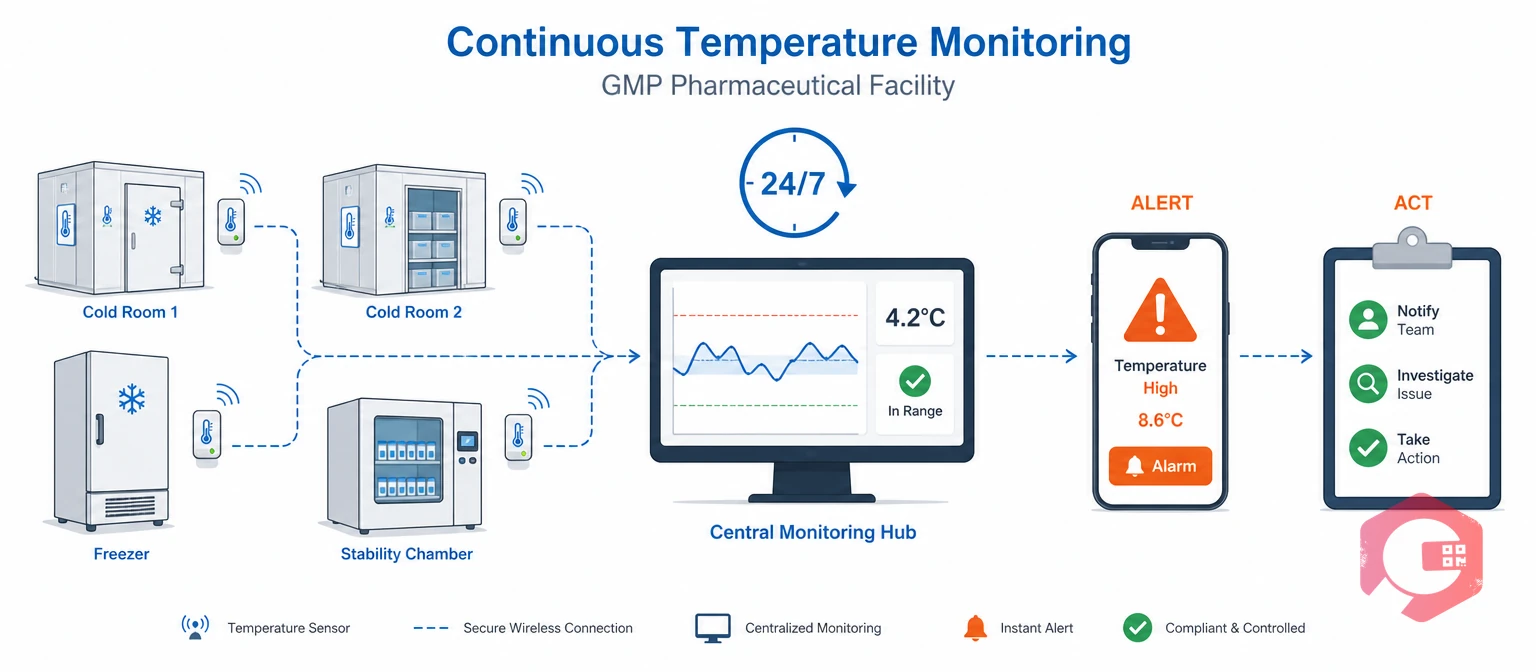
Temperature is a controlled condition in many GMP areas.
Continuous temperature monitoring is automatic, round-the-clock recording of temperature with alarms when limits are crossed. Common areas include cold rooms, refrigerators and freezers, controlled room temperature warehouses, incubators, stability chambers and cleanrooms.
The US cGMP rules in 21 CFR Part 211 include requirements for suitable storage conditions and for maintained, calibrated equipment. The EU GMP guidelines cover qualification and computerized systems. See also this overview of good manufacturing practice.
This guide covers storage and environmental monitoring. Process cycles such as sterilization, and transport logistics, are separate topics. Limits and intervals come from your product, your qualification and your risk assessment, so this guide gives none.
Use the matrix as a starting point. Your own qualification and risk assessment set the real limits and intervals.
| Element | Best Practice | Maintenance Task | Record to Keep |
|---|---|---|---|
| Mapping and placement | Map the space and place sensors at worst-case spots. Repeat after major change. | Support mapping runs; move or add sensors under change control. | Mapping report; sensor location plan. |
| Sensor calibration | Calibrate against traceable standards at risk-based intervals. Record as-found and as-left results. | Schedule and perform calibration; swap sensors that are due. | Certificates; as-found data. |
| Alarm limits and delays | Set alert and action limits from product needs. Use delays that avoid false alarms without hiding real ones. | Check settings after repairs and changes. | Alarm settings record. |
| Alarm testing and contacts | Test alarms on a schedule. Keep contact lists and after-hours cover current. | Run tests; fix failed alert paths. | Test log; contact list. |
| Power and network | Plan for power loss and data gaps. Test backup power and data buffering. | Test backup power; check batteries and signal. | Test records; gap log. |
| Equipment upkeep | Maintain what holds temperature: seals, defrost, compressors, fans and HVAC. | Preventive maintenance by criticality. | PM work orders and checklists. |
| Excursion response | Follow a written procedure from alarm to investigation. | Diagnose, repair and confirm the fix. | Excursion report; work order. |
| Data review | Review data and alarms on a schedule. Trend drift and repeat alarms. | Act early on trends. | Review sign-off; trend reports. |
| Change and requalification | Assess changes to equipment, layout, sensors or software. Requalify where needed. | Raise change records for repairs. | Change record; requalification decision. |
A mapping study shows where a space runs hotter or colder. Sensors go at the worst-case spots, and the study is repeated after major changes. A well-calibrated sensor in the wrong place can miss a problem.
Calibration records matter too. Record as-found and as-left results. An as-found result outside tolerance means checking the product held since the last good calibration.

The SURVEY-SENSE-ESCALATE-ASSURE framework is a four-part loop for keeping continuous temperature monitoring reliable. Quality owns the product decisions, and maintenance owns the upkeep.
The SURVEY-SENSE-ESCALATE-ASSURE Framework:
Check sensor placement, signal and power before go-live with the IoT sensor deployment validation checklist.
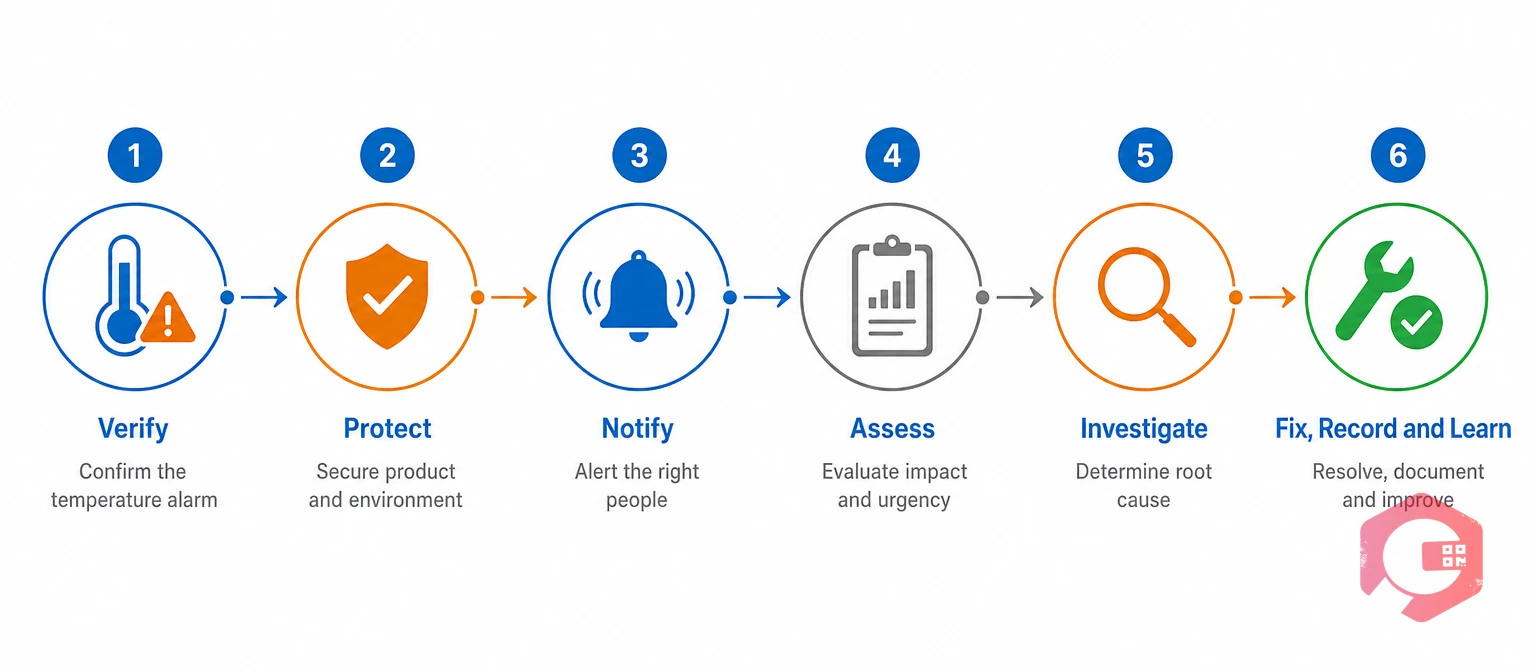
A temperature excursion is a period when product is held outside its allowed range. A clear order of steps stops people guessing. Your written procedure sets the details, and this is a typical outline.
Quality decides what happens to the product. Maintenance supplies the cause, the repair and the evidence.
Many failures here are quiet. The system keeps running, but the safeguards around it have slipped. Many maintenance teams recognize at least two of these.
A Computerized Maintenance Management System supports continuous temperature monitoring by keeping sensors and monitored equipment maintained and by turning alarms into tracked repair work. It does not replace your validated monitoring system. Cryotos is a maintenance platform, not a monitoring system or sensor supplier, so the official temperature record stays in your validated system.
Maintenance teams using Cryotos have reported up to 30% reduction in unplanned downtime and 25% faster repair turnaround. For monitored equipment, fewer breakdowns can also mean fewer excursions.
Deviations, change control and product impact decisions stay in your quality system. Ask any software vendor how its records connect to your monitoring and quality systems.
It is automatic, round-the-clock recording of temperature in areas such as cold rooms, warehouses and chambers. The system raises alarms when readings leave their limits. It supports product protection and gives a record of control.
There is no single interval. Set it from the sensor's role, its drift history and your risk assessment, and review it over time. Record as-found and as-left results, and assess product impact when an as-found result is out of tolerance.
Verify the reading, protect the product and notify the people named in your procedure. Quality assesses the effect on product. Maintenance finds the cause, repairs the fault and records the work against the event.
Mapping shows where a space runs hotter or colder. Sensors at the worst-case spots catch problems that a sensor in an average spot would miss. Repeat mapping after major changes to layout, load or equipment, as your procedures require.
Both. Quality decides what happens to the product, and maintenance finds and fixes the cause. Name an owner for each step in your procedure.
No. A validated monitoring system holds the temperature record, its audit trail and its alarm handling. A CMMS keeps sensors and equipment maintained and tracks the repair work. Ask your vendor how the two connect.
Continuous temperature monitoring only protects product when the sensors work and the alarms lead to repairs. Schedule a free demo to see how Cryotos schedules sensor calibration, tracks alarm-driven work orders and keeps signed records in one place.


Cryotos AI predicts failures, automates work orders, and simplifies maintenance—before problems slow you down.



