

CTQ parameters drive maintenance excellence in pharmaceutical manufacturing by showing which equipment and instruments can affect product quality. Those items get the tightest maintenance, calibration and review. Without that link, maintenance effort follows habit or cost instead of impact on the patient. A CTQ-driven approach starts with the quality attributes and works back to the wrench.
This guide explains CTQ, CQA and CPP in plain terms and shows how they identify critical equipment. It gives a four-step framework and a matrix you can adapt. It also shows what a maintenance system can and cannot do.
Key Takeaways
Three terms are often mixed up in pharma quality work. Each has a different job.
A CTQ parameter is a measurable characteristic that matters to the patient and must be controlled. The term comes from lean and six sigma practice, as this overview of critical to quality explains. The formal ICH terms are more precise, and some teams use CTQ as a plain label for both.
A critical quality attribute (CQA) is a product property that must stay within a set limit. A critical process parameter (CPP) is a process setting whose variation can affect a CQA. The ICH Q8 guideline defines both, so check your own definitions against it.
| Term | Plain Meaning | Example (Illustrative) | Usual Owner |
|---|---|---|---|
| CTQ parameter | A characteristic that matters to the patient and must be controlled. | The dose is right; the product is sterile. | Quality and process teams. |
| CQA | A product property that must stay within a limit. | Assay, content uniformity, dissolution, sterility. | Quality and development. |
| CPP | A process setting that can affect a CQA. | Temperature, time, pressure, speed, pH. | Process and validation teams. |
| Critical equipment or instrument | Equipment that controls or measures a CPP. | Autoclave, filling pump, temperature probe. | Engineering and maintenance, with quality. |
A critical instrument is an instrument whose reading is used to control or prove a critical parameter. Quality owns the list of CQAs and CPPs. Maintenance owns the care of the equipment and instruments behind them. The examples here are illustrations, so use your own product files for the real ones.
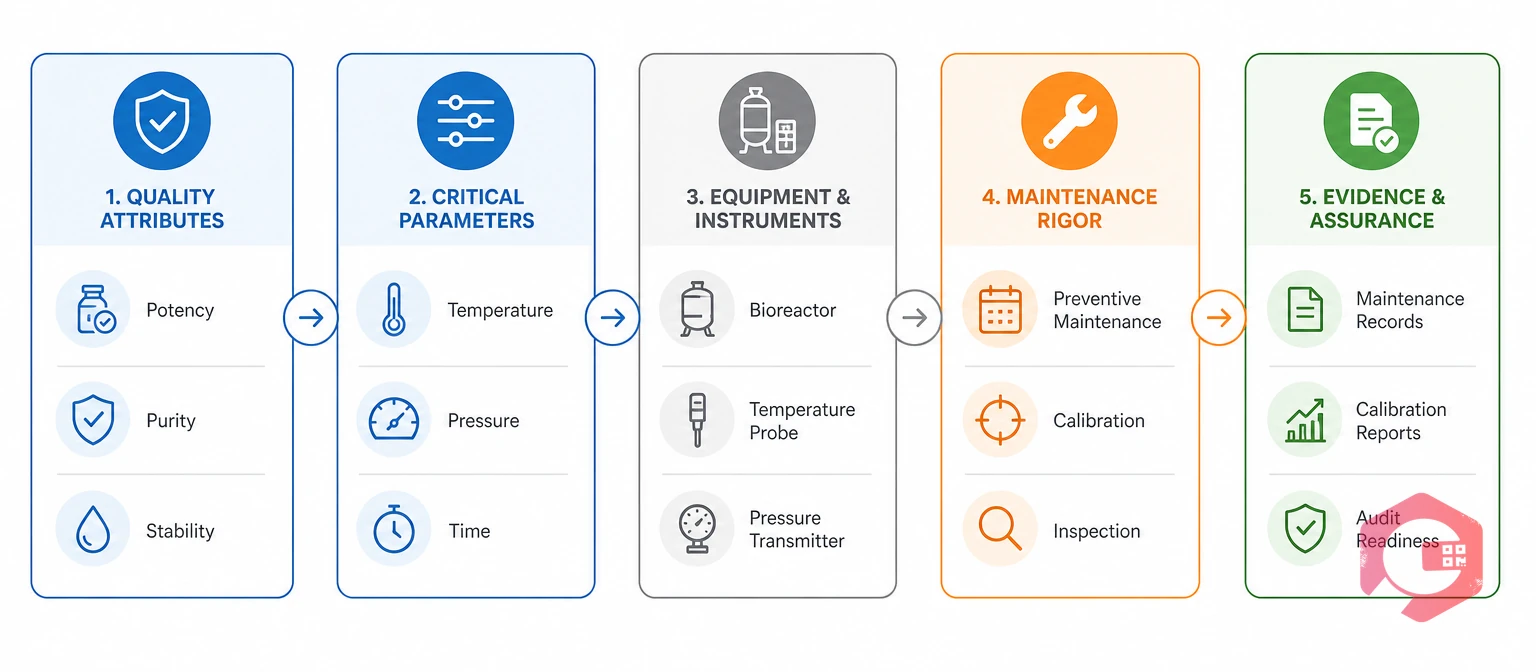
Five steps link a CTQ parameter to a maintenance task.
Many sites group equipment into tiers, such as critical, supporting and non-critical. Quality signs off the tiers, and maintenance applies them. The US cGMP rules in 21 CFR Part 211 include requirements for equipment maintenance and for calibration of instruments.
This matrix shows how quality attributes turn into maintenance focus. All examples are illustrative, so use your own product data.
| CQA (Example) | Related Parameter | Critical Equipment | Maintenance Focus |
|---|---|---|---|
| Sterility | Sterilization temperature, pressure and time. | Autoclave, temperature probes. | Probe calibration; door seals; cycle records; requalification decision after repair. |
| Cleanroom air quality | Air pressure differences, filter integrity. | Air handling units, HEPA filters, pressure sensors. | Filter integrity tests; sensor calibration; alarm response. |
| Fill volume | Pump accuracy and speed. | Filling machine, load cells. | Calibration; wear checks on pump parts; verification after repair. |
| Tablet hardness | Compression force, tooling condition. | Tablet press, force sensors. | Tooling inspection; force sensor calibration; wear trends. |
| Blend uniformity | Mixing time and speed. | Blender, drive, timer. | Speed and timer checks; drive upkeep. |
| Moisture content | Inlet air temperature and flow. | Fluid bed dryer, temperature and flow sensors. | Sensor calibration; filter and seal checks; airflow checks. |
Here is an illustrative example. A temperature probe on a sterilizer is found out of tolerance at its routine calibration. Because that probe measures a critical parameter, the team checks the batches run since the last good calibration and records the decision. A probe on a non-critical storage fridge gets a simpler review.
Use the maintenance audit checklist to check whether your critical equipment records are complete.

The MAP-RANK-ASSIGN-PROVE framework turns the logic chain into four working steps. Quality leads the first two, and maintenance leads the last two.
The MAP-RANK-ASSIGN-PROVE Framework:

Excellence here means keeping CTQ parameters in control, protecting the validated state of the process and being able to prove it. These habits mark a mature program.
Many failures here are quiet. The program exists, but the link between CTQ parameters and maintenance does not. Many maintenance teams recognize at least two of these.
A Computerized Maintenance Management System supports CTQ parameters by making critical equipment visible and recording the work done on it. It does not set CQAs, run risk assessments or replace the quality system. Cryotos is a maintenance platform for pharmaceutical manufacturing, not a quality management or batch record system.
Maintenance teams using Cryotos have reported up to 30% reduction in unplanned downtime and 25% faster repair turnaround. On critical equipment, fewer unplanned failures can also mean fewer product impact checks.
Risk assessments, change control decisions, deviations and batch records stay in your quality systems. Ask any software vendor how its maintenance records connect to them.
They are measurable characteristics that matter to the patient and must be controlled. In formal terms they relate to critical quality attributes and the critical process parameters that affect them. Quality defines them, and maintenance protects the equipment behind them.
Each CQA depends on certain process parameters. The equipment that controls those parameters, and the instruments that measure them, are the critical items. They get tighter maintenance, calibration and review than equipment with no effect on quality.
The team should assess the effect on product made since the last good calibration and record the decision. They should also record the repair, the root cause and any follow-up action. Your quality procedures define the exact steps.
Yes, usually. Critical items often get tighter intervals, deeper checks, defined spares and change control for repairs. Non-critical items can follow simpler rules. Quality should sign off the tiers.
Quality signs off the decision because it owns the CQAs and the risk method. Maintenance and engineering give input on how the equipment works and fails. Both teams should use the same list.
A CMMS can schedule PM and calibration, hold signed checklists, track work orders and root cause, and store documents. It does not replace the quality system. Ask your vendor how its records meet your own validation and data integrity needs.
CTQ parameters only protect patients when maintenance acts on them. Schedule a free demo to see how Cryotos schedules tiered PM, captures signed records and tracks findings on critical equipment.


Cryotos AI predicts failures, automates work orders, and simplifies maintenance—before problems slow you down.



