IATF 16949 maintenance compliance means proving, with records, that your equipment, tooling, and facilities are planned, maintained, measured, and reviewed so they keep producing conforming parts. The main requirement sits in clause 8.5.1.5, which asks automotive suppliers to run a documented total productive maintenance (TPM) system. That system must include maintenance objectives, preventive and predictive methods, spare parts planning, and management review.
Auditors rarely accept a schedule on its own. They ask for evidence that tasks were done on time, that objectives were tracked, and that missed targets led to action. This guide walks through every IATF 16949 maintenance compliance requirement, the evidence auditors expect, and a four-step framework that keeps your plant audit-ready all year.
Key Takeaways

IATF 16949 maintenance compliance is proof that your equipment stays capable of making conforming parts. It covers how you plan, do, measure, and review maintenance on machines, tooling, gauges, and facilities.
The International Automotive Task Force publishes the standard, which builds on ISO 9001:2015 with extra automotive requirements. IATF-recognized certification bodies audit suppliers against it. Many vehicle makers require certification from their supply chain.
Most suppliers use a Computerized Maintenance Management System (CMMS) to meet these expectations. Auditors want dated, traceable records, not memory or loose spreadsheets. In an IATF 16949 plant, maintenance is a quality control, not a support function.
Clause 8.5.1.5 is the IATF 16949 requirement for a documented total productive maintenance system. It applies to every manufacturing site in your certification scope. It sets a minimum list of elements the system must cover.
Total productive maintenance gets operators, technicians, and engineers working together to keep equipment reliable. The table below paraphrases the clause, so check the standard text and your customer-specific requirements before you finalize your own procedure.
| Required Element | What the Clause Expects | Evidence Auditors Ask For | Common Gap |
|---|---|---|---|
| Equipment identification | A list of the process equipment needed to make conforming product at the required volume. | Critical equipment list tied to the process flow and control plan. | List is outdated or covers only bottleneck machines. |
| Replacement parts | Spare parts for that equipment are available when needed. | Spare parts list with minimum and maximum levels and stock records. | No criticality ranking; key spares out of stock. |
| Maintenance resources | Resources for machine, equipment, and facility maintenance. | Staffing plan, budget, skill records, contractor agreements. | Skills not recorded; contractor work not tracked. |
| Packaging and preservation | Equipment, tooling, and gauging are protected when idle or stored. | Preservation procedures and storage check records. | Idle tooling stored with no checks. |
| Customer-specific requirements | Customer rules on maintenance are applied. | Customer requirement matrix mapped to PM tasks. | Customer rules known but missing from work orders. |
| Maintenance objectives | Documented objectives such as OEE, MTBF, MTTR, and PM compliance. | Metric definitions, monthly results, trend charts. | Objectives set but never measured. |
| Review and action plans | Regular review of the plan and objectives, with a documented action plan when objectives are missed. | Review minutes and corrective action records. | Missed targets with no action plan. |
| Preventive maintenance | Preventive methods are in use. | PM schedule, task lists, completed work orders. | Overdue PMs closed with no notes. |
| Predictive maintenance | Predictive methods are used as applicable. | Condition monitoring plan and trend records. | Sensors installed but readings not acted on. |
| Periodic overhaul | Planned overhauls for equipment that needs them. | Overhaul plan and completed overhaul records. | Overhaul deferred with no risk review. |
Treat each row as a question an auditor can ask about IATF 16949 maintenance compliance, and make sure you can answer it with a record.
Want to check your own maintenance numbers first? The free Cryotos OEE calculator shows where your availability, performance, and quality stand today.
IATF 16949 maintenance compliance reaches beyond clause 8.5.1.5, so auditors can raise maintenance questions from almost any direction.
Most facilities find these links during internal audits, when an auditor follows one failure from the shop floor back through the quality system. A single breakdown record can touch six clauses at once.
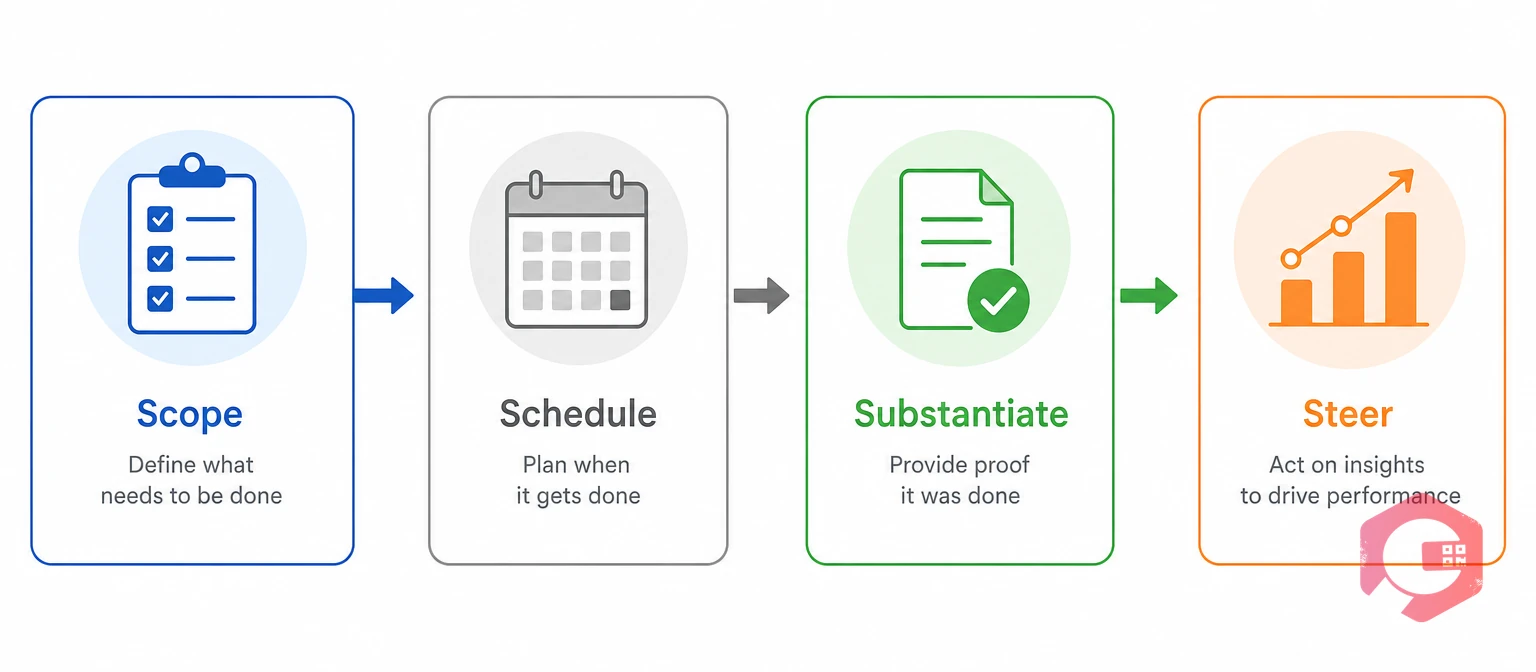
The Four-S Maintenance Compliance Framework is a four-step loop for turning clause 8.5.1.5 into daily practice. Each step answers one question an auditor will ask.
The Four-S Maintenance Compliance Framework:
In audit terms, the four steps ask what matters, what is planned, what happened, and what you did about it. A plant that can answer all four with records has IATF 16949 maintenance compliance built into daily work, not just audit week.
A maintenance objective is a measurable target for equipment performance that management reviews on a set schedule. IATF 16949 names OEE, MTBF, MTTR, and preventive maintenance compliance as examples, but it does not set numeric targets.
| Metric | Formula | Illustrative Target | Review Frequency | Typical Owner |
|---|---|---|---|---|
| OEE | Availability × Performance × Quality. | Improve on last year’s baseline each quarter. | Monthly | Plant manager |
| MTBF | Operating time ÷ number of failures. | Higher than last year’s average. | Monthly | Reliability engineer |
| MTTR | Total repair time ÷ number of repairs. | Lower than last year’s average. | Monthly | Maintenance supervisor |
| PM compliance | PM tasks done on time ÷ PM tasks scheduled × 100. | 95% of PM tasks on time. | Weekly and monthly | Maintenance planner |
| Unplanned downtime | Unplanned stop hours ÷ scheduled production hours × 100. | Below the site limit. | Weekly | Production and maintenance leads |
You set targets from your own history and your customers’ needs, so treat the targets above as examples. If you scheduled 200 PM tasks in a month and finished 184 on time, PM compliance is 92%.
Maintenance teams with strong IATF 16949 maintenance compliance define each metric once, in writing, so every month’s number means the same thing.
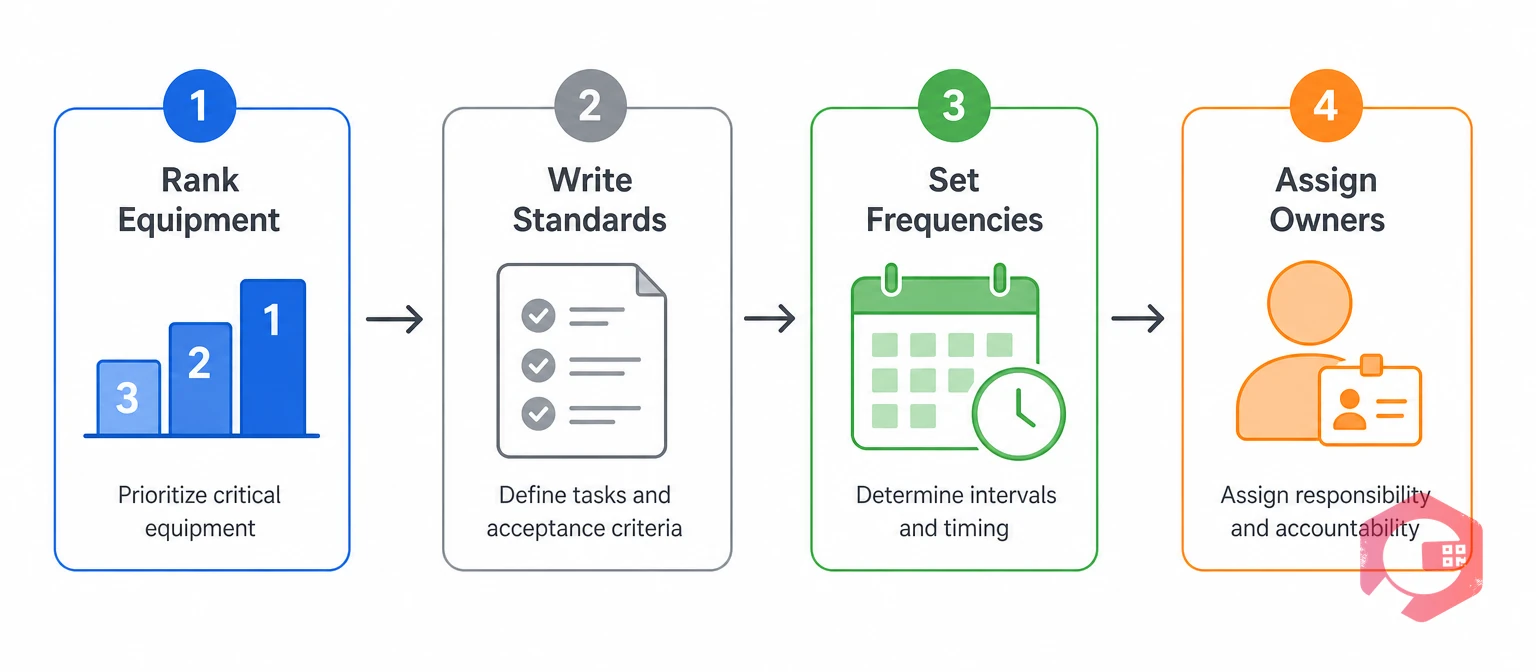
An IATF 16949 preventive maintenance plan is a risk-ranked schedule of tasks that protect product quality and delivery. Clause 8.5.1.5 expects you to identify the equipment needed to make conforming product at the required volume, and then maintain it.
Start with the process flow diagram, the control plan, and your process failure mode and effects analysis (FMEA). Machines that control special characteristics, feed bottlenecks, or have no backup rank highest.
Use a simple A, B, C scale and record the reason for each rank. Auditors often ask why a machine sits at the top or bottom of the list.
A task called “check press” fails an audit because nobody can tell what good looks like. Each task needs four things:
Digital maintenance checklists make these fields mandatory, so a task cannot close with a blank result.
Use manufacturer guidance, failure history, running hours, and customer rules to set each interval. Time-based tasks suit calendar-driven wear, while usage-based tasks suit parts that wear with cycles, hours, or output.
Cryotos preventive maintenance software supports both calendar and run-hour triggers, so the schedule follows how the machine actually runs.
Clause 8.5.1.5 expects resources for maintenance, so auditors check that every task has an owner and that technicians have time to do it. Operator-led care, such as daily cleaning, inspection, and lubrication, shares the load and is a core TPM habit.
A plan with ranked equipment, written standards, data-based frequencies, and named owners answers most of what an auditor will ask about IATF 16949 maintenance compliance.
Predictive maintenance is the use of condition data to schedule repairs before a failure happens. For IATF 16949 maintenance compliance, clause 8.5.1.5 asks for predictive methods “as applicable.” Decide where condition monitoring adds value, and record that decision.
Cryotos connects sensor and meter data through IoT meter reading, so readings from connected equipment are logged against the asset and can prompt maintenance action.
A periodic overhaul is a planned teardown and renewal of equipment at set hours or intervals. Record the scope, the parts used, and the checks that prove the machine is capable again.
After an overhaul, a capability check and first-piece approval before releasing production are a sensible control. Deferred overhauls need a documented risk review, because deferral without one is a common audit finding.
Tooling and spare parts management is the part of IATF 16949 maintenance compliance that keeps lines running and tools traceable. Clause 8.5.1.6 covers production tooling and test equipment, while clause 8.5.1.5 covers spare parts and preservation.
Cryotos inventory management gives barcode stock visibility and minimum-level alerts. A critical spare at zero stock is the fastest way to turn a minor failure into a missed shipment.
Maintenance connects to the quality system through the FMEA, the control plan, and problem solving. These links show auditors that maintenance protects the product, not just the machine.
Record failure codes and root causes on every corrective job in your work order management system, so repeat failures are easy to find. Maintenance teams that close this loop turn each repeat failure into a changed PM task or FMEA row, which strengthens IATF 16949 maintenance compliance.
An audit evidence register is a list of every maintenance record an auditor may ask to see. Building one turns IATF 16949 maintenance compliance from an audit-week scramble into a monthly habit.
| Record | Related Clause | What Auditors Check | Typical Weak Spot |
|---|---|---|---|
| Critical equipment list | 8.5.1.5 | Matches the process flow and control plan. | Not updated after new lines or equipment. |
| PM schedule and completion history | 8.5.1.5 | Tasks done on time with sign-off. | Overdue tasks closed with no reason. |
| Maintenance objective results | 8.5.1.5, 9.3 | Monthly values and trends. | Metrics calculated differently each month. |
| Management review minutes | 9.3 | Maintenance performance discussed and actions assigned. | Maintenance missing from the agenda. |
| Spare parts list and stock records | 8.5.1.5 | Minimum levels met for critical spares. | Critical spares at zero stock. |
| Tooling status and maintenance records | 8.5.1.6, 7.5.3.2.1 | Tool status, repair history, and ownership. | Status kept on whiteboards. |
| Calibration records | 7.1.5.2 | Instruments in date and traceable. | Gauges used past the due date. |
| Corrective action and root cause records | 10.2.3 | Root cause found and fix verified. | Fix recorded only as “part replaced”. |
| Contingency plan test records | 6.1.2.3 | Key-equipment failure scenarios tested. | Plan written but never tested. |
Review the register monthly, and any gap you find is a gap you can close before an auditor finds it.
Maintenance audit findings usually come from gaps between the plan and the evidence, not from missing plans. Maintenance teams that pass audits cleanly avoid these traps:
Closing these IATF 16949 maintenance compliance gaps early is far cheaper than answering a finding later.
A CMMS supports IATF 16949 maintenance compliance by keeping schedules, histories, spare parts, and metrics in one traceable system. Cryotos maps to the clause 8.5.1.5 elements in these ways:
Suppliers can see how this fits their plants on the automotive manufacturing maintenance solutions page. Maintenance teams using Cryotos have reported up to 30% reduction in unplanned downtime and 25% faster repair turnaround. Those gains feed directly into MTBF, MTTR, and OEE results.
The standard does not require software, but a single system makes the evidence audit-ready by default.
IATF 16949 requires a documented total productive maintenance system under clause 8.5.1.5. It covers critical equipment, spare parts, and resources. It also covers preservation, customer rules, maintenance objectives, and regular review. Preventive methods, predictive methods as applicable, and periodic overhaul complete the list.
No, the standard does not require any specific software. However, you must keep controlled, traceable records, and a CMMS makes dated schedules, work histories, and metrics much easier to produce during an audit.
The standard names OEE, MTBF, MTTR, and preventive maintenance compliance as examples of maintenance objectives. It does not set numeric targets, so you define targets from your own data and any customer-specific requirements.
Maintenance objectives must be a topic of management review, and the standard calls for management review at least annually, more often when risk is higher. Many plants also review maintenance metrics monthly in operations meetings to catch problems sooner.
Clause 8.5.1.5 lists predictive methods “as applicable.” That means you should assess where condition monitoring adds value, apply it there, and document the decision for the rest of your equipment.
Keep tooling records, including maintenance and ownership, for the active production period plus one calendar year. Customers or regulators may require longer, so check your customer-specific requirements first.
Clause 8.5.1.5 expects a documented action plan to address corrective actions when objectives are not met. Auditors look for the plan, an owner, a due date, and proof that you followed up.
A certification body recognized by IATF audits your system against the standard. Customers can also run their own supplier audits, and your internal audits should cover maintenance as well.
IATF 16949 maintenance compliance gets easier when every schedule, work order, spare part, and objective lives in one system. Schedule a free demo to see how Cryotos helps your plant build audit-ready maintenance records.


Cryotos AI predicts failures, automates work orders, and simplifies maintenance—before problems slow you down.