Conveyor maintenance for auto spare parts warehouses is the systematic practice of inspecting, lubricating, adjusting, and replacing conveyor components on a defined schedule to prevent unplanned downtime and protect order fulfilment performance. Research from the Plant Engineering research group shows that unplanned conveyor downtime costs industrial facilities an average of $260,000 per hour in lost productivity and recovery labour — making planned maintenance one of the highest-ROI activities in any warehouse operation.
Key Takeaways
Auto spare parts warehouses face unique conveyor stress: Metal dust, varied part weights, and high SKU density accelerate component wear far faster than general merchandise facilities.
A five-tier schedule drives results: Daily operator checks, weekly technician inspections, monthly lubrication tasks, quarterly overhauls, and annual drive system reviews form the backbone of any effective programme.
Most failures are preventable: Belt slippage, roller seizure, and motor overheating each have specific, low-cost root causes that scheduled PM eliminates before they become breakdowns.
CMMS converts schedules into actions: Automated work order scheduling, IoT condition monitoring, and spare parts inventory management are the three capabilities that close the gap between a maintenance plan and actual compliance.
Why Conveyor Maintenance Matters in Auto Spare Parts Warehouses
Auto spare parts warehouses place far greater stress on conveyor systems than general merchandise facilities. Parts arrive in mixed packaging — heavy engine blocks alongside lightweight rubber gaskets. SKU counts are high, throughput windows are tight, and most operations run two or three shifts with little buffer for unplanned stops.
When a conveyor fails in this environment, the ripple effect is immediate. Pick queues back up within minutes. Shipping cutoffs are missed. Dealer orders sit unfulfilled. According to McKinsey & Company, automotive supply chains lose up to 20% of annual operating profit to unplanned equipment failures. A Reliable Plant analysis found that facilities with documented conveyor preventive maintenance programmes experience 35–45% fewer unplanned failures compared to run-to-failure operations.
The stakes are not abstract. An automotive CMMS built around structured conveyor PM directly protects throughput, dealer relationships, and the margin that disappears with every unplanned hour of downtime.
Key Conveyor Components to Inspect Regularly
Effective conveyor maintenance starts with knowing which components fail most often and why. In auto spare parts environments, four areas demand the closest attention.
Belts and Splices: The belt is the highest-wear item on any conveyor. In spare parts warehouses, belt surfaces accumulate oil residue from packaged parts, which reduces traction and accelerates slippage. Inspect belt edges for fraying, check splice integrity at every seam, and look for longitudinal cracks along the centre line that indicate overloading or misalignment. A 5mm belt drift, left uncorrected, compounds into structural belt damage within days in a high-volume warehouse environment.
Rollers and Bearings: Metal dust generated by auto parts packaging — brake dust, casting grit, swarf from machined components — penetrates bearing seals and causes premature seizure. Spin every roller by hand during inspections. Any roller that resists, makes noise, or wobbles should be tagged for immediate replacement. A seized roller creates belt drag that overloads the drive motor and causes downstream belt wear within hours.
Drive Systems and Motors: The drive motor, gearbox, and chain or belt coupling are the mechanical heart of the conveyor system. Motor terminal corrosion, gearbox oil degradation, and chain stretch are the leading failure causes in this component group. Check motor operating temperature during each shift — running above rated temperature by more than 10°C indicates an imminent failure. Measure chain elongation monthly; replace at 2% stretch before it jumps sprocket teeth.
Tensioners and Tracking Systems: Belt tracking errors and incorrect tension are the root cause of the majority of belt failures. Belt too loose — slippage and spillage. Belt too tight — excessive bearing load and premature splice failure. Tensioner screws should be checked weekly for uniform adjustment on both sides. Any asymmetry in tension creates diagonal drift that no tracking guide can fully correct.
Conveyor Maintenance Schedule for Auto Spare Parts Warehouses
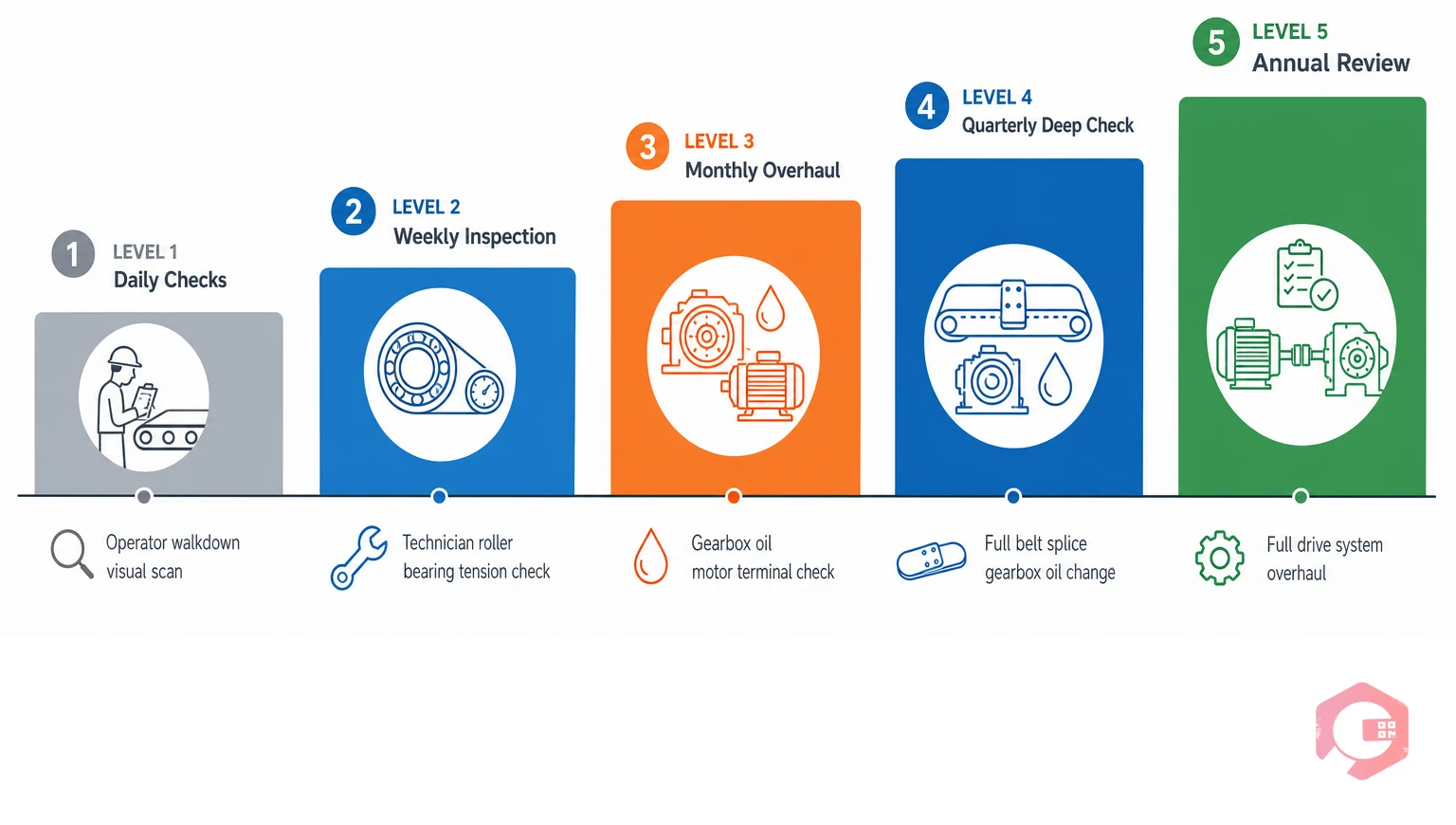
A structured, interval-based schedule is the backbone of any effective conveyor maintenance programme. Irregular or reactive maintenance always costs more than disciplined, calendar-driven PM. Here is the five-tier schedule used by high-performing auto spare parts warehouse operations.
Daily — Operator Walkdown (10–15 minutes per shift): Before each shift, the operator walks the full conveyor line. Check for visible belt damage, unusual noise, belt tracking deviation beyond 5mm, any accumulated debris on rollers, and emergency stop functionality at every station. Log observations digitally at the start of each shift using a maintenance checklist tool. Issues flagged at this stage cost minutes to correct — the same issues missed here cost hours of downtime within the week.
Weekly — Technician Inspection (45–60 minutes): A trained technician checks roller spin resistance across the full belt length, measures belt tension at mid-span, re-lubricates all accessible bearing points, checks chain tension and lubrication on drive systems, and inspects all splice joints under load conditions. Any component scoring amber in the inspection log gets a scheduled replacement within five working days.
Monthly — Lubrication and Electrical Check: Flush and refill gearbox lubrication to manufacturer specification. Inspect motor terminal connections for corrosion and tighten any loose connections. Check all safety interlocks, limit switches, and emergency stop circuits. Measure motor insulation resistance where possible. Update the asset maintenance log with current readings for trend tracking over subsequent months.
Quarterly — Full Belt-Off Overhaul: Take the conveyor offline for a full inspection. Remove the belt and inspect the underside for wear patterns that predict misalignment or overloading. Replace any rollers showing more than 0.5mm of surface wear or resistance to rotation. Change gearbox oil. Inspect the full drive chain for elongation. Check all tensioner hardware for fatigue cracks. This is also the correct interval for a full preventive maintenance programme audit — confirming that task lists reflect any operational changes since the previous quarter.
Annual — Drive System Overhaul and Control Panel Review: Complete replacement or refurbishment of drive motor bearings. Full gearbox disassembly and internal inspection. Thermal imaging of the motor control panel and all electrical connections to identify hotspots before they become failures. Replace all belt splices regardless of apparent condition. Full calibration of all speed controls and variable frequency drives.
Common Conveyor Failures in Parts Warehouses and How to Prevent Them
Understanding the failure mode is the fastest path to the right preventive action. Three failure types account for the majority of conveyor downtime in auto spare parts warehouse environments.
Belt Slippage and Misalignment: The most common failure mode in spare parts warehouses. Root causes are insufficient belt tension, oil or grease contamination from packaged parts on the belt surface, and worn drive pulley lagging. Prevention: tension checks weekly, contamination source identification and physical separation of oily part families, drive pulley lagging replacement every 18–24 months regardless of visual appearance. A lagging surface that looks acceptable at a glance loses 30–40% of its grip coefficient before showing visible wear.
Roller and Bearing Seizure: Metal dust from auto parts packaging — particularly from brake components, machined housings, and bare steel parts — penetrates standard bearing seals over time. Once contamination enters the bearing race, seizure follows within weeks. Prevention: sealed or shielded bearings specified for dusty environments, roller replacement on a fixed schedule rather than waiting for failure, and targeted air purging of roller clusters in high-dust zones every quarter.
Drive Motor Overheating: Auto spare parts conveyors handle highly variable loads — heavy palletised engine components one hour, light shelf-pick totes the next. This load variability creates overload spikes that overheat motors not sized for peak demand. Prevention: verify motor sizing against actual peak load measurements, not design-average estimates. Install thermal overload relays set at 105% of rated current. Add forced-air cooling to motors in enclosed drive enclosures where ambient temperature exceeds 35°C.
Each of these failure modes produces early warning signs detectable in routine inspections — before the failure occurs. Using work order management software with structured inspection results fields ensures those warning signs get recorded, tracked, and acted on rather than logged and forgotten.
How CMMS Software Improves Conveyor Maintenance
A CMMS transforms conveyor maintenance from a reactive, clipboard-based process into a data-driven operation that prevents failures rather than recovering from them. Three capabilities drive the most measurable improvement in auto spare parts warehouse environments.
Automated Work Order Scheduling: Every conveyor gets a digital asset profile with its full PM schedule built in — daily checks, weekly inspections, monthly lubrication, quarterly overhauls, and annual drive overhauls. The CMMS auto-generates work orders at the correct interval, assigns them to the right technician, and sends reminders via mobile, email, or WhatsApp before the due date. PM tasks stop depending on someone remembering to schedule them. Compliance becomes the default, not the exception.
IoT Condition Monitoring Integration: Vibration sensors on drive motors and critical bearings, temperature sensors on motor housings, and belt alignment sensors on tracking guides feed real-time data into the CMMS. When a reading crosses a pre-set threshold — motor temperature above 75°C, vibration amplitude exceeding baseline by 20% — the system auto-generates a condition-based work order before the component fails. This is the capability that moves a conveyor PM programme from scheduled prevention to true predictive maintenance. Warehouses using CMMS-integrated IoT monitoring typically reduce unplanned conveyor failures by 50–60% within the first year.
Spare Parts Inventory Management: Every conveyor asset is linked to a bill of materials in the CMMS — the specific belt grades, roller dimensions, bearing specifications, and motor types it requires. Minimum stock thresholds are set per component, and the system generates purchase order alerts before stock reaches zero. When a technician raises a work order for a belt replacement, the system confirms parts availability before the job is scheduled — eliminating the scenario where the maintenance team arrives at a conveyor with the right skills and no parts. The inventory management module links every part issued to the work order that consumed it, giving a complete cost-per-asset maintenance record over time.
Warehouses using a CMMS for conveyor PM consistently report 30–40% reductions in unplanned downtime within the first year. The downtime tracking module quantifies that improvement in hours and cost — giving the maintenance manager data to demonstrate ROI to operations leadership in every monthly review.
Frequently Asked Questions
How often should conveyor belts be inspected in a warehouse?
In a high-throughput auto spare parts warehouse, conveyor belts need a visual inspection at the start of every shift (daily), a detailed technician inspection weekly covering tension, tracking, and splice condition, and a full belt-off examination quarterly. Daily checks catch the rapid-onset issues — debris accumulation, sudden tracking drift, and visible damage — before they cause failures. Weekly inspections catch the slower-onset issues that daily visual checks miss, such as gradual tension loss and early bearing wear signals.
What causes conveyor belt slippage in a spare parts warehouse?
The three most common causes are insufficient belt tension, contamination of the belt surface with oil or grease from packaged auto parts, and worn drive pulley lagging. In spare parts environments, oil contamination is a particularly common culprit because many parts — engine components, brake assemblies, hydraulic fittings — arrive pre-coated in protective lubricants that transfer to the belt surface during transit. Identifying and physically isolating oily part families from belt conveyor lines is often the most effective corrective action.
Can CMMS software manage conveyor maintenance in a warehouse?
Yes — a CMMS handles every element of a conveyor maintenance programme. It auto-schedules preventive maintenance at the correct intervals, assigns tasks to technicians via mobile work orders, tracks completion and compliance rates, manages spare parts inventory linked to each conveyor's bill of materials, integrates with IoT sensors for condition-based monitoring, and generates maintenance history reports that track cost-per-asset over time. A CMMS replaces the combination of paper logs, spreadsheets, and calendar reminders that most warehouse maintenance teams rely on today.
What is the most important conveyor maintenance task in an auto spare parts warehouse?
Belt tension and tracking checks are the highest-priority routine task. Incorrect tension and belt tracking errors are the root cause of the majority of belt failures, splice failures, and drive motor overloads in spare parts warehouse environments. A daily tension and tracking check takes under five minutes per conveyor and prevents the most common and most costly failure modes. When this single check is performed consistently, belt life typically extends by 30–50% compared to operations without a routine.
If your warehouse is still managing conveyor maintenance on paper logs or spreadsheets, book a free Cryotos demo today and see how auto spare parts warehouses build a complete, data-driven conveyor maintenance programme — from automated PM scheduling to IoT condition monitoring — in a single platform.