

Maintenance teams using a Computerized Maintenance Management System resolve unplanned failures faster, prevent more breakdowns before they happen, and spend less time chasing paperwork. Cryotos CMMS gives your team a measurable operational edge — not through complexity, but by replacing manual guesswork with clear, actionable data at every stage of the maintenance cycle.
Most maintenance departments still run on a mix of spreadsheets, phone calls, and paper forms. When a machine fails, the response is reactive: someone phones the right technician, someone else tracks down the part, and a supervisor tries to piece together what happened from fragmented notes. This approach is expensive, unpredictable, and harder to scale as your asset base grows. According to SMRP benchmarks, the average maintenance department spends 33% of its labour hours on reactive work that a structured PM programme could have prevented.
This guide explains exactly how Cryotos CMMS transforms that picture — from work order creation through performance reporting — and why the teams that adopt Cryotos CMMS consistently outperform those that don't.
Key Takeaways

Reactive maintenance is not just inconvenient — it is measurably more expensive than a structured, planned approach. Studies from the Society for Maintenance and Reliability Professionals (SMRP) consistently show that reactive maintenance costs two to five times more per asset than a well-run preventive program, when factoring in emergency labour rates, expedited parts procurement, and production loss during unplanned stoppages.
The gap shows up most clearly in three areas. First, emergency work orders interrupt planned schedules, pulling technicians away from preventive tasks and creating a compounding backlog. Second, without a central asset history, every repair starts from scratch — technicians repeat diagnostic steps that have already been done, and repeat failures stay invisible until they cause another shutdown. Third, spare parts management breaks down: teams either over-order to avoid stockouts or find themselves waiting days for a critical component because nobody tracked actual consumption.
The companies that close this gap fastest are the ones that give their maintenance teams the right system — not more people or bigger budgets. Cryotos is built around that principle.
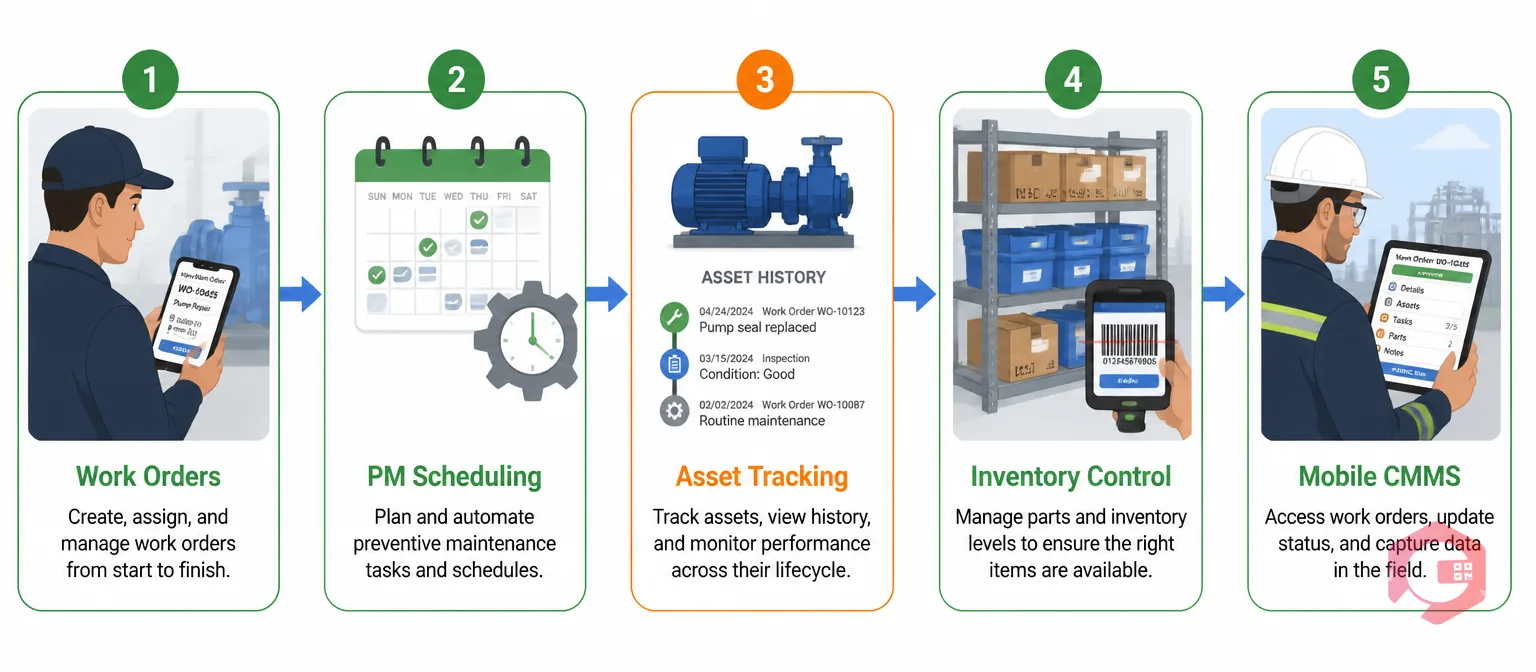
Cryotos is a cloud-based, mobile-first maintenance management platform that centralizes every maintenance activity — from scheduled inspections to emergency repairs — in a single system your whole team can access in real time.
Here is what that looks like in practice across the five core functions maintenance teams use every day:
Work order management in Cryotos replaces scattered phone calls and email threads with a structured digital workflow that tracks every job from creation to closure. Supervisors create work orders by voice, photo, or QR code scan. The system assigns the job to the right technician based on skills and availability, sends a real-time notification via the mobile app or WhatsApp, and tracks progress until the job closes.
Every closed work order creates an auditable record — including the technician who did the work, parts used, time taken, and any notes or photos attached on site. This means your team builds an asset history with every repair, rather than losing that knowledge the moment the job is done. Use Cryotos's work order management software to eliminate the back-and-forth that slows every reactive repair.
Cryotos's preventive maintenance software runs both calendar-based and meter-based PM schedules. A compressor gets serviced every 500 run hours. A conveyor belt gets inspected every 30 days. These schedules fire automatically — no one has to remember to create the work order, and no PM gets missed because a supervisor was on leave.
The system also supports dynamic PM triggers based on real-time IoT readings, so service intervals can reflect actual operating conditions rather than fixed time windows. Teams that move from purely reactive maintenance to a structured PM programme with Cryotos report up to 30% fewer unplanned stoppages within the first six months.
Asset lifecycle tracking gives every piece of equipment a complete digital identity — including purchase date, service history, parts replaced, total maintenance spend, and current condition. When a technician opens a work order on an ageing pump, they see every previous repair, who did it, and what parts were used. That context cuts diagnostic time significantly and helps managers make evidence-based repair-or-replace decisions instead of guessing.
GPS and NFC/BEACON tracking keeps location data current for mobile assets. QR code scanning lets technicians pull up an asset record in seconds without searching through a database manually.
Downtime tracking runs continuously in the background, recording every stoppage by asset, department, and failure mode — giving your team the MTTR and MTBF data you need to prioritise maintenance investment where it delivers the highest return.
See how Cryotos maintenance management software handles the full asset lifecycle, from commissioning through disposal, in a single connected platform.
Spare parts delays are one of the most common causes of extended downtime. Cryotos tracks every part in your storeroom using barcode and QR scanning, applies LIFO, FIFO, or average-cost valuation, and sends automatic low-stock alerts before you run out of critical items — not after.
Parts consumed in a work order are deducted from inventory automatically, so stock levels are always current. Minimum-threshold alerts trigger purchase requests without manual monitoring, and warehouse structure mapping means technicians know exactly where to find what they need.
Technicians working in the field or in areas without reliable connectivity use the mobile CMMS app in full offline mode. Work orders, checklists, asset data, and parts information all sync to the device before they go offline. When connectivity returns, the app syncs completed jobs automatically — no manual re-entry, no lost data.
Digital signatures, photo attachments, and on-site notes can all be captured from a smartphone. This means the field record is complete and accurate without anyone needing to return to an office to file a paper form.

The CMMS Maintenance Advantage Framework describes the four interconnected capabilities that turn a CMMS from a scheduling tool into a genuine competitive advantage for maintenance teams. Most organisations implement one or two of these capabilities and see partial results. The teams that achieve the largest performance improvements are the ones that activate all four.
The CMMS Maintenance Advantage Framework:
Maintenance teams using Cryotos have reported up to 30% reduction in unplanned downtime and 25% faster repair turnaround — both driven by activating all four elements of this framework together, not in isolation.
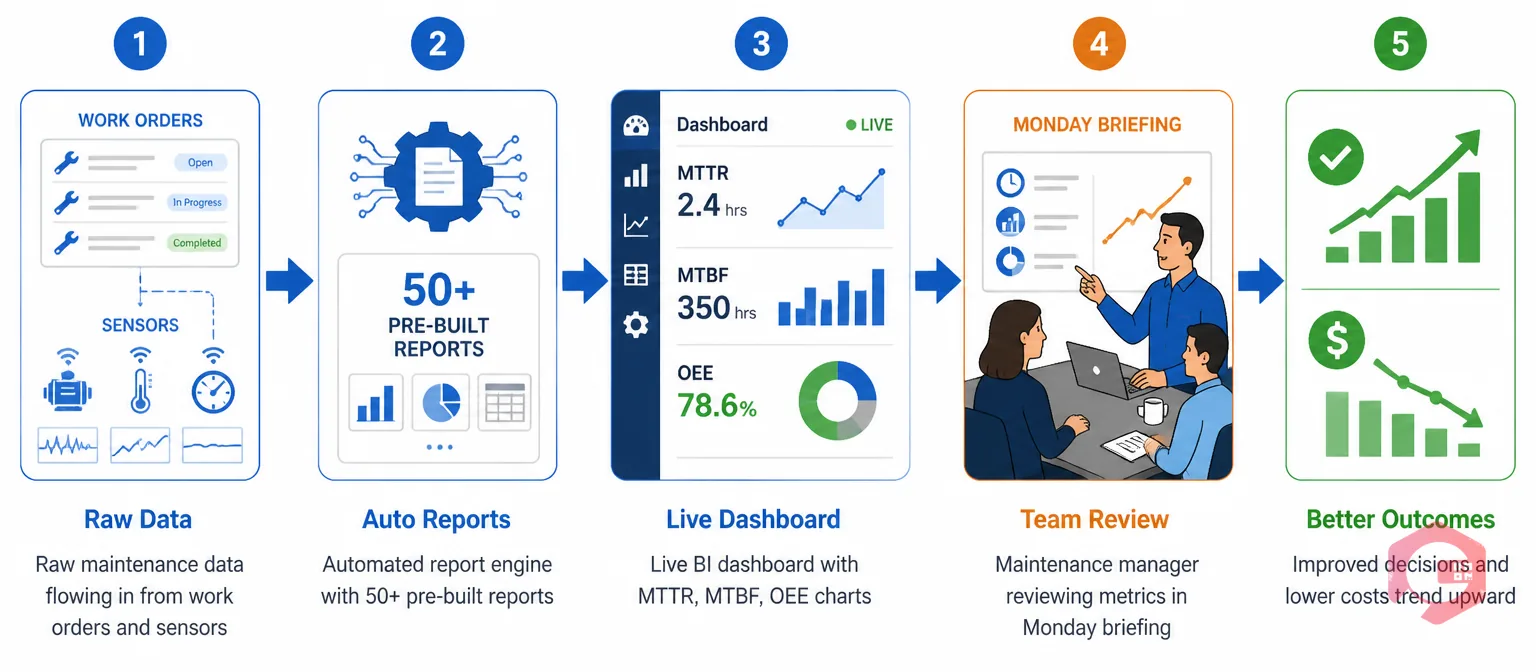
Data is only useful if someone can act on it. Cryotos's maintenance KPI dashboard gives maintenance managers and plant directors a live view of the metrics that drive operational performance — without waiting for manual reports to be compiled.
The platform includes over 50 pre-built reports covering OEE, equipment availability, PM compliance rate, backlog trends, and maintenance cost per asset. Custom reports can be built using the drag-and-drop report builder and scheduled for automatic email delivery to any stakeholder on a daily, weekly, or monthly basis.
The practical impact is significant. A maintenance manager reviewing a live dashboard at Monday morning's team briefing can see which assets had unplanned stoppages last week, which PMs are due this week, which technicians have the heaviest workload, and where parts costs are trending upward. That conversation — grounded in current data — produces better decisions than a spreadsheet review based on last month's numbers.
For managers who want to benchmark their current maintenance performance before making investment decisions, the MTTR and MTBF calculators on the Cryotos platform let you calculate your starting point and track improvement over time.

Cryotos delivers value across every role in the maintenance operation — not just the team that does the hands-on work.
Technicians spend less time hunting for information and more time doing productive work. Work orders arrive on their phones with all relevant asset data, checklists, and parts information already attached. Job sign-off takes seconds via digital signature. When they need to log a repair note or attach a photo, it happens in the app — no paper forms, no office trips.
Managers get a real-time view of every open job, every overdue PM, and every technician's current assignment. Scheduling conflicts surface before they become missed maintenance events. Monthly performance reviews go from a manual data collection exercise to a thirty-minute dashboard review with clear action items.
Leadership needs maintenance performance data without wading through raw records. Cryotos dashboards show equipment availability, maintenance cost trends, and PM compliance rates in a format built for operational decision-making — not data analysis. Capital expenditure decisions, resourcing calls, and reliability investment priorities all become easier when you can see the numbers clearly.
Inventory managers benefit from automatic stock depletion tracking, low-threshold purchase alerts, and full parts consumption history by asset. Over-ordering and stockouts both cost money; Cryotos gives procurement teams the data to find the right balance.
Cryotos CMMS serves maintenance teams across a wide range of operating environments. The core platform adapts to the specific requirements of each sector while keeping the same underlying advantage: replacing manual, disconnected processes with a single integrated system that gives every stakeholder the information they need to act decisively.
Manufacturing plants use Cryotos to manage high-frequency preventive maintenance on production equipment, track OEE in real time, and reduce the emergency work order rate that disrupts production schedules. Cryotos CMMS integrates directly with IoT sensors via SCADA and PLC connections, so condition-based triggers can fire automatically when equipment readings drift outside normal operating ranges — before any visible failure develops.
Facilities management teams use the platform to coordinate maintenance across multiple properties, track contractor performance, and maintain compliance documentation for inspections. The space management and multi-site reporting features give facilities directors a consolidated view across every location without switching between systems.
Healthcare facilities rely on Cryotos for biomedical equipment tracking, scheduled calibration management, and the audit-ready maintenance records that Joint Commission and CMS regulatory bodies require. The complete digital audit trail on every work order means documentation is always ready for an unannounced inspection — not assembled under pressure the night before.
Food and beverage operations use the PM scheduling and maintenance checklist features to stay ahead of food safety audit requirements and equipment hygiene standards. Automatic PM triggers tied to production cycles ensure critical sanitation and equipment checks never get skipped during high-output periods.
Across all of these contexts, the advantage is the same: maintenance teams that run on structured, data-driven systems outperform those still dependent on manual processes — in cost, reliability, and compliance.
The maintenance team advantage of using Cryotos CMMS is the shift from reactive, manual operations to a structured, data-driven maintenance programme. Teams gain real-time visibility into every work order, asset, and inventory level; automated preventive maintenance schedules replace manual reminders; and every completed job builds an asset history that makes future repairs faster and better informed. The result is measurably lower downtime, lower maintenance cost per asset, and a team that spends more time on productive work and less time on administrative tasks.
Most maintenance teams complete their initial Cryotos setup — including asset loading, PM schedule configuration, and team onboarding — within two to four weeks. The mobile-first design and intuitive interface mean technicians typically reach full workflow adoption within their first week. For larger facilities with complex asset inventories, a phased rollout by department or production line gives teams time to validate their configuration before expanding across the full operation.
Yes. Cryotos's mobile app is built for full offline operation. Technicians can access work orders, asset data, maintenance checklists, and parts information without an internet connection. All activity completed offline syncs automatically when connectivity is restored, so no job data is lost and the central records stay accurate without any manual intervention from the technician.
Cryotos integrates with IoT sensors via SCADA and PLC connections for real-time equipment condition monitoring, ERP systems including SAP and Microsoft Dynamics 365 for maintenance cost and procurement data, and WhatsApp for work order notifications and technician communication. These integrations mean Cryotos works alongside the systems your organisation already uses rather than replacing them.
Cryotos reduces maintenance costs through three mechanisms. First, automated PM schedules prevent the expensive emergency repairs that come from deferred maintenance. Second, complete asset histories allow managers to spot repeat failure patterns and address root causes rather than treating the same failures repeatedly. Third, real-time inventory tracking eliminates the over-ordering and expediting fees that come from poor parts visibility. Together, these mechanisms typically deliver measurable cost reduction within the first six months of consistent use.
Your maintenance team already knows what good maintenance looks like — structured, proactive, data-driven, and built around reliable information. Cryotos gives them the system to run it that way every day. Schedule a free demo to see how Cryotos CMMS fits into your current operation and where the biggest performance gains are available for your team.



Cryotos AI predicts failures, automates work orders, and simplifies maintenance—before problems slow you down.



