

Dairy processing is one of the few industries where a maintenance failure and a food safety incident are the same event. A pasteuriser that doesn’t reach hold temperature, a CIP system that runs a wash cycle at 3°C below specification, or a cold store that drifts 2°C above the permitted range are not just equipment problems — they are potential public health events that attract regulatory action, product recalls, and audit scrutiny. This is why dairy plant maintenance cannot operate like a standard industrial maintenance programme. Temperature is not just an environmental parameter; it is the primary control point for food safety, and the maintenance of every system that affects temperature must be documented, traceable, and defensible.
This guide explains how dairy plants use temperature-based PM triggers in their CMMS to convert sensor data into automatic maintenance actions, what FDA and FSSAI auditors look for in maintenance records, and what changes operationally when your CMMS is configured correctly for a temperature-driven food safety environment.

In most industrial environments, maintenance triggers are time-based (service every 500 hours) or condition-based (vibration above threshold). In dairy processing, a third trigger type is essential: parameter-based maintenance driven directly by temperature sensor readings. When a critical temperature boundary is crossed — in either direction — it may not be a sign that equipment is about to fail. It is a sign that the food safety process has already been compromised, and that both corrective maintenance and product safety assessment must begin immediately.
There are four distinct categories of temperature-based PM triggers in dairy plant operations:

Not every piece of equipment in a dairy plant warrants temperature-based CMMS integration. Focusing initial deployment on three equipment categories delivers the highest food safety and compliance return for the configuration investment.
Pasteurisers are the most heavily regulated assets in a dairy plant. The FDA’s Pasteurized Milk Ordinance (PMO) mandates specific time-temperature requirements, continuous recording of pasteurisation temperatures, and documented corrective action for any deviation. A CMMS configured with temperature triggers for pasteurisers does three things automatically: generates a corrective work order when temperature drops below hold threshold, timestamps the exceedance event for regulatory documentation, and prevents the batch from being released to downstream processing until the maintenance work order is closed and sign-off is recorded. This closed loop replaces the manual paperwork chain that makes PMO compliance labour-intensive in plants without integrated maintenance management.
Heat exchangers serving pasteurisers require separate maintenance attention because fouling of the heat transfer surfaces directly reduces thermal efficiency and can cause pasteurisation temperatures to drift below specification under normal operating conditions. A CMMS that tracks both temperature exceedance events and the preventive maintenance history of heat exchanger plates allows maintenance managers to correlate temperature deviations with fouling progression and adjust CIP frequency and inspection intervals accordingly.
Cold storage maintenance in dairy plants has a dual compliance dimension: equipment condition and product safety documentation. A refrigeration system failure that causes a cold store to reach 6°C requires both a maintenance response (compressor check, refrigerant leak test, defrost control inspection) and a product safety assessment (time above temperature, product type, risk classification). A CMMS that logs both the temperature exceedance event and the corrective maintenance work order against the same asset record creates the combined technical and safety documentation that regulators expect to see during an audit.
Continuous temperature logging integrated with the CMMS provides something that manual temperature logs cannot: an unbroken, tamper-evident chain of custody for temperature data across every hour the cold store has been in service. This is the standard that FDA 21 CFR Part 11 requires for electronic records in regulated food environments.
CIP system maintenance is frequently under-resourced relative to its food safety importance. The assumption that a CIP system either runs or it doesn’t misses the more common failure mode: a CIP cycle that completes, produces a cycle completion signal, and logs as successful — but ran 8°C below specification because a steam trap failed or a heat exchanger is fouled. Without temperature-based validation of CIP cycle completion, a passed CIP record is evidence that the cycle ran, not that it ran correctly.
A CMMS with temperature-based PM triggers for CIP systems validates the cycle by confirming that the critical temperature setpoints were reached and maintained for the required duration. If they were not, the system generates a maintenance alert, blocks the production line from resuming, and requires a signed corrective action before clearance. This validation architecture is the difference between a CIP record that satisfies an auditor and one that raises questions about the integrity of the entire hygiene programme.
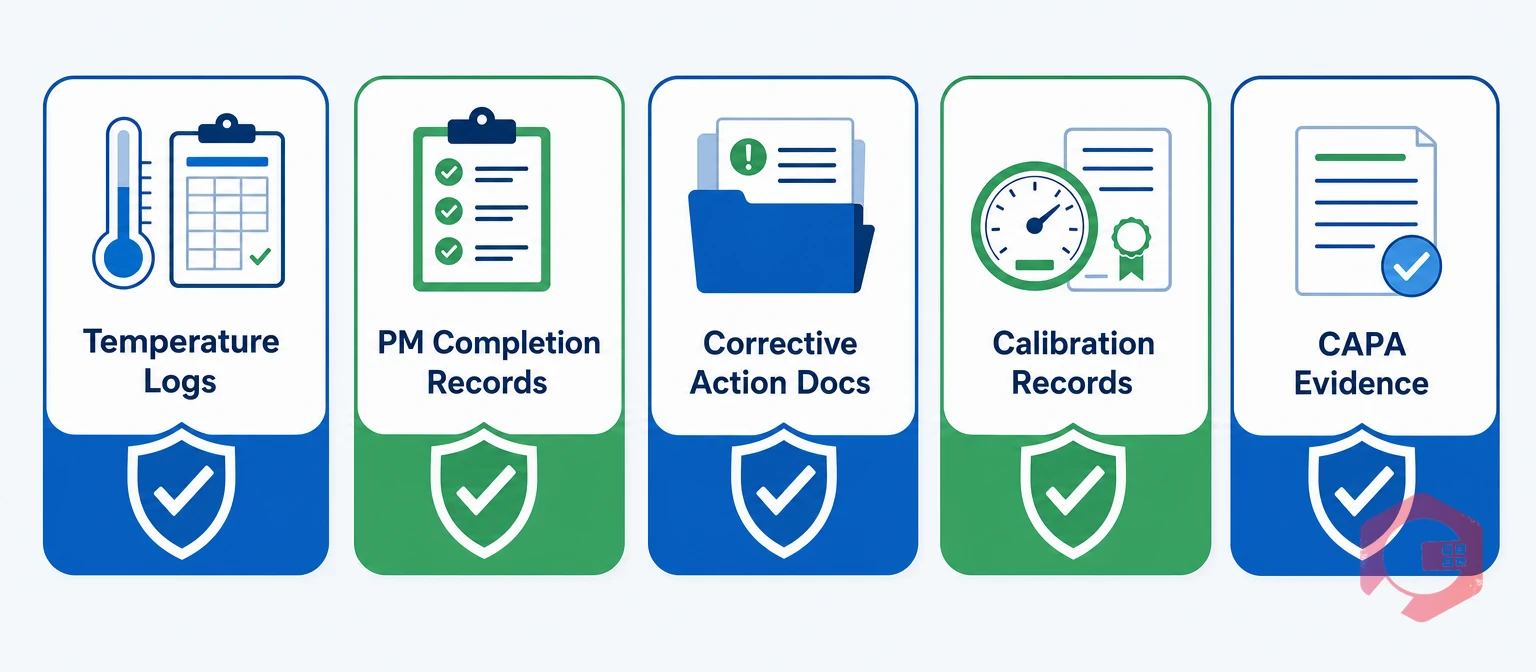
Regulatory audits of dairy plant maintenance programmes focus on five documentation requirements. Meeting these requirements in a manual system is possible but labour-intensive; a well-configured CMMS produces all five automatically as a byproduct of normal maintenance operations.
The FDA PMO requires continuous recording of pasteurisation temperatures using approved chart recorders or electronic equivalents. Electronic records must comply with 21 CFR Part 11, which mandates that records are attributable, legible, contemporaneous, original, and accurate (the ALCOA+ principles). A CMMS that receives temperature data directly from plant sensors and stores it with a tamper-evident audit trail meets this requirement. Auditors will look at how temperature records are generated, whether they can be altered, and whether every data point is timestamped with a system clock that cannot be manually overridden.
Auditors routinely ask to see evidence that when a temperature exceedance occurred, a maintenance response followed. They want to see: what was the exceedance, when was it detected, what work was done, who signed off, and how long did it take. A CMMS that auto-generates a work order from a temperature trigger and links that work order to the originating temperature event provides this documentation chain automatically. The alternative — manually correlating temperature chart records with handwritten maintenance logs — is both time-consuming and prone to gaps that create audit findings.
Under FSMA (Food Safety Modernization Act) and similar FSSAI requirements, any deviation from a critical control point limit must trigger a documented corrective action. The corrective action record must show what happened, why it happened, what was done immediately (contain the deviation), what was done to prevent recurrence (correct the cause), and how the effectiveness of the corrective action was verified. A CMMS produces the immediate corrective action documentation automatically through the work order; the cause analysis and verification steps are added by the responsible manager and captured in the same work order record.
An auditor who sees that a pasteurisation temperature consistently ran at exactly 72.0°C will ask to see the calibration records for the temperature sensor and recorder. If those calibration records cannot be produced, or if the last calibration was 18 months ago, the entire pasteurisation dataset becomes suspect. A CMMS that tracks calibration tasks as preventive maintenance work orders against each temperature instrument ensures that calibration intervals are not missed and that calibration records are stored against the instrument’s asset record, immediately retrievable during an audit.
Auditors pay particular attention to whether the same equipment generates repeated temperature exceedances. A single cold store temperature exceedance is an incident. Three exceedances in six months on the same cold store is a systemic problem that requires a formal Corrective and Preventive Action (CAPA). A CMMS that tracks all work orders by asset makes this pattern immediately visible: when a third temperature-triggered work order is generated against the same asset within a defined period, the system can automatically flag it for CAPA review rather than treating it as a standalone corrective action.
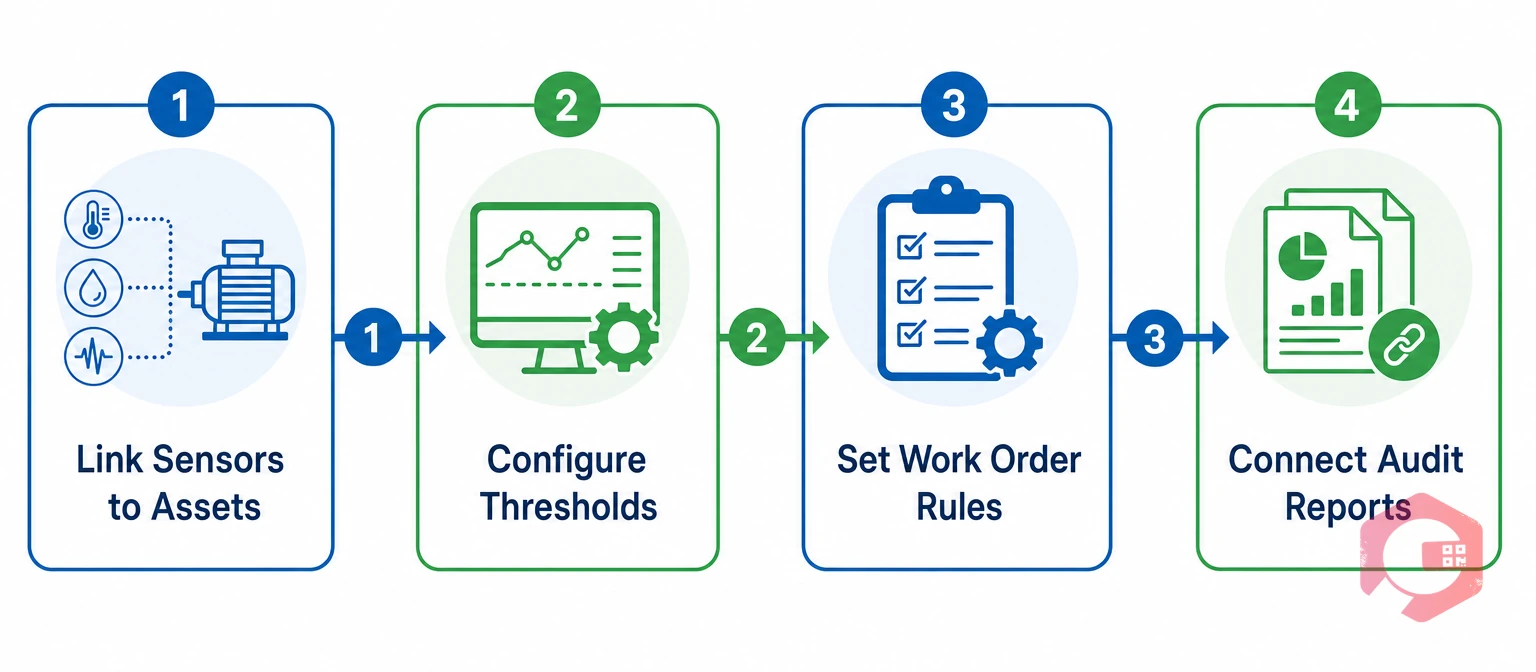
Configuring Cryotos CMMS for temperature-based PM triggers in a dairy plant involves four setup stages. Each stage can be completed incrementally, starting with the highest-criticality equipment and expanding across the plant as the configuration is validated.
Each temperature sensor in the plant is associated with a specific asset in the Cryotos asset register: the HTST pasteuriser holding tube, the cold store unit cooler, the CIP return temperature sensor. This association means that when a temperature reading is received, the system knows exactly which asset it belongs to, what its configured thresholds are, and what maintenance history is relevant. Cryotos’s IoT meter reading module connects to temperature data feeds from SCADA systems, PLCs, and building management systems using standard protocols.
For each linked sensor, threshold values are configured based on regulatory requirements and process specifications. The pasteuriser holding temperature threshold is set at 72°C (for HTST); the cold store upper limit at 4°C for raw milk or 8°C for finished products; the CIP caustic phase minimum at the plant-specific validated temperature. Thresholds include both the alert value (first notification, inspect and investigate) and the alarm value (immediate corrective action, production hold). This two-tier structure prevents alert fatigue while ensuring genuine exceedances trigger an urgent response.
When a threshold is crossed, Cryotos automatically creates a work order with pre-configured attributes: asset identity, threshold that was breached, reading value, timestamp, priority level, and assigned team or individual. The work order template for a pasteurisation temperature exceedance, for example, includes a checklist for the technician: verify sensor reading against backup recorder, inspect flow diversion valve operation, check heating medium supply, and document the batch hold decision. The template ensures that every temperature event is investigated consistently, regardless of which technician responds.
Cryotos’s report builder generates compliance-ready exports of temperature exceedance events, linked work orders, corrective actions, and sign-offs. These reports can be scheduled for automatic generation and distribution to the quality manager and plant manager on a weekly or monthly basis, or generated on demand for audit preparation. The report includes the complete chain from temperature event to completed corrective action, formatted to meet the documentation expectations of PMO audits, FSMA preventive controls verification, and FSSAI inspection requirements.
The most significant operational difference that temperature-based CMMS integration makes is not during normal operations — it is during regulatory audits. Without integrated temperature-maintenance documentation, an audit preparation typically requires days of effort: pulling chart records, cross-referencing with maintenance logbooks, compiling corrective action evidence, verifying calibration dates. The manual correlation between when a temperature event occurred and when the maintenance response happened is done by hand, and gaps in the record — which are inevitable in paper-based systems — become audit findings.
With Cryotos configured for temperature-based PM triggers, audit preparation is reduced to generating a report. Every temperature exceedance is linked to its corrective work order. Every corrective work order shows who did the work, when, what was found, and what was replaced. Every calibration is tracked as a PM against the instrument asset. The auditor can trace any temperature event to its maintenance response in seconds, and the evidence is electronic, timestamped, and audit-trail protected.
Plants using this approach consistently report that regulatory audits go from a multi-day preparation exercise to a single afternoon of report generation. The documentation is either in the system or it isn’t — and if the system is configured correctly, it always is.
The compliance argument for temperature-based CMMS integration is compelling on its own. But the operational and financial case is equally strong:
If your dairy plant is managing temperature exceedances through manual logs, paper-based corrective action records, and separate calibration files, the gap between your current documentation burden and what a well-configured CMMS provides is large and closing fast as regulatory scrutiny of electronic record integrity increases. Cryotos CMMS connects temperature sensor data, maintenance work orders, calibration records, and compliance reporting in a single platform designed for food-regulated environments. Book a demo to see how temperature-based PM triggers work in practice for a dairy processing operation.
HTST pasteurisation requires milk to reach at least 72°C (161.6°F) and be held for a minimum of 15 seconds. A CMMS tracks compliance by receiving continuous temperature data from the pasteuriser holding tube sensor, generating an automatic work order when temperature drops below 72°C during a processing run, and logging the exceedance event with timestamp and batch reference for regulatory documentation. The closed-loop record from exceedance detection to corrective action completion meets FDA PMO documentation requirements.
The FSSAI (Food Safety and Standards Authority of India) requires documented temperature monitoring, corrective actions for deviations, and calibration records for measuring instruments in dairy processing facilities. A CMMS supports FSSAI audits by providing automatically generated records for all three requirements: temperature logs linked to asset records, corrective work orders generated from temperature exceedances, and calibration PM records against temperature measurement instruments. These records are retrievable on demand in a format auditors can review directly.
Yes, in environments where the CMMS is integrated with the plant’s process control system. When a temperature threshold is crossed, the CMMS can trigger a production hold signal that prevents product from advancing to downstream processing until the corrective maintenance work order is closed and a qualified person signs off the product assessment. This integration requires connection between the CMMS and the plant’s SCADA or PLC system, which Cryotos supports through its IoT meter reading and workflow automation modules.
A temperature alert fires when a reading approaches but has not yet crossed the critical limit — for example, a cold store at 3.5°C when the limit is 4°C. This triggers an inspection work order to investigate the cause before a product safety issue occurs. A temperature alarm fires when the critical limit is actually crossed, triggering an immediate corrective action work order and a product safety assessment. The two-tier structure prevents alert fatigue on the first tier while ensuring that genuine critical limit exceedances receive an urgent, documented response.




Cryotos AI predicts failures, automates work orders, and simplifies maintenance—before problems slow you down.



