A digital maintenance log for the textile industry is a structured, cloud-based record of every maintenance activity performed on textile machinery - from ring frames and looms to stenter machines and humidification systems. Unlike paper-based registers that get lost, damaged, or ignored, a digital log captures who did what, when, on which machine, and why - and makes that data searchable and auditable in seconds. For textile plants running 24/7 across multiple shifts, this single change can be the difference between a planned stoppage and an unplanned breakdown.
What Is a Digital Maintenance Log?
A digital maintenance log is an electronic record-keeping system that tracks every maintenance event - inspections, repairs, replacements, lubrications, and calibrations - against specific machines or assets. In the textile industry, this means each loom, spinning frame, winding machine, or dyeing vessel gets its own complete history, accessible from any device, at any time.
Traditional paper logbooks in textile plants are prone to incomplete entries, illegible handwriting, missing shift records, and physical damage from the harsh workshop environment - humidity, dust, and chemical exposure all take their toll. A digital log eliminates these vulnerabilities while adding capabilities paper never could: automated alerts, trend analysis, and audit trails.
Why Textile Plants Still Struggle with Paper Logs
Despite knowing the risks, many textile manufacturers still rely on physical registers and whiteboards to track maintenance. The hidden costs add up quickly:
Incomplete and illegible entries rushed during fast-paced production shifts create gaps in the maintenance record that no one catches until a machine fails.
No accountability across shifts — when faults recur, there is no clear way to trace which technician logged what, or whether anything was logged at all.
Physical damage and deterioration — paper registers face constant exposure to humidity, oil, lint dust, and chemical residue in spinning and weaving sections, causing them to become unreadable within months.
No automated follow-ups or alerts — a missed lubrication or flagged fault noted on paper triggers nothing, with no escalation or reminder until equipment fails.
Zero real-time visibility for management, who must physically walk the floor and check each register to understand current machine status across shifts.
Industry data consistently shows that unplanned downtime in textile manufacturing costs between 5% and 20% of total production capacity. A significant portion of that is directly linked to poor maintenance record-keeping and missed preventive actions.
Key Components of a Textile Maintenance Log
A well-structured digital maintenance log for a textile plant should capture more than just "what broke and when." Here are the essential fields every log entry needs:
Asset/Machine ID — a unique identifier linked to each specific machine, spindle bank, or loom line for precise tracking across the full asset lifecycle.
Date, Time, and Shift — exact timestamps with shift identification (morning, afternoon, night) to ensure full traceability across multi-shift operations.
Type of Maintenance — classified as preventive, corrective, predictive, or condition-based, critical for KPI tracking, cost analysis, and compliance audit reporting.
Work Description — a detailed account of what was inspected, adjusted, replaced, or repaired, specific enough that any technician can understand what was done.
Parts Used — every consumable and spare part consumed, with part numbers auto-linked to inventory for real-time stock updates.
Technician Identity — digital signature or employee ID confirming who performed the task, replacing illegible handwritten first names.
Machine Status on Completion — whether the machine was returned to full production, placed on hold pending parts, or flagged for urgent supervisor review.
Next Scheduled Action — an auto-triggered follow-up task with a due date and assigned technician, ensuring preventive maintenance never slips unnoticed between shifts.
Types of Machines That Need Dedicated Logs in Textile Plants
Different textile machines have vastly different maintenance profiles. A digital log system should support machine-specific templates rather than forcing every asset into a generic form.
Spinning machines - (ring frames, open-end) run continuously and require frequent roller maintenance, traveller changes, and spindle speed checks.
Weaving machines - (rapier, air-jet, water-jet looms) need reed condition, heddle frame wear, and cam timing tracked.
Dyeing and finishing machines - require seal replacements, pump condition, chemical dosing calibration, and temperature sensor records with strict date-stamping for regulatory compliance.
Humidification and HVAC systems - should record humidity sensor readings, filter change dates, and duct cleaning cycles.
How Going Digital Transforms Maintenance Logging
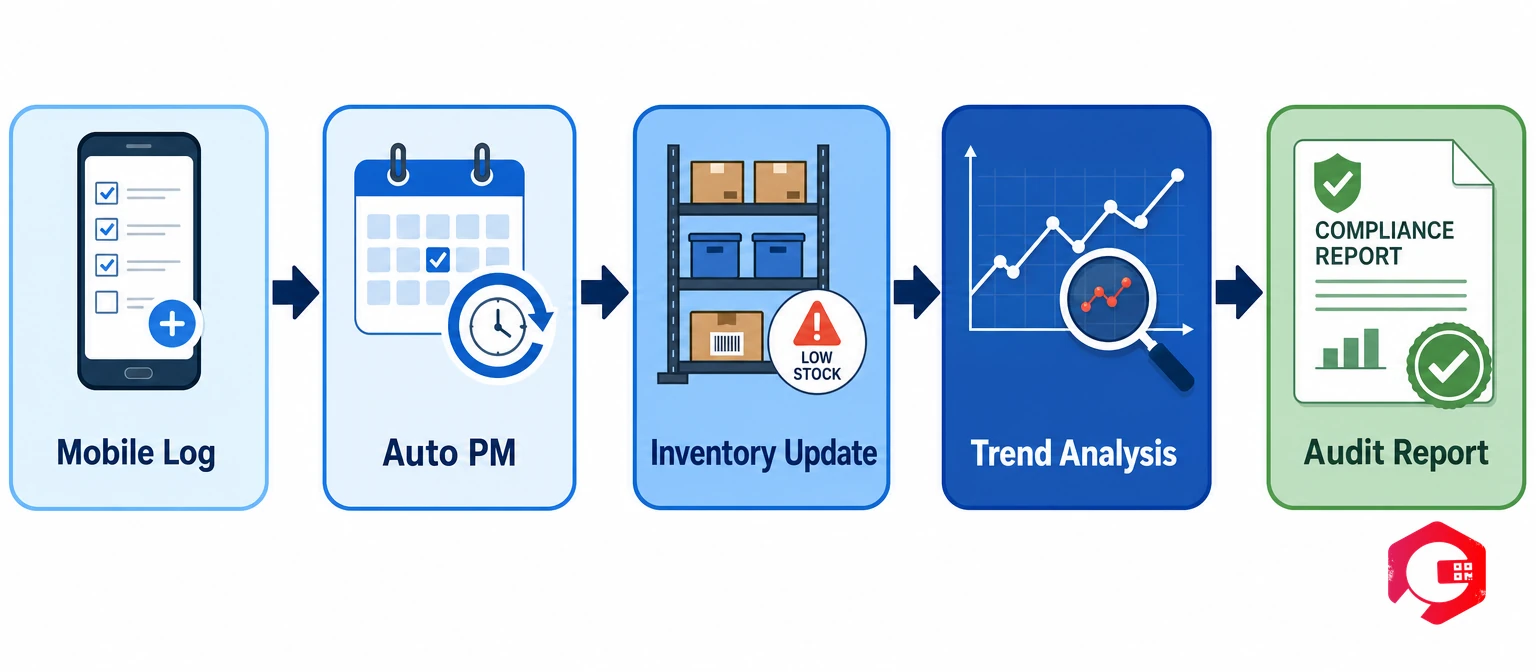
Switching from paper to a CMMS-based digital maintenance system fundamentally changes how maintenance is managed. The benefits compound over time:
Real-time visibility across all shifts — managers and supervisors can see the live status of every machine and every open work order from any device, no physical walkthrough required.
Automated PM scheduling — the next task triggers automatically when a log entry is closed, eliminating manual diary tracking and missed services.
Instant inventory deduction with configurable low-stock alerts to prevent critical stockouts before they cause downtime.
Mobile logging from the machine floor reduces transcription errors and end-of-shift backlogs that lead to incomplete records.
Searchable, audit-ready maintenance history — any machine's full record retrieved in seconds for ISO or buyer audits.
Trend analysis that automatically surfaces recurring faults, increasing repair frequency, or degrading performance before catastrophic failures occur.
Textile plants using digital preventive maintenance software consistently report 25-30% improvements in machine availability within the first year.
What a Real Digital Maintenance Log Entry Looks Like
Here is a practical example of what a single digital log entry looks like for a rapier loom in a textile plant, compared to what typically ends up in a paper log:
Date / Time: "7/4" (no time) → 07 Apr 2026, 14:32 — Night Shift
Work Done: "Checked and oiled" → Replaced worn rapier tape (PN: RT-2240), re-tensioned weft carrier, lubricated main cam shaft with Mobil DTE 26
Parts Used: Not recorded → Rapier Tape x1 (auto-deducted from inventory)
Technician: "Ravi" (illegible) → Ravi Kumar — Digital signature + employee ID
Next Action: Not recorded → Next PM scheduled: 21 Apr 2026 — Rapier head inspection (auto-triggered)
The difference is not just neatness — it is the depth and usability of the data. The digital entry automatically updates inventory, triggers the next PM task, and builds a searchable history without any extra effort from the technician.
Compliance and Audit Benefits for Textile Manufacturers
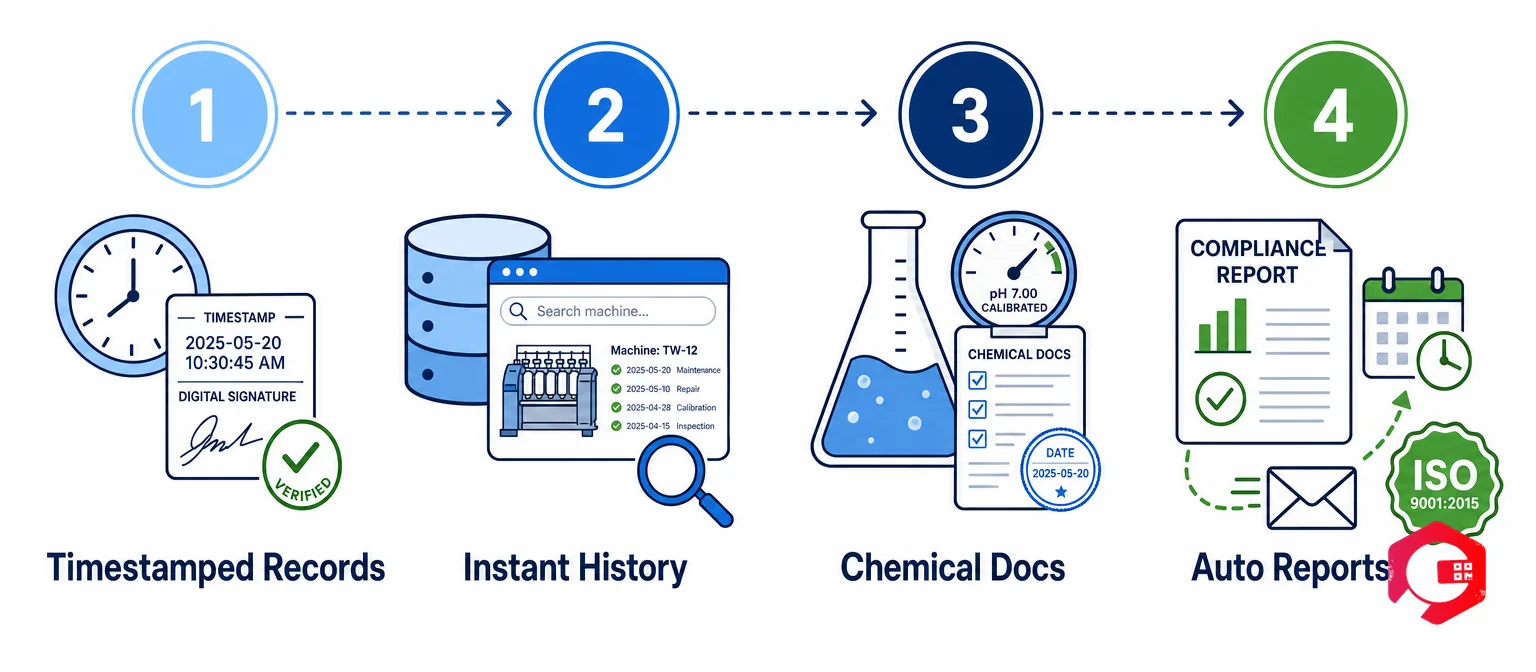
Textile manufacturers increasingly face compliance requirements for ISO 9001, OEKO-TEX STANDARD 100, GOTS, and local factory safety regulations. Digital maintenance logs deliver:
Timestamped and tamper-proof records satisfying ISO 9001 and factory safety audit requirements without manual compilation.
Instant history retrieval for any machine, date range, or technician in seconds, eliminating hours spent searching physical files before each audit cycle.
Chemical handling and calibration documentation for dyeing and finishing equipment meeting OEKO-TEX and GOTS requirements.
Automated compliance reporting distributed to quality managers, compliance officers, and buyers at defined intervals.
How Cryotos CMMS Simplifies Maintenance Logging for Textile Plants
Cryotos CMMS is built for high-intensity manufacturing environments — and textile plants are a natural fit. Here is how the platform specifically addresses the maintenance logging challenges textile manufacturers face:
Machine-specific log templates for each class of textile equipment — spinning frames, looms, dyeing vessels, and HVAC systems — so technicians log what actually matters for each asset.
Mobile-first logging with QR code asset identification, letting technicians log at the machine without returning to a desktop.
Automated PM scheduling and escalation — overdue jobs are escalated to supervisors automatically, eliminating manual follow-up on busy production days.
Real-time inventory integration with reorder alerts to prevent critical spare stockouts that delay repairs.
Multi-shift accountability — every log entry is tied to a specific technician, shift, and timestamp for complete visibility.
On-demand audit-ready reporting formatted for ISO 9001, OEKO-TEX, and internal quality requirements.
Textile plants using Cryotos have reported up to 30% reduction in unplanned downtime and 25% faster repair times. If your textile plant is still relying on paper registers, ledgers, or spreadsheets to track maintenance, the cost of staying put is higher than the cost of switching.
Frequently Asked Questions
What is a digital maintenance log in the textile industry?
A digital maintenance log in the textile industry is an electronic record that captures every maintenance activity performed on textile machinery. It replaces paper registers with a searchable, timestamp-verified, cloud-based system that supports compliance audits, shift handovers, and predictive maintenance analysis.
Why is paper-based maintenance logging a problem in textile plants?
Paper logs are vulnerable to environmental damage (humidity, dust, chemical spills), incomplete entries, illegible handwriting, and accountability gaps. In a multi-shift textile plant, paper logs create information silos that lead to missed maintenance tasks and avoidable breakdowns.
Which textile machines most need dedicated maintenance logs?
All textile machines benefit from dedicated logs, but the highest-priority assets are spinning machines (ring frames, open-end), weaving machines (rapier, air-jet, water-jet looms), dyeing and finishing equipment, and humidification systems.
How does a digital maintenance log support textile compliance audits?
Digital maintenance logs create timestamped, signed, and searchable records that satisfy audit requirements for ISO 9001, OEKO-TEX, and GOTS. Auditors can verify maintenance history, calibration records, and chemical handling documentation in minutes.
Can Cryotos CMMS work for small and mid-sized textile mills?
Yes. Cryotos CMMS scales from small single-plant operations to multi-site manufacturing groups. Small and mid-sized mills get the same core features - mobile logging, PM scheduling, inventory integration, and reporting - without needing a dedicated IT team.