A digital thread is the connected, traceable flow of data that follows an asset from design and purchase through installation, operation, maintenance and retirement. For maintenance teams, it means a pump's specification, warranty, PM history, breakdowns, spare parts and repair costs stay linked instead of being scattered across engineering files, ERP records and spreadsheets.
Most plants already have this data. The problem is that it sits in separate systems, so no one sees the full story of an asset when a decision is due. A digital thread closes that gap, and a Computerized Maintenance Management System (CMMS) is often the layer that turns it into daily maintenance action.
Key Takeaways
A digital thread is a connected flow of data that keeps an asset's information traceable from design through retirement. The term first appeared in a 2013 US Air Force report, and the digital thread concept has since spread from aerospace into manufacturing, energy and facilities.
The NIST digital thread for smart manufacturing project describes it as information that links design, manufacturing and product support across the life cycle. In practice, every stage adds a new layer of records to the same asset.
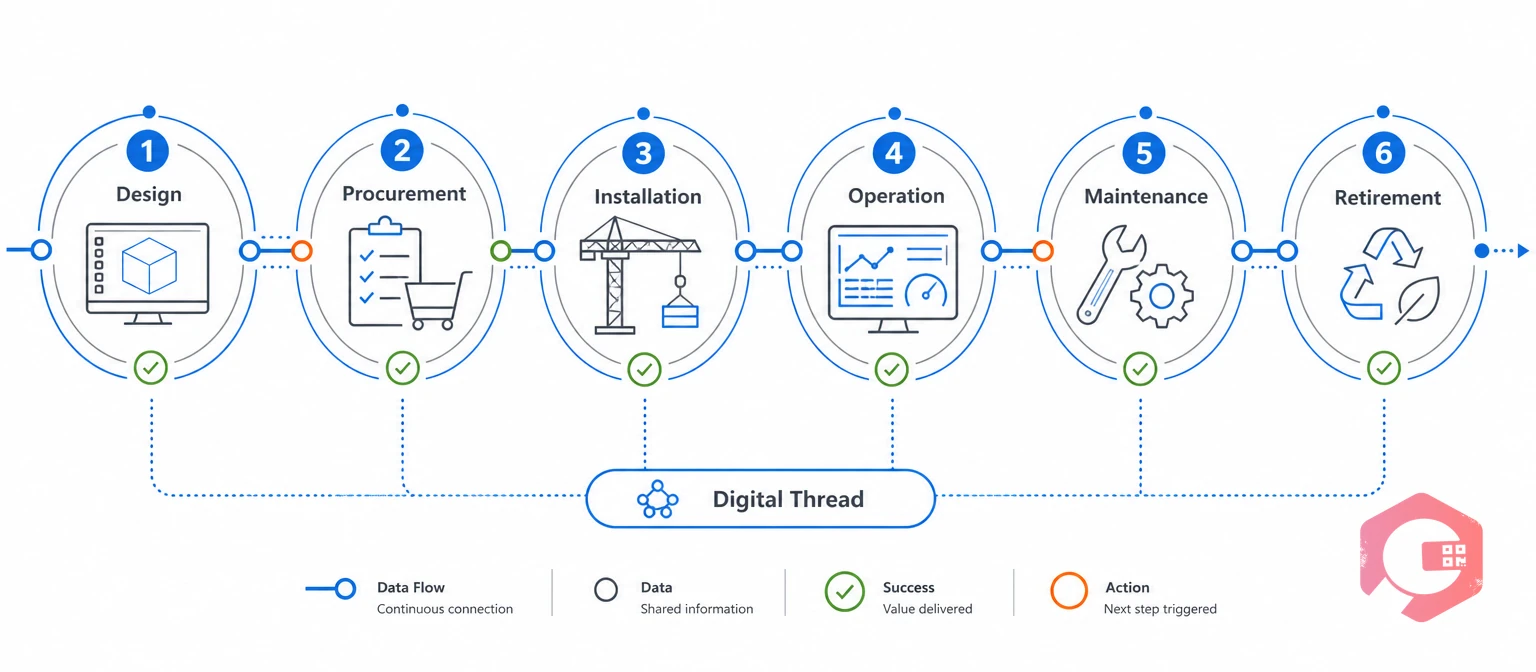
When these records connect, you see one continuous asset story instead of isolated entries in separate systems. This whole-life view also matches ISO 55000, the international asset management standard, which treats an asset as a responsibility that lasts its entire life, not a one-time purchase.
A digital twin is a computer model of a physical asset, process or system that mirrors how it behaves in the real world. The digital thread is the connected data flow underneath, and the digital twin uses that data to represent, monitor or simulate the asset.
| Aspect | Digital Thread | Digital Twin |
|---|---|---|
| Core purpose | Connects and traces data across the asset lifecycle | Represents and simulates a physical asset |
| Scope | Enterprise-wide, across many systems and stages | Usually one asset, line or process |
| Question it answers | What happened to this asset, and where did the data come from? | How is this asset behaving now, and what happens if conditions change? |
| Data use | Links past and current records across systems | Uses live and past data to run a model |
| Maintenance example | A pump's purchase, PM, failure and repair records stay linked | A model of the pump predicts bearing wear from vibration data |
| Dependency | Can exist without a twin | Needs a reliable data thread to stay accurate |
A simple rule helps: the digital thread connects the information, and the digital twin uses it. If the thread has gaps or poor data quality, any twin built on top of it will give you the wrong answers.
A digital thread turns asset lifecycle management into a maintenance history you can use. A critical production pump, for example, does not start its story when a technician gets a breakdown alert.
Its record may begin with the original specification, supplier, purchase value and warranty. Installation adds the location and start-up date, operation adds runtime and condition readings, and maintenance adds PMs, inspections, breakdowns, parts, repair costs and downtime.
Connected lifecycle data turns an asset's past into evidence you can act on.
Want to know how long a critical asset runs between failures today? Use the free MTBF calculator to set a reliability baseline before you connect your data.
The digital thread matters for maintenance because almost every maintenance decision depends on asset history. A repair, a PM change or a replacement call is only as good as the records behind it.
Most maintenance teams we work with don't lack data. They lack connected data, so the same questions get answered from memory, phone calls and spreadsheet searches.
A digital thread replaces that guesswork with evidence-based maintenance decisions.
A maintenance layer is the part of a digital thread that turns asset data into planned work, repairs and performance metrics. In most plants, a CMMS plays this role, while PLM, ERP and IoT platforms hold the design, finance and operating strands.
A CMMS is not the entire enterprise digital thread. It is the layer that generates the most frequent asset events, so it often decides whether the thread is complete or full of gaps.

Cryotos connects these records on a single asset timeline. It also exchanges data with ERP systems such as SAP and Microsoft Dynamics 365, and with IoT sources through SCADA, PLC or edge devices, so the right data is there when a maintenance decision is made.
Connected data creates value only when it changes what a maintenance team does next. In a disconnected process, a machine fails, a technician repairs it, the work order closes, and the event becomes one more old record.
The Thread-to-Decision Framework (5C):

Cryotos supports the Correct step with preventive maintenance software that lets you update PM intervals and checklists based on real failure history. The question shifts from "What happened?" to "Why did it happen, and what should we do differently next time?"
A digital thread in manufacturing is easiest to understand through one asset. Picture a critical pump feeding a production line that has failed three times in six months, each time with a similar bearing failure.
Clear spare parts management records made the supplier pattern obvious. The value comes from connecting the events, so each decision is better than the one before.
A digital thread gives maintenance teams both quick, measurable gains and longer-term strategic value. Maintenance teams using Cryotos have reported up to 30% reduction in unplanned downtime and 25% faster repair turnaround once asset, work order and downtime data sit in one place.
Quick wins build the business case, while the strategic benefits keep the program going.
Measure a digital thread by the maintenance KPIs it improves, not by how many systems it connects. Record a baseline before you link your data, then review the same metrics every month.
| KPI | What It Shows | Digital Thread Signal | Business Outcome |
|---|---|---|---|
| PM compliance | Share of scheduled PMs done on time | Overdue PM backlog shrinks | Fewer avoidable failures |
| MTBF | Average run time between failures | Rises on assets with fixed root causes | Higher asset availability |
| MTTR | Average time to restore an asset | Falls as history and parts are easier to find | Shorter production losses |
| Unplanned downtime | Hours lost to breakdowns | Drops on critical assets | More output from the same assets |
| Repeat breakdowns | Same failure mode on the same asset | Declines after RCA-driven PM changes | Lower emergency repair cost |
| Spare consumption | Parts used per asset and failure mode | Unusual usage flagged early | Better stock planning and less excess inventory |
| Maintenance cost per asset | Labor, parts and contractor spend | Visible by asset and failure type | Smarter repair-or-replace decisions |
A maintenance KPI dashboard puts these metrics side by side so you can tie gains to operating results. The business case is strongest when a KPI gain links directly to less downtime, higher availability or lower emergency spend.
You build a digital thread by connecting the systems you already use, not by buying another isolated application. Start with the maintenance layer, because it creates the most frequent asset events.
Larger organizations often pair a CMMS with enterprise asset management software to govern the full lifecycle across sites. In that setup, Cryotos serves as the maintenance layer that keeps asset and work data connected and useful.
A digital thread is a connected trail of data that follows an asset or product through its whole life, from design to retirement. It lets anyone trace where information came from and how it changed. For maintenance, it means the full asset history is in one place.
A digital thread connects and traces data across systems and lifecycle stages. A digital twin is a model of a physical asset that uses that data to monitor or simulate it. You can have a digital thread without a twin, but a twin needs a good thread to stay accurate.
No. A CMMS is one important layer of the digital thread, covering asset records, PMs, work orders, inspections, spares and maintenance KPIs. A full digital thread also links design, ERP, IoT and analytics data, often through integrations or APIs.
At minimum, it should include the asset register, criticality, warranty, PM schedules, inspection results, breakdowns, work orders, spare parts used, repair costs and downtime. Runtime and condition readings from IoT sensors make the thread more useful for usage-based and predictive maintenance.
Start by cleaning your asset register and moving all maintenance work into one CMMS. Then connect ERP for parts and cost data and add IoT or SCADA readings for operating data. Expand to engineering and analytics systems once the maintenance layer is reliable.
Set a baseline for PM compliance, MTBF, MTTR, unplanned downtime, repeat breakdowns and maintenance cost per asset. Track the same KPIs monthly after connecting your data. Tie each gain to a business result, such as hours of production saved or emergency repair spend avoided.
A digital thread pays off when connected asset and maintenance data drives better decisions on the shop floor. Schedule a free demo to see how Cryotos links your asset history, PMs, work orders and spares into one connected maintenance layer.


Cryotos AI predicts failures, automates work orders, and simplifies maintenance—before problems slow you down.