

Email-based maintenance alerts in food and beverage plants deliver structured, timestamped fault notifications directly to the right technician or supervisor the moment a work order is raised, updated, or left unacknowledged — replacing the informal verbal handover call that has caused maintenance information to go missing between shifts for decades.
In most F&B facilities, the shift handover call is where maintenance continuity breaks down. A night-shift supervisor phones the incoming day-shift lead at 6 AM, runs through a verbal list of open faults, and hopes the details land correctly. In a loud packaging hall or a chilled processing area where headsets are restricted, half the context gets lost. By 8 AM, the day team is chasing faults the night team already half-fixed — with no record of what was done, what parts were used, or what still needs attention.
According to a Plant Engineering analysis of maintenance communication failures, information gaps at shift changeover account for up to 25% of unplanned downtime incidents in process manufacturing. Email-based CMMS alerts close that gap by making maintenance handover structured, documented, and auditable — automatically.
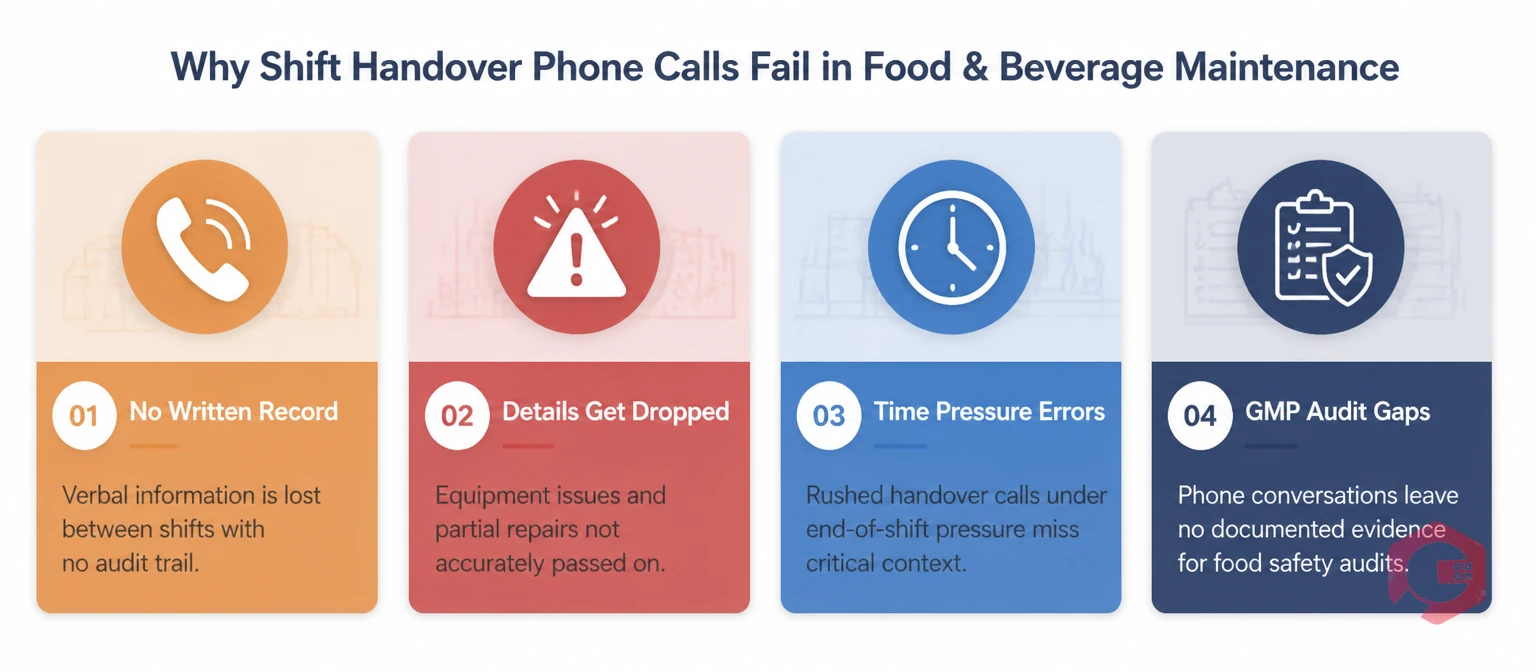
The F&B environment creates specific conditions that make verbal maintenance handovers unreliable in ways that don't apply to most other industries. Understanding these conditions explains why email alerts aren't just a convenience upgrade — they're a structural fix for a recurring operational failure.
Filling lines, pasteurisers, packaging machines, and conveyor systems run at noise levels that make phone conversations genuinely difficult. In many facilities, personal mobile phones are restricted or prohibited entirely in production and processing areas to prevent contamination. A maintenance supervisor on the floor at shift changeover has no reliable way to conduct a thorough verbal handover — and the calls that do happen are often rushed, incomplete, or taken in a corridor outside the processing zone where the relevant equipment isn't visible.
Email alerts bypass this problem entirely. The alert fires from the CMMS the moment a fault is logged, an open work order is approaching its target completion time, or a scheduled preventive maintenance task has been missed. The incoming shift receives the full status update on a shared workstation or authorised device before they set foot on the floor — with context that a shouted phone call at 6 AM could never provide.
F&B plants running 24-hour operations typically have leaner maintenance coverage on night shifts. A single technician may cover the entire facility, handling reactive faults as they arise with minimal documentation. When the day shift arrives, there's often no direct overlap — the night tech clocks out as the day team arrives, leaving a verbal note with a supervisor who may not have been present when the fault occurred.
Email alerts fix this at the source. Every fault logged by the night technician — every work order opened, every part consumed, every fault described — generates an automatic email to the configured recipient list. The day-shift maintenance lead arrives with a complete inbox record of every maintenance event from the prior eight hours, in the order they occurred, with the exact details entered at the time. No translation, no omission, no memory gap.
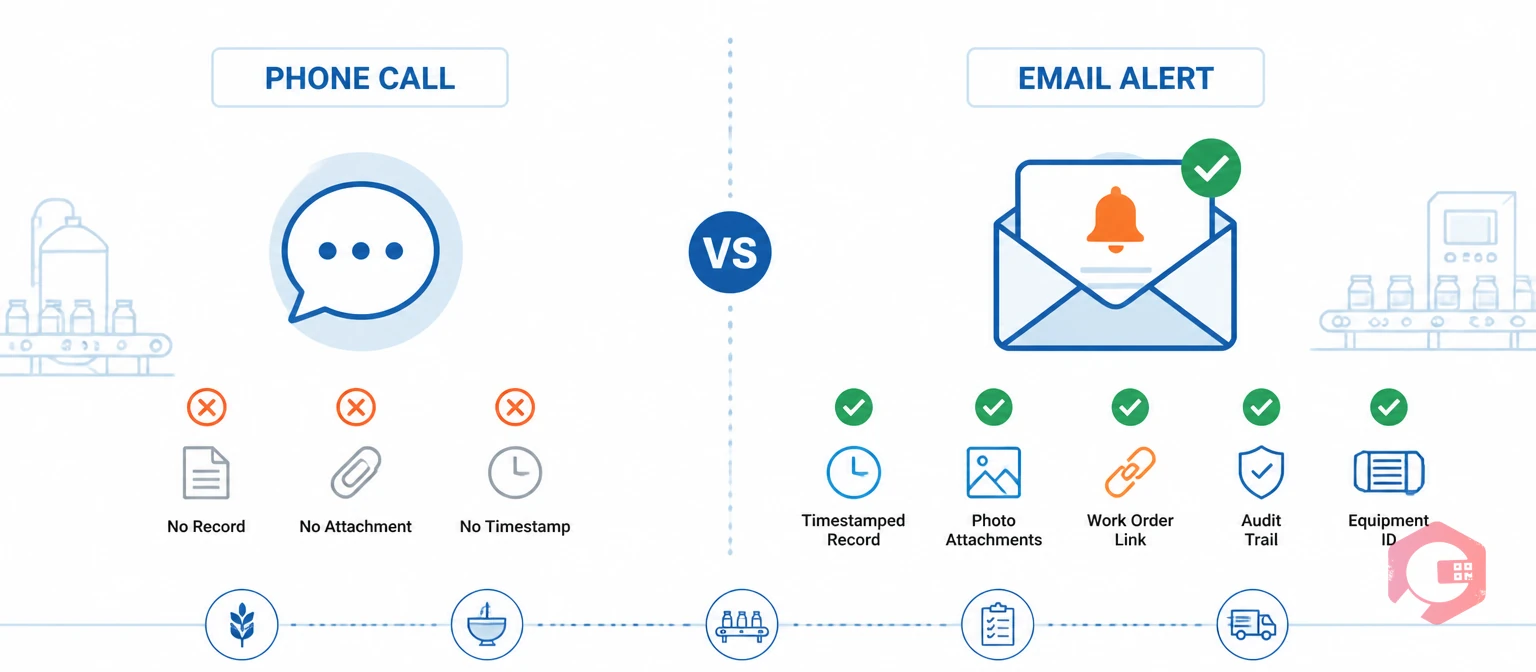
The specific information inside a CMMS-generated email alert is categorically different from what a verbal handover conveys. This isn't just about format — it's about completeness and accuracy under operational pressure.
A well-configured CMMS email alert for a maintenance event carries:
None of this information survives a verbal handover reliably. Studies from the National Center for Biotechnology Information on shift handover communication show that verbal information transfers retain accuracy rates below 50% when the receiver is under operational pressure — a common state for a maintenance lead arriving to a busy production start-up. A CMMS email alert carries 100% of the information the sender entered, every time.
For food and beverage manufacturers operating under GMP, BRC Global Standards, FSSC 22000, or SQF requirements, maintenance communication is not just an operational matter — it is a compliance matter. Auditors reviewing a plant's maintenance records want to see evidence that maintenance events were communicated across shifts, that open faults were escalated appropriately, and that no critical equipment was returned to service without documented sign-off.
A verbal handover call leaves no audit trail. An email alert from a CMMS leaves a complete one. According to the BRC Global Standard for Food Safety, documented maintenance communication between shifts is an expected element of a compliant maintenance management system. The ISO 22000 food safety management standard similarly requires that maintenance activities are planned, communicated, and recorded in a way that supports traceability across operational periods. Email-based alerts generate that documentation automatically — timestamped, attributed to a named user, and stored against the relevant work order record in the CMMS.
When an auditor asks "how do you communicate maintenance status across shifts?", the answer "we use a CMMS that sends automatic email alerts to the incoming shift supervisor for every open work order" is both more credible and more verifiable than "we do a handover call." The email trail is evidence. The phone call is memory.
Cryotos CMMS stores all email alert activity against the relevant work order record, making it straightforward to pull a complete shift communication history for any asset, any date range, during an audit. The food and beverage CMMS module is designed specifically for this compliance context, with configurable notification rules that match common F&B audit requirements.
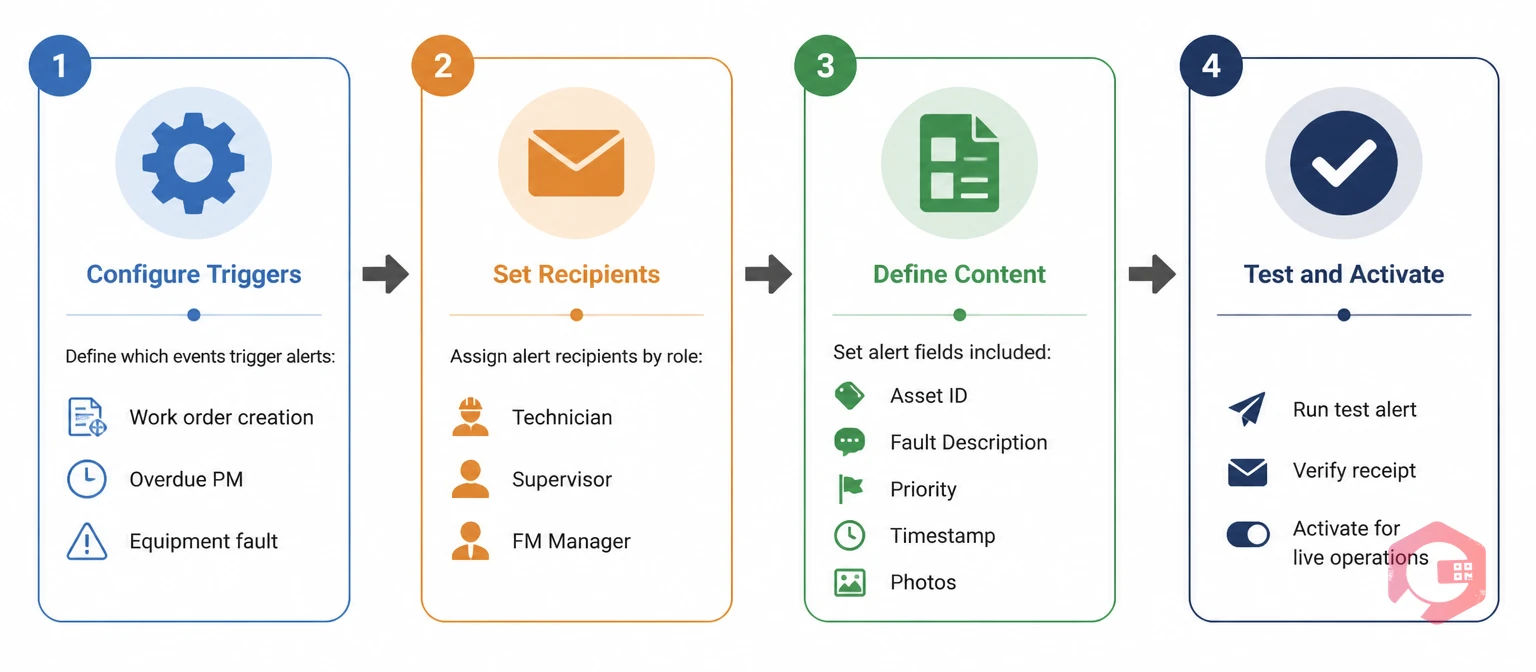
The configuration process for email-based maintenance alerts is straightforward in a modern CMMS. Three steps take you from ad-hoc notifications to a structured shift handover alert system.
Start by deciding which maintenance events should generate an automatic email alert, and to whom. A practical starting framework for F&B plants:
Email alerts are most useful when they reach the right person, not a shared inbox that nobody monitors. Configure recipient groups in your CMMS that reflect your actual shift structure: a day-shift group, a night-shift group, a supervisor group, and a management escalation group. Alerts route to the active shift group automatically based on the time the event is triggered. This means the night-shift technician raising a fault at 2 AM automatically notifies the night supervisor — not the day-shift lead who won't be on site for four hours.
An email alert that goes unread is no better than a voicemail nobody listened to. Configure escalation rules so that any Priority 1 alert not acknowledged within a defined window — 15 or 30 minutes is standard for urgent faults — automatically re-alerts the next level up the chain. In Cryotos, this is handled through the email and WhatsApp notification builder, which supports conditional escalation logic without requiring custom coding.
Many F&B maintenance teams use WhatsApp groups as an informal substitute for structured shift handover. A technician sends a message to the "Maintenance" group chat, the incoming shift sees it (or doesn't), and the information lives in a chat thread that nobody systematically reviews. This is an improvement on a phone call in some ways — it creates a text record — but it falls well short of what a CMMS email alert provides.
The key differences:
This doesn't mean WhatsApp has no place in F&B maintenance communication — it works well for quick, informal coordination between technicians during a shift. But for shift-to-shift handover, it doesn't replace a structured CMMS notification. Cryotos supports both channels: work order management notifications can fire via email for formal handover records and via WhatsApp for real-time technician communication simultaneously.
Cryotos CMMS is built with configurable notification workflows that match the specific communication patterns of food and beverage maintenance operations. The platform's email builder allows maintenance teams to design custom alert templates — pulling specific work order fields, asset data, and priority indicators into each alert — so the email reaching the incoming shift supervisor carries exactly the information they need to start the shift without a phone call.
Key capabilities relevant to F&B shift handover:
F&B manufacturers using Cryotos report a 30% reduction in unplanned downtime and 25% faster repair times — outcomes directly linked to the fact that maintenance information reaches the right person at the right time, every shift, without the gaps that verbal handovers create. If your morning shift is still starting with a phone call instead of a structured inbox, Cryotos CMMS gives your team the tools to change that today.
A well-configured shift handover email alert should include the asset ID and location, fault description in the technician's own words, current work order status, priority level, assigned technician, any parts consumed or on order, and the timestamp of every status change. This gives the incoming shift a complete picture of all open maintenance activity without any verbal briefing required.
Yes, when generated by a CMMS and stored against the relevant work order record. GMP and BRC auditors expect documented evidence of maintenance communication across shifts. An email alert trail from a CMMS — timestamped, attributed to a named user, linked to a specific work order — meets that requirement. Informal channels like phone calls or WhatsApp messages do not generate the audit-ready documentation that regulators expect.
A CMMS alert is structured, automated, and audit-ready — it pulls data directly from the work order record and fires according to configured rules, with escalation if unacknowledged. A WhatsApp message depends entirely on someone remembering to send it, includes only what that person typed, and cannot be linked back to a specific asset or work order in a way that satisfies a compliance audit. For formal shift handover, a CMMS alert is the correct tool; WhatsApp works for informal technician coordination during a shift.
For most maintenance handovers, yes — a structured CMMS email alert covers the information that a phone call or brief meeting would convey, plus additional context that verbal handovers typically miss. Some facilities retain a short written or in-person handover for complex, multi-day repairs or safety-critical situations. But for standard open work orders, PM status, and fault updates, a well-configured CMMS email alert system eliminates the need for a dedicated handover call and the information loss that comes with it.
This is where escalation rules matter. A properly configured CMMS re-alerts the supervisor or the next level up if a Priority 1 alert goes unacknowledged within a defined window. For lower-priority alerts, the shift summary email gives the supervisor a consolidated view of all open items at the start of their shift, so nothing falls through the gaps even if individual alerts were missed. The shift summary is the safety net that makes the whole system work reliably.
The shift handover call is one of the oldest traditions in F&B plant maintenance — and one of the most reliable sources of information loss. When a 5-minute phone call is the only record that a bearing was running hot, a pump seal was leaking, or a PM was deferred to tomorrow, that information is one distraction away from disappearing entirely.
Email-based maintenance alerts from a CMMS don't just replace the handover call. They replace it with something categorically better — structured, timestamped, audit-ready, and automatically delivered to every person who needs it, every shift, without anyone having to remember to make the call. For food and beverage plants where GMP compliance, contamination risk, and shift continuity all intersect, that upgrade is not optional — it is a competitive and regulatory necessity.
Book a free Cryotos demo to see how the email and WhatsApp notification builder works in a real F&B maintenance environment, and what a fully configured shift alert system looks like in practice.


Cryotos AI predicts failures, automates work orders, and simplifies maintenance—before problems slow you down.



