
Equipment condition affects product quality in a direct way. As machinery wears down or drifts out of tolerance, that variability shows up in your output. Total Productive Maintenance (TPM) fixes this problem. It combines operator-led inspection, planned maintenance, and condition monitoring to catch wear before it reaches the product.
This link between equipment condition and defect rates is one of the most overlooked factors in manufacturing quality control. Most plants track machine uptime closely but rarely connect it back to the quality numbers on the same line.
Key Takeaways

Equipment condition is the physical and operational state of a machine compared to its design specs. When a machine runs within spec, tolerances hold and output stays consistent. When equipment condition slips, output starts to drift too.
Most maintenance teams underestimate how fast small problems add up. A worn bearing, a loose fixture, or a weak sensor rarely causes a big failure right away. Instead, it creates small errors. Over time, these errors turn into inconsistent parts, off-spec batches, or failed inspections.
Reliability-centered maintenance (RCM) treats this link as a core idea: equipment condition isn't just an uptime number. It's a direct input into quality control.

Equipment degradation turns into defects by adding process variation that goes past a product's tolerance range. This shift is rarely sudden. It's usually a slow slide that goes unnoticed until quality inspectors start flagging output.
Here's a simple example. A packaging line runs a sealing press with a worn heating element. At first, seals still pass. Over a few weeks, seal strength drops just enough to fail random spot checks. By the time someone flags it, hundreds of units may already be affected.
Teams that catch this path early — through vibration checks, thermal imaging, or routine inspection — stop defects before they reach a customer. This is far cheaper than reacting after the fact.
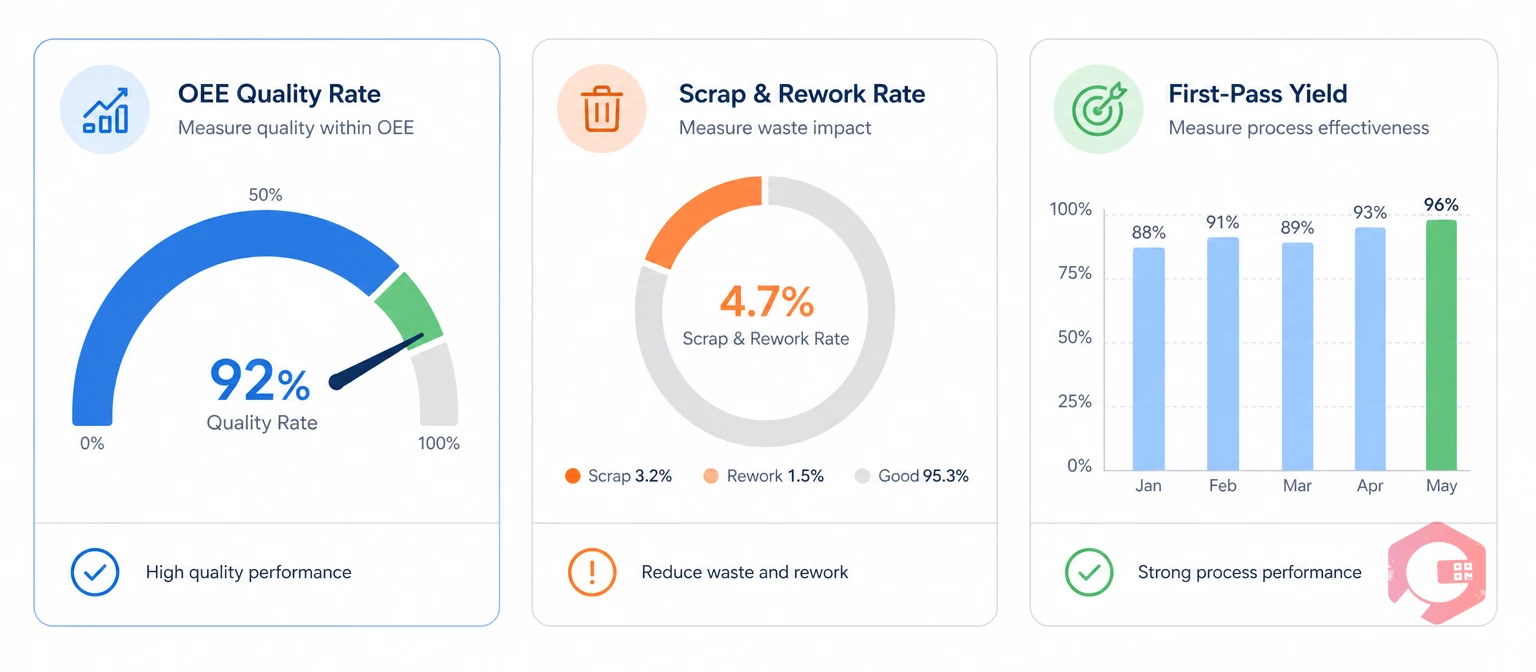
You measure the cost of poor equipment condition through three linked metrics: OEE's quality rate, scrap and rework percentage, and first-pass yield. These numbers turn equipment condition into dollars. They give maintenance and quality teams a shared language.
Most facilities that track these metrics next to maintenance data start to see a clear pattern. Quality dips almost always follow a maintenance gap by days or weeks, not the other way around.
For example, a plant might see first-pass yield drop two weeks after a skipped lubrication cycle on a critical asset. Without linking the two data sets, that drop looks random. With them linked, the cause is obvious.
Teams that want to measure this link can start with an OEE calculator to set a baseline before rolling out a TPM program.
Total Productive Maintenance (TPM) is a maintenance approach that makes equipment reliability a shared job between operators and maintenance teams, not just a maintenance-only task. It aims for zero breakdowns, zero defects, and zero accidents through structured, proactive work. You can read more about the origins of Total Productive Maintenance and its eight pillars.
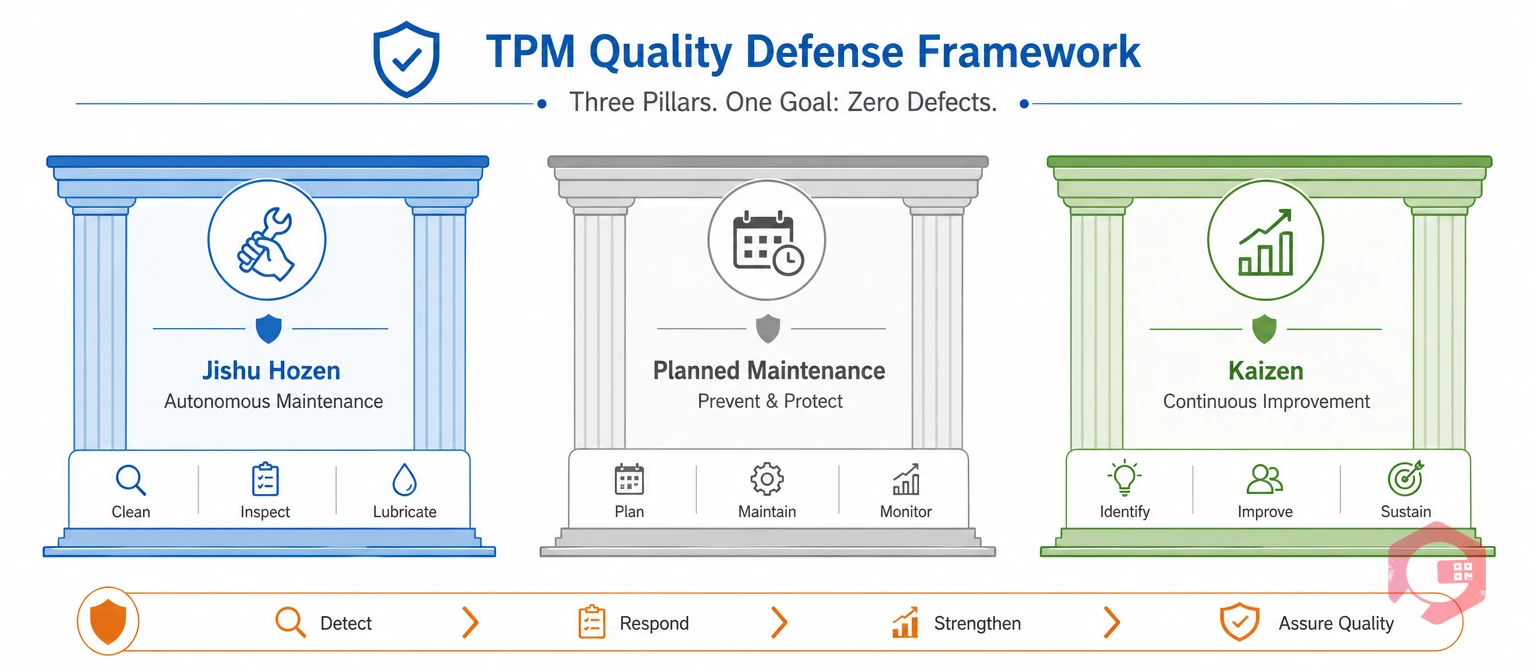
TPM rests on eight pillars, but three have the biggest impact on condition-driven quality loss:
The TPM Quality Defense Framework:
Plants that use all three pillars well tend to see quality problems drop before they see downtime numbers improve. Condition-driven defects respond faster to TPM than breakdowns do.
Jishu Hozen puts equipment inspection in the hands of the people running the machine every shift, not just the maintenance team that visits on a schedule. This matters because operators notice small changes first. A new sound, a slight shake, or a temperature shift often shows up long before a formal inspection catches it.
Facilities using structured autonomous maintenance programs catch condition issues at the "abnormal but not yet failed" stage. This is exactly where quality loss starts, and it's the cheapest point to fix it.
Kaizen is the practice of making small, ongoing improvements based on what autonomous maintenance and planned maintenance reveal. Without it, teams keep fixing the same condition-driven defect over and over instead of removing its root cause. The term comes from a broader Kaizen philosophy used across lean manufacturing.
In a TPM setting, Kaizen turns a Jishu Hozen observation — "this seal wears out every six weeks" — into a lasting fix. That might be a redesigned seal, a new lubrication schedule, or an updated inspection checklist.
Common mistake: teams treat Kaizen as an occasional event instead of a continuous cycle tied to what Jishu Hozen finds. This is where most TPM programs stall.
Cryotos has built a dedicated TPM module that gives Jishu Hozen and Kaizen a digital home, instead of leaving them as paper checklists or tribal knowledge. Operators log autonomous maintenance inspections right against the asset. Every recurring issue gets tracked through a structured Kaizen workflow instead of getting lost after a shift change.
This closes the gap between "operators noticed something" and "maintenance and quality teams acted on it." That gap is exactly where condition-driven defects usually slip through.
Maintenance teams using Cryotos have reported up to 30% reduction in unplanned downtime and 25% faster repair turnaround. These gains trace directly back to catching condition issues before they turn into quality failures.
Picture a shift operator who notices a slight rattle on a conveyor motor. With a digital Jishu Hozen checklist, they log it in seconds. The system flags it against the asset's history, and if the same rattle shows up again next month, Kaizen tracking surfaces the pattern instead of letting it slide as a one-off.
The clearest signs that TPM is improving product quality are a rising first-pass yield, a falling scrap rate, and a better OEE quality component. Track them together, not one at a time.
A BI dashboard that pulls these metrics into one view makes it much easier to prove TPM's quality impact to plant leadership, instead of relying on guesswork.
No single program removes every defect. But TPM cuts condition-driven variance a lot by catching equipment wear before it affects output. Most facilities see the fastest gain in first-pass yield within the first few months of steady Jishu Hozen practice.
Jishu Hozen is autonomous maintenance done by equipment operators. It includes daily cleaning, inspection, and basic adjustment, rather than scheduled work done by a maintenance technician. It catches issues between formal preventive maintenance visits, when small problems are cheapest to fix.
Kaizen as a TPM pillar is a continuous, ongoing cycle of small improvements tied to daily observations. A "Kaizen event" is usually a time-boxed workshop focused on one process. Both matter, but the continuous version is what stops condition-driven defects from coming back.
Cryotos has a dedicated TPM module with structured Jishu Hozen checklists and Kaizen tracking, on top of standard preventive maintenance scheduling. This gives maintenance teams one system for both reactive work and TPM-driven quality practices.
Equipment condition and product quality are more closely linked than most maintenance programs treat them, and TPM's operator-led approach closes that gap before it costs you a batch. Schedule a free demo to see how Cryotos's TPM module puts Jishu Hozen and Kaizen to work on your shop floor.


Cryotos AI predicts failures, automates work orders, and simplifies maintenance—before problems slow you down.



