
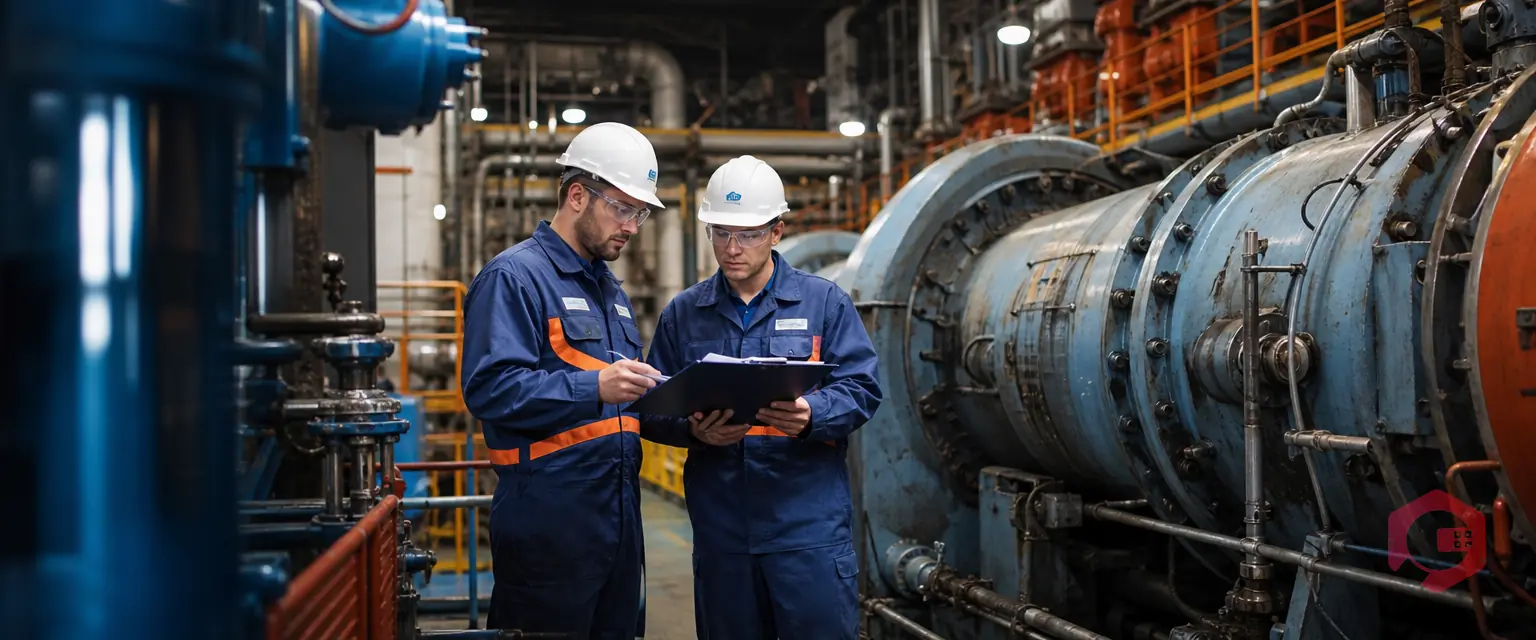
An equipment upgrade vs retrofit decision comes down to one question: are you improving what an asset already does, or adding a capability it never had? An upgrade replaces a part with a newer version of the same part. Same job, better performance. A retrofit adds new functions to an asset without replacing the whole unit. Facilities teams that mix up these two categories tend to overspend on assets a smaller fix would have solved. Or they underspend on assets that needed full replacement, and the same failure comes back months later. This guide gives you a five-signal framework for making the equipment upgrade vs retrofit call correctly, asset by asset.
Key Takeaways
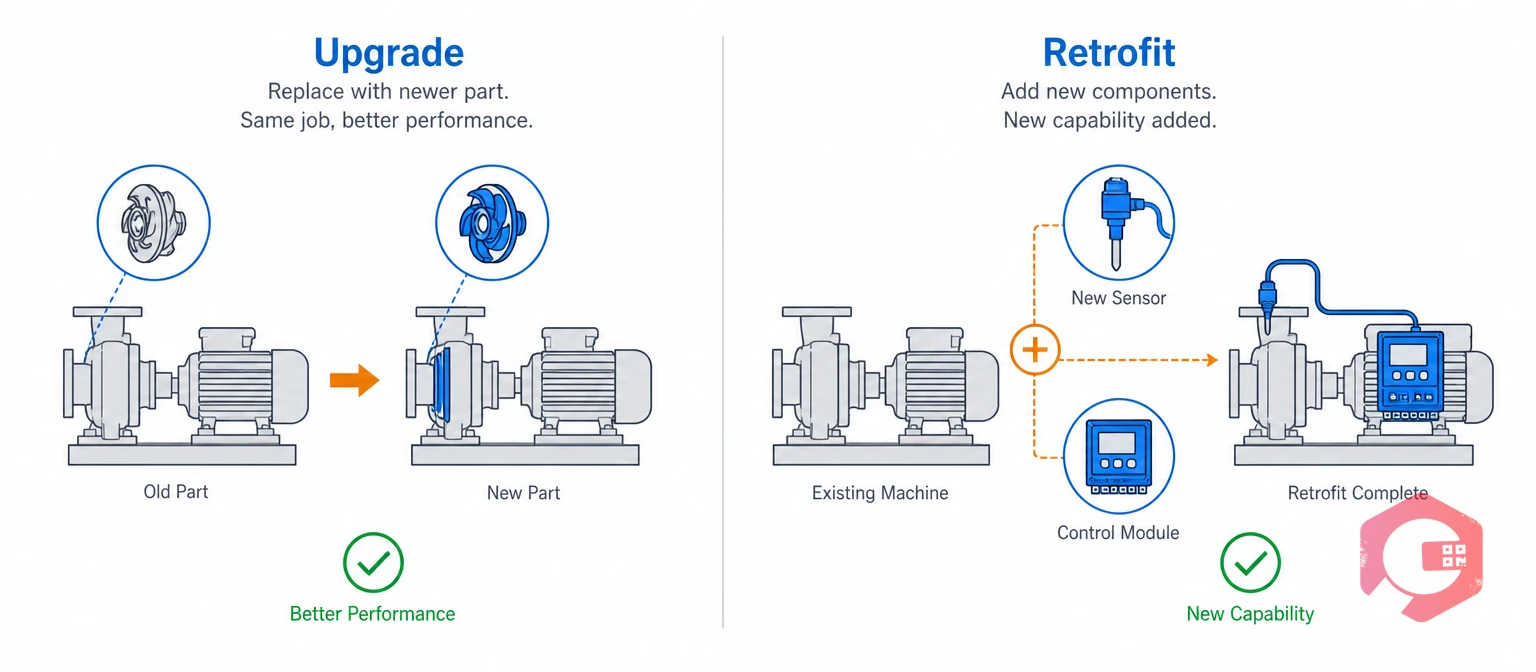
An equipment upgrade replaces a part with a newer version of the same part. A retrofit adds new capability to an asset without replacing the whole unit. Both extend an asset's working life. But they solve different problems, and they carry very different price tags.
An upgrade keeps the machine's job the same. You're not changing what the asset does. You're just improving how well it does it.
The cost gap between the two is significant. A retrofit on a single subsystem typically runs 20-40% of full replacement cost. An upgrade to a like-for-like part costs a fraction of that. Confusing the two categories is how facilities budgets get blown. A team approves a "small fix" that turns into a full retrofit once the real scope is understood, and the budget request that started small ends up needing executive sign-off it was never planned for.
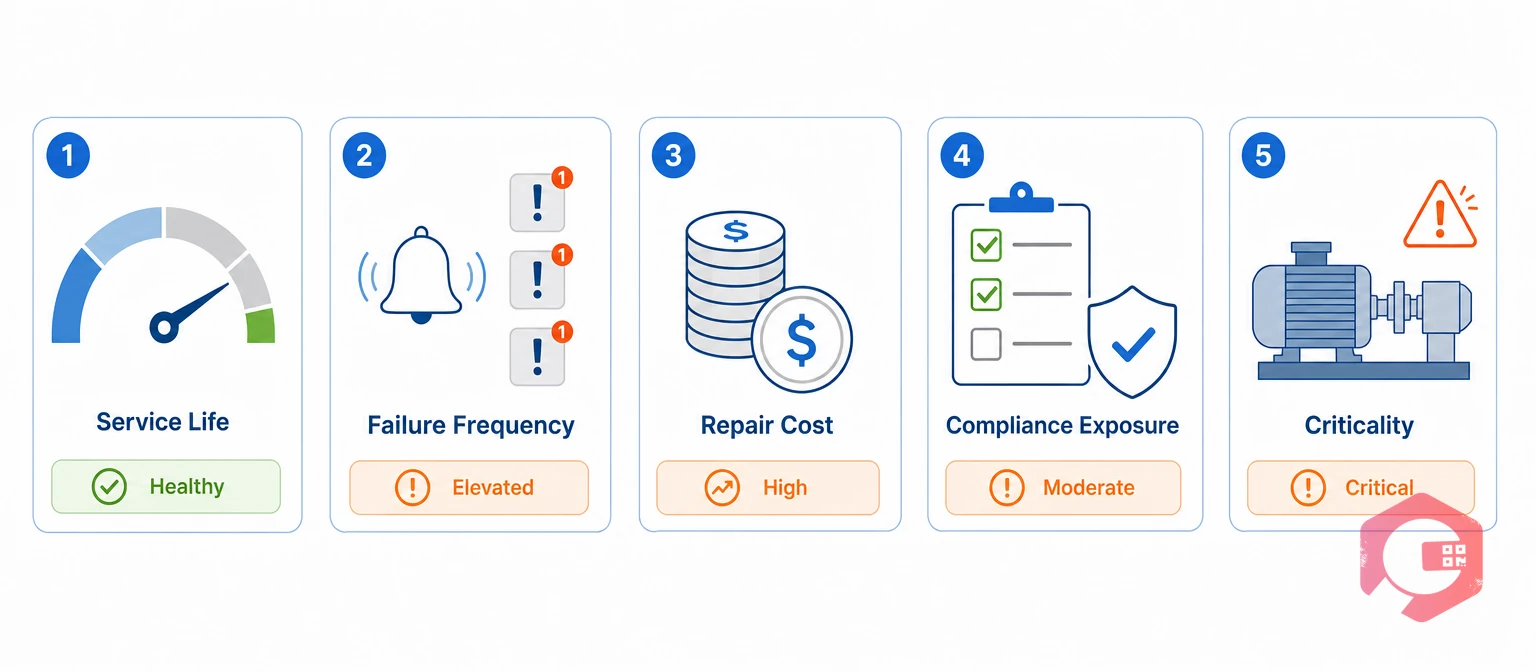
Five measurable signals determine whether an asset is a retrofit candidate or needs a full upgrade: service life, failure frequency, cumulative repair cost, compliance exposure, and criticality. Teams that check all five before spending money make fewer wrong calls than teams that decide from memory.
The 5-Signal Retrofit Threshold:
Most maintenance teams already track pieces of this signal set. A work order here, a parts invoice there. But it only works when the numbers come from real asset records, not memory. A preventive maintenance software platform that logs cost and failure data at the asset level turns this from a guess into a repeatable check. This is the same logic behind life-cycle cost analysis: total cost of ownership, not sticker price, should drive the upgrade vs retrofit call.
Reliability-centered maintenance backs this up. The reliability-centered maintenance framework found that failure isn't purely age-driven. Decisions should weigh real failure and cost data over calendar age alone. Running all five signals together, instead of picking just one, keeps teams from retrofitting an asset that's already past saving.
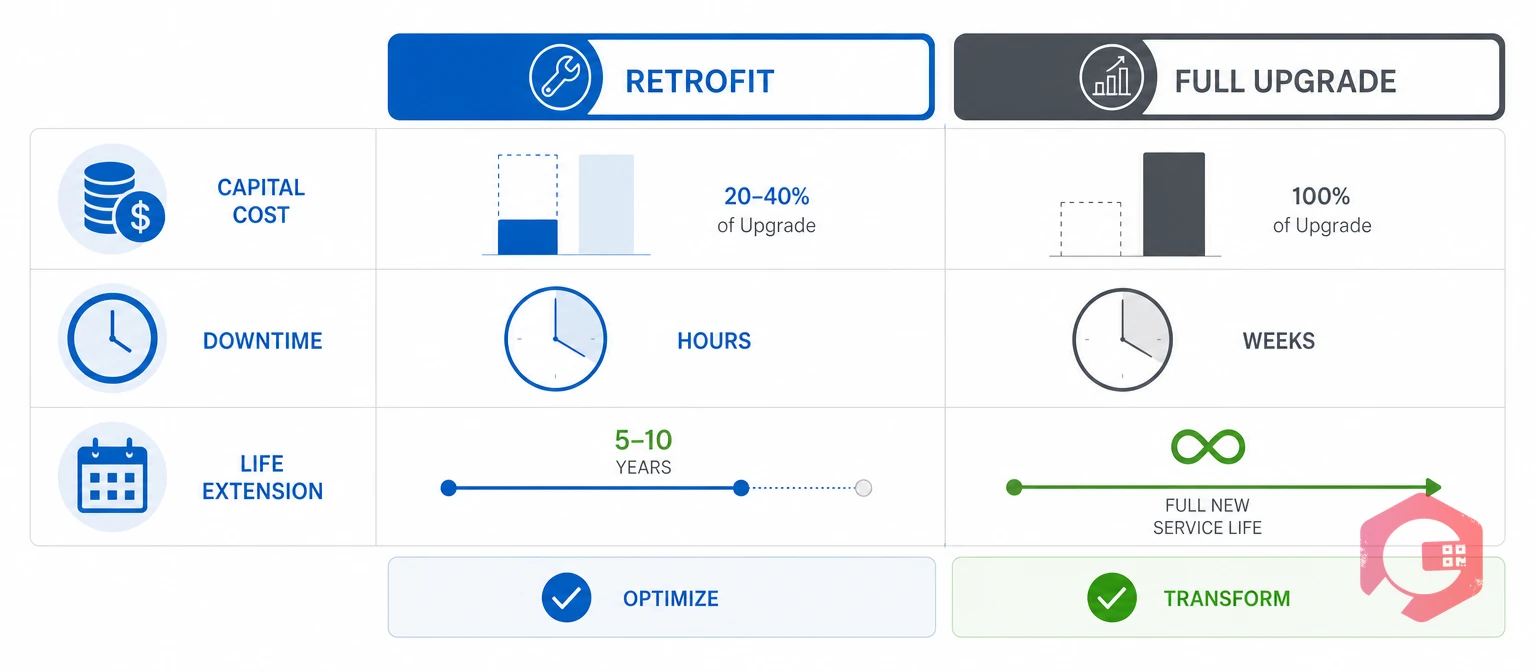
A retrofit typically costs 20-40% of full replacement and adds 5-10 years of service life. A full upgrade costs the full unit price but resets the asset to a complete new service life. The table below breaks down the trade-offs most facilities teams weigh before committing budget.
| Factor | Retrofit | Full Upgrade |
|---|---|---|
| Typical capital cost | 20-40% of replacement cost | 100% (full unit plus install) |
| Downtime | Hours to a few days, often phased | Days to weeks, full outage |
| Life extension | 5-10 years | Full new service life (15-25 years) |
| Best fit | Asset under ~70% of rated life, mechanically sound | Asset near end of life, obsolete parts, or non-compliant |
| Risk profile | Underlying parts may fail again soon | Higher upfront risk, lower ongoing risk |
Most facilities teams underestimate the downtime gap. A retrofit can often be phased. You replace one part while the rest of the unit keeps running. A full upgrade usually means a complete shutdown for the install window.
If failure frequency is the deciding signal on your asset, run the numbers first. It makes the upgrade vs retrofit case easier to defend. Try the MTBF calculator to see where your asset actually stands before you commit budget.
Choose a retrofit when the failing part is a single subsystem on an otherwise sound asset, parts are still available, and a full replacement's lead time doesn't fit your schedule. These conditions cover most of the retrofit-friendly cases facilities teams run into.
Most facilities hit this exact scenario with HVAC and process equipment. The compressor or controller is failing, but the frame, piping, and structure are sound. A targeted retrofit — new controls, a VFD, or a rebuilt compressor — fixes the real problem without triggering a full-unit replacement.
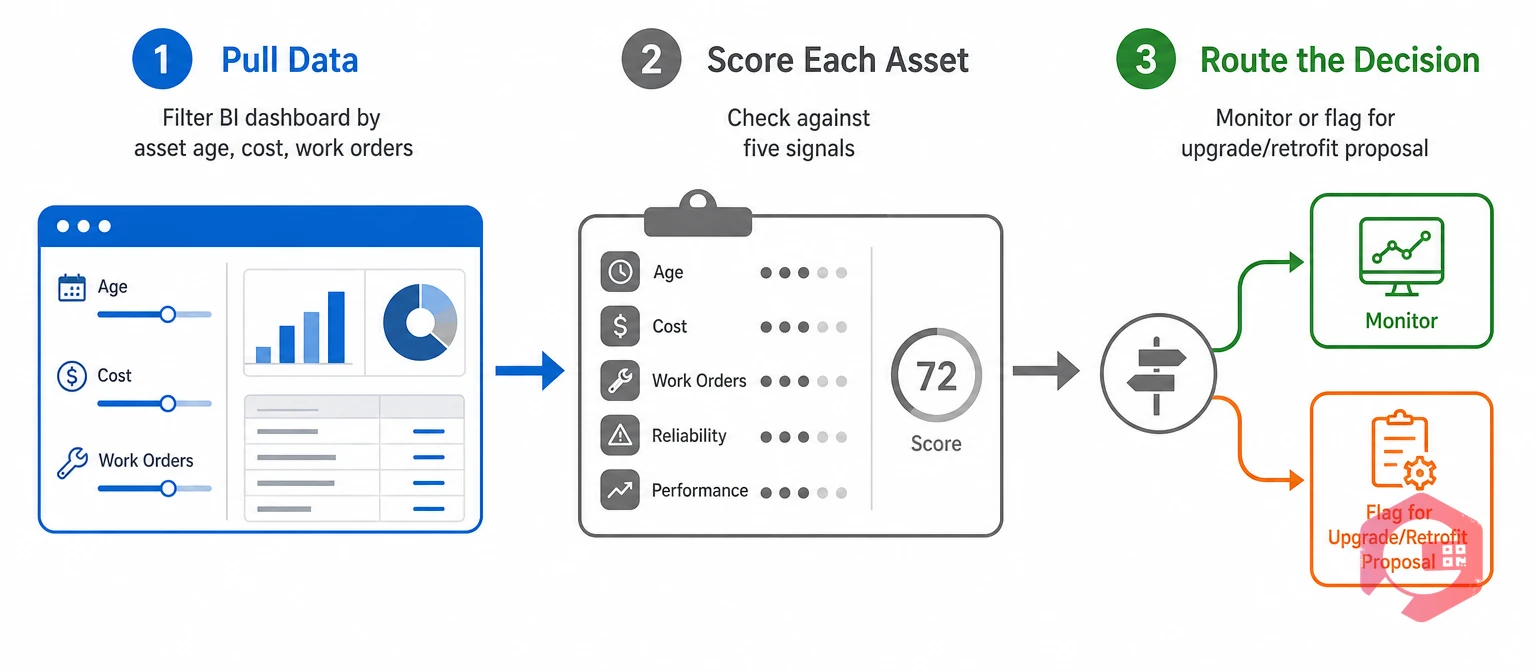
Applying the 5-Signal Retrofit Threshold across a whole facility only works if service life, failure history, and repair cost are tracked at the asset level, not guessed from memory. Most facilities teams that try to run this review off spreadsheets skip it after the first quarter. The data entry work outweighs the value.
A Computerized Maintenance Management System turns this into a standing process instead of a one-off task. Pulling an asset's repair cost, failure count, and install date takes seconds when that data already lives in downtime tracking and work order history. No digging through invoices or relying on a technician's memory. This kind of asset-level tracking is also the idea behind the ISO 55000 asset management standard: base decisions on real asset data, not assumption.
Maintenance teams using Cryotos have reported up to 30% reduction in unplanned downtime and 25% faster repair turnaround. Those gains come directly from having accurate, current asset data ready the moment an upgrade vs retrofit call needs to be made, not after the fact.
Log the decision and its reasoning directly on the asset record once it's made. The next person to review that asset isn't starting from zero, and the same signal data feeds the next quarterly pass automatically. Over a few cycles, this turns a one-off judgment call into a documented, auditable pattern across the whole portfolio.
Check the asset against five signals: service life used, failure frequency, cumulative repair cost, compliance exposure, and criticality. If it clears most of these — sound structure, available parts, a manageable downtime window — a retrofit usually makes sense. If it trips two or more, including cost near 40-50% of replacement, a full upgrade is usually the better move.
An upgrade swaps in a newer version of the same part. Same job, better performance. A retrofit adds capability the asset didn't have before, like new controls, automation, or condition monitoring, without replacing the whole unit.
A retrofit usually runs 20-40% of full replacement cost, depending on how many parts need work. Once retrofit spend on one asset crosses roughly 60% of a new unit's price, once labor and setup are counted, a full upgrade usually becomes the smarter call.
Yes. A CMMS tracks the exact inputs this decision needs: asset age, failure history, repair cost, and compliance deadlines, all in one place. The review takes minutes instead of a manual pull from spreadsheets, invoices, and memory.
Getting the equipment upgrade vs retrofit call right, asset by asset, comes down to having the right cost and failure data on hand when you need it. Schedule a free demo to see how Cryotos tracks that data automatically across your entire asset portfolio.

Cryotos AI predicts failures, automates work orders, and simplifies maintenance—before problems slow you down.



