
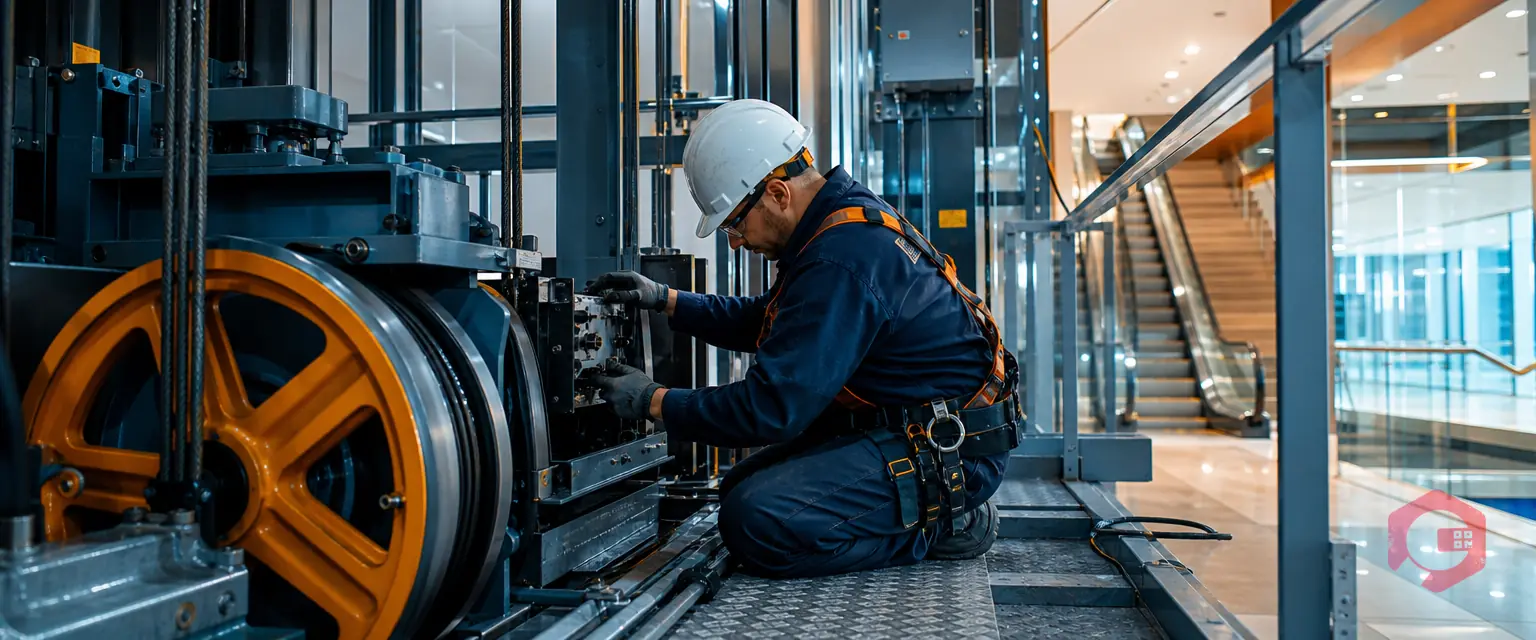
An elevator and escalator maintenance checklist is the set of inspection and service tasks a technician runs on every visit to keep a unit safe and code-compliant. It covers the car, hoistway, and machine room. For escalators, it also covers the step chain, handrail, and comb plates. Building owners who pair this checklist with maintenance software see fewer callbacks and pass code inspections faster.
Key Takeaways
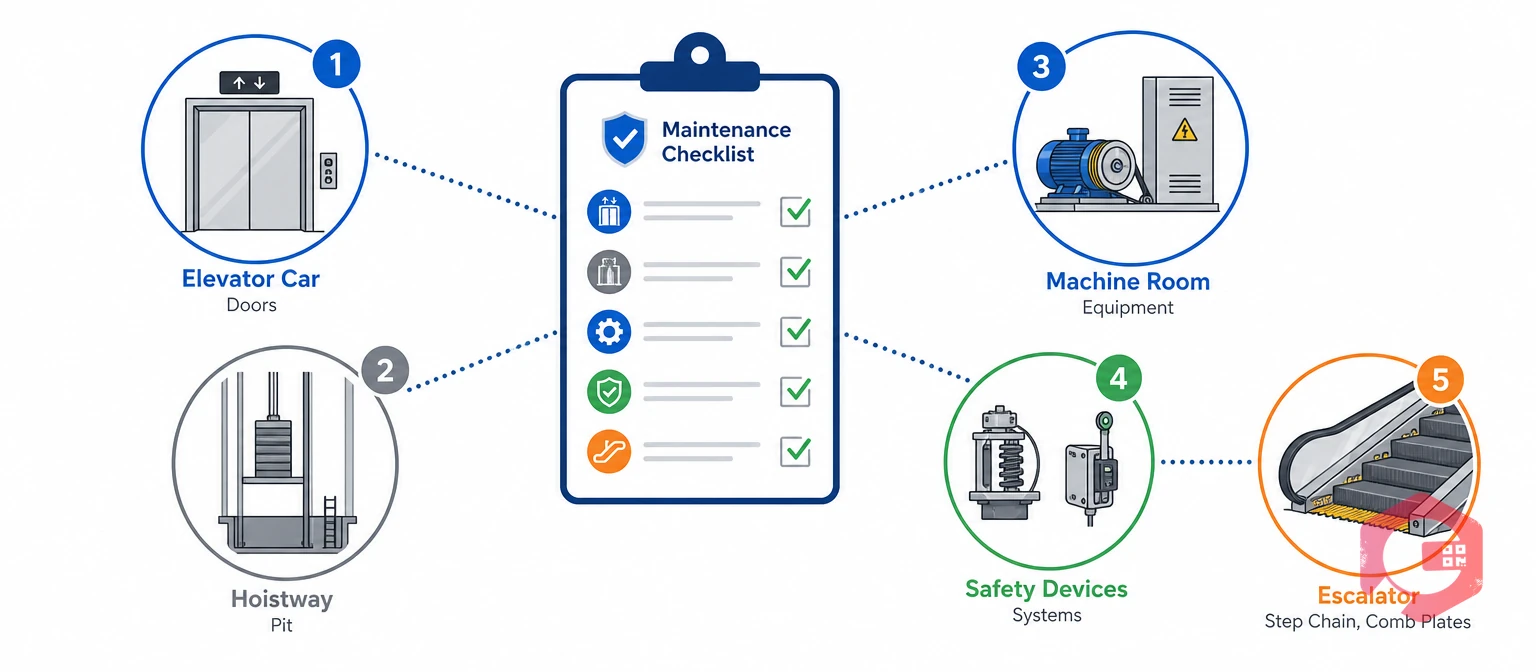
A maintenance checklist is a documented, repeatable list of inspection tasks tied to a fixed schedule. For elevators and escalators, that schedule matters more than most equipment. Both machines run thousands of cycles a day and carry passengers. A small mechanical drift can turn into a safety issue within weeks.
An elevator and escalator maintenance checklist usually splits by area. That includes the car and doors, the hoistway and pit, the machine room, and the safety devices that stop a unit during a fault. Escalators add the step chain, comb plates, and handrail speed check.
Every task on the checklist should tie to one specific asset ID, not just a building name. That link is what keeps the service history usable years later, when an inspector or insurer asks for proof.
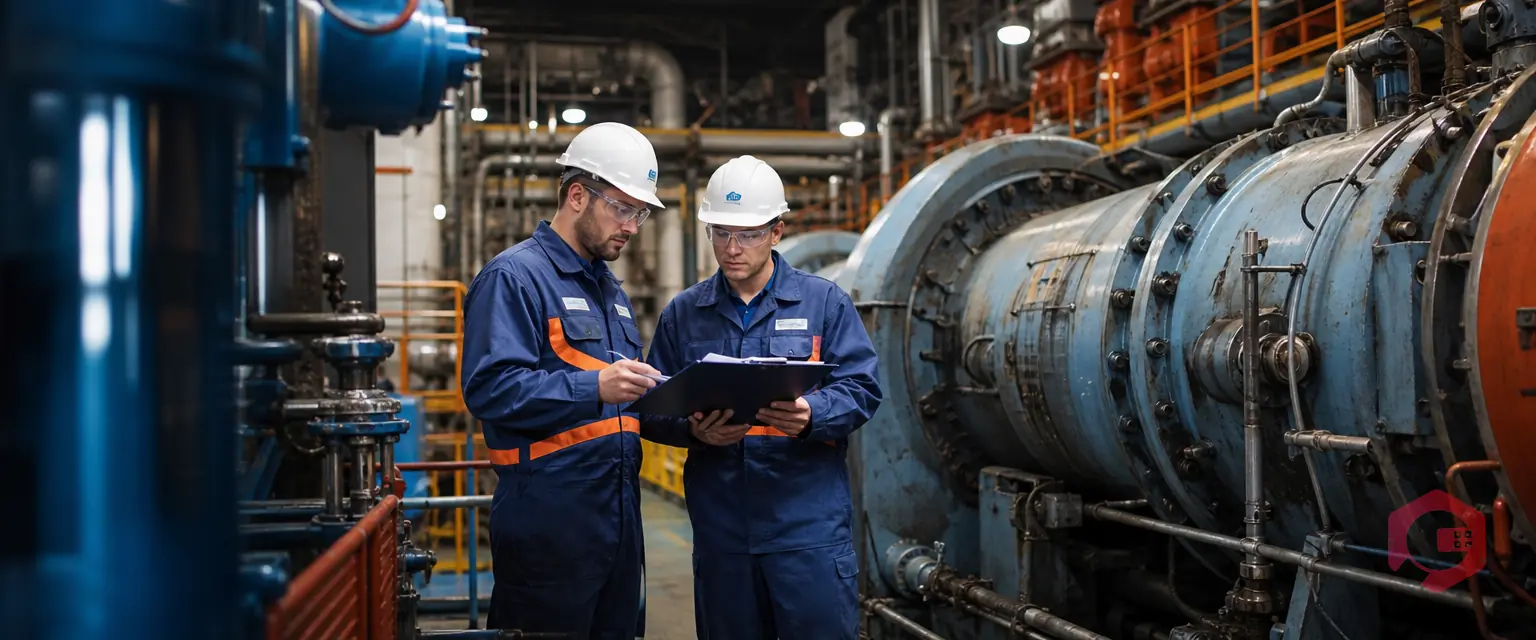
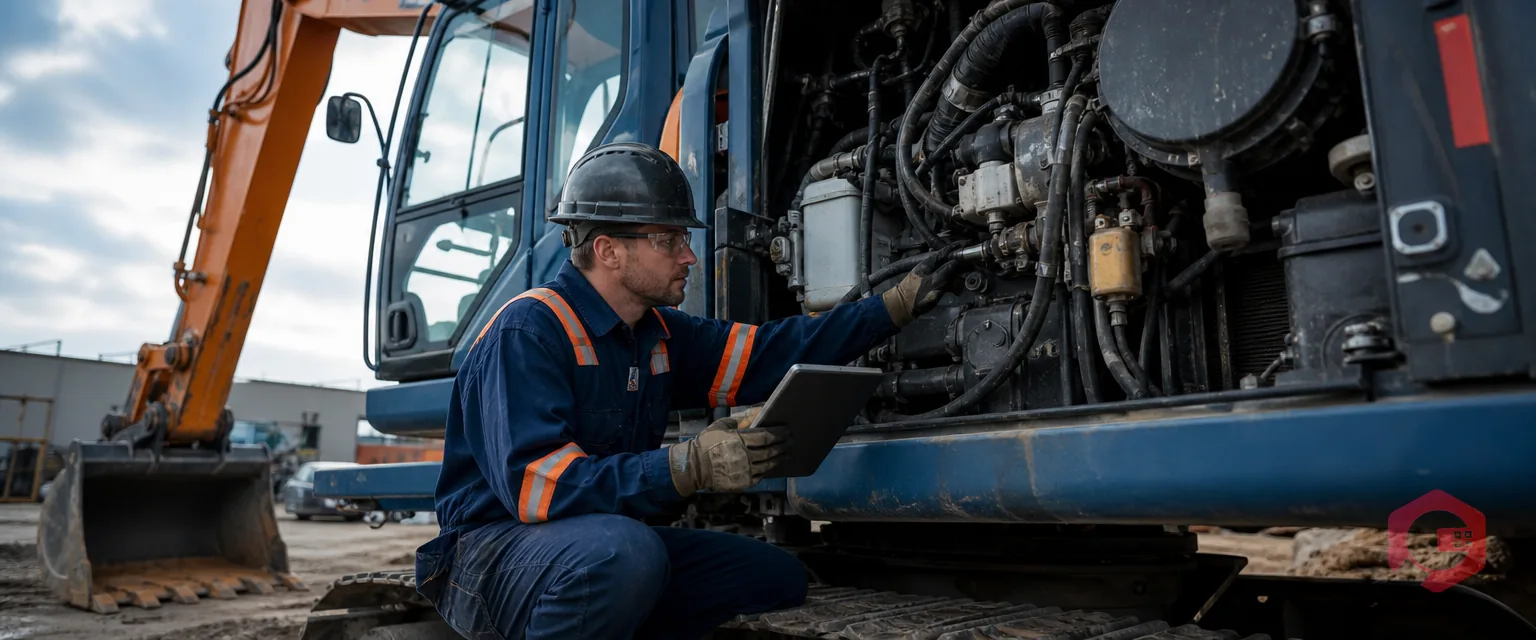
Who actually runs the elevator and escalator maintenance checklist depends on the contract. Some building owners keep an in-house technician on staff. Most rely on an OEM or an independent service company instead. Either way, the same checklist should apply, since the code doesn't care who holds the wrench.
Elevator and escalator maintenance compliance matters because most places legally require a signed, dated record. That record has to prove every safety task was done, not just that a technician showed up. ASME A17.1 is the safety code most U.S. and Canadian jurisdictions use to set inspection intervals and paperwork standards.
The Occupational Safety and Health Administration has flagged incomplete maintenance records as a repeat factor in elevator and escalator incidents. Injury data from eLCOSH shows many of these cases trace back to a maintenance gap, not just equipment age.
Writing a good checklist is step one. Preventive maintenance software is what keeps that same checklist on track once a technician has forty units on their route instead of four.
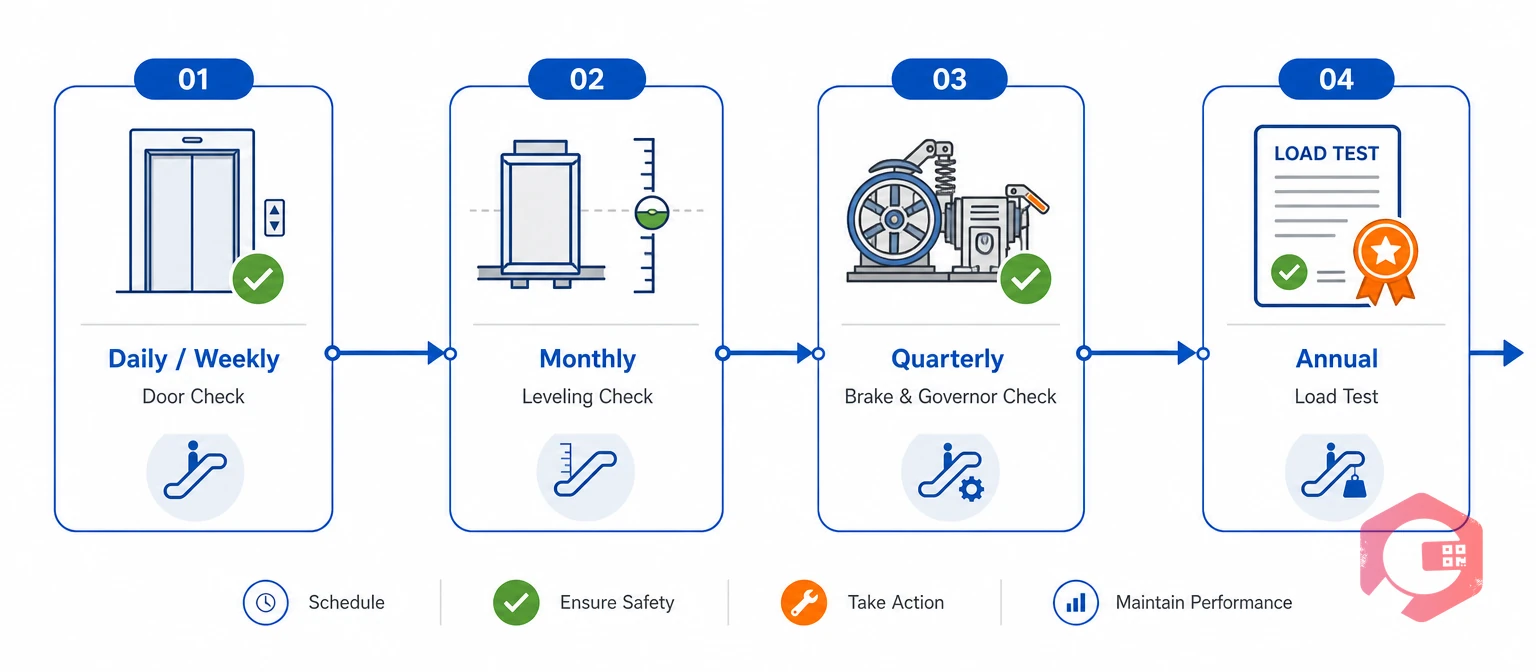
The elevator and escalator maintenance checklist breaks into five frequency tiers. Each tier targets a different failure risk. Most maintenance teams follow close to this same cadence, no matter the OEM, building type, or region.
Good maintenance checklist software turns this five-tier cadence into automatic reminders. Nobody has to remember a wall calendar or a spreadsheet tab.
Elevator maintenance software enforces checklist completion and stores an audit-ready record on its own. A paper checklist depends on a technician remembering to fill every field correctly. That gap shows up fast the moment a regulator or insurer asks for proof.
| Factor | Paper Checklist | Maintenance Software |
|---|---|---|
| Completeness | Depends on memory | Required fields block a blank submission |
| Audit trail | Can be lost or backdated | Timestamped and locked once signed |
| Failed-item follow-up | A manual note, easy to miss | Opens a corrective work order on its own |
| Portfolio view | One binder per building | One dashboard across every site |
When a safety check fails inside a digital checklist, work order management tools open a corrective task right away. Nobody has to write a separate note and hope someone reads it later.
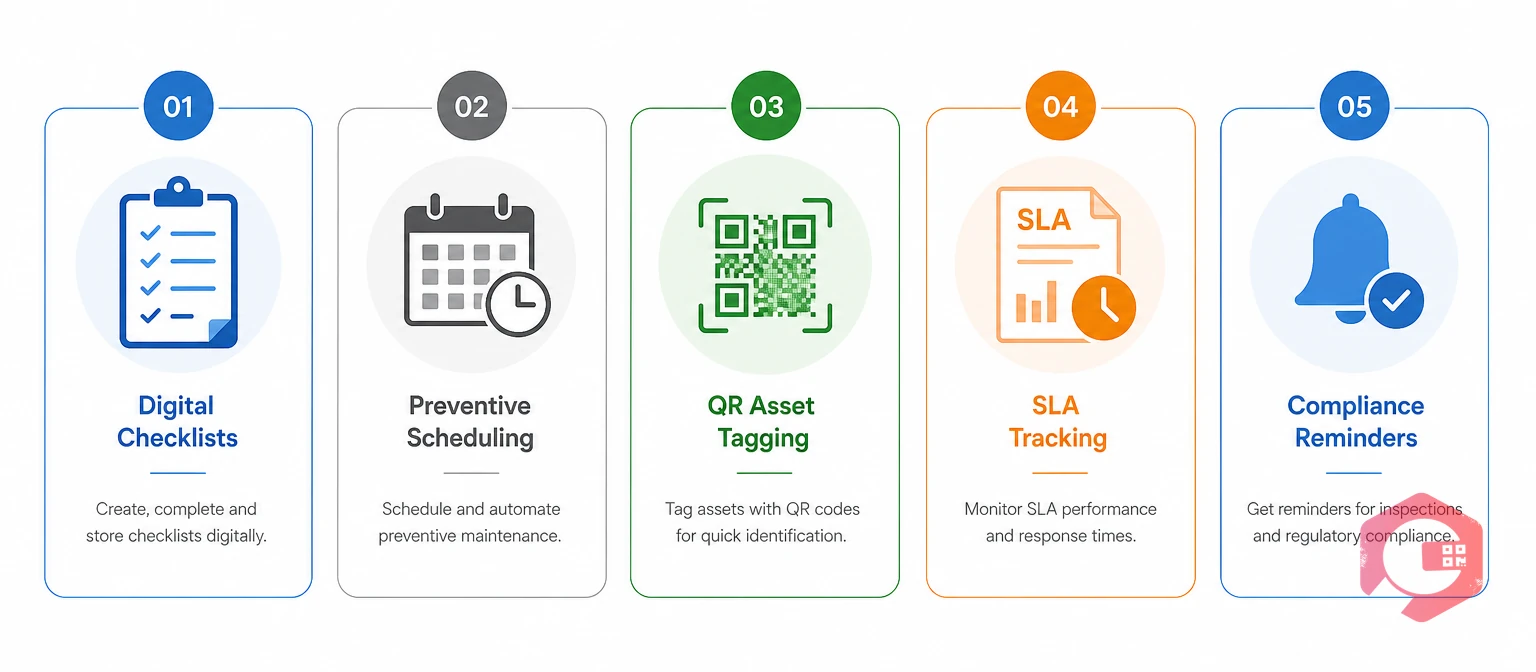
The right elevator and escalator maintenance software combines a few core pieces. Together they stop a unit from ever running on a lapsed inspection. Most general facilities tools miss at least one of these.
The Vertical Transportation Software Checklist:
Most teams that switch from spreadsheets to a Computerized Maintenance Management System notice the compliance gap first. Certificates that used to live in someone's memory now carry a hard renewal date instead.
A platform missing even one of these five points tends to show up as a gap during the next audit cycle, not on day one. A missing QR tag means a technician has to search for the right asset record by hand. A missing SLA timer means nobody can prove how fast an entrapment call actually got a response. Checking all five before you commit to a contract saves a renegotiation a year later.
Choosing elevator and escalator maintenance software comes down to matching a few things to your portfolio. Checklist flexibility, mobile reliability, and reporting depth all matter. A five-unit building has different needs than a 200-unit service contract.
An asset and equipment inspections checklist template is a quick way to see how a platform structures its forms before you commit to a full rollout.
It also helps to ask a vendor for a reference customer running a similar portfolio size. A platform that handles five buildings well doesn't always scale cleanly to fifty, especially once multiple contractors need their own login and permission level.
Cryotos supports elevator and escalator maintenance through configurable checklists, QR-based fault reporting, and compliance dashboards built for this exact kind of work. Maintenance teams using Cryotos have reported up to 30% reduction in unplanned downtime and 25% faster repair turnaround. Those gains come directly from checklists that can't be submitted half-finished.
Most facilities teams managing a large elevator or escalator portfolio struggle to prove compliance across dozens of buildings at once. One dashboard showing PPM compliance percentage, open tickets, and callback rate per unit removes that guesswork. It works the same way whether the technician is an in-house employee or an outside OEM contractor.
Most elevator and escalator maintenance checklist failures come from a small set of repeat mistakes, not a single big error. Spotting these early saves a lot of rework later.
Most of these mistakes disappear once a checklist moves off paper. A required field can't be skipped, and a photo prompt can't be dismissed without an attachment.
Most codes call for monthly safety checks, quarterly mechanical inspections, and one full annual test. Escalators add a monthly step-chain and handrail check on top of that same schedule.
A full checklist covers door operation, car and pit safety devices, machine room condition, and brake or governor function. For escalators, it also covers step chain tension and comb-plate switches, each tied to one asset ID.
Yes. Software enforces required fields and photo proof, so a checklist can't be marked complete with gaps. It also keeps a timestamped, signed record that a paper binder can't guarantee over time.
It flags a repeat fault on the same unit right away. A pattern that would take months to spot on paper shows up after just the second visit instead.
Both share the same core structure of door or step checks, safety devices, and machine room items. An escalator checklist adds step chain tension, comb-plate switches, and handrail speed sync, which an elevator checklist doesn't need.
The building owner is ultimately responsible, even when an outside OEM or service company does the actual work. Most owners write this duty into the service contract and ask for a copy of every completed checklist as proof.
Getting this checklist right, unit by unit, is what keeps a vertical transportation portfolio safe and audit-ready. Schedule a free demo to see how Cryotos runs elevator and escalator maintenance on one platform.

Cryotos AI predicts failures, automates work orders, and simplifies maintenance—before problems slow you down.



