
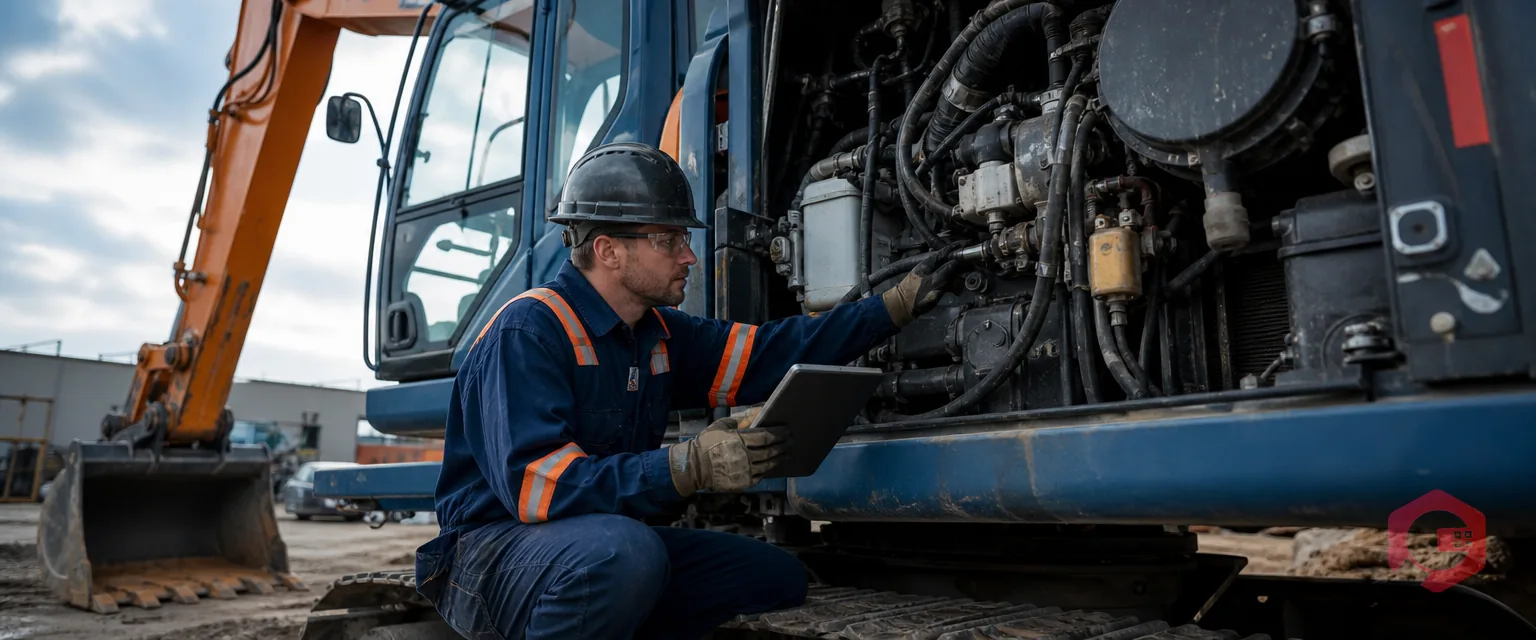
Managing warranty claims for heavy equipment comes down to one recurring problem: the failure is covered, but the paperwork isn't there to prove it. Manufacturers condition heavy equipment warranties on documented proof that maintenance happened on schedule, and most claim denials trace back to a missing record, not an excluded failure. Doing this inside the same CMMS that already runs your preventive maintenance means the proof exists before you ever need to file a claim. This guide covers why claims get denied, a framework for keeping every asset claim-ready, and how to track warranty coverage across a mixed fleet without losing money to a paperwork gap.
Key Takeaways
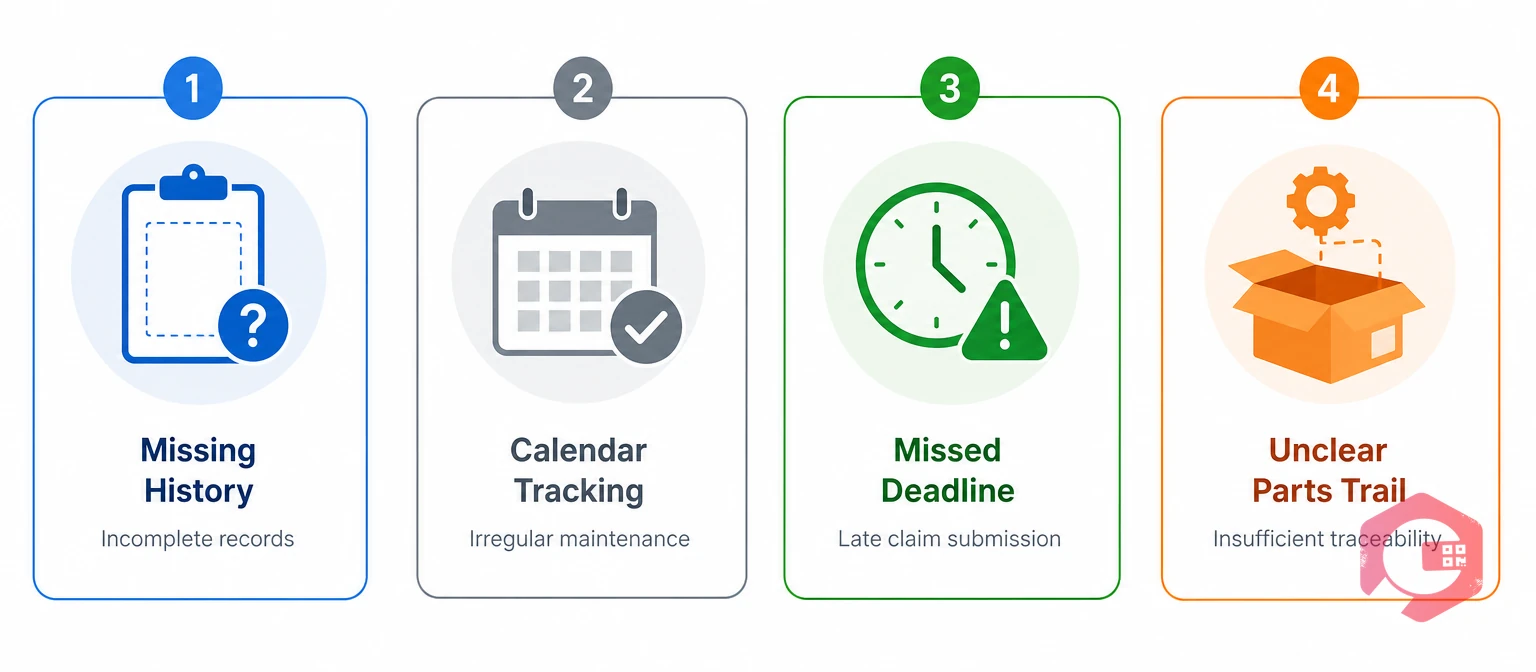
A warranty claim for heavy equipment rarely gets denied because the failure itself falls outside coverage. It gets denied because the fleet owner can't produce proof that required maintenance happened on schedule, in the order the manufacturer specified.
None of these are coverage disputes. They're paperwork gaps, and paperwork gaps are exactly what a documented maintenance system is built to close.
A warranty is a manufacturer's promise to repair or replace a covered failure. That promise is conditioned on the equipment being maintained according to specified terms, a condition every warranty carries by design. Heavy equipment OEMs write those terms tightly: specific service intervals, specified parts or fluids, and documented proof that both happened.
A claim typically needs four things: the failure description, the meter-hour reading at failure, the maintenance history leading up to it, and the parts and labor used in the repair. Missing any one of these gives the OEM's claims reviewer a reason to deny or delay, even when the failure itself is clearly covered.
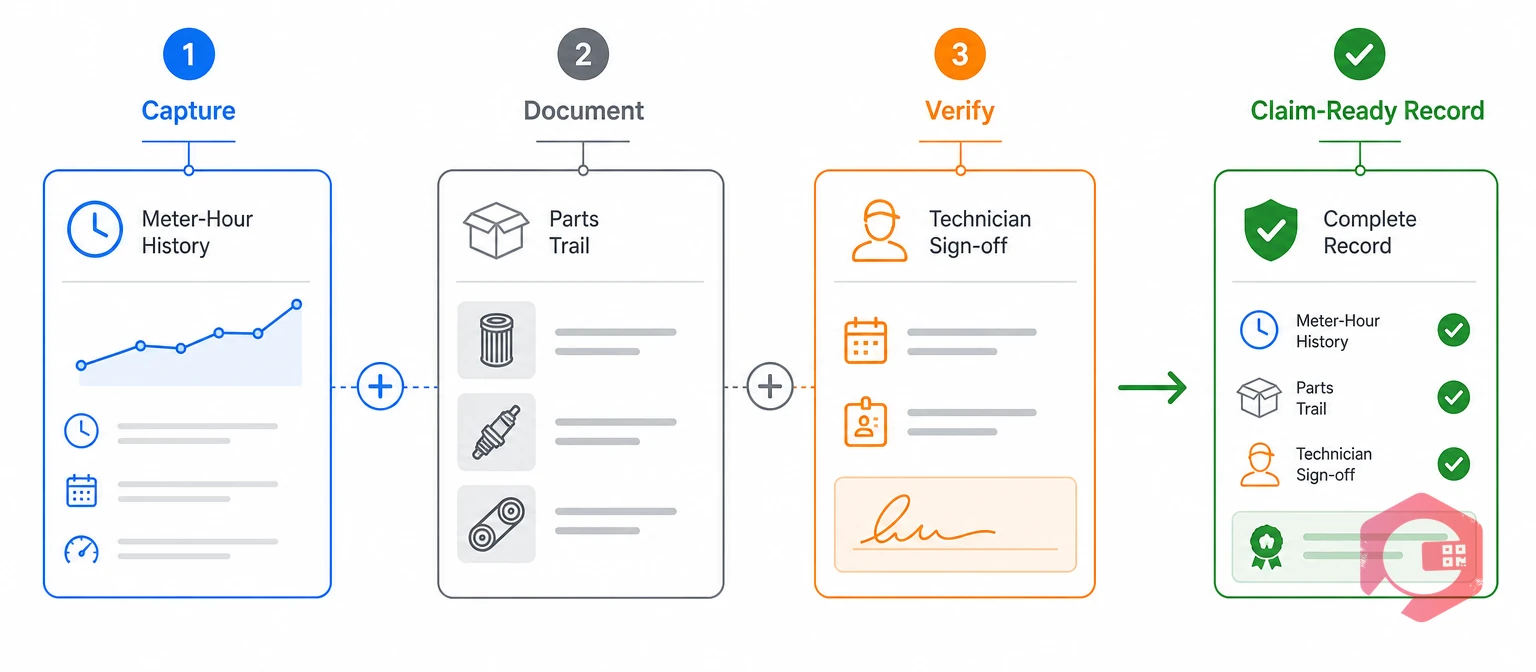
The Claim-Ready Maintenance Record: a documented standard, built on preventive maintenance practice, has three parts. Most denied claims are missing at least one of them.
Cryotos's maintenance checklists capture all three at the point of service. The claim-ready record builds itself as maintenance happens, instead of being reconstructed after a failure.
Heavy equipment warranty intervals are specified in operating hours: every 250, 500, or 1,000 hours, not every 30 or 90 days. A machine that sits idle for two weeks and then runs hard for three days doesn't fit a calendar-based PM schedule, but it fits an hour-based one exactly.
Cryotos's IoT meter reading feature triggers preventive maintenance directly off actual operating hours. The maintenance record lines up with the exact interval language in the warranty terms, instead of an approximation based on the calendar.
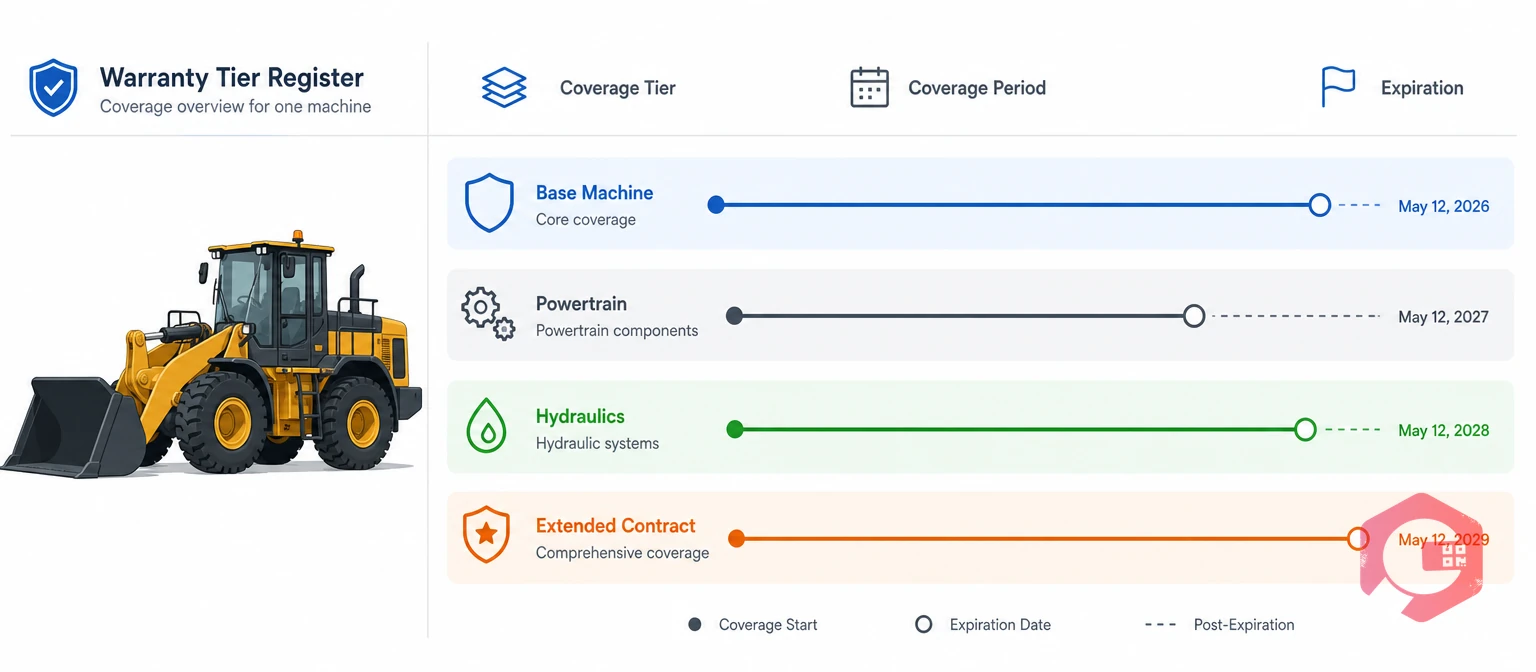
A single piece of heavy equipment can carry several overlapping warranty tiers at once, each with its own expiration date and its own coverage terms.
| Warranty Tier | Typical Duration | What It Covers | Compliance Requirement |
|---|---|---|---|
| Base Machine | 12–24 months or a set hour limit | General structural and mechanical defects | Standard PM schedule per OEM interval |
| Powertrain | Often longer than base machine coverage | Engine, transmission, drivetrain components | Fluid and filter changes at specified hours |
| Hydraulics | Varies by manufacturer and model | Pumps, cylinders, hydraulic lines | Fluid analysis and seal inspection intervals |
| Extended Service Contract | Purchased separately, stacks on base coverage | Extends base or powertrain terms | Same documentation standard as base warranty |
Cryotos's expiration reminder feature tracks each tier's end date independently on the asset record. A lapsed extended contract doesn't get mistaken for still-active base coverage.
Fleet owners often assume any aftermarket part or independent service automatically voids a warranty. In the United States, that isn't how the law works. The Magnuson-Moss Warranty Act limits how far a manufacturer can go in denying a claim over aftermarket parts. The manufacturer must show that specific part actually caused the failure, per the federal statute governing product warranties.
| Scenario | Typical Warranty Impact |
|---|---|
| OEM parts, OEM-authorized service | No impact on coverage |
| Aftermarket part, documented equivalent quality | Generally does not void coverage on its own |
| Aftermarket part directly linked to the failure | Manufacturer can deny the specific claim |
| Independent service, undocumented | Weakens the claim even if service was proper |
The deciding factor isn't whether a part was OEM. It's whether the maintenance record can show what was used and that it didn't cause the failure. That record is what makes the difference between a denied claim and an approved one.
A strong claim packages four things together. It needs the failure description, the meter-hour reading at the time of failure, the complete maintenance history for the affected system, and the parts and labor record for the repair.
Cryotos's document management attaches invoices, inspection reports, and service records directly to the asset. All four pieces are already assembled before a claim is even filed, instead of being reconstructed against a filing deadline.
Cryotos ties warranty tracking directly to the asset record. Meter-hour readings trigger PM tasks on the manufacturer's actual interval. Completed work orders attach parts, labor, and documentation permanently. Expiration reminders flag each warranty tier independently before it lapses.
Fleets managing heavy equipment through Cryotos have reported up to a 30% reduction in unplanned downtime and 25% faster repair turnaround. Those outcomes also translate directly into stronger, faster-approved warranty claims when a covered failure does happen. See Cryotos's heavy equipment maintenance solution page for how this fits a mixed fleet.
Most heavy equipment warranty claims are denied because the fleet owner can't prove maintenance was completed on schedule, not because the failure itself is excluded from coverage. Missing meter-hour records, incomplete parts documentation, and missed filing deadlines are the most common causes.
Not automatically. Under the Magnuson-Moss Warranty Act, a manufacturer generally must show that a specific aftermarket part caused the failure before denying a claim on those grounds. Using aftermarket parts alone doesn't forfeit coverage.
Heavy equipment usage varies widely between idle periods and heavy operation, so manufacturers specify maintenance intervals in operating hours to match actual wear rather than elapsed calendar time. A calendar-only maintenance log can't demonstrate compliance with these hour-based terms.
A complete claim needs the failure description, the meter-hour reading at the time of failure, the maintenance history for the affected system, and a record of the parts and labor used in the repair.
A warranty claim is only as strong as the maintenance record behind it. Schedule a free demo to see how Cryotos keeps every asset in your fleet claim-ready, before you ever need to file.




Cryotos AI predicts failures, automates work orders, and simplifies maintenance—before problems slow you down.



