
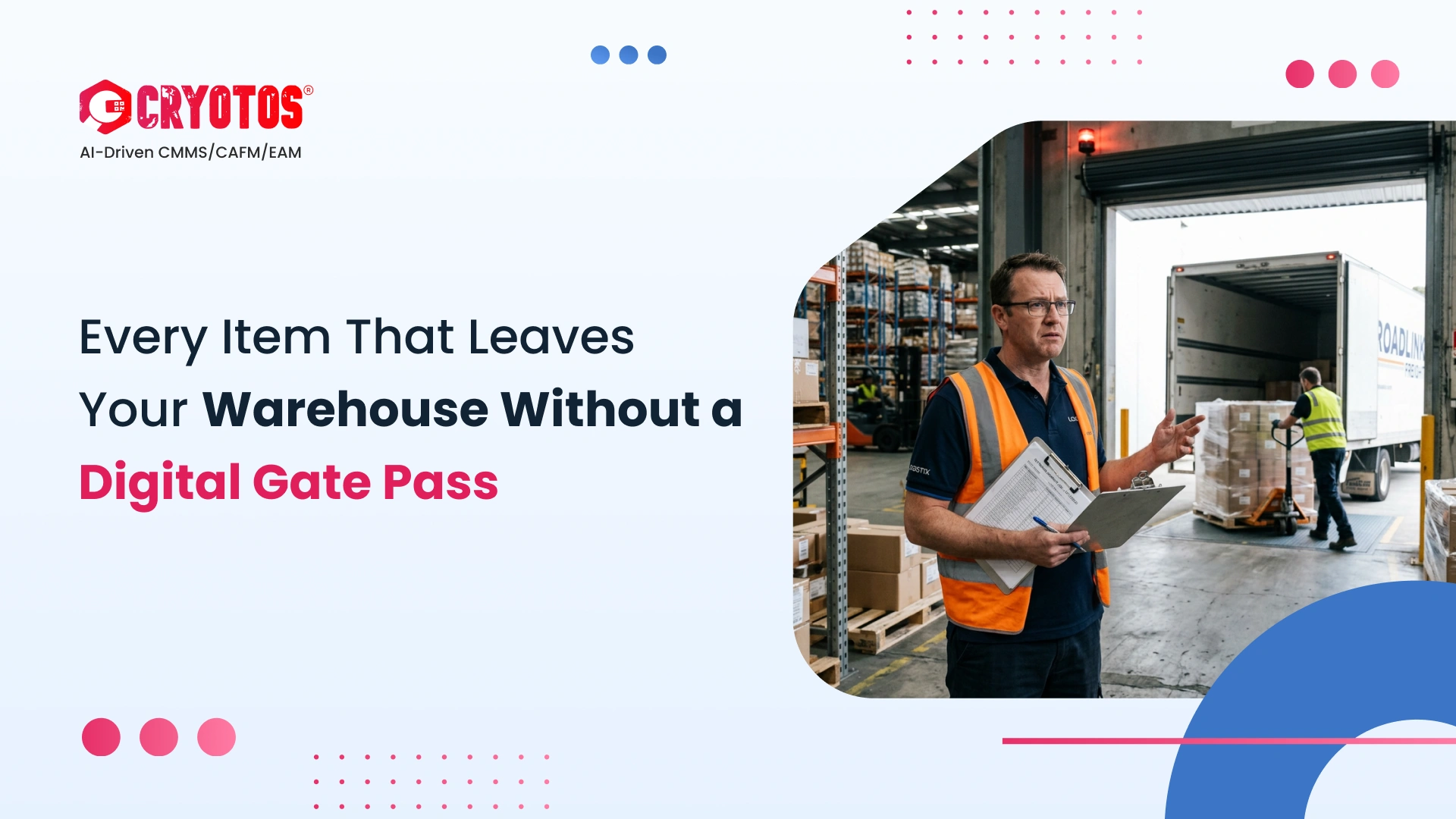
Picture this — a delivery driver arrives at your warehouse. He is picking up twelve units of a fast-moving SKU that a customer has returned. Your warehouse associate helps him load the items. The driver leaves. The associate moves on to the next task. Three days later, your inventory system shows a discrepancy. Twelve units are missing from the expected return count. Finance flags it. Operations investigate. Nobody can say for certain what happened to those units — because nothing was recorded at the point they left the building.
Was it a system error? A mislabeled return? Did the units go missing between the customer and your warehouse? Or did twelve units walk out of your facility without a single record being made?
Without a gate pass, you cannot answer that question. And in ecommerce, questions you cannot answer cost you money — in shrinkage, in audit failures, and in disputes you cannot win because you have no proof.
A Material Gate Pass — or MGP — is exactly what the name suggests. It is a formal, authorized record of every item that moves through your warehouse gate, whether inbound or outbound.
Think of it as a passport for your inventory. Just as a person cannot cross a border without a document verifying their identity and purpose, no item should leave your warehouse without a record verifying what it is, why it is leaving, who authorized it, and where it is going.
In traditional warehousing, gate passes were paper forms filled out by security or store staff at the point of dispatch. They captured basic details — item description, quantity, vehicle number, destination — and were filed in a register that nobody looked at until something went wrong.
In modern ecommerce operations, that paper process has become the weakest link in the entire inventory chain. Fast-moving stock, multiple outbound movements per hour, rotating staff, multi-location warehouses, and the sheer volume of non-sale outflows — returns, repairs, vendor samples, transfers, loan items — have made manual gate passes not just inefficient but genuinely dangerous to inventory accuracy.
Most ecommerce operations have tight processes for the movements everyone can see — customer order dispatch, inbound stock receiving, returns processing. These are visible flows. They are tracked, measured, and reported.
The movements that quietly drain inventory accuracy are the ones in between. The ones that happen informally, without a system record, because they do not fit neatly into the standard order-to-dispatch workflow.
Here are the most common categories:
A brand sends products to an influencer for a review. A catalogue team takes units for a photoshoot. A sales team carries samples to a trade event. In every one of these cases, inventory leaves the warehouse — sometimes never to return — and in many operations, nothing is recorded except verbal authorization.
A piece of equipment, a returned unit with a cosmetic defect, or a display sample that needs reworking, goes out to a third party for repair. If it is a returnable movement, the expectation is that it comes back. But without a formal returnable gate pass with a defined return date and quantity, there is no system trigger when it does not arrive back on time.
The inventory moving from one of your locations to another is still your inventory — but between the moment it leaves Warehouse A and the moment it arrives at Warehouse B, it exists in a tracking grey zone. If anything goes wrong in transit, your ability to investigate depends entirely on how clearly the outbound movement was recorded at the source.
A vendor quality issue, an over-delivery, a wrong SKU — all of these require stock to move back to the supplier. Without a formal non-returnable gate pass authorizing and recording the outbound movement, your inventory record shows the stock as still present long after it has left.
Items written off and removed from inventory need to exit the physical premises. Without a recorded movement, the stock sits in a digital limbo — written off in the system but unverified in reality.
Each of these categories is routine. Each happens in every ecommerce operation. And in most operations, none of them are tracked with the same rigour as a customer order.
The purpose of a gate pass is accountability — a record that a specific movement happened, with specific items, at a specific time, authorized by a specific person.
A paper gate pass technically fulfils this purpose. The problem is what happens to that paper afterwards.
It goes into the register. The register sits at the security desk or in the warehouse manager's office. When something goes wrong and an investigation begins, someone must physically search through that register — or multiple registers, across multiple shifts, across multiple gates — to find the relevant entry.
Assuming that the entry was made correctly. And legibly. And with the right details.
Manual gate pass systems introduce error at every stage — in the data entry, in the quantity verification, in the filing, and in the retrieval. When a discrepancy is discovered weeks or months after the movement occurred, the paper trail that was supposed to provide accountability often provides nothing more than a partially legible record that raises more questions than it answers.
And that is assuming the gate pass was filled out at all. In high-volume ecommerce warehouses where dozens of movements happen every hour, the gate pass is the easiest step to skip when the team is under pressure.
Not all outbound movements are the same, and a well-designed gate pass system treats them differently.
A returnable gate pass is issued when items leave the warehouse with the expectation of coming back. Repairs sent to a third-party service center. Stock loaned to a pop-up event. Equipment dispatched for testing. Samples sent to a vendor for quality verification.
The key elements of an RGP are the expected return date, the return quantity, and the person or organization responsible for the return. A digital system tracks these parameters and alerts the warehouse team when a returnable movement is overdue — before the discrepancy is discovered in a cycle count.
A non-returnable gate pass covers permanent outbound movements — vendor returns, disposal and liquidation, inter-warehouse transfers, and any other outflow where the items are not expected to come back. These movements need to be authorized, verified, and recorded so that the inventory record is updated at the point of departure, not retrospectively.
The distinction matters because the downstream consequences are different. A missing returnable item has a recovery window — it may still come back. A non-returnable movement that was not recorded creates a phantom in your inventory that inflates your apparent stock levels until a count reveals the discrepancy.
The consequences of untracked outbound movements compound over time. A single unrecorded transfer is a minor discrepancy. Dozens across a month, across multiple gates and multiple shifts, become a significant inventory accuracy problem with no clear starting point for investigation.
Inventory discrepancies cannot be explained: When your physical count and your system count do not match, you need to be able to explain why. If the gap traces to a vendor return that was not recorded, a transfer that happened informally, or a repair that was dispatched without documentation, the investigation hits a wall. You cannot reconcile what was never recorded.
Audit findings with no defense: Regulatory audits, financial audits, and client audits all require the same thing — proof that your inventory records reflect reality. When movements are unrecorded, that proof does not exist. An auditor who finds a gap between your system stock and your physical count will classify it as unexplained shrinkage — and unexplained shrinkage raises questions about inventory management practices that take time and effort to resolve.
Vendor and supplier disputes you cannot win: When you return stock to a supplier and they dispute the quantity, or claim they never received the items, your only evidence is the outbound record from your warehouse. Without a gate pass that captures the quantity, the vehicle, the time, and the authorization, you are in a dispute with no documentation on your side.
Shrinkage that accumulates invisibly: Retail inventory shrinkage costs US retailers tens of billions of dollars annually. A significant portion of that shrinkage happens not from dramatic theft but from the quiet accumulation of small, unrecorded movements — items that left for legitimate reasons with no record made, and items that left without authorization precisely because no record was required.
A digital Material Gate Pass system does not add friction to warehouse operations. Done correctly, it removes it — by replacing a manual form-filling step with a structured digital workflow that is faster, more accurate, and infinitely more useful when you need to investigate something later.
Here is how it works in practice.
A movement is initiated — A warehouse manager or authorized user raises a gate pass request in the system — specifying the items, the quantities, the movement type (returnable or non-returnable), the destination or recipient, the vehicle details, and the reason for the movement.
Approval happens in the system — For movements above a defined threshold — by value, by quantity, or by SKU category — a multi-level approval workflow is triggered. The approving manager receives a notification, reviews the details, and authorizes or rejects the movement. This approval happens digitally, creating a timestamped record of who approved what and when.
The gate pass is generated — Once approved, the system generates a unique gate pass — with a QR code or barcode — that accompanies the physical movement. Security staff at the gate scan the pass to verify the items match the authorization before allowing the vehicle to exit.
Inventory is updated at the point of movement — The moment the gate pass is confirmed at exit, the inventory system updates. The units are no longer counted as present. If it is a returnable movement, the system creates an open return record that tracks the expected return date and triggers alerts if it is not closed.
A complete audit trail is created — Every action in the process — the request, the approval, the gate verification, the exit confirmation — is captured with a timestamp and a user record. When a question arises about a specific movement weeks later, the complete history is retrievable in seconds.
Cryotos builds Material Gate Pass management directly into its warehouse and inventory module — connecting every outbound movement to the inventory records, the approval workflow, and the audit trail in one system.
Every gate pass in Cryotos is structured around the movement type. Returnable gate passes create an open return record with a defined due date, automatically alerting the warehouse team when a return is overdue. Non-returnable passes immediately update inventory levels at the point of authorization, keeping the system and physical reality in sync.
The approval workflow is configurable — you define which movements require single approval, multi-level authorization, or no approval at all based on value thresholds, item category, or destination type. Approvers receive instant notifications via mobile, email or WhatsApp, so authorization does not become a bottleneck.
At the gate, QR code or barcode scanning verifies the items against the authorized pass before the vehicle moves. Nothing leaves without matching the record. Any discrepancy between the physical items and the gate pass is flagged immediately, not discovered three weeks later in a cycle count.
Every completed gate pass — its authorization chain, the items verified, the time of exit, and the vehicle details — feeds directly into the stock ledger. The movement history is searchable, filterable, and exportable for audit purposes.
For ecommerce operations running multiple warehouses, Cryotos provides a unified view of all gate pass activity across every location. A movement from Warehouse A to Warehouse B is recorded at both ends — as an outbound gate pass at the source and an inbound receipt at the destination — giving you a complete chain of custody for every inter-warehouse transfer.
Here is a quick way to assess how much risk your current process carries.
Pick any week in the last month. Now answer these questions:
How many items left your warehouse that were not customer orders? What was the exact quantity of each? Who authorized each movement? At what time did each movement happen? Where did each item go? Which ones have come back — and which are still outstanding?
If you can answer all those questions with complete accuracy in under five minutes, your outbound movement control is in good shape.
If the answers require a call to the warehouse manager, a search through a paper register, or an honest admission that some of those movements were never formally recorded — you already have a liability problem. You just have not yet discovered what it is costing you.
A digital gate pass system does not change what leaves your warehouse. It ensures that everything that leaves is authorized, verified, recorded, and traceable. And in ecommerce, where inventory accuracy is the foundation of every financial and operational decision, that traceability is not optional.
The inventory that leaves your warehouse through proper customer orders is the easy part. Your systems track it, your dashboards report it, and your team is accountable for every unit. The inventory that leaves through every other channel — returns to vendors, repairs, samples, transfers, disposal — is where accountability quietly breaks down. Not because of malice. Because there is no structured process that requires it.
A digital Material Gate Pass closes that gap. Every item that leaves your warehouse, for any reason, is authorized before it moves, verified at the point of movement, and recorded in a system that can be searched, reported, and presented as evidence when a question arises.
The items that left without a gate pass are already gone. But what leaves next — that you can control.
If you would like to see how Cryotos manages Material Gate Pass for ecommerce warehouse operations, book a free product tour.




Cryotos AI predicts failures, automates work orders, and simplifies maintenance—before problems slow you down.



