

First time right (FTR) is the percentage of maintenance tasks completed correctly on the first attempt. There's no rework, no repeat work order, and no quality failure traced back to equipment that wasn't actually ready. Plants with weak FTR rates lose money in three places: scrap from a bad first run, technician hours spent fixing the same fault twice, and downtime that a standard procedure should have prevented. The strategies below target the four root causes that decide whether a job goes right the first time: standardized procedures, parts and information availability, early fault detection, and disciplined root cause analysis.
Key Takeaways

First time right is the rate at which a manufacturing task gets completed correctly on the first try. A repair, a changeover, a quality check, or a production run all count. FTR is a close cousin of first pass yield, a term borrowed from Six Sigma methodology. But FTR covers maintenance execution too, not just production output.
Most plants already track pieces of FTR without naming it that way. A repeat work order is a maintenance ticket reopened for the same fault within a short window, usually 30 days. A quality hold tied to equipment condition, or a callback after a "completed" repair, are FTR failures hiding in plain sight. They often sit in three different systems, so nobody adds them up into one number.
Each strategy in this guide maps to one of these four causes. Fix the cause, and the FTR rate moves.

A low FTR rate quietly inflates three cost lines. Scrap from a bad first run gets logged as a quality issue. Rework hours get buried in overtime. Unplanned downtime gets blamed on the asset instead of the process that let it fail.
Maintenance teams using manufacturing maintenance software have reported up to 30% reduction in unplanned downtime and 25% faster repair turnaround. Both numbers are downstream effects of catching problems earlier and fixing them right the first time.
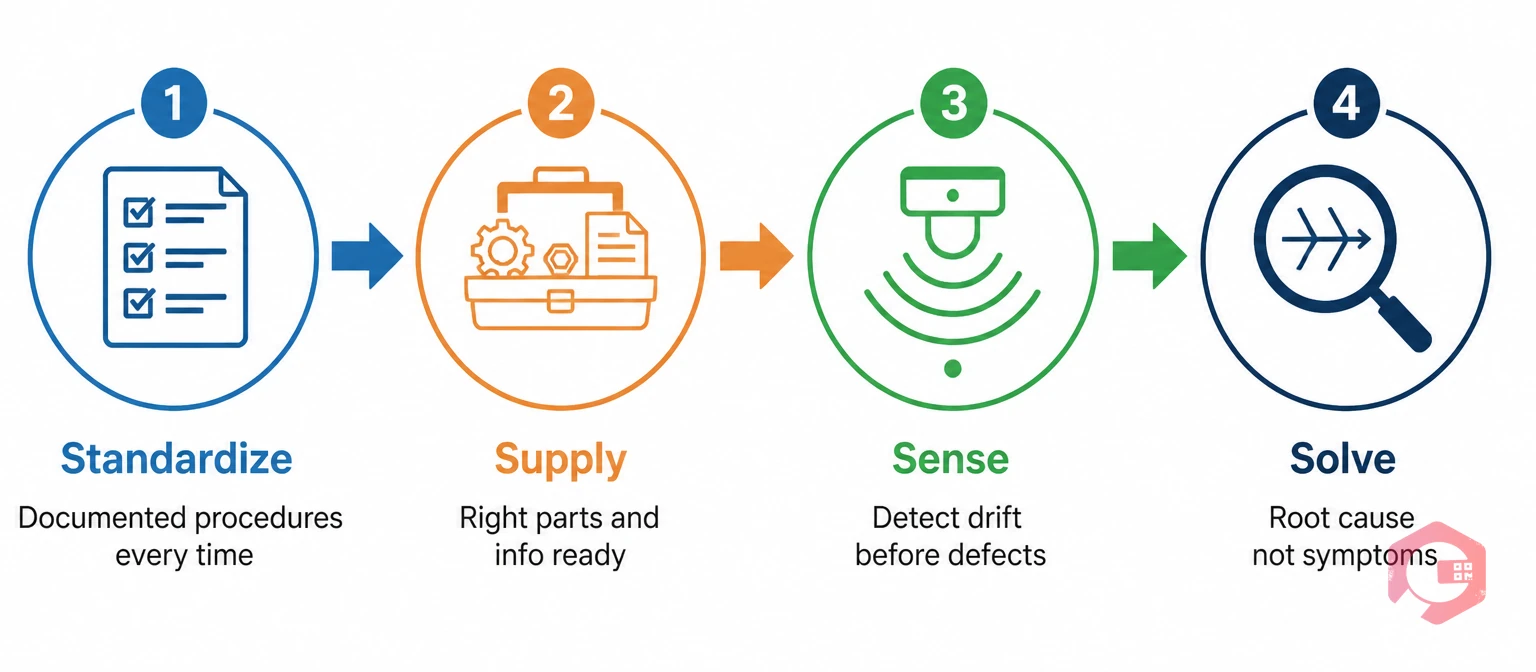
Most plants that successfully raise their FTR rate are working through the same four levers. They just don't always call it a framework.
The First Time Right 4S Framework:
This overlaps with lean maintenance principles. Lean treats rework and unplanned downtime as waste to be designed out of the process, not absorbed as a cost of doing business.
Use the OEE calculator to see where your current performance stands against each of these four levers.
Standardizing procedures is usually the fastest, lowest-cost way to raise FTR. It removes variance without new hardware or extra headcount. Five technicians following five different mental versions of the same task will always produce inconsistent results, no matter how skilled each one is.
A Computerized Maintenance Management System (CMMS) centralizes these checklists. The latest version is always what a technician sees on a mobile device, not a printed sheet from two revisions ago.
A technician who arrives without the right part has two bad options. They either improvise a workaround or leave the job half-finished. Both count as FTR failures, and both usually show up later as a second visit. Part and information availability is a planning problem more than a technician skill problem.
Smaller manufacturers building out this kind of planning discipline for the first time have outside help available too. The NIST Manufacturing Extension Partnership works specifically with small and mid-sized plants on process improvement, including the planning systems that support a higher FTR rate. Even a basic min-stock alert on the ten most-used spare parts removes a large share of avoidable second visits.
Detecting a fault before it causes a defect shifts maintenance from reactive to predictive. It's the strategy with the most direct link to scrap reduction. Equipment rarely fails without warning. It usually fails because nobody was watching for it.
Plants that combine scheduled PMs with operator-level sensing typically catch most drift-related faults before they reach a quality check. Plants without that combination usually catch them after.
Root cause analysis (RCA) is a structured method for finding the true source of a failure. It goes deeper than the symptom that triggered the work order in the first place. Without this step, a fixed asset can fail again within weeks, and that second visit counts against FTR just as much as the first one did.
Common mistake: most teams document the fix but not the cause. The same failure pattern resurfaces under a different work order number a few months later, and nobody connects the two.

You can't improve a number you aren't tracking. FTR is rarely tracked by name, even though most of its inputs already exist in a typical CMMS or quality system.
| Metric | What It Measures | Where It Comes From | Signals Poor FTR |
|---|---|---|---|
| First Pass Yield | % of units passing quality check without rework | Quality / production system | Below 90% on stable processes |
| Repeat Work Order Rate | % of work orders reopened within 30 days | CMMS work order history | Above 5-8% on the same asset |
| MTTR | Average time to repair a failure | CMMS downtime log | Rising trend over consecutive quarters |
| PM Compliance % | % of scheduled PMs completed on time | CMMS PM schedule | Below 85% compliance |
A drop in PM compliance is usually the earliest warning sign of a coming FTR problem. It points directly at the standardize and sense pillars of the 4S Framework. The overall equipment effectiveness (OEE) metric is a useful companion here. Its quality component reflects FTR failures at the production line level. Standards like the ISO 9001 quality management standard ask for this kind of traceable measurement as part of a documented quality system.
First time right means a maintenance or production task gets completed correctly on the first attempt. There's no rework, no repeat work order, and no quality issue traced back to the equipment involved. It applies to repairs, changeovers, and quality checks alike, not just final product inspection. Most plants can calculate a rough FTR number just by combining data they already have in their CMMS and quality systems.
First pass yield is a production-floor metric. It measures the percentage of units passing quality inspection without rework. FTR is the broader concept that also covers maintenance execution, such as whether a repair was completed correctly without a follow-up visit a few weeks later.
A rising repeat work order rate is usually the first sign. Declining PM compliance percentage and an upward trend in MTTR are the other two clearest warnings. Tracking all three together gives a more reliable picture than watching any single metric on its own.
Yes, mainly through four mechanisms. Standardized digital checklists remove procedure variance. Real-time parts and asset history sit at the point of work. Condition-based maintenance triggers catch drift early. Built-in root cause analysis tools stop repeat failures from recurring unnoticed.
Raising first time right is rarely about one fix. It's the compounding effect of standardized procedures, available parts, early fault detection, and closed-loop root cause analysis working together. Schedule a free demo to see how Cryotos helps manufacturing plants close these gaps and turn first time right from a vague goal into a tracked, improving number.



Cryotos AI predicts failures, automates work orders, and simplifies maintenance—before problems slow you down.



