

Fluid viscosity affects pump reliability, energy use, and maintenance planning because thicker liquids raise friction, power demand, and heat, while thinner liquids weaken lubrication and increase internal leakage. A pump that runs on the wrong viscosity wears faster, costs more to run, and fails on a schedule nobody planned for.
Most maintenance teams size and service pumps for one set of conditions, yet real liquids change with temperature, age, and contamination. This guide shows what changes inside the pump, how the energy penalty builds, and how to bring viscosity into your maintenance plan.
Key Takeaways
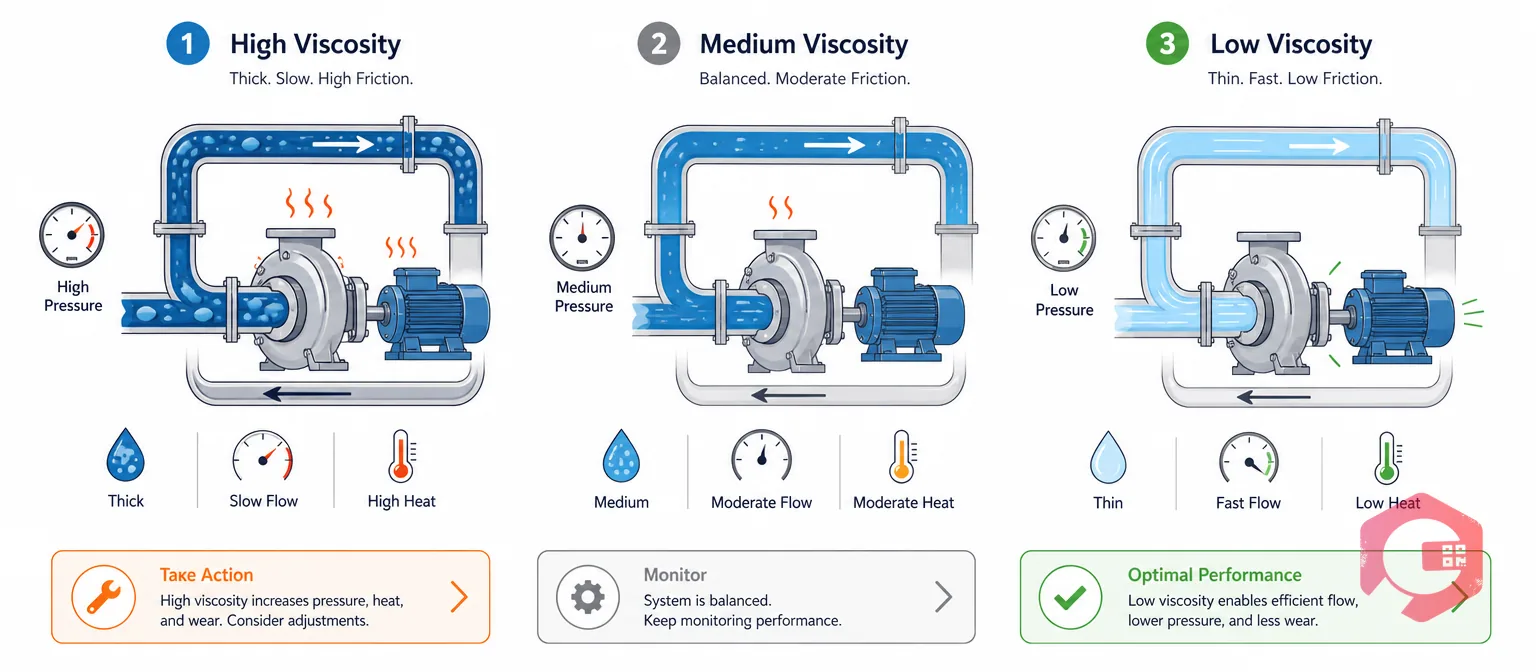
Fluid viscosity is a liquid's resistance to flow. Water at room temperature measures about 1 centipoise (cP). Heavy lube oils and process liquids can be hundreds or thousands of times thicker.
Data sheets use two units. Kinematic viscosity is dynamic viscosity divided by liquid density. It is reported in centistokes (cSt), and lubricant grades under ISO 3448 are rated in cSt at 40 °C. An ISO VG 46 oil, for example, has a midpoint of 46 cSt at that temperature.
Viscosity index is a number that shows how much a liquid's viscosity changes with temperature. A low index means the liquid thickens sharply in the cold and thins sharply when hot. A pump sized for a warm afternoon may struggle at a cold start.
The Hydraulic Institute's ANSI/HI 9.6.7 guideline explains how viscous liquids change the performance of rotodynamic pumps, and most pump makers apply its correction method. The takeaway is simple: a pump curve drawn for water does not describe a thick liquid.
A centrifugal pump loses flow, head, and efficiency as viscosity rises, while a positive displacement pump gains volumetric efficiency but demands more power and suction pressure. The table compares how each type responds.
| Factor | Centrifugal pump | Positive displacement pump |
|---|---|---|
| Higher viscosity | Flow, head, and efficiency all fall. | Flow holds steady and slip falls, so volumetric efficiency improves. |
| Power demand | Rises quickly from disc friction and hydraulic losses. | Rises with the force needed to push thick liquid through clearances and lines. |
| Suction risk | Inlet friction cuts available NPSH, so cavitation risk grows. | Thick liquid can starve the inlet unless speed is cut and suction lines are large. |
| Lower viscosity | Performance moves closer to the water curve. | More slip, a thinner sealing film, and faster internal wear. |
| Typical fit | Thin to moderately thick liquids. | Thick, shear-sensitive, or variable liquids. |
| Main maintenance concern | Seal and bearing heat, cavitation damage. | Internal wear when thin; relief valve and drive overload when thick or cold. |
Many engineers move from centrifugal to positive displacement designs once viscosity climbs into the hundreds of centistokes, though the switch point depends on flow, head, and cost. Whatever the type, run the pump near its best efficiency point for the working viscosity, not the water curve.
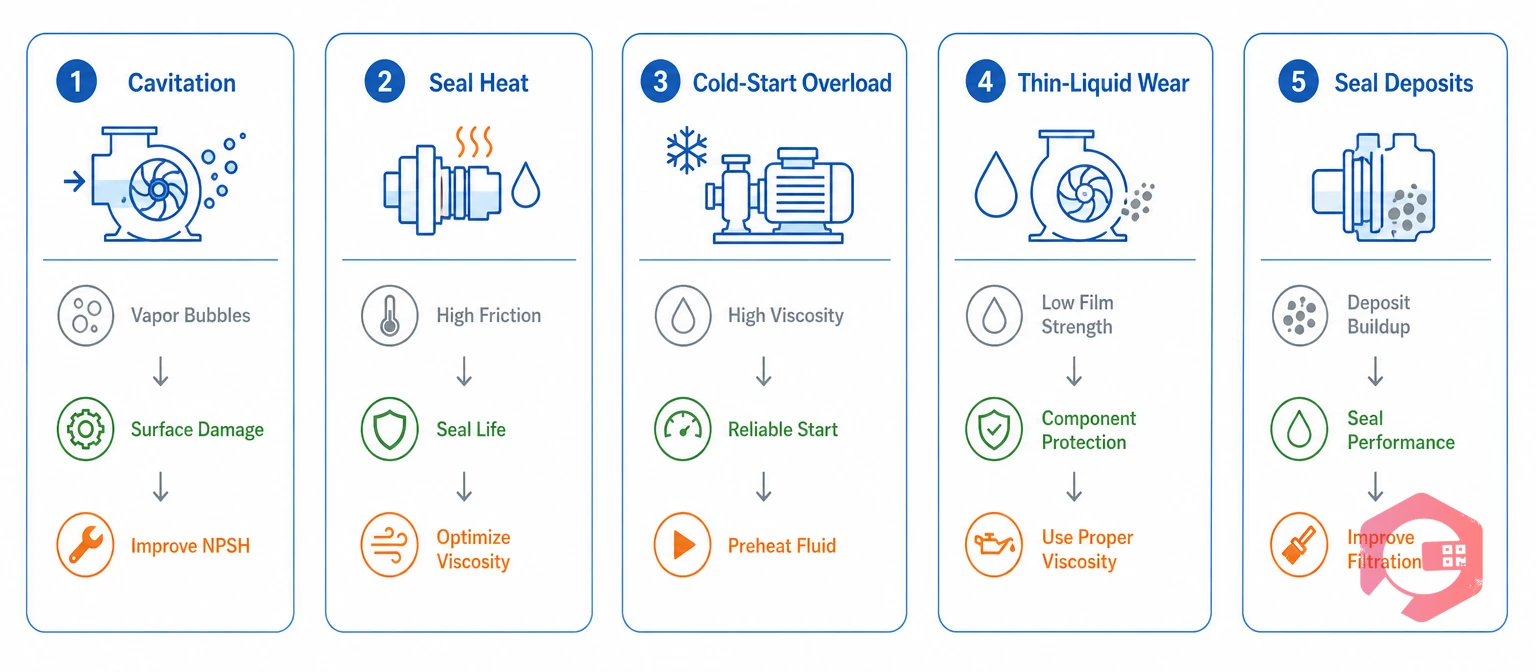
Fluid viscosity changes pump reliability by shifting the load on seals, bearings, and wetted parts and by changing how well the pump keeps a lubricating film. Five failure paths show up most often.
Maintenance teams that study repeat seal and bearing failures often find a viscosity link behind them. Log the liquid condition on every work order. Then downtime tracking shows which pumps carry the most unplanned maintenance. Most viscosity-related failures build slowly, which makes them easy to catch early.
Turn your pump repair history into a failure baseline with the Cryotos MTBF calculator.
Higher fluid viscosity raises pump energy use because the motor must supply more shaft power for the same flow. Hydraulic power equals flow times head times density times gravity. Shaft power is that value divided by pump efficiency.
A viscosity correction factor is a multiplier that adjusts a pump's water-based curve for a thicker liquid. The Hydraulic Institute method applies separate factors to flow (CQ), head (CH), and efficiency (Cη), and the result is a lower curve and a higher power draw. Four losses explain most of the extra kilowatts.
Warming a thick liquid can cut pump power, but heating costs energy too, and the liquid must stay within its safe limits. Confirm any temperature change with your process engineer.
With IoT meter reading from SCADA, PLC, or edge devices, teams can trend motor amps, liquid temperature, and discharge pressure together. A rising amp trend at steady flow is an early sign of thickening liquid, worn clearances, or a fouled impeller. Energy is usually the first place a viscosity problem becomes visible.
A fluid viscosity maintenance planning matrix links each viscosity condition to the change it causes in the pump, the action to take, and a suggested check rhythm. Treat the rhythms as examples, because your OEM manual, liquid supplier, and lab limits set the real intervals.
| Condition | What Changes in the Pump | Maintenance Action | Suggested Rhythm |
|---|---|---|---|
| Viscosity rises above design (cold liquid, aging, oxidation) | Higher amps, lower flow, hot seals. | Check heat tracing and filters; review liquid age and sample results. | Each round; sample per lab plan. |
| Viscosity falls below design (hot liquid, dilution, shear) | More slip, thinner film, faster wear. | Look for overheating or dilution; trend vibration and wear. | Monthly vibration route. |
| Large swings between day and night or summer and winter | Moving duty point; trips at cold start. | Adjust start-up steps and PM triggers by season. | Seasonal review. |
| Contaminated or mixed liquid | Deposits, abrasive wear, seal damage. | Flush, filter, and confirm the grade before any top-up. | At every top-up. |
| Poor suction conditions | Cavitation noise, pitted impeller. | Inspect strainers and suction lines; confirm NPSH margin. | Weekly walk. |
| Seals and bearings under heat | Leaks, rising temperature, vibration. | Inspect faces and temperatures; replace by condition. | Per PM and run hours. |
Build these rows into preventive maintenance software so that each check becomes a work order with a checklist and a recorded reading.
Reliability-centered maintenance (RCM) and FMEA reviews usually list viscosity drift as a failure cause for pumps that move oil or process liquids. Feed those findings into the matrix, then adjust the rhythm as your trend data builds.
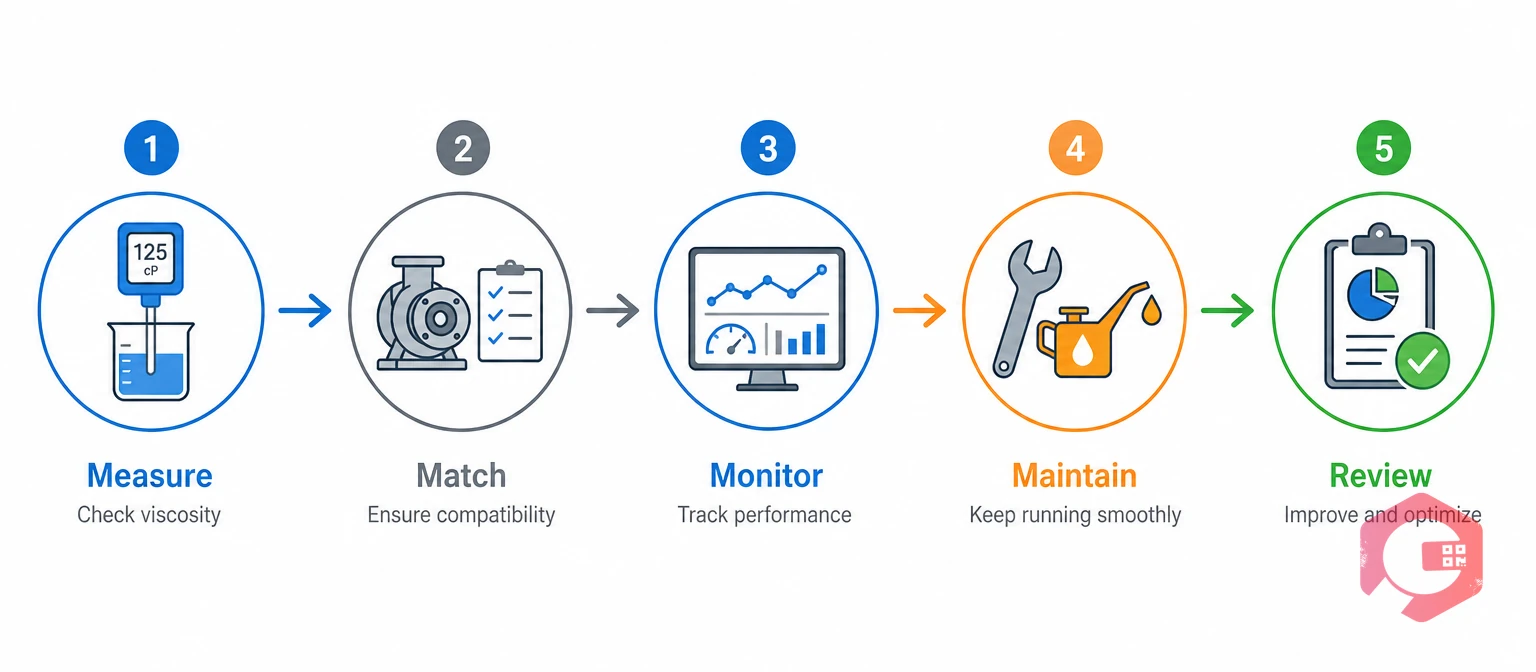
A viscosity-aware pump care program follows five steps: measure, match, monitor, maintain, and review. Each step answers one question about the liquid the pump moves.
The Viscosity-Aware Pump Care Framework:
Here is an illustrative example. A transfer pump moves lube oil from an outdoor tank, and its motor amps climb every winter morning. The team measures the oil at the coldest start, adds a warm-up step, and switches the PM trigger to run hours, which stops the winter trips.
Start with your five most critical pumps. Measure first, because every later step depends on knowing the real viscosity range.
The most common fluid viscosity mistake in pump programs is sizing and servicing from a water curve instead of the liquid the pump moves. Most maintenance teams recognize at least two of the mistakes below.
Most of these fixes cost little. They need a clear owner and a recorded reading, not new equipment.
A Computerized Maintenance Management System (CMMS) supports viscosity-aware pump maintenance by scheduling the checks, recording the readings, and tracking each repair back to its cause. It does not measure viscosity. Cryotos is a maintenance platform, not a viscometer or lab system, so lab results stay in your lab and the numbers that matter are recorded against each pump.
Maintenance teams using Cryotos have reported up to 30% reduction in unplanned downtime and 25% faster repair turnaround. For pump fleets, earlier warning on rising amps or temperature can mean fewer surprise failures.
Ask any software vendor how its records connect to your lab and process systems, because viscosity data usually starts there.
Higher viscosity lowers the efficiency of centrifugal pumps because disc friction and internal losses grow. The pump then delivers less flow and head and draws more power. A viscosity correction factor from the pump maker shows the size of the change.
Cold liquid is thicker, so start-up torque and motor current rise sharply. Couplings, shafts, and windings take the shock. Warm-up steps, heat tracing, or a soft starter can help, depending on the liquid and the drive.
Slip and leakage increase, and the lubricating film gets thinner. Pumps that rely on the liquid for lubrication, such as gear and vane pumps, wear faster. Output can also fall below the design flow.
There is no single interval. Many lubrication programs sample on a fixed schedule and after any change in duty, temperature, or supplier, and they flag a shift of about 10 percent from baseline for review. Use your OEM and lab limits first.
Positive displacement pumps often handle thick liquids better, because their flow holds steady as viscosity rises. The final choice depends on flow, pressure, shear sensitivity, and cost, so check the maker's viscosity data.
It can store viscosity results as readings and keep lab reports with the pump record. It does not measure viscosity, so the numbers still come from your lab or instruments.
Pumps last longer when the maintenance plan matches the liquid they move. Schedule a free demo to see how Cryotos turns viscosity-aware inspection routines into tracked, auditable work orders.



Cryotos AI predicts failures, automates work orders, and simplifies maintenance—before problems slow you down.



