
FMEA vs PFMEA vs DFMEA is a question of scope, not of which method is better. FMEA is the umbrella risk method. DFMEA points it at product, formula, and package design. PFMEA points it at the filling, sealing, coding, and packing steps that make the product.
For most FMCG launches, the answer is both, in order. DFMEA removes risk from the design, then hands the traits the line must hold over to PFMEA. This guide compares FMEA vs PFMEA vs DFMEA side by side. It walks through a real leak example and shows which one fits your next SKU or line change.
Key Takeaways
FMEA vs PFMEA vs DFMEA differ mainly in what they study, who owns them, and when they run. The table below shows the core split for FMCG teams.
| Dimension | FMEA | DFMEA | PFMEA |
|---|---|---|---|
| Scope | The umbrella method for any product, process, system, or service | Product, formula, component, and package design | Batching, filling, capping, sealing, coding, packing, and handling |
| Core question | How can this fail, and what happens? | What can fail because of the design? | What can fail while we make, fill, or pack it? |
| Unit of analysis | A function or a step | Design functions, materials, tolerances, and interfaces | Process steps, machine settings, changeovers, and cleaning |
| Typical owner | A cross-functional team | R&D, packaging, and design engineering | Process engineering, operations, quality, and maintenance |
| Best timing | Any lifecycle stage | Concept, prototype, and redesign | Line design, commissioning, new SKUs, and process changes |
| Main outputs | Ranked risks and actions | Revised specs, design tests, and critical traits | Control plans, SOPs, error-proofing, and PM tasks |
The takeaway: FMEA names the method, while DFMEA and PFMEA name where you point it.
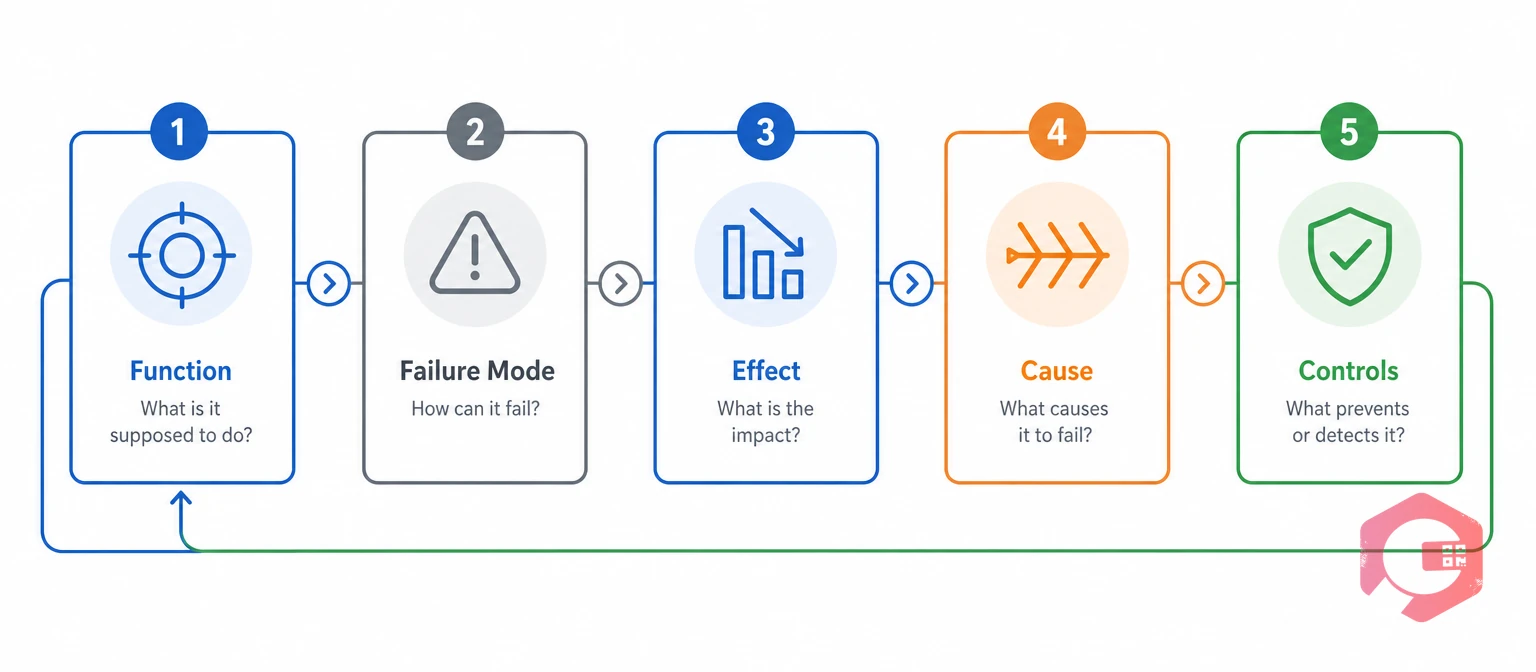
Failure Mode and Effects Analysis (FMEA) is a step-by-step method for finding how something can fail before it does. The IEC 60812 standard describes it as a way to find failure modes and their effects so that fixes can be ranked. The American Society for Quality calls it a proactive tool for design and process control.
Every FMEA works through the same five questions:
For the standard worksheet columns, see this FMEA definition and worksheet guide. The takeaway: most FMEA vs PFMEA vs DFMEA confusion starts when nobody says which one the team ran.
Design FMEA (DFMEA) is FMEA applied to what the product and package are designed to do. It asks whether the formula, bottle, cap, pouch, or label can fail because of how it was specified. In FMCG, DFMEA usually covers:
DFMEA fixes the design before release. It changes the material, shape, tolerance, or spec. R&D, packaging, and regulatory teams usually own it. The takeaway: if a better spec would remove the failure, it is a DFMEA item.
Want Occurrence ratings backed by data? Use the free failure rate calculator to set a baseline from your own breakdown history.
Process FMEA (PFMEA) is FMEA applied to how the plant makes the product, step by step. It asks what can go wrong while you batch, fill, cap, seal, code, label, inspect, pack, or move product. Typical PFMEA causes in FMCG include:
Many PFMEA causes are equipment causes. That is why the controls often land with maintenance teams. Jaw wear and sensor drift need a preventive maintenance program with condition checks, not just end-of-line inspection. Maintenance teams using Cryotos have reported up to 30% reduction in unplanned downtime and 25% faster repair turnaround.
The takeaway: if changing the method, setting, fixture, or equipment condition removes the failure, it is a PFMEA item.
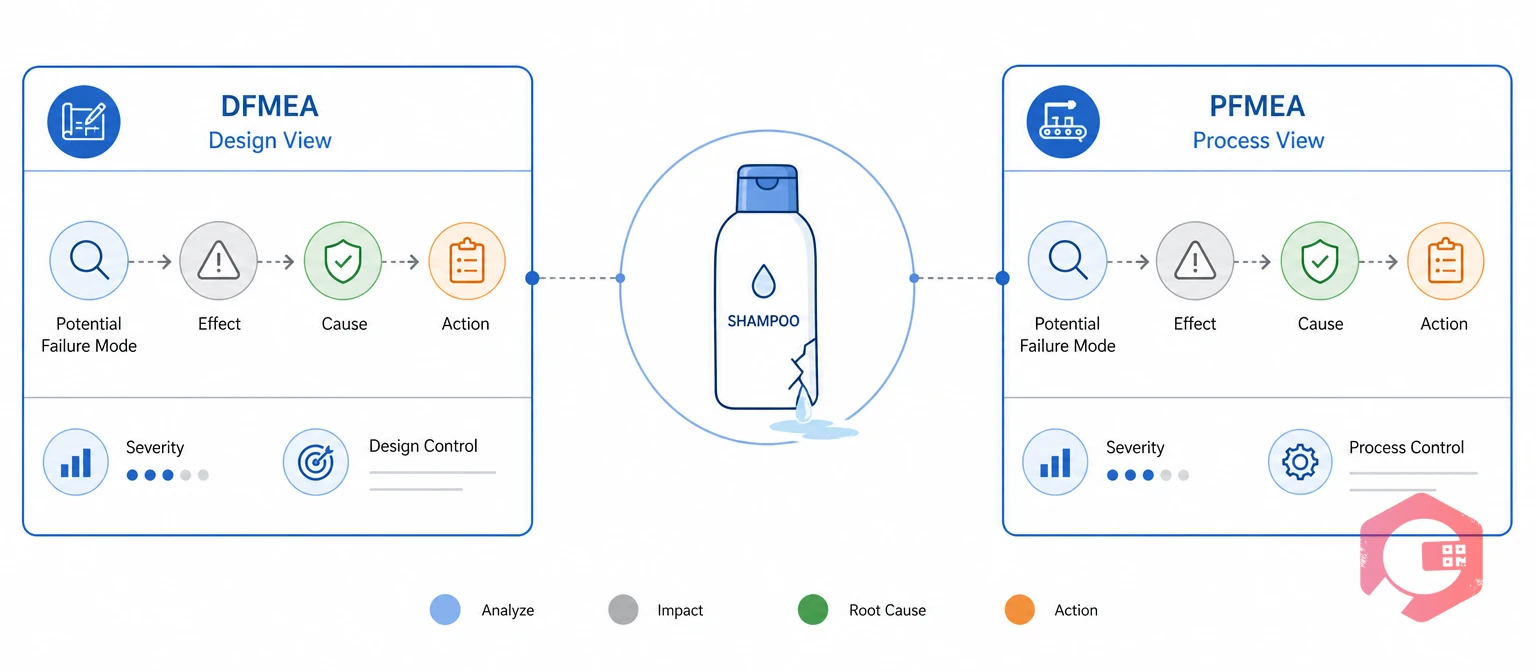
DFMEA and PFMEA can study the same symptom and reach different fixes. Take a shampoo bottle that leaks in transit.
| Element | DFMEA View | PFMEA View |
|---|---|---|
| Failure mode | The closure system does not hold the required seal | The closure is applied outside the validated torque window |
| Potential cause | Tolerance stack, wrong liner, material creep, or a weak sealing land | Wrong capper recipe, worn chuck, cross-threading, or a missed setup check |
| Prevention control | Design rules, tolerance analysis, and compatibility testing | Locked recipes, setup standards, preventive maintenance, and poka-yoke |
| Detection control | Leak, drop, and transport tests at worst-case conditions | Inline torque monitoring, start-up approval, and periodic leak tests |
| Best action | Change the design, spec, or validation plan | Stabilize the process and error-proof the setup |
If the root cause is a weak sealing land, adding torque checks on the line only contains the problem. Send design-caused failure modes back to DFMEA instead of inspecting around them.
Choose the analysis by the source of the risk and the change you are making. Use this table as a quick guide.
| Situation | Primary Analysis | How to Use It |
|---|---|---|
| New formula or recipe | DFMEA first | Check stability, compatibility, and shelf life, then pass process-sensitive traits to PFMEA |
| New cap, pump, pouch, or label | DFMEA and PFMEA | DFMEA covers design fit; PFMEA covers forming, filling, sealing, and coding |
| New line or major equipment change | PFMEA | Study each step, setting, changeover, and inspection point |
| Existing line with repeat defects | PFMEA update | Test Occurrence ratings against real scrap, downtime, and complaint data |
| Complaint traced to the spec or pack | DFMEA update | Revisit the design function, tolerance, and test coverage |
| New SKU on an existing line | Usually both | Confirm new design traits, then confirm the line can make and detect them |
| Food-safety hazard | HACCP first | Use the required hazard analysis; PFMEA adds quality detail but never replaces it |
That last row matters for food and beverage plants. The FDA HACCP guidelines set the food-safety hazard analysis, and FMEA should sit next to it. The takeaway: in FMEA vs PFMEA vs DFMEA choices, the change you are making usually names the analysis.
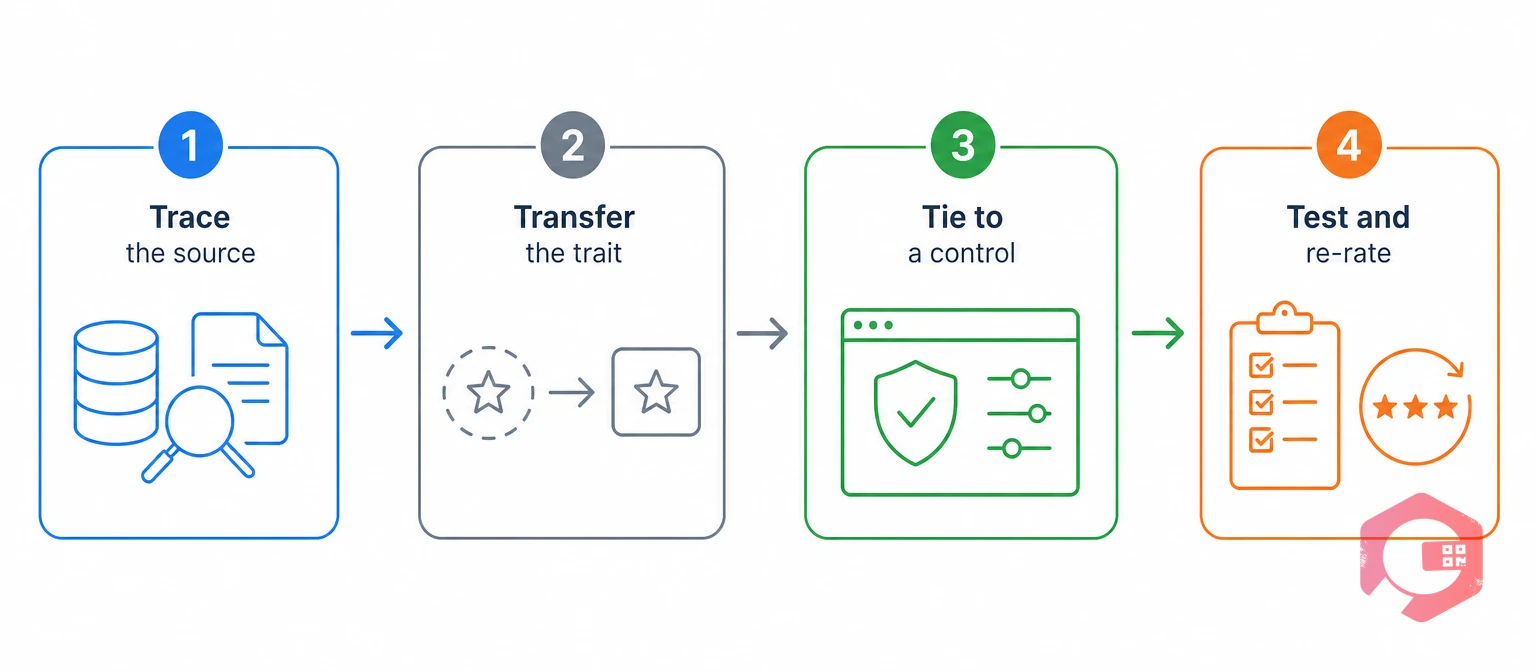
Most FMCG launch problems start at the handoff, not inside either worksheet. A design risk the line must control has to move from DFMEA into PFMEA, then into daily work.
The Design-to-Line Handoff Method:
Packaging engineering's DFMEA flags seal geometry, laminate compatibility, and drop resistance. Quality moves the critical seal traits to PFMEA. PFMEA then studies jaw heat, pressure, dwell time, and pouch alignment. Maintenance adds jaw-wear and sensor checks. Operations adds start-up checks.
In a Computerized Maintenance Management System, each of those actions becomes an assigned, dated task through work order management, with proof attached at close. The takeaway: a handoff is done only when each design risk has a named control on the line.
A risk priority number (RPN) is the product of the Severity, Occurrence, and Detection ratings. Most teams rate each from 1 to 10, so RPN = S × O × D.
Different scores can give the same RPN with very different exposure. A leak rated S9 × O2 × D5 and a label smear rated S3 × O6 × D5 both score 90. Keep your scoring honest with four rules:
The AIAG-VDA FMEA Handbook replaced RPN with Action Priority for automotive work. It is not an FMCG rule. Still, it shows why severity should never hide inside one number.
Most FMEA vs PFMEA vs DFMEA mix-ups in FMCG come from scope and follow-through. A common mistake is treating the analysis as a one-time launch document.
The takeaway: a living FMEA, reviewed whenever suppliers, materials, recipes, or line speed change, beats a perfect one filed away.
FMEA is the method, DFMEA applies it to the product and package design, and PFMEA applies it to the steps that make the product. If a design change fixes the risk, use DFMEA. If a process change fixes it, use PFMEA.
DFMEA usually starts first, during concept and prototype work. PFMEA follows once the process flow is known. It takes the critical design traits as inputs. On fast launches the two often overlap, which is fine if the handoff is logged.
No. HACCP and any required preventive-control analysis handle food-safety hazards. PFMEA can add quality detail, and the two can share controls. But PFMEA never replaces the required food-safety analysis.
Update it whenever a new ingredient, supplier, package part, machine, recipe, or line speed comes in. Also update it when a failure mode repeats or a complaint points to the process. Named owners and written triggers keep it current.
Settling FMEA vs PFMEA vs DFMEA is step one; keeping every action alive on the line is the real work. Schedule a free demo to see how Cryotos turns PFMEA actions into scheduled PM tasks, checklists, and tracked work orders.



Cryotos AI predicts failures, automates work orders, and simplifies maintenance—before problems slow you down.