

A focused improvement module in a CMMS helps FM firms build a continuous improvement culture across sites by turning individual problem-solving events into a structured, documented, and transferable process — one where a fix proven at one property automatically becomes the standard approach at every equivalent property in the portfolio, and where the improvement record becomes evidence of service quality in contract reviews.
Most FM firms already do improvement work. Engineers find smarter ways to fix recurring faults. Site managers adjust maintenance schedules based on what the data shows. Supervisors coach their teams through better processes. The problem is that none of this compounds. The improvement exists in the head of the person who made it, at the site where it happened, for as long as that person stays. When they leave, or when the same problem appears at a different site, the wheel gets reinvented from scratch.
According to McKinsey's research on lean operations in service organisations, service firms that institutionalise improvement — embedding it in systems rather than relying on individual practice — sustain performance gains 3–4 times longer than those that rely on cultural initiative alone. A focused improvement module is the mechanism that makes FM improvement institutional rather than individual.
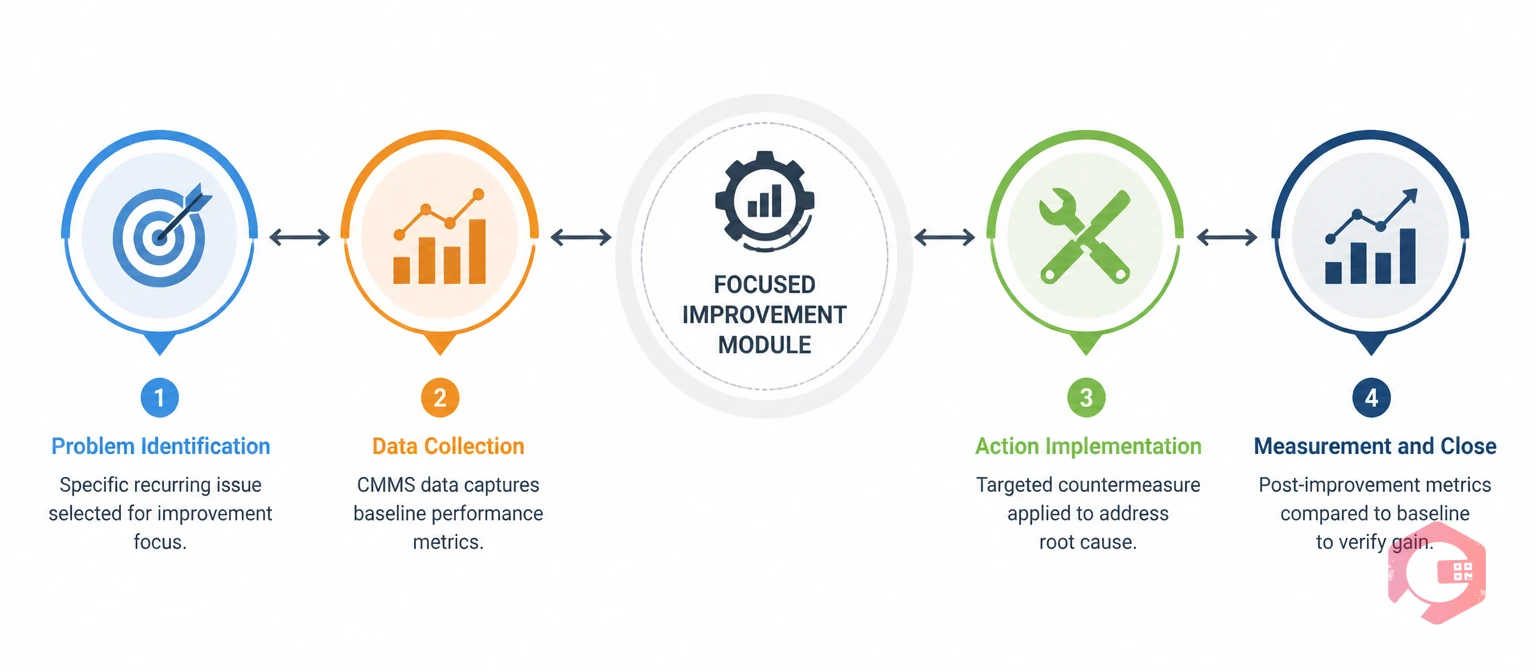
Focused Improvement (FI) is one of the eight pillars of Total Productive Maintenance (TPM). In a manufacturing context, it refers to structured team-based projects that tackle specific recurring losses — a machine that generates disproportionate downtime, a process step that consistently produces defects, a maintenance task that always overruns. In an FM context, the principle translates directly: an FI is a structured project targeting a specific recurring problem at a specific site or asset type, with a defined process, a measurable outcome, and a documented result that can be shared across the portfolio. According to the International Facility Management Association's operations research, FM organisations that apply structured improvement methodologies to recurring maintenance issues consistently outperform those relying on reactive problem management in both cost efficiency and client retention metrics.
A focused improvement module in a CMMS is the digital infrastructure that supports this work. It provides a structured way to raise an improvement opportunity from operational data, assign it to a responsible team, track the investigation and resolution steps, measure the before-and-after outcome, and publish the improvement as a transferable standard. Without the module, FI exists as a concept that smart FM managers apply informally. With it, FI becomes an organisational process that any site can run, that any operations director can monitor, and that any client can see evidence of in a monthly or quarterly performance report.
The distinction from a general CMMS dashboard or a Kaizen event is important. A dashboard surfaces data — it doesn't drive action. A Kaizen event is a point-in-time intervention — it doesn't build a system. A focused improvement module is a repeatable, tracked workflow that connects data observation to structured action to documented outcome to portfolio-wide standardisation. It's the difference between noticing a problem and solving it once, and solving a problem in a way that prevents it from occurring at any other site in the portfolio.
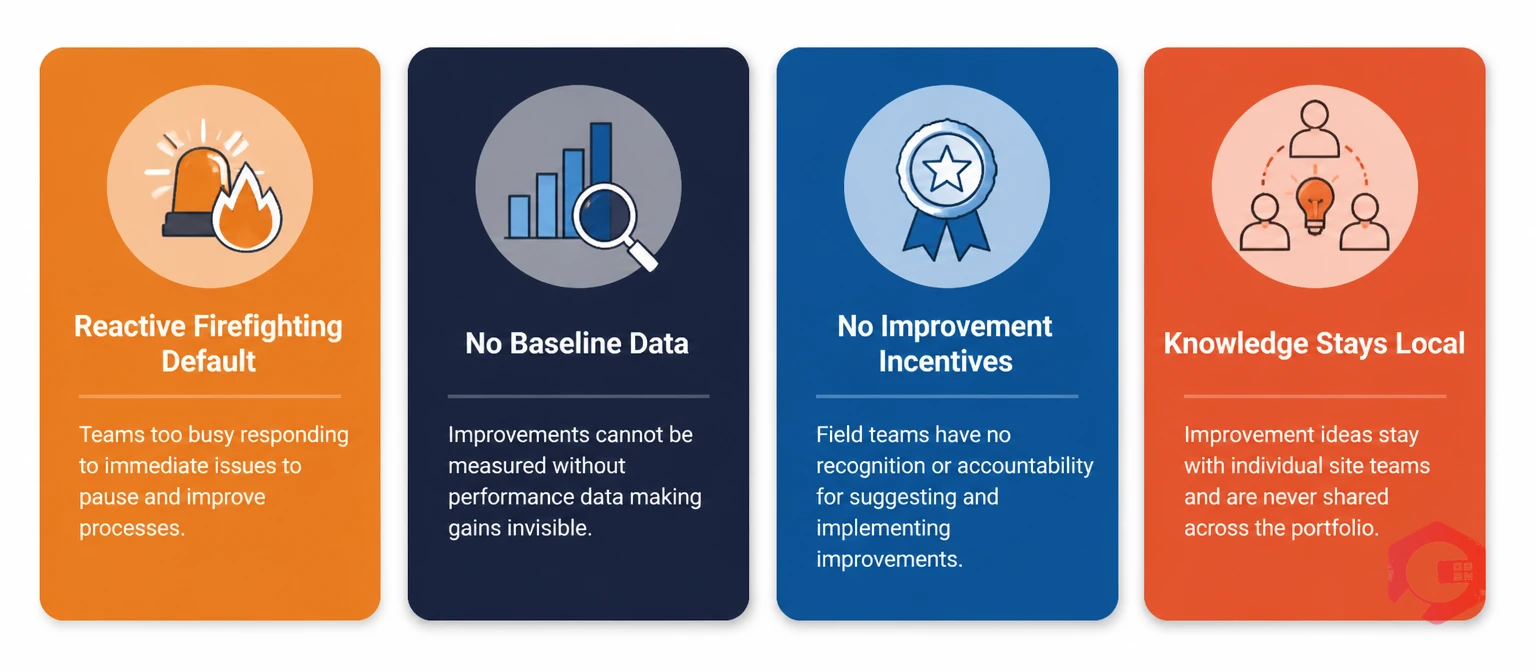
The obstacles to continuous improvement culture in FM are well understood by anyone who has tried to build one. They're not obstacles of attitude — most FM professionals want to improve. They're structural obstacles that exist in how FM work is organised and how FM firms operate commercially.
When a site engineer in a managed office building finds a better way to manage the cooling tower chemical dosing schedule — one that cuts chemical consumption by 20% and reduces the risk of biological contamination — that improvement lives at that building. The engineer might mention it to their supervisor. The supervisor might pass it on at a team meeting. But without a system that captures the improvement as a structured record and pushes it as a standard to other properties with the same cooling tower configuration, it never travels. Six months later, a different site engineer at a property three miles away is still running the old schedule — wasting chemical, carrying more risk, and adding unnecessary cost to a contract that the FM firm is trying to retain on tight margins.
This is the defining problem of FM improvement at scale. The portfolio contains dozens or hundreds of sites, each of which is generating small improvements through the daily intelligence of its maintenance team — and none of those improvements reaches the other sites. The learning is in the people, not in the system.
When improvement is informal, there's no organisational memory. A site manager spends six weeks working through a recurring pump failure pattern and finds that the root cause is a specific gasket specification that degrades faster in their water chemistry. They fix it. The pump stops failing. Eighteen months later, the site manager leaves. The new manager inherits no record of what was investigated, what was found, or what fix was applied. The pump starts failing again. The investigation begins from zero.
This cycle repeats constantly in FM firms that manage improvement informally. The institutional knowledge is personal knowledge — fragile, non-transferable, and lost every time someone leaves. A focused improvement module creates a system of record: every improvement project is documented from problem identification through to resolution and outcome measurement, with all investigation notes, data references, and fix decisions stored against the relevant asset and property in the CMMS. The knowledge belongs to the organisation, not to the individual. The ISO 55001 asset management standard specifically requires that organisations maintain documented information about the outcomes of improvement actions — a requirement that an FI module satisfies systematically where informal practice cannot.
FM operations run on reactive pressure. The fault that came in at 8 AM, the SLA that's about to breach, the tenant who's escalated — these are the things that occupy every available hour on a busy FM helpdesk. Improvement work that isn't embedded in a formal process will always get deferred to tomorrow, and tomorrow never comes.
A focused improvement module creates protected space for improvement work by making it a tracked deliverable rather than an aspiration. When an FI project is raised, assigned, and has a due date, it carries the same operational weight as an open work order. It shows on dashboards. It ages. It escalates if it isn't progressing. The improvement isn't crowded out by reactive work because the system treats it with the same urgency as operational tasks — not because the culture has magically changed, but because the system enforces that priority.
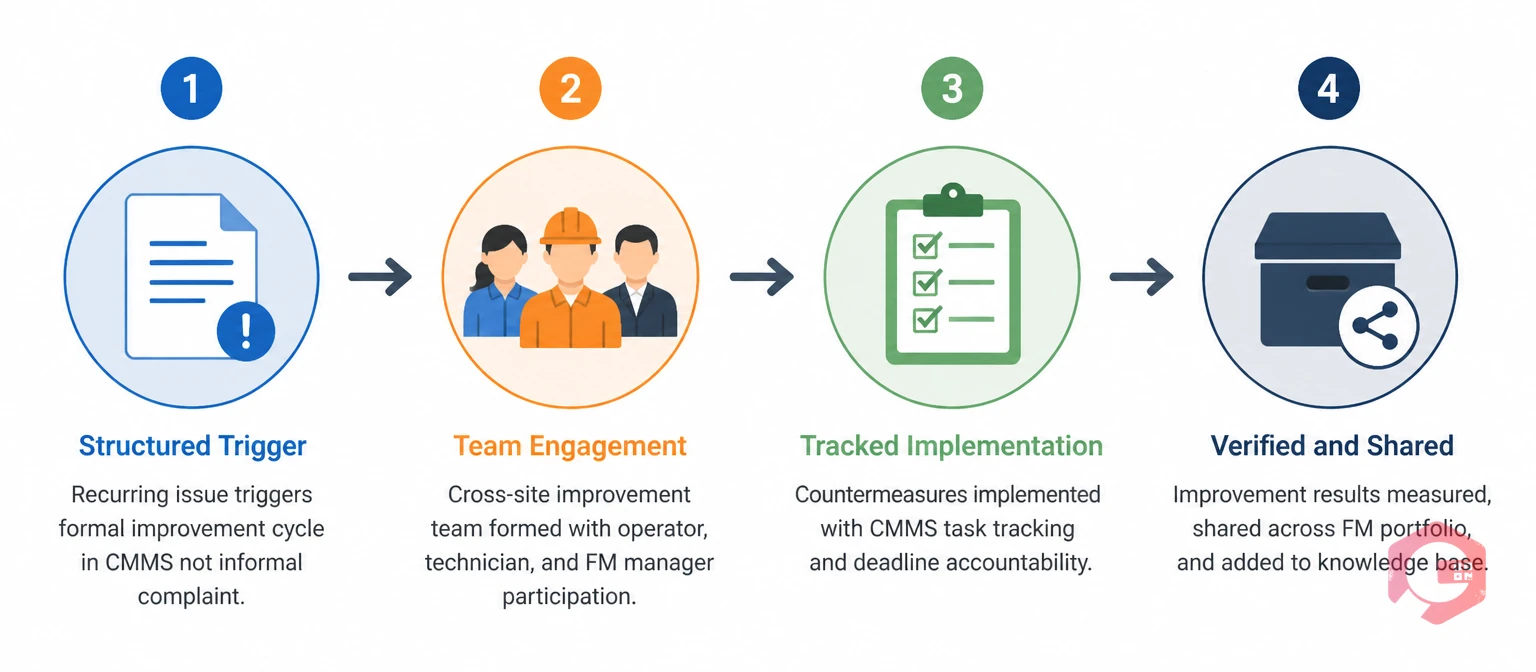
The practical impact of introducing a focused improvement module into an FM operation plays out across three dimensions: how problems get identified, how fixes get shared, and how accountability for improvement gets maintained without creating bureaucratic overhead.
In an FM firm running a CMMS, the data that should be driving improvement decisions already exists. Recurring breakdown patterns on specific asset types show up in MTBF trend reports. Properties with above-average reactive maintenance ratios show up in PM compliance comparisons. Specific fault codes that keep repeating across multiple sites are visible in work order category analysis. The problem is that this data rarely gets actioned as improvement opportunities — it's reviewed in reporting cycles, noted in management meetings, and then filed while reactive work takes over.
A focused improvement module connects the analytical view directly to the improvement workflow. When the BI Dashboard shows that three properties in the portfolio have had repeated HVAC compressor failures in the past 90 days, the operations manager can raise an FI project directly from that data view — assigning it to a technical lead, defining the investigation scope, and setting a target improvement metric. The problem has gone from a data observation to a tracked improvement project in minutes, without it going through a management reporting cycle that adds two weeks of delay.
The most valuable feature of a digital focused improvement module isn't what it does for the site where the improvement happens — it's what it does for every other site in the portfolio. When an FI project is completed and the improvement is documented and verified, the module supports publishing that improvement as a portfolio standard: an updated maintenance checklist, a revised PM schedule, an amended work instruction, or a new fault code with a linked corrective action template.
That publication step pushes the improvement through the CMMS to every property that has the relevant asset type or applies the relevant process. The site engineers at those properties receive the updated procedure through their standard maintenance workflow — they don't need to know that it came from an FI project at a different site, and they don't need to do anything except follow the updated standard. The cross-site learning happens automatically, embedded in the system, with no reliance on communication chains or team meetings to carry the information.
One of the reasons CI programmes fail in FM firms is that they add process overhead without adding corresponding value in the day-to-day experience of the people doing the work. An improvement programme that requires engineers to fill in additional forms, attend additional meetings, and report into additional management layers will be resisted — not because people don't want to improve, but because the overhead cost is borne by the engineers and the benefit is captured by the management reporting cycle.
A focused improvement module minimises this friction by embedding improvement tracking into the same system that engineers already use for their daily work orders. Raising an FI project takes the same steps as raising a corrective work order. Documenting the investigation uses the same note and attachment fields the engineer already uses on every job. The improvement becomes part of the normal workflow rather than an additional programme on top of it. The workflow automation module in Cryotos supports this integration — linking FI projects to the work order, asset, and PM records they relate to, without requiring engineers to operate a separate improvement system alongside their operational tools.
FM firms increasingly operate in a procurement environment where price differentiation is limited and service quality differentiation requires evidence, not assertions. A prospective client asking two FM firms to tender for a 150-property managed portfolio will receive similar pricing and similar promises of quality from both. What distinguishes them — and what increasingly sophisticated facilities managers are looking for — is documented evidence of operational discipline.
A focused improvement module produces that evidence automatically. Every completed FI project is a documented record of: the problem identified, the data that surfaced it, the investigation method applied, the root cause established, the fix implemented, the outcome measured, and the improvement deployed across the portfolio. Presented in a quarterly performance report, a library of completed FI projects tells a procurement manager or building owner something no KPI dashboard can: that this FM firm doesn't just report on performance — it systematically improves it.
According to the RICS guidance on FM service delivery, facilities management contracts increasingly include requirements for continuous improvement plans as a standard element of service delivery — not as a differentiator, but as a baseline expectation. An FM firm that can produce a structured FI record satisfies this requirement with evidence. One that produces a written CI plan with no supporting improvement history satisfies it with paper. The Report Builder in Cryotos allows FM firms to extract FI project summaries, improvement metrics, and portfolio-wide deployment records as formatted reports — ready for client performance packs without any manual data assembly.
Cryotos CMMS gives FM firms the operational infrastructure to run a structured focused improvement programme across their entire portfolio — connecting the data that identifies improvement opportunities to the workflow that tracks them, and the knowledge management tools that ensure completed improvements reach every relevant site.
Key capabilities supporting FI in FM operations:
FM firms using Cryotos to run structured improvement programmes consistently report stronger client retention and more successful contract renewals — not because the improvement metrics are impressive in isolation, but because the improvement evidence is visible, documented, and presented in a format that procurement managers and building owners can evaluate. If your CI programme currently lives in a slide deck and a good intention, Cryotos CMMS gives your operations team the system to make it real across every site in your portfolio.
A focused improvement module is a structured workflow within a CMMS that supports the identification, investigation, resolution, measurement, and cross-site deployment of improvement projects in FM operations. It differs from a general analytics dashboard — which surfaces data without driving action — and from an ad-hoc Kaizen event — which produces a one-time fix without building a transferable record. A focused improvement module turns individual problem-solving into a documented, repeatable organisational process that compounds improvements across the entire FM portfolio over time.
It changes improvement from a cultural aspiration to an operational deliverable. When an FI project is raised in the system, assigned to a named owner, and tracked with a target date and outcome metric, it carries the same operational weight as an open work order. Engineers and site managers aren't asked to improve as an addition to their workload — they do improvement work within the same system they use for daily maintenance operations. The culture changes because the system changes the incentive structure, not because a management communication campaign asked people to think differently.
When an FI project is completed and the improvement is verified, the improved procedure or PM schedule change is deployed through the CMMS to every property that has the relevant asset type or applies the relevant process. Site engineers at those properties receive the updated standard through their normal maintenance workflow — the improvement reaches them without requiring a separate communication or training event. The cross-site learning is embedded in the system configuration, not dependent on anyone remembering to share it.
Without a digital module, improvement programmes rely on individual initiative, informal communication, and manual documentation — all of which degrade under operational pressure and are lost when people leave. The three most common failure modes are: improvements staying local and never scaling across the portfolio; no system of record for what was tried and what worked; and reactive workloads crowding out improvement activity because improvement has no formal status in the operational system. A focused improvement module addresses all three by making improvement a tracked, visible, system-supported deliverable rather than an optional extra.
Yes — increasingly so. FM procurement is moving toward evidence-based evaluation of service quality, and regulators like RICS expect continuous improvement plans as a baseline element of FM service delivery. A library of completed FI projects — showing the problem identified, the root cause, the fix applied, the metric improvement, and the sites updated — provides documented evidence of operational discipline that a written CI plan without supporting records cannot match. FM firms that present this evidence in client performance packs consistently report stronger retention rates and more successful retendering outcomes.
Continuous improvement culture in an FM firm doesn't start with a values statement or a training programme. It starts with a system that makes improvement visible, trackable, and consequential — one where a problem identified at Site A becomes a documented project, a verified fix, and a deployed standard at Sites B through Z, without anyone having to manually carry that knowledge across the portfolio.
A focused improvement module is that system. It turns the daily intelligence of every site engineer and operations manager into an organisational asset — one that compounds over time as completed FI projects build a library of proven fixes, a cross-site standard of practice, and a documented improvement record that clients can evaluate and that contracts can be built on. Without the module, improvement stays personal. With it, improvement becomes institutional.
Book a free Cryotos demo to see how the focused improvement and workflow automation capabilities work across a real FM portfolio — and what a documented CI programme looks like when it's embedded in the operational system rather than presented as a strategy document.




Cryotos AI predicts failures, automates work orders, and simplifies maintenance—before problems slow you down.



