

Spare parts management, procurement, and material movement are the invisible backbone of every warehouse operation. When a critical bearing runs out, when a purchase order takes two weeks to approve, or when materials cross facility gates without documentation — the entire supply chain feels it.
This blog focuses on the operational supply chain intelligence that Cryotos CMMS brings to warehouses: from real-time spares inventory and automated procurement workflows to bin-to-bin transfers, formal gate pass management, and audit-ready MRN/GRN records.
Spare parts management is one of the most underappreciated and highest-impact functions in warehouse operations. Too few spares and you face extended downtime when critical equipment fails. Too many spares and you're tying up capital in slow-moving or obsolete stock. The wrong spares in the wrong location mean technicians waste time searching instead of repairing.
Cryotos brings structured discipline to spares inventory management across every dimension.
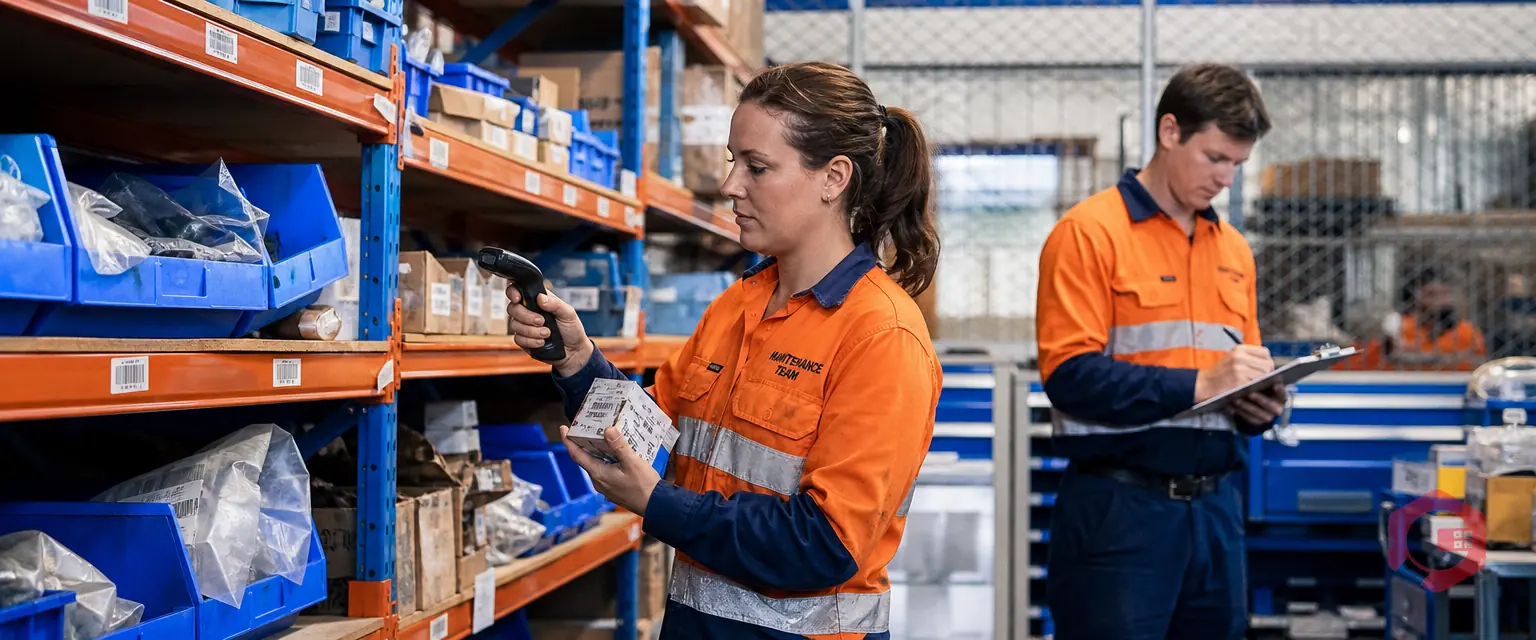
Cryotos maintains a live, accurate count of every spare part across every location. As parts are issued for work orders, returned after maintenance, received from vendors, or transferred between bins, the system updates instantly. Maintenance technicians can check stock availability from the Cryotos mobile app before heading to the storeroom — eliminating wasted trips and unauthorized substitutions.
Every spare part in Cryotos can be assigned a minimum stock level. When quantities fall below the threshold, the system automatically:
This eliminates emergency last-minute procurement and ensures that critical spares for high-priority assets — like forklift hydraulic seals or conveyor drive belts — are always available when needed.
When a technician completes a work order, every spare part consumed is recorded directly against that work order. This creates a precise consumption history that supports:
By linking consumption data to work orders and assets, Cryotos builds a living inventory model — one that learns your warehouse's actual usage patterns and recommends reorder points based on real demand, not guesswork.
Procurement in a warehouse maintenance context is not just about purchasing — it is a critical link in the maintenance reliability chain. When a required spare part is out of stock, the speed, accuracy, and cost-effectiveness of procurement directly determines how long critical equipment stays down.
Cryotos integrates procurement management directly with inventory and maintenance modules, creating a seamless flow from low-stock alert to delivered goods.
The procurement process in Cryotos follows a structured, approval-governed workflow:
By linking procurement to inventory thresholds and work order consumption data, Cryotos eliminates the 'panic buying' cycle — where teams only realize a spare is missing when equipment has already failed. Proactive reorder based on actual consumption patterns reduces emergency purchases by up to 35%.
One of the most common — and most costly — warehouse inefficiencies is the accumulation of excess or misplaced spare parts. A conveyor belt repair consumes 8 of 10 available bearings from one bin. The remaining 2 sit untouched for 18 months while the same bearing is re-purchased for another facility. This 'spare parts dumping' problem ties up capital, distorts inventory accuracy, and inflates procurement costs.
Cryotos solves this through structured transfer workflows that give spare parts full material traceability and prevent duplication of purchases.
Within a single warehouse, spare parts frequently need to move between storage locations — from a receiving bay to a dedicated storeroom, or from general shelving to a point-of-use bin near a specific machine. Cryotos manages these movements through formal transfer requests that:
For multi-facility organizations, Cryotos enables controlled inter-facility spare parts transfers. When one warehouse runs short on a specific hydraulic cylinder while another has surplus stock, a transfer can be initiated instead of placing a new procurement order — saving cost and reducing lead time.
The transfer process includes:
Multi-facility transfer management directly reduces redundant purchasing, eliminates dead stock accumulation, and improves network-wide spare parts utilization. Organizations typically see a 20–30% reduction in total spare parts inventory value within the first year of implementation.
Warehouses are active inbound and outbound logistics environments. Vendor deliveries arrive. Tools and equipment are loaned to contractors. Spare parts go out for off-site repair and return. Without a formal gate pass system, this movement is invisible — creating security gaps, compliance failures, and asset loss.
Cryotos's gate pass module formalizes every movement of materials, equipment, and assets across warehouse boundaries.
| Gate Pass Type | Usage Scenario |
|---|---|
| Outward Gate Pass | Materials or assets leaving the facility |
| Inward Gate Pass | Vendor deliveries and received materials |
| Returnable Gate Pass | Items sent out expected to return (repairs, loans) |
| Non-Returnable Gate Pass | Items permanently dispatched (transfers, disposal) |
Every gate pass follows a defined workflow that enforces authorization and creates a permanent audit record:
Gate pass data integrates with inventory and asset tracking modules — so when a part leaves for off-site repair on a returnable gate pass, its status is automatically updated to 'Out for Repair' and its bin location is cleared, preventing it from appearing as available stock.
Material Requisition Notes (MRN) and Goods Receipt Notes (GRN) are the twin pillars of inventory accounting accuracy. Every movement of material into or out of the storeroom must be formally documented to maintain a reliable stock count, support financial reconciliation, and satisfy audit requirements.
Cryotos digitizes and automates both processes, eliminating manual paperwork while creating a comprehensive, time-stamped trail for every transaction.
An MRN is raised every time material is issued from the storeroom — whether for a maintenance work order, a production requirement, or an inter-facility transfer. In Cryotos, MRN creation is triggered by:
Each MRN captures: item code and description, quantity issued, unit of measure, issuing store location, receiving department or person, associated work order or project reference, and the issuing officer's digital signature. Stock levels are debited instantly upon MRN confirmation.
A GRN is raised every time goods are physically received into the warehouse — from an external vendor delivery, an internal inter-facility transfer, or a return from off-site repair. Cryotos GRN processing includes:
The GRN links directly to the vendor invoice for three-way matching (PO → GRN → Invoice), supporting accounts payable reconciliation and preventing payment for undelivered goods.
Cryotos MRN and GRN records are immutable, timestamped, and digitally signed — making them fully auditable for ISO certification, financial year-end audits, insurance assessments, and regulatory inspections. Every stock movement is traceable to a specific user, date, time, and business justification.
| Feature | Without Cryotos | With Cryotos |
|---|---|---|
| Spare Parts Tracking | Manual stock count, frequent discrepancies | Real-time QR-scanned inventory with bin-level accuracy |
| Procurement | Manual PR emails, no approval tracking | Structured PR → PO → GRN workflow with automated alerts |
| Spares Transfer | Informal phone calls, no formal records | Authorized MRN-backed bin-to-bin and inter-facility transfers |
| Gate Pass | Paper-based, often missing or incomplete | Digital gate pass with approvals, signatures, and overdue alerts |
| MRN / GRN | Paper forms, manual ledger entries | Digital, linked to work orders, instant stock updates |
| Reporting | Monthly Excel reports, always outdated | Real-time dashboards with drill-down to part/transaction level |
The operational supply chain in a warehouse — spares inventory, procurement, inter-facility transfers, gate pass control, and material documentation — is only as strong as the system that manages it. Manual processes, paper records, and fragmented email approvals don't just slow things down; they create invisible risks that surface as downtime, audit failures, and inflated costs.
Cryotos CMMS connects all of these functions into a single, integrated operational layer. A low-stock alert triggers a purchase request. An approved PO becomes a GRN on delivery. A work order issues parts via MRN. A transfer request generates documentation at both ends. A gate pass tracks every item that crosses the warehouse boundary.
The result is a warehouse that manages its inventory precisely, controls its supply chain proactively, and generates the financial and operational intelligence needed to continuously improve.
Ready to Bring Precision to Your Warehouse Supply Chain? Book a free Cryotos demo and see how your warehouse can move from manual stock chaos to intelligent, audit-ready inventory operations in as little as 8 weeks.


Cryotos AI predicts failures, automates work orders, and simplifies maintenance—before problems slow you down.



