

Most maintenance problems are not solved at desks. They are solved at equipment — where the vibration that shows up as a CMMS alert is actually a loose base plate, where the recurring motor fault is actually a ventilation blockage two metres away, where the technician who has been on that line for four years knows exactly what the root cause is and has never been asked. Gemba — the Japanese word for "the actual place" — is the practice of going to where work happens to observe it directly, rather than managing from reports and dashboards alone. In maintenance, it is one of the highest-return practices available to a maintenance manager, and one of the most consistently neglected. According to the Lean Enterprise Institute, the most critical lean principle is understanding the actual situation — and you cannot understand the actual situation of a maintenance operation from a distance.
This guide covers what Gemba means specifically in a maintenance context, what managers typically miss when they don't go to the floor, how to conduct a structured maintenance Gemba walk, and how to connect observations to CMMS actions so that what you find actually gets fixed.
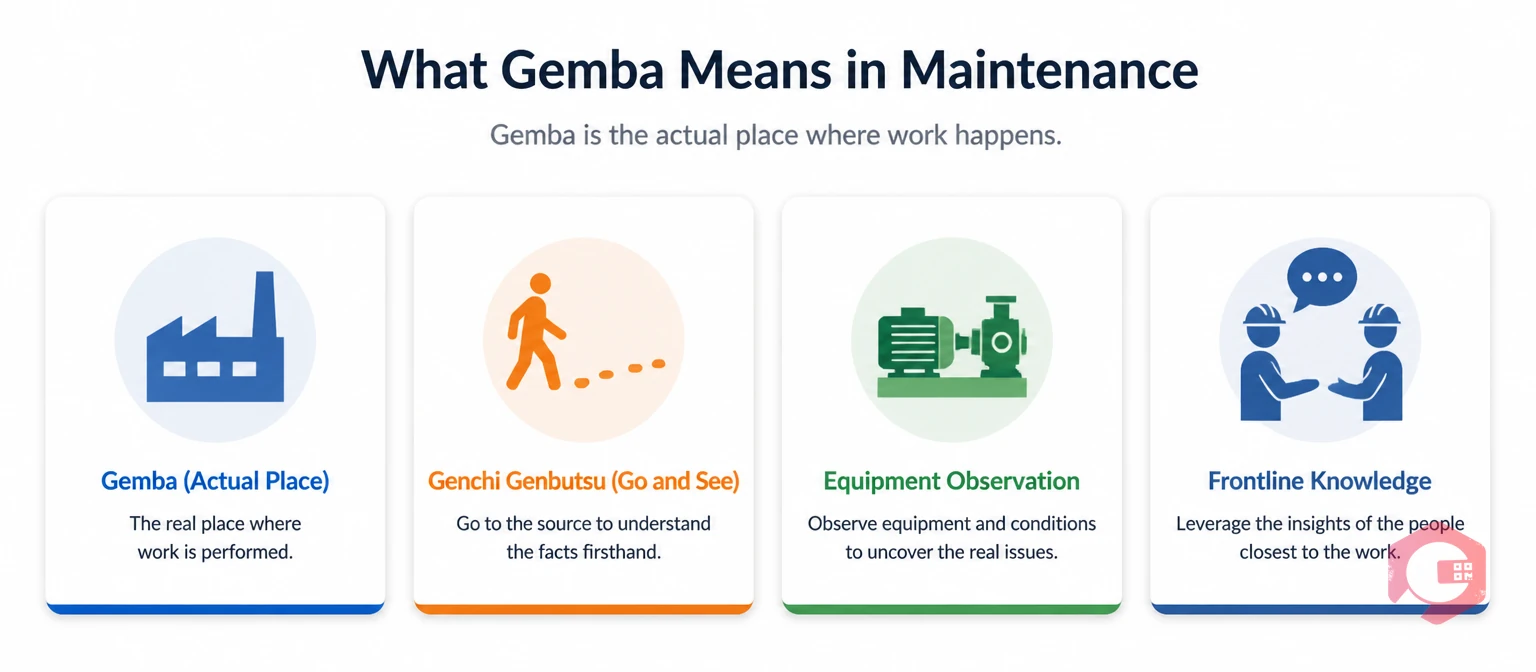
Gemba (現場) translates literally as "the actual place" — the location where value-creating work occurs. In manufacturing, Gemba is the production floor. In maintenance, Gemba is wherever the maintenance work happens: at the equipment, in the plant room, on the roof, in the service corridor. It is not the maintenance office, not the CMMS dashboard, and not the weekly KPI report. Those are representations of what has happened at Gemba; they are not Gemba itself.
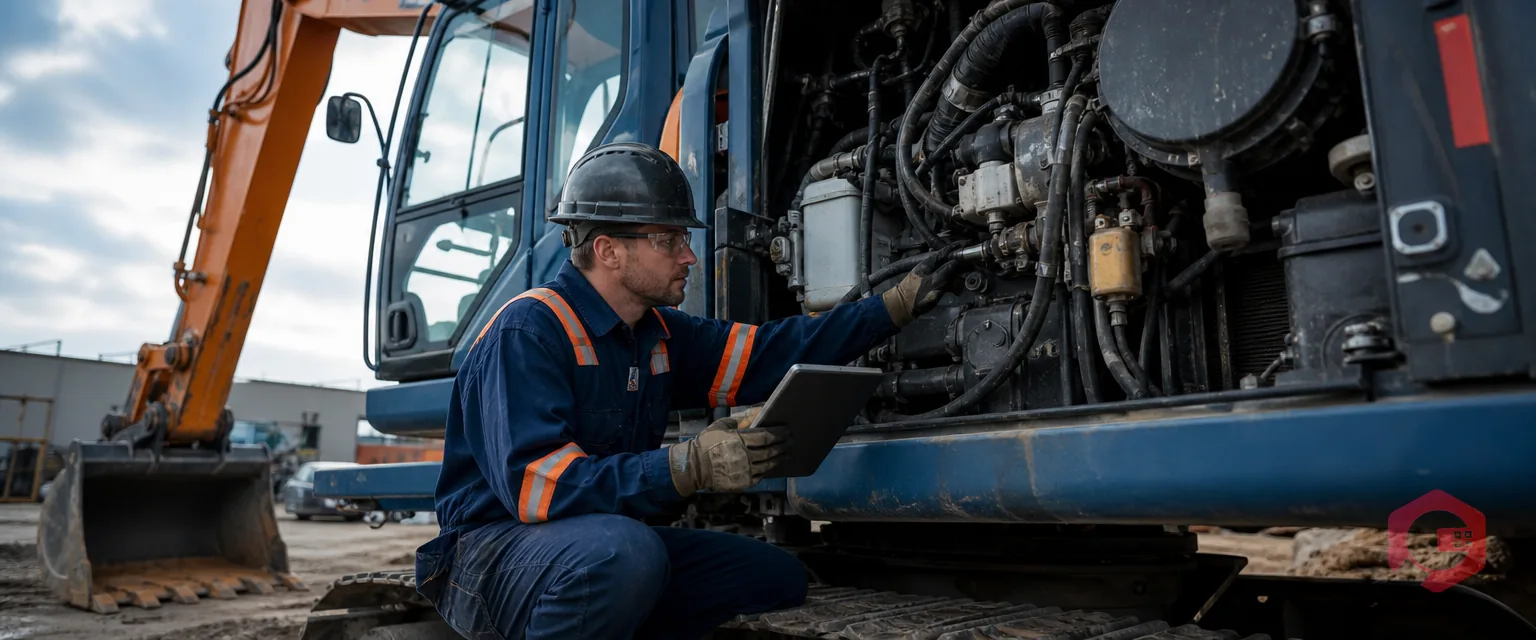
The practice associated with Gemba in the Toyota Production System is Genchi Genbutsu — "go and see for yourself." Toyota engineers and managers are expected to make decisions based on direct observation of the actual situation, not on secondhand reports. In maintenance terms, this means that a maintenance manager who is diagnosing a recurring pump failure should stand in front of that pump, watch it operate, talk to the technician who services it, and look at the surrounding environment — before drawing any conclusions about root cause or corrective action.
A maintenance inspection is a structured check against a predefined list — verify this parameter, test this function, confirm this reading. An inspection tells you whether things are within specification. Gemba is observation without a fixed agenda — you go to the floor to learn what you don't already know, to see what the inspection checklist doesn't ask about, and to have the conversations that don't happen in formal review meetings.
Both are necessary. A maintenance programme needs structured inspections for compliance and predictability. It also needs Gemba walks for the qualitative, contextual, human-layer intelligence that structured inspections systematically exclude. The technician who knows that a particular pump always runs hot on Monday mornings after the weekend shutdown — but has never logged that observation because there's no field for it on the PM checklist — is a Gemba asset waiting to be accessed.
Genchi Genbutsu is the Toyota practice that underpins Gemba walks. It requires that decisions affecting a process or system be grounded in direct observation of that process or system — not in assumptions, reports, or the opinions of people who are also not at the Gemba. In a maintenance context, this principle has a direct practical implication: if the person deciding how to respond to a recurring failure has never personally observed that failure at the asset, their decision is based on incomplete information. Gemba walks are the mechanism for closing that information gap systematically.
Desk-based maintenance management creates a specific set of blind spots — not because the manager is incompetent, but because the information that flows through reports and CMMS dashboards is necessarily filtered, aggregated, and delayed. Five categories of maintenance reality are consistently invisible from the desk.
These are the problems that Gemba walks surface — and that no amount of dashboard reviewing will reveal:

A Gemba walk is not an informal wander. It is a structured observation with a defined focus, a consistent method, and a clear output. The discipline of the walk is what separates Gemba from general floor time — and what makes findings actionable rather than anecdotal.
Start with a question, not a checklist. The best Gemba walks in maintenance are organised around a specific problem or theme: "Why does this asset have the highest reactive maintenance frequency in the plant?" or "What is causing our filter replacement interval to exceed the designed schedule in Zone 3?" Entering the Gemba with a specific question sharpens observation and prevents the walk from becoming a general tour that produces no actionable findings.
Review the CMMS data for the area or asset you're observing before you go. Work order history, PM completion rates, recurring fault codes, parts consumption — not to form conclusions, but to know what to look for. The CMMS data tells you where the anomalies are; the Gemba walk tells you why they exist. The BI Dashboard surfaces these anomalies quickly — the three assets with the highest reactive work order frequency, the zone with the lowest PM completion rate, the technician team with the longest average resolution time — each of these is a Gemba focus point waiting to be investigated.
Observe before you ask. Spend time watching the process, the equipment, and the technicians at work before engaging in conversation. What you see in unguarded observation — the workaround someone applies automatically, the noise that everyone has stopped noticing, the puddle that everyone steps around — is often more informative than the answers you'll get when people know they're being observed.
When you do engage, ask open questions: "What does this normally sound like? How is that different from what I'm hearing now?", "What do you wish was easier about maintaining this equipment?", "What would you change about the PM schedule for this asset if you could?" These questions access the frontline knowledge that never makes it into formal records.
Record observations on mobile as you walk — a brief description of each observation, a photograph, the asset location, and an initial assessment of whether it requires a work order, a PM schedule adjustment, a design investigation, or simply acknowledgement. The work request feature allows observations to be logged directly from the floor and converted into CMMS work orders in real time — the finding doesn't have to wait until you return to the desk to enter the system.
The failure mode of most Gemba walks is not poor observation — it is poor follow-through. Observations are made, notes are taken, and then nothing changes because the findings never get converted into formal actions with ownership, timelines, and tracking. The Gemba walk that produces a notebook full of observations and no CMMS entries is an expensive tour with no return.
Within 24 hours of the walk, every observation should be classified and actioned: immediate safety or operational risks become priority work orders; maintenance deficiencies become standard or scheduled work orders; PM schedule findings become PM schedule adjustments; systemic observations become improvement projects with owners. Each action is traceable back to the Gemba observation that generated it — creating the improvement cycle that justifies the next walk.
A well-executed maintenance Gemba walk generates a specific set of outputs, each mapped to a CMMS action type. This table serves as a reference for classifying observations during and after the walk:
| Observation Type | Example Finding | CMMS Action Generated |
|---|---|---|
| Active defect — safety or operational risk | Coolant pooling on floor around CNC machine; guard missing from conveyor drive | Priority corrective work order (P1/P2) with same-day or next-day SLA |
| Maintenance deficiency — non-urgent | Filter visibly saturated; belt fraying at edge; lubrication point dry | Scheduled corrective work order with asset ID and parts specification |
| PM schedule gap | Technician confirms bearing housing always runs hot 2 weeks before PM interval — PM interval too long | PM schedule frequency reduction for that asset; updated task checklist |
| Environmental condition affecting performance | Plant room temperature 12°C above specification; compressor efficiency visibly degraded | Improvement work order for ventilation assessment + CMMS threshold alert set on temperature meter |
| Frontline knowledge capture | Technician identifies early-warning sound pattern not currently monitored | New inspection checklist item added to PM task; operator inspection task created |
| Workaround concealing failure | Temporary shim under pump base has been in place 4+ months; underlying misalignment not logged | Root cause investigation work order; PM task updated to check alignment at each service |
The table is not exhaustive — Gemba walks in different plant contexts will produce different observation types. The principle is consistent: every observation gets a CMMS action classification before the walk is considered complete. Unclassified observations are observations that will not drive improvement.
The relationship between Gemba and CMMS is not one-directional. It is a continuous loop. The CMMS tells the maintenance manager where to focus the Gemba walk — the assets with the highest reactive frequency, the zones with the lowest PM compliance, the technicians logging the most repeat faults. The Gemba walk tells the CMMS what to capture that it's not currently capturing — the new inspection task, the adjusted PM interval, the environmental alert threshold, the frontline knowledge that should be in the system but isn't.
Without the CMMS, Gemba walks produce observations with no reliable path to action and no mechanism for tracking whether actions were taken. Findings go into notebooks, discussions, and follow-up emails that lose urgency within days. Without Gemba walks, the CMMS captures the what of maintenance performance — the work orders, the completion rates, the failure codes — but rarely the why. It is accurate and incomplete.
According to McKinsey's lean operations research, organisations that combine structured frontline observation with digital operational systems achieve improvement outcomes that neither approach produces alone — the observation surfaces the problems; the system converts them into sustained improvements. In maintenance, Gemba is the observation practice; the CMMS is the improvement system. The combination is what produces durable results rather than one-time fixes.

Cryotos CMMS supports Gemba-driven maintenance improvement at every stage of the observation-to-action cycle. Before the walk, the BI Dashboard surfaces the maintenance anomalies that most warrant floor investigation — repeat fault assets, declining PM compliance zones, technicians with consistently higher-than-average resolution times — giving the Gemba walk a data-grounded focus before it starts.
During the walk, the Cryotos mobile app allows maintenance managers and technicians to log observations, photograph defects, and raise work requests directly from the asset location — with QR code scanning that links the observation to the correct asset record instantly. Observations don't wait for a desk; they enter the system while standing in front of the evidence. This eliminates the most common failure point of the Gemba cycle — the walk that produces good observations that never make it into the CMMS because re-entry is slow and other priorities intervene.
After the walk, work order management software converts Gemba observations into tracked, assigned, SLA-governed corrective actions. PM adjustments are made in the PM scheduling module with the Gemba walk as the documented trigger for the change — creating an audit trail that connects every PM revision to its real-world evidence base rather than to a manager's desk-based assumption. The Report Builder tracks Gemba-generated work orders as a category — showing how many observations from each walk were actioned, how many generated corrective repairs, and how many led to PM schedule changes — making the return on Gemba investment visible rather than anecdotal. Teams using Cryotos report a 30% reduction in unplanned downtime, with Gemba-driven PM optimisation consistently cited as a contributing factor in operations where floor-level observation is embedded as a regular management practice.
Gemba in maintenance management is the practice of going to the physical location where maintenance work occurs — the equipment, the plant room, the production floor — to observe conditions directly rather than relying on reports, dashboards, or secondhand accounts. The term comes from the Japanese word for "the actual place" and is rooted in the Toyota Production System's principle of Genchi Genbutsu — "go and see for yourself." In maintenance, Gemba walks are used to surface problems that are not visible in CMMS data, to capture frontline technician knowledge that hasn't entered formal systems, and to identify root causes that only become apparent through direct observation of operating equipment and working conditions.
The optimal frequency depends on the scale and complexity of the maintenance operation, but a practical starting point for most maintenance teams is one structured Gemba walk per week, each with a defined observation focus. In high-frequency production environments, daily brief Gemba walks (15–20 minutes) targeting specific equipment or areas are common in lean manufacturing operations. Monthly deep-dive walks covering the full maintenance area are appropriate for less intensive environments. The key is regularity — a Gemba walk culture that produces one observation per month and converts all findings to CMMS actions delivers more value than a quarterly deep-dive that produces a long observation list that never gets fully actioned.
Gemba findings should be captured in the CMMS at the point of observation using a mobile CMMS app — not transcribed from notes after the fact. At the asset, the manager photographs the defect, scans the asset QR code to link the record, describes the observation, and classifies it: immediate corrective work order, scheduled corrective work order, PM schedule adjustment, or improvement investigation. This real-time capture ensures that observations enter the system with their full context intact — asset location, condition photograph, and the manager's assessment — before that context fades with time. For observations that require investigation before a specific action can be determined, a holding category in the CMMS keeps them visible until the classification is complete.
A maintenance inspection checks known parameters against defined standards — it tells you whether specific measurable conditions are within specification. A Gemba walk observes the work and the conditions without a fixed agenda, looking for what is abnormal, unexpected, or not captured by the inspection checklist. An inspection asks "is this within tolerance?" A Gemba walk asks "is there anything here that shouldn't be, or anything missing that should be present?" Both are necessary and complementary. Inspections provide structured, defensible compliance records. Gemba walks provide the contextual, qualitative intelligence that structured inspections cannot. A maintenance improvement cycle that relies only on inspections will consistently miss the problems that don't fit neatly into the inspection format.
The real problems in a maintenance operation are rarely the ones that show up clearly in reports. They are the workaround that became standard practice, the environmental condition nobody logged, the frontline knowledge that never entered the system, and the interaction effect that no individual data point captures. Gemba walks surface these problems by taking the maintenance manager to where the evidence actually is — at the equipment, with the people who work on it every day.
The observation has no lasting value without the system that converts it to action. For maintenance teams ready to build a Gemba practice that produces sustained improvement rather than anecdotal observation, Cryotos CMMS provides the mobile capture, work order workflow, and PM scheduling tools to close the loop between what you see on the floor and what gets fixed. Book a free demo today and see how your Gemba observations look when every one of them becomes a traceable CMMS action.

Cryotos AI predicts failures, automates work orders, and simplifies maintenance—before problems slow you down.



