A high reliability organization (HRO) keeps serious failures rare, even though its work is complex and risky.
Maintenance is where the first warning signs usually appear. Think of a worn seal, a skipped inspection, or a repeat breakdown. Teams that act on those signals early prevent failures and incidents. Teams that ignore them repair the same problems again and again.
Building a high reliability organization takes five maintenance layers, a few proven practices, and metrics that show progress. These ideas work in nuclear plants, refineries, factories, and hospitals alike.
Key Takeaways

A high reliability organization is one that keeps failures rare despite complex, high-risk work. Researchers at UC Berkeley first described the idea in the 1980s. They studied aircraft carriers, air traffic control, and nuclear power plants.
Karl Weick and Kathleen Sutcliffe later distilled that research into five principles. Maintenance teams can apply each one directly:
ISO 55000 asset management standards and OSHA process safety rules push in the same direction. Both ask organizations to manage risk across the asset lifecycle. Read the Wikipedia overview of high reliability organizations for the research. The AHRQ primer on high reliability adds healthcare examples.
For a plant manager, the practical question is not whether to copy an aircraft carrier. It is whether the plant learns from small failures fast enough to prevent big ones.
An HRO is defined by its habits, and maintenance is where those habits become visible.
Maintenance is the backbone of a high reliability organization because it touches every asset and sees problems first.
Mechanical integrity is the discipline of keeping critical equipment fit for use throughout its life. OSHA requires it for covered facilities under its Process Safety Management standard, 29 CFR 1910.119(j).
Serious incidents often trace back to three maintenance patterns:
The 2005 BP Texas City refinery explosion shows what happens when safety discipline slips. The blast killed 15 workers and injured about 180 others, and the U.S. Chemical Safety Board investigation pointed to organizational and safety-culture failures alongside equipment problems.
Reliable organizations treat maintenance as a safety system, not a cost center.
Want to see where your critical assets stand today? Use the free MTBF calculator to measure the time between failures on your most important equipment.
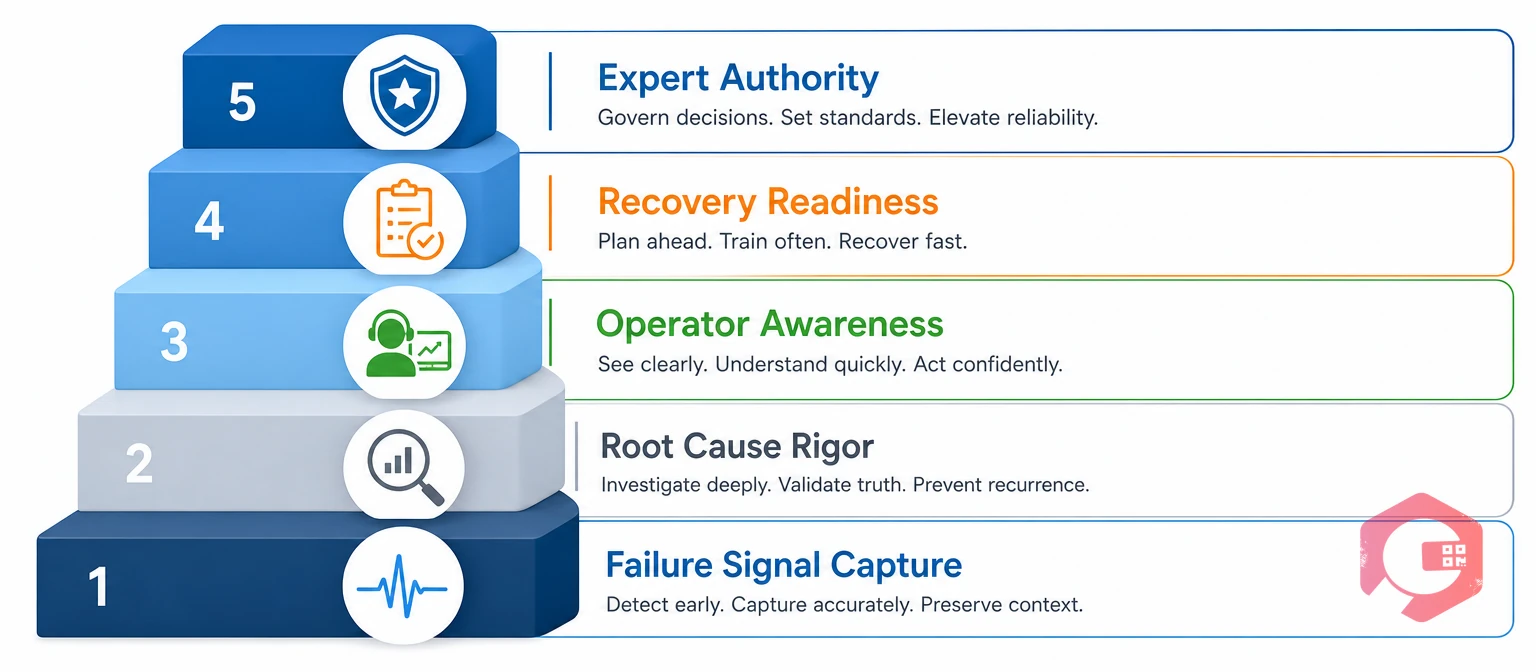
An HRO needs five maintenance layers working together.
The Five-Layer HRO Maintenance Stack:
The layers follow the five HRO principles in order, from preoccupation with failure to deference to expertise.
Most facilities already do parts of this work. The common mistake is running each layer alone. An operator reports a defect, but it never reaches the engineer who could remove its cause.
A reliable plant runs all five layers as one connected system.
Detecting problems early is the cheapest way to reduce failures. Two practices make it routine: defect reporting and operator-led inspections.
A near miss is an unplanned event that did not cause harm or damage but easily could have. An HRO makes reporting easy and safe, then acts on what comes in.
Route every report into a work order management workflow. Each one needs an owner, a priority, and a due date within one shift. Reports without owners die in inboxes.
A useful report takes under a minute to file and captures four details:
Operators notice changes long before sensors or schedules do. Give them short inspection routes, simple condition checks, and a direct line to the planner.
Well-built maintenance checklists turn that awareness into data. Each round records what was checked, what was found, and who followed up.
Early signals only reduce failures when someone owns the response.
Three practices stop repeat failures and speed up recovery: root cause analysis, risk-based planning, and clear decision rights.
Root cause analysis is a structured way to find why a failure happened, not just what broke. Set clear triggers so that investigations start by rule, not by mood:
Use reliability-centered maintenance (RCM) to decide which tasks each asset needs. Use failure mode and effects analysis (FMEA) to rank failure modes by severity, occurrence, and detectability.
Ranking assets by criticality shows where preventive and predictive effort pays off. Rate each asset by safety risk, production impact, and repair difficulty. Then match the strategy to the score:
Preventive maintenance is planned work that fixes small problems before they become failures. Cover high-risk assets first with preventive maintenance software that schedules inspections by calendar, runtime, or condition.
Deference to expertise means the technician closest to the problem can pause a job. They can also escalate a risk or reject an unsafe permit without waiting for approval. Write that right into procedures and back it up in practice.
Pair it with training. Add cross-checks on high-risk tasks such as lockout and tagout, so decisions rest on skill, not rank.
Fixing causes, ranking assets, and trusting the people closest to the work all cut repeat failures.
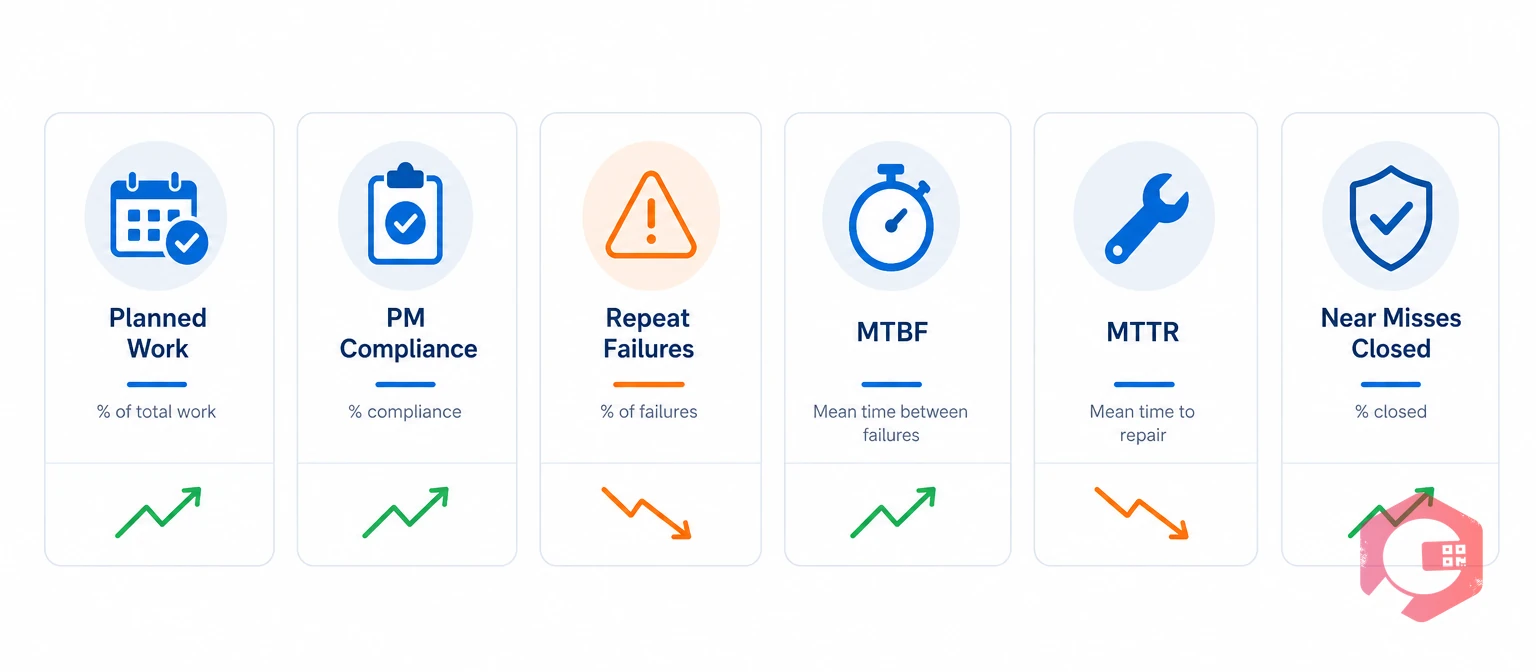
A reliability scorecard shows whether your HRO practices are working. It tracks a few leading and lagging metrics on a fixed schedule.
| Metric | What It Shows | Healthy Trend | Review Cadence |
|---|---|---|---|
| Planned work percentage | Share of labor hours spent on planned jobs instead of emergencies | Rising | Monthly |
| PM compliance | Share of scheduled preventive tasks finished on time | Rising | Weekly |
| Repeat failure rate | Failures on the same asset and failure mode within a set period | Falling | Monthly |
| MTBF | Average operating time between failures on critical assets | Rising | Monthly |
| MTTR | Average time to restore an asset after a failure | Falling | Monthly |
| Near misses closed | Share of reported near misses with a completed corrective action | Rising | Weekly |
| Unplanned downtime | Hours lost to unexpected stops on critical assets | Falling | Weekly |
Most maintenance teams should start with the three or four metrics their data can support today. Add more as downtime tracking and failure coding improve. Balance two kinds of metrics:
A reliable plant watches both kinds, and gives every metric an owner and a review date.
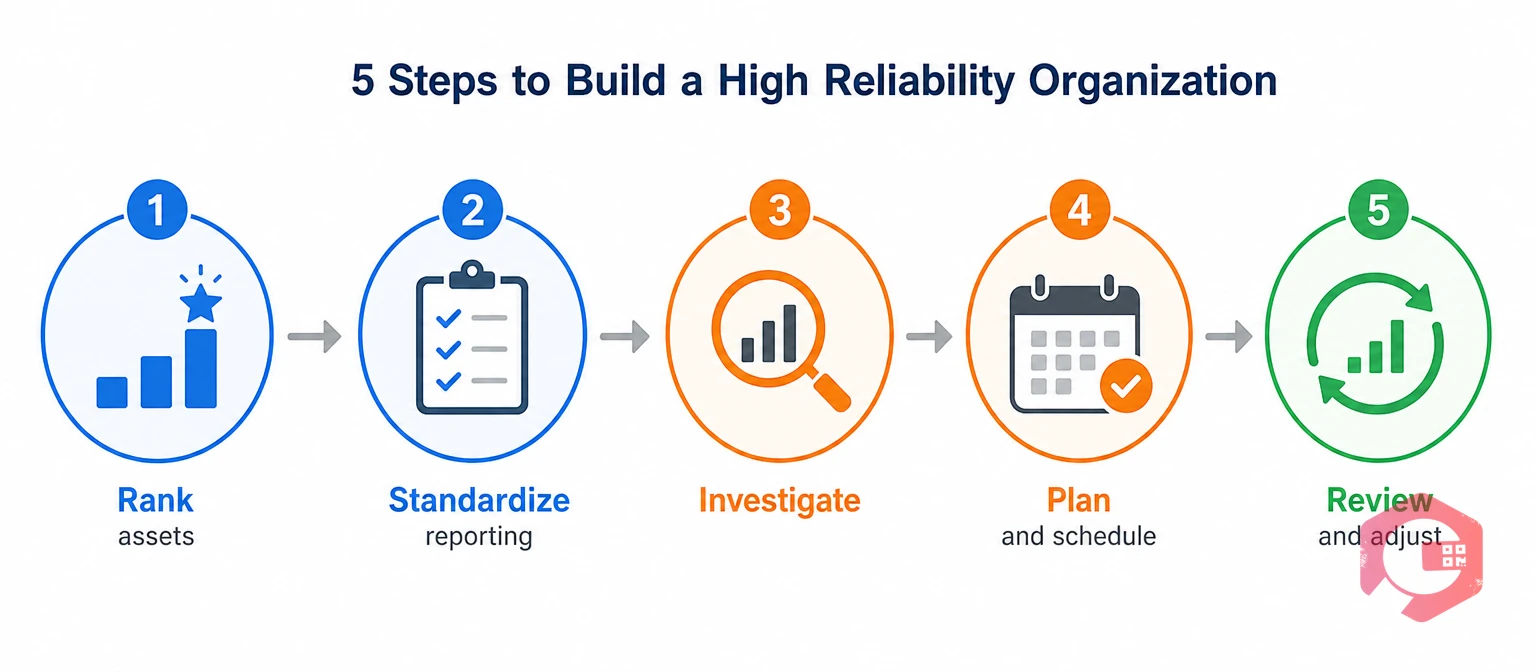
Build a high reliability organization in five steps, starting with the assets that carry the most risk.
A Computerized Maintenance Management System (CMMS) keeps these steps connected. It holds asset records, work orders, inspection results, and failure history in one place. Maintenance teams using Cryotos have reported up to 30% reduction in unplanned downtime and 25% faster repair turnaround.
Start small. One production line or one critical asset class is enough to prove the model. Then roll it out across sites.
Reliability grows one ranked, owned, and reviewed asset at a time.
Most attempts to build an HRO stall for the same four reasons. Each has a direct fix:
Progress stalls when reliability work is treated as a side project instead of the daily routine.
A high reliability organization is a company or facility that has few serious accidents despite risky, complex operations. It earns that record by spotting small problems early, investigating them honestly, and responding fast. Maintenance records and routines are a large part of how it does that.
Maintenance finds defects before they fail. It removes the causes of repeat failures and keeps safety-critical equipment working. It also produces the inspection and work order data that leaders need to spot patterns. Without that data, an organization is guessing about risk.
The five principles come from Karl Weick and Kathleen Sutcliffe. They are preoccupation with failure, reluctance to simplify, sensitivity to operations, commitment to resilience, and deference to expertise. Maintenance teams apply them through defect reporting, root cause analysis, and operator inspections. Recovery planning and shared decision rights complete the set.
Nuclear power, naval aviation, air traffic control, and commercial aviation are the classic examples. Healthcare, oil and gas, utilities, and manufacturing now use the same principles. A single failure in those settings can harm people or halt production.
There is no fixed timeline, because culture changes more slowly than procedures. Many plants see early gains once they standardize defect reporting and plan work by asset risk. Lasting results come from keeping those habits in place for years.
A reliable plant runs on maintenance data that people trust. Schedule a free demo to see how Cryotos helps your team track defects, plan preventive work, and prove reliability gains.



Cryotos AI predicts failures, automates work orders, and simplifies maintenance—before problems slow you down.