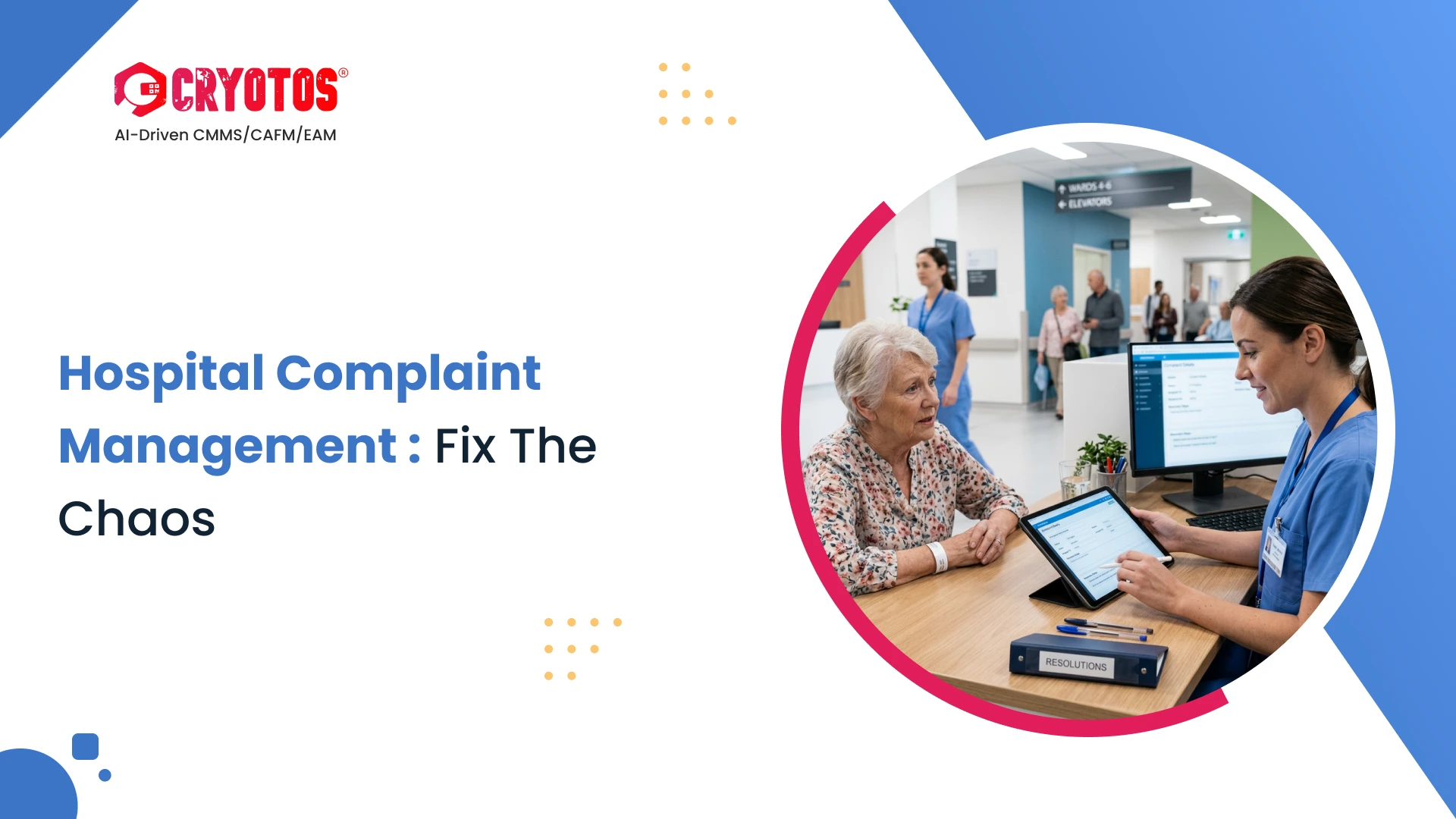
When a staff member flags a broken sterilizer at 7 AM, the expectation is simple: someone picks it up, acts on it, and closes it out. But in most hospitals, that's not what happens. The report goes into a logbook, a WhatsApp group, or an email chain - and somewhere between the raising and the resolving, it disappears.
A hospital complaint management system brings every reported issue into one trackable place, assigns it to the right person, and follows it through to confirmed resolution. It doesn't just digitize the process - it makes the entire chain of events visible, from the first report to the final sign-off.
This blog walks through why complaint management breaks down in hospital settings, what it costs when it does, and what a working system actually looks like across departments and locations.
A single-facility hospital with a close-knit maintenance team can survive on informal processes. Issues get spotted, names get mentioned in the corridor, and things get fixed. It's imperfect, but it holds together.
Add a second building. Add a satellite clinic. Add three more departments reporting to the same team. Now the informal process doesn't hold. Complaints pile up in places nobody checks. Issues that needed a same-day fix wait three days because the request never made it to the right person.
The Joint Commission has consistently identified poor communication in facility operations as a factor in preventable adverse events. That's not just a patient safety concern - it's a direct signal that operational systems aren't keeping pace with institutional complexity.
The problem isn't effort. Most maintenance teams work hard. The problem is that hard work applied to a broken process still produces broken outcomes.
These aren't edge cases. They show up repeatedly in hospital facilities teams that haven't moved past manual complaint handling - and each one compounds the others.
Outpatient clinics, diagnostic centres, and administrative blocks each tend to develop their own workarounds for logging issues. Some use paper. Some use group chats. Some rely on whoever happens to speak to the right supervisor that day. Without a single intake point, complaints from these locations routinely get lost before anyone with the authority to act on them even knows they exist.
When there's no status layer on top of the complaint queue, everything blurs together. A supervisor who wants to know what's outstanding has to manually verify each item - calling technicians, checking notebooks, cross-referencing emails. This burns time that should be going toward actual maintenance work, and it means things get marked as handled when they aren't.
Without a history of complaints linked to specific assets or locations, repeat failures go undetected as a pattern. A ward's air handling unit breaks down in March, July, and October. Each time it's treated as a fresh incident. Nobody adjusts the maintenance schedule. Nobody escalates to the vendor. The cost accumulates - in parts, in labour, and in disruption to clinical operations.
Research points to equipment-related downtime as one of the most avoidable sources of operational cost in hospital environments. Complaint data, properly tracked, is one of the earliest indicators that a piece of equipment is heading toward failure.
Every major piece of hospital equipment - imaging systems, HVAC, generators, elevators - typically operates under an Annual Maintenance Contract. These contracts have different vendors, different timelines, and different renewal requirements. Without a system that tracks them centrally and sends advance alerts, renewals slip. The hospital finds out when a covered repair turns into a full out-of-pocket expense.
Medical equipment moves. A portable ultrasound unit ends up in a different ward. A wheelchair fleet gets redistributed after a renovation. Without real-time asset tracking, staff spend meaningful time locating equipment that should be immediately accessible - particularly during urgent care situations where delays carry real consequences.
Accreditation bodies require evidence that maintenance complaints are being logged, acted upon, and closed within appropriate timeframes. When records are scattered across logbooks, spreadsheets, and inboxes, producing that evidence for a NABH or Joint Commission audit means manually reconstructing a paper trail that was never properly maintained in the first place.
The shift from manual tracking to a structured hospital complaint management system isn't just about speed - it's about replacing assumptions with facts.
Whether a request comes from the ICU, the outpatient pharmacy, or the facilities team at a satellite site, it enters the same system. Every complaint gets a reference number, a timestamp, a location tag, and a category. Nothing slips through because someone forgot to forward an email.
When a complaint is logged, the system generates a work order and routes it to the appropriate person based on the type of issue, the location, and current workload. The manual dispatch step - and all the coordination it requires - is eliminated.
Every open complaint has a visible status. Every closed one has a record. A department head can pull up complaints by location, asset, or timeframe without touching a single spreadsheet. That's not just convenient - it's the foundation for actual accountability.
Complaint data feeds directly into preventive maintenance planning. When the system shows that a particular asset generates repeated complaints every few months, the PM schedule gets adjusted before the next failure - not after. This is how hospitals shift from fixing problems to preventing them.
Service agreements are logged with their renewal dates and vendor details. Automated alerts go out weeks in advance - enough time for the procurement team to review terms, raise a purchase order, and renew without any lapse in coverage.
Real-time tracking means your team knows exactly where each piece of equipment is, what condition it's in, and when it was last maintained. Equipment doesn't go missing between departments. Maintenance doesn't get skipped because an asset wasn't where the schedule assumed it would be.
Not every complaint management tool is designed for healthcare operations. These are the capabilities that genuinely matter in a hospital environment:
Nurses, biomedical technicians, and housekeeping staff raise complaints from wards and corridors - not from desks. A system that requires someone to sit at a computer to log an issue will not get used consistently. QR code scanning against specific assets or rooms is a strong indicator that a platform was built with frontline users in mind.
Different complaint types carry different urgency. A broken call light in a patient room is not the same as a failed sterilizer in the surgical unit. The system should let you configure escalation timelines and notification paths by complaint category - not apply a generic default to everything.
When a technician receives a complaint about a specific piece of equipment, they should be able to see that asset's full maintenance history, open work orders, and parts availability from within the same screen. Without that connection, you have a complaint tool - not a maintenance management tool.
Accreditation audits don't come with long lead times. Every action taken on every complaint - who raised it, who was assigned, what was done, when it was closed - should be timestamped and exportable without any manual assembly.
The hospitals that handle complaints well aren't necessarily the ones with the largest maintenance teams. They're the ones where every reported issue enters a system that makes it visible, assigns it immediately, and keeps it tracked until it's genuinely resolved.
That shift has a compounding effect. When staff see that complaints get acted on consistently, they report more carefully and more regularly. Better reporting produces better data. Better data drives smarter maintenance decisions. Over time, the volume of reactive complaints starts to fall - because the underlying issues are being caught earlier.
Cryotos CMMS is built to support exactly this kind of operation - multi-location hospitals that need a single system to manage complaints, track assets, automate contract renewals, and surface the patterns that manual processes miss entirely. If your team is still working around a process that isn't serving them, book a free demo and see what the alternative looks like.




Cryotos AI predicts failures, automates work orders, and simplifies maintenance—before problems slow you down.