How Cryotos (Cloud-Based CMMS) Improves Scalability and Security

Article Written by:

Ganesh Veerappan

Created On:

April 27, 2026

How Cryotos (Cloud-Based CMMS) Improves Scalability and Security

A cloud-based CMMS (Computerized Maintenance Management System) improves scalability and security by delivering enterprise-grade infrastructure on demand - letting your maintenance operations grow across sites, teams, and assets without the cost or risk of on-premise systems. As organizations expand, a cloud CMMS like Cryotos gives you the flexibility to add users and locations in minutes, while built-in encryption, role-based access control, and real-time audit trails protect every piece of your maintenance data.

For maintenance managers and plant heads overseeing growing operations, the question is no longer whether to move to the cloud - it is how quickly you can make the shift before outdated systems become a liability. Businesses running on spreadsheets or legacy on-premise software are already losing ground: missed PM schedules, siloed asset data, and security gaps that regulators are paying closer attention to every year.

This post breaks down exactly how a cloud-based CMMS delivers scalability and security - and why these two benefits are inseparable in modern maintenance operations.

What Is a Cloud-Based CMMS?

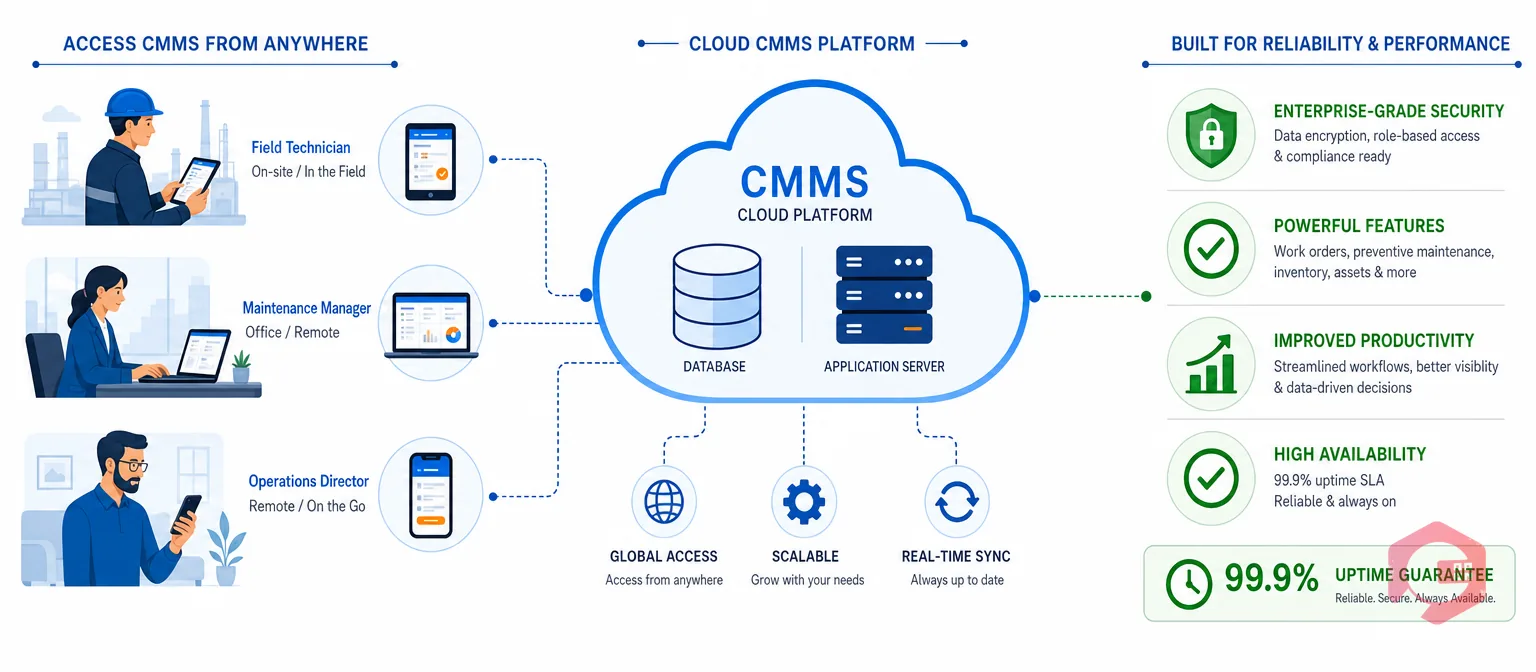
A cloud-based CMMS is maintenance management software hosted on remote servers and accessed via the internet - rather than installed on local hardware at your facility. Instead of paying for servers, IT staff, and costly upgrades, you access the platform through a browser or mobile app and the provider handles infrastructure, uptime, backups, and security patches.

This delivery model - often called SaaS (Software as a Service) - changes the economics and capabilities of maintenance management entirely. You pay a subscription, get immediate access to the latest features, and scale your usage up or down based on need. There is no capital expenditure on servers, no downtime during software updates, and no risk of losing critical maintenance data because of a local hardware failure.

For organizations managing assets across multiple facilities, shifts, or countries, a cloud CMMS provides something on-premise software simply cannot: a single, real-time view of every work order, asset, and technician - regardless of where they are.
How Cloud CMMS Improves Scalability

How Cryotos (Cloud-Based CMMS) Improves Scalability and Security — lifecycle

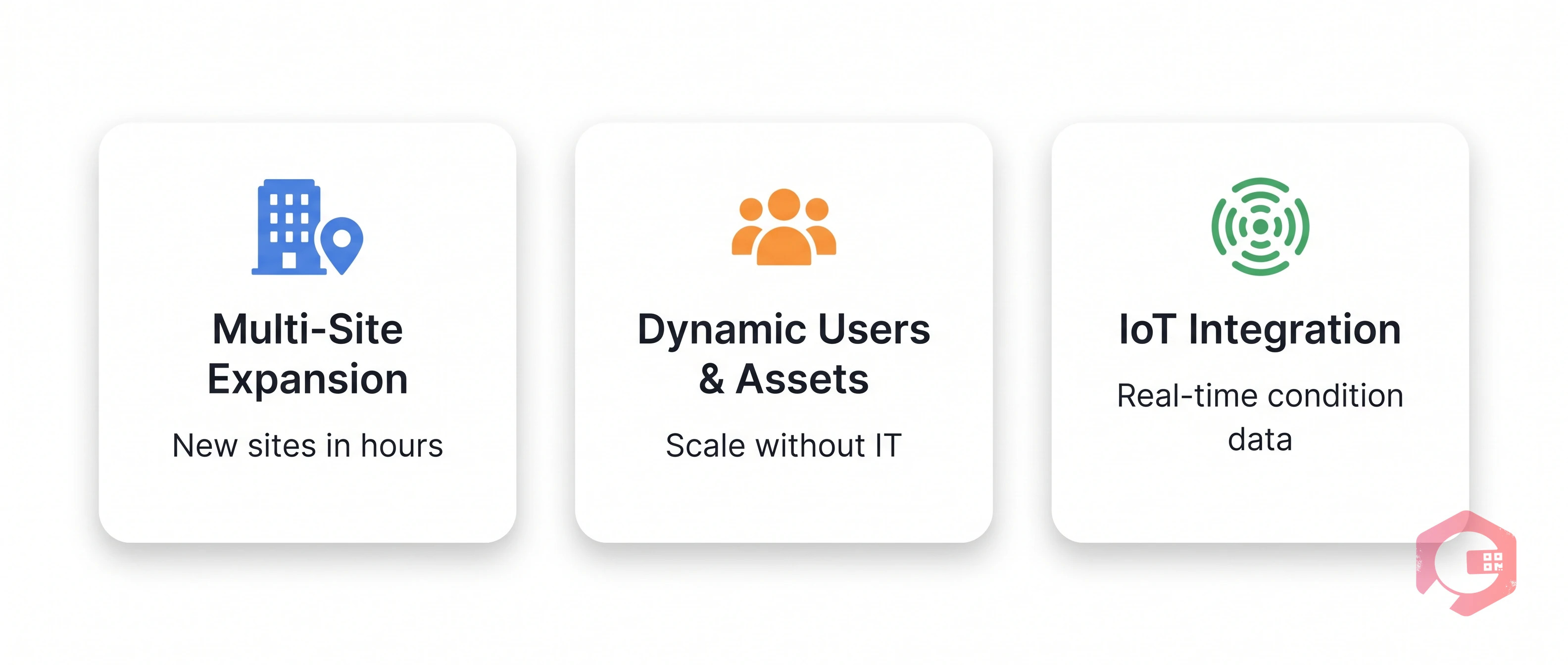
Scalability in maintenance management means your system can grow with your business without requiring a complete overhaul. A cloud-based CMMS delivers this in three concrete ways.

Multi-Site Expansion Without IT Complexity

When your operations expand to a new facility, a cloud CMMS lets you onboard that site in hours - not months. You create a new location in the system, assign technicians, and link assets. There is no need to install new software, configure local servers, or send an IT team on-site. Every new location inherits the same workflows, checklists, and reporting structures you have already built.

For plant heads overseeing multiple facilities, this means a consolidated dashboard that shows open work orders, overdue PMs, and downtime metrics across all sites in one view. You stop managing chaos in silos and start seeing patterns - which machines fail most often, which sites are lagging on preventive maintenance, and where resources need to shift.

Cryotos supports multi-site operations with location-level filtering, so site managers see only their data while plant heads get the full picture. The platform's role-based access control ensures the right people see the right information - at scale.

Dynamic User and Asset Growth

Traditional on-premise CMMS systems are licensed by the number of users or assets at point of purchase. Scaling up means renegotiating contracts, upgrading server capacity, and dealing with IT bottlenecks. Cloud platforms eliminate this friction entirely. Adding a new technician, supervisor, or asset takes minutes. You can scale from ten users to a thousand without any change to the underlying infrastructure.

This matters most during periods of rapid growth or seasonal demand spikes. A food processing plant ramping up for peak season can add technicians to the system overnight. A manufacturing company bringing a new production line online can register hundreds of new assets, assign PM schedules, and configure IoT sensor integrations - all before the line runs its first cycle.

IoT Integration at Scale

Cloud-based CMMS platforms are designed to integrate with IoT sensors, SCADA systems, and PLCs without the infrastructure constraints that limit on-premise installations. As you add sensors to equipment, the cloud CMMS ingests that data, triggers automated work orders when thresholds are breached, and feeds real-time condition data into your BI dashboards.

Cryotos connects directly with IoT devices and edge platforms, enabling true condition-based maintenance at scale. When a motor's vibration reading exceeds a safe threshold at 2 AM, the system creates a work order, alerts the on-call technician via WhatsApp, and logs the event - all without human intervention. Organizations using this approach have reported up to 30% reductions in unplanned downtime and 25% faster repair times.

How Cloud CMMS Strengthens Security

How Cryotos (Cloud-Based CMMS) Improves Scalability and Security — workflow

Security in a cloud CMMS is not a single feature - it is a layered architecture that protects your maintenance data at every level: data in transit, data at rest, user access, and audit compliance. Here is how each layer works in practice.

Role-Based Access Control (RBAC)

Not every technician needs access to every asset or every report. Role-based access control lets you define exactly what each user can see, create, or modify. A field technician can view and close their assigned work orders. A supervisor can approve work orders and view team performance. A plant head can access cost reports and downtime analytics. A system administrator manages users and permissions.

This granular control prevents data leakage, accidental modifications to critical asset records, and unauthorized access to financial or compliance data. In industries like pharmaceuticals, food processing, and energy - where regulatory auditors scrutinize access logs - RBAC is not optional. It is a compliance requirement.

Cryotos implements user role-level access across all modules: work orders, assets, inventory, reporting, and workflows. Each permission is configurable, so your system structure mirrors your organizational hierarchy exactly.

Data Encryption and Secure Transmission

All data transmitted between your devices and the Cryotos cloud is encrypted using industry-standard TLS (Transport Layer Security). Data stored in the cloud is encrypted at rest, meaning even if someone were to access the physical storage infrastructure, the data would be unreadable without the encryption keys.

This level of protection is something most on-premise systems simply cannot match. Maintaining encryption on local servers requires specialized IT skills and ongoing investment in security infrastructure. Cloud providers invest hundreds of millions in security annually - giving smaller organizations enterprise-grade protection at a fraction of the cost.

Audit Trails and Compliance Readiness

Every action taken in a cloud CMMS is logged with a timestamp, user ID, and record of what changed. Who closed that work order? Who modified that PM schedule? Who accessed that asset's maintenance history? The audit trail answers every question - and does so automatically, without any manual effort from your team.

This is critical for ISO 55000 compliance, GMP audits, FDA inspections, and OSHA record-keeping requirements. When an auditor walks in and asks for the complete maintenance history of a critical piece of equipment, you generate the report in seconds - not hours of document hunting. Cryotos maintains a full audit trail across all modules and makes these records exportable in audit-ready formats.

Automated Backups and Disaster Recovery

On-premise systems are only as reliable as the hardware and IT practices supporting them. A server failure, power surge, or ransomware attack can wipe out years of maintenance records and asset history. Cloud platforms eliminate this risk through automated backups and geographically distributed data storage. Even if one data center experiences an outage, your data is replicated across multiple locations and restored automatically.

For a maintenance team, this means zero risk of losing critical PM records, safety compliance documentation, or work order histories - the exact data that protects you during regulatory audits and insurance claims.
Cloud vs. On-Premise: The Scalability and Security Gap

How Cryotos (Cloud-Based CMMS) Improves Scalability and Security — problems grid

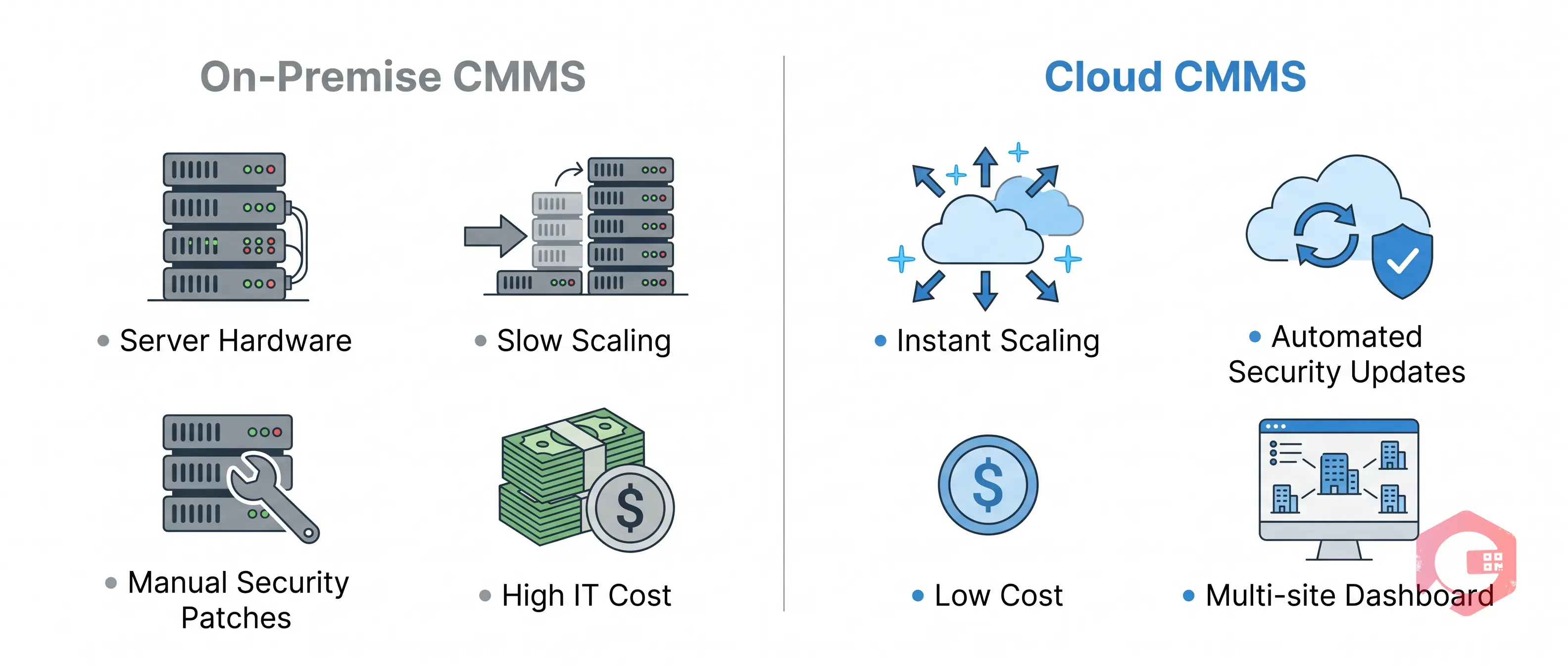
The differences between cloud and on-premise CMMS become most visible when organizations try to scale or respond to a security incident.

On-premise systems require dedicated IT staff to manage updates, patches, and security configurations. When a critical vulnerability is discovered, IT teams must manually deploy fixes across every installation - a process that can take days or weeks, leaving the system exposed. Cloud providers push security updates automatically, often within hours of a vulnerability being identified.

Scaling an on-premise system requires hardware investment, IT project work, and planned downtime. A cloud CMMS scales on demand - often with no involvement from IT at all. New sites, new users, new IoT integrations can be provisioned in the same day.

For organizations managing complex, multi-facility operations, the total cost of ownership (TCO) for cloud CMMS is consistently lower than on-premise when you account for hardware, IT staffing, security, and upgrade costs over a five-year period.
How Cryotos Delivers Both

How Cryotos (Cloud-Based CMMS) Improves Scalability and Security — scenario

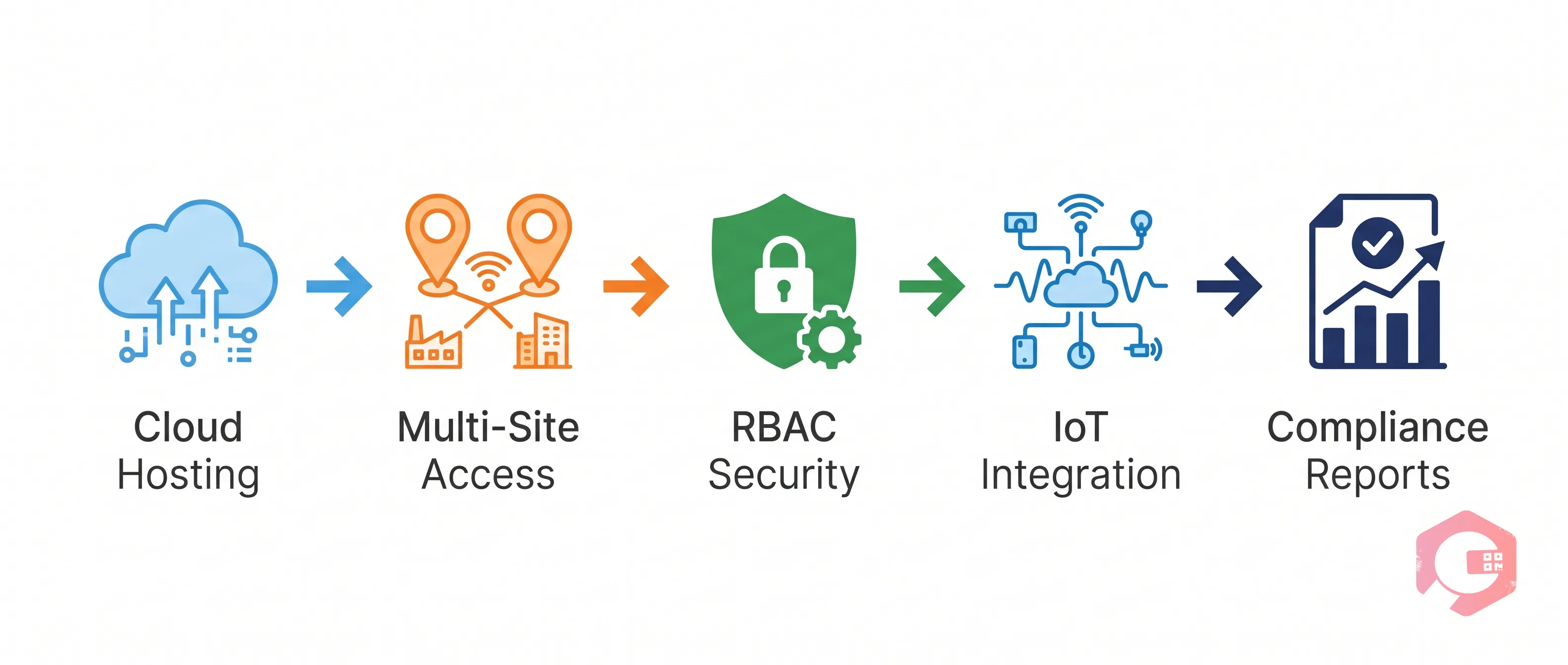
Cryotos is built as a cloud-native CMMS designed specifically for the scalability and security demands of modern maintenance operations. It brings together the full range of capabilities that plant heads and maintenance managers need to manage growing operations safely and efficiently.

On the scalability side, Cryotos supports unlimited assets and locations, dynamic PM scheduling based on calendar dates or IoT-triggered meter readings, multi-site dashboards with location-level filtering, and seamless integrations with ERP systems like SAP and Microsoft Dynamics 365. The mobile app works offline - critical for technicians in remote areas or facilities with patchy connectivity - and syncs automatically when the connection is restored.

On the security side, Cryotos implements role-based access control across all modules, full audit trails on every action, encrypted data transmission and storage, and compliance-ready reporting for regulatory inspections. The platform's workflow automation ensures that safety procedures - including Permit to Work and Lockout-Tagout - are embedded directly into work orders, creating a verifiable safety record with every maintenance task.

Organizations using Cryotos have reported 30% reductions in downtime, 25% faster repair times, and significantly reduced audit preparation time - because the system builds the compliance record automatically, every single day.

If your current CMMS requires IT involvement every time you add a site, limits the number of users, or cannot generate an audit-ready maintenance history on demand, it is already holding your operations back. Cryotos is designed to remove those constraints - so your maintenance program scales as fast as your business does, with the security your data requires. Explore the Cryotos CMMS platform or learn how asset management works at scale.

Frequently Asked Questions

Is a cloud-based CMMS more secure than on-premise?

For most organizations, yes. Cloud CMMS providers invest significantly in security infrastructure - including encryption, automated backups, intrusion detection, and regular penetration testing. On-premise systems require your internal IT team to manage all of this, which creates gaps that cloud providers close automatically through continuous updates and monitoring.

How quickly can a cloud CMMS scale to a new facility?

With a platform like Cryotos, adding a new facility typically takes hours - not weeks. You configure the location, add technicians, register assets, and set up PM schedules. There is no need for on-site IT work, server installation, or software licensing renegotiation. Your new site is live and connected to your central dashboard from day one.

How does a cloud CMMS help with compliance and audits?

Cloud CMMS platforms maintain a complete, timestamped audit trail for every action taken in the system. When a regulatory auditor asks for maintenance records, safety checklists, or work order histories, you generate the report in seconds. Cryotos also embeds compliance requirements - like Permit to Work and LOTO procedures - directly into work orders, ensuring your team follows protocol on every job and the record is created automatically.

What happens to our data if the cloud provider goes down?

Reputable cloud CMMS providers like Cryotos use geographically distributed data centers with automatic failover. If one data center experiences an outage, traffic shifts to another location automatically - keeping your system available. Data is continuously backed up across multiple locations, so there is no risk of losing maintenance history even in the event of a major infrastructure failure.

Want to Try Cryotos CMMS Today? Lets Connect!
Thank you! Your submission has been received!
Oops! Something went wrong while submitting the form.
Related Post

How Cryotos (Cloud-Based CMMS) Improves Scalability and Security

Calendar
Duration:
7 min read
calendar today
Published on
April 27, 2026
Featured Image

A cloud-based CMMS (Computerized Maintenance Management System) improves scalability and security by delivering enterprise-grade infrastructure on demand - letting your maintenance operations grow across sites, teams, and assets without the cost or risk of on-premise systems. As organizations expand, a cloud CMMS like Cryotos gives you the flexibility to add users and locations in minutes, while built-in encryption, role-based access control, and real-time audit trails protect every piece of your maintenance data.

For maintenance managers and plant heads overseeing growing operations, the question is no longer whether to move to the cloud - it is how quickly you can make the shift before outdated systems become a liability. Businesses running on spreadsheets or legacy on-premise software are already losing ground: missed PM schedules, siloed asset data, and security gaps that regulators are paying closer attention to every year.

This post breaks down exactly how a cloud-based CMMS delivers scalability and security - and why these two benefits are inseparable in modern maintenance operations.


What Is a Cloud-Based CMMS?

A cloud-based CMMS is maintenance management software hosted on remote servers and accessed via the internet - rather than installed on local hardware at your facility. Instead of paying for servers, IT staff, and costly upgrades, you access the platform through a browser or mobile app and the provider handles infrastructure, uptime, backups, and security patches.

This delivery model - often called SaaS (Software as a Service) - changes the economics and capabilities of maintenance management entirely. You pay a subscription, get immediate access to the latest features, and scale your usage up or down based on need. There is no capital expenditure on servers, no downtime during software updates, and no risk of losing critical maintenance data because of a local hardware failure.

For organizations managing assets across multiple facilities, shifts, or countries, a cloud CMMS provides something on-premise software simply cannot: a single, real-time view of every work order, asset, and technician - regardless of where they are.

How Cloud CMMS Improves Scalability

How Cryotos (Cloud-Based CMMS) Improves Scalability and Security — lifecycle

Scalability in maintenance management means your system can grow with your business without requiring a complete overhaul. A cloud-based CMMS delivers this in three concrete ways.

Multi-Site Expansion Without IT Complexity

When your operations expand to a new facility, a cloud CMMS lets you onboard that site in hours - not months. You create a new location in the system, assign technicians, and link assets. There is no need to install new software, configure local servers, or send an IT team on-site. Every new location inherits the same workflows, checklists, and reporting structures you have already built.

For plant heads overseeing multiple facilities, this means a consolidated dashboard that shows open work orders, overdue PMs, and downtime metrics across all sites in one view. You stop managing chaos in silos and start seeing patterns - which machines fail most often, which sites are lagging on preventive maintenance, and where resources need to shift.

Cryotos supports multi-site operations with location-level filtering, so site managers see only their data while plant heads get the full picture. The platform's role-based access control ensures the right people see the right information - at scale.

Dynamic User and Asset Growth

Traditional on-premise CMMS systems are licensed by the number of users or assets at point of purchase. Scaling up means renegotiating contracts, upgrading server capacity, and dealing with IT bottlenecks. Cloud platforms eliminate this friction entirely. Adding a new technician, supervisor, or asset takes minutes. You can scale from ten users to a thousand without any change to the underlying infrastructure.

This matters most during periods of rapid growth or seasonal demand spikes. A food processing plant ramping up for peak season can add technicians to the system overnight. A manufacturing company bringing a new production line online can register hundreds of new assets, assign PM schedules, and configure IoT sensor integrations - all before the line runs its first cycle.

IoT Integration at Scale

Cloud-based CMMS platforms are designed to integrate with IoT sensors, SCADA systems, and PLCs without the infrastructure constraints that limit on-premise installations. As you add sensors to equipment, the cloud CMMS ingests that data, triggers automated work orders when thresholds are breached, and feeds real-time condition data into your BI dashboards.

Cryotos connects directly with IoT devices and edge platforms, enabling true condition-based maintenance at scale. When a motor's vibration reading exceeds a safe threshold at 2 AM, the system creates a work order, alerts the on-call technician via WhatsApp, and logs the event - all without human intervention. Organizations using this approach have reported up to 30% reductions in unplanned downtime and 25% faster repair times.

How Cloud CMMS Strengthens Security

How Cryotos (Cloud-Based CMMS) Improves Scalability and Security — workflow

Security in a cloud CMMS is not a single feature - it is a layered architecture that protects your maintenance data at every level: data in transit, data at rest, user access, and audit compliance. Here is how each layer works in practice.

Role-Based Access Control (RBAC)

Not every technician needs access to every asset or every report. Role-based access control lets you define exactly what each user can see, create, or modify. A field technician can view and close their assigned work orders. A supervisor can approve work orders and view team performance. A plant head can access cost reports and downtime analytics. A system administrator manages users and permissions.

This granular control prevents data leakage, accidental modifications to critical asset records, and unauthorized access to financial or compliance data. In industries like pharmaceuticals, food processing, and energy - where regulatory auditors scrutinize access logs - RBAC is not optional. It is a compliance requirement.

Cryotos implements user role-level access across all modules: work orders, assets, inventory, reporting, and workflows. Each permission is configurable, so your system structure mirrors your organizational hierarchy exactly.

Data Encryption and Secure Transmission

All data transmitted between your devices and the Cryotos cloud is encrypted using industry-standard TLS (Transport Layer Security). Data stored in the cloud is encrypted at rest, meaning even if someone were to access the physical storage infrastructure, the data would be unreadable without the encryption keys.

This level of protection is something most on-premise systems simply cannot match. Maintaining encryption on local servers requires specialized IT skills and ongoing investment in security infrastructure. Cloud providers invest hundreds of millions in security annually - giving smaller organizations enterprise-grade protection at a fraction of the cost.

Audit Trails and Compliance Readiness

Every action taken in a cloud CMMS is logged with a timestamp, user ID, and record of what changed. Who closed that work order? Who modified that PM schedule? Who accessed that asset's maintenance history? The audit trail answers every question - and does so automatically, without any manual effort from your team.

This is critical for ISO 55000 compliance, GMP audits, FDA inspections, and OSHA record-keeping requirements. When an auditor walks in and asks for the complete maintenance history of a critical piece of equipment, you generate the report in seconds - not hours of document hunting. Cryotos maintains a full audit trail across all modules and makes these records exportable in audit-ready formats.

Automated Backups and Disaster Recovery

On-premise systems are only as reliable as the hardware and IT practices supporting them. A server failure, power surge, or ransomware attack can wipe out years of maintenance records and asset history. Cloud platforms eliminate this risk through automated backups and geographically distributed data storage. Even if one data center experiences an outage, your data is replicated across multiple locations and restored automatically.

For a maintenance team, this means zero risk of losing critical PM records, safety compliance documentation, or work order histories - the exact data that protects you during regulatory audits and insurance claims.

Cloud vs. On-Premise: The Scalability and Security Gap

How Cryotos (Cloud-Based CMMS) Improves Scalability and Security — problems grid

The differences between cloud and on-premise CMMS become most visible when organizations try to scale or respond to a security incident.

On-premise systems require dedicated IT staff to manage updates, patches, and security configurations. When a critical vulnerability is discovered, IT teams must manually deploy fixes across every installation - a process that can take days or weeks, leaving the system exposed. Cloud providers push security updates automatically, often within hours of a vulnerability being identified.

Scaling an on-premise system requires hardware investment, IT project work, and planned downtime. A cloud CMMS scales on demand - often with no involvement from IT at all. New sites, new users, new IoT integrations can be provisioned in the same day.

For organizations managing complex, multi-facility operations, the total cost of ownership (TCO) for cloud CMMS is consistently lower than on-premise when you account for hardware, IT staffing, security, and upgrade costs over a five-year period.

How Cryotos Delivers Both

How Cryotos (Cloud-Based CMMS) Improves Scalability and Security — scenario

Cryotos is built as a cloud-native CMMS designed specifically for the scalability and security demands of modern maintenance operations. It brings together the full range of capabilities that plant heads and maintenance managers need to manage growing operations safely and efficiently.

On the scalability side, Cryotos supports unlimited assets and locations, dynamic PM scheduling based on calendar dates or IoT-triggered meter readings, multi-site dashboards with location-level filtering, and seamless integrations with ERP systems like SAP and Microsoft Dynamics 365. The mobile app works offline - critical for technicians in remote areas or facilities with patchy connectivity - and syncs automatically when the connection is restored.

On the security side, Cryotos implements role-based access control across all modules, full audit trails on every action, encrypted data transmission and storage, and compliance-ready reporting for regulatory inspections. The platform's workflow automation ensures that safety procedures - including Permit to Work and Lockout-Tagout - are embedded directly into work orders, creating a verifiable safety record with every maintenance task.

Organizations using Cryotos have reported 30% reductions in downtime, 25% faster repair times, and significantly reduced audit preparation time - because the system builds the compliance record automatically, every single day.

If your current CMMS requires IT involvement every time you add a site, limits the number of users, or cannot generate an audit-ready maintenance history on demand, it is already holding your operations back. Cryotos is designed to remove those constraints - so your maintenance program scales as fast as your business does, with the security your data requires. Explore the Cryotos CMMS platform or learn how asset management works at scale.

Frequently Asked Questions

Is a cloud-based CMMS more secure than on-premise?

For most organizations, yes. Cloud CMMS providers invest significantly in security infrastructure - including encryption, automated backups, intrusion detection, and regular penetration testing. On-premise systems require your internal IT team to manage all of this, which creates gaps that cloud providers close automatically through continuous updates and monitoring.

How quickly can a cloud CMMS scale to a new facility?

With a platform like Cryotos, adding a new facility typically takes hours - not weeks. You configure the location, add technicians, register assets, and set up PM schedules. There is no need for on-site IT work, server installation, or software licensing renegotiation. Your new site is live and connected to your central dashboard from day one.

How does a cloud CMMS help with compliance and audits?

Cloud CMMS platforms maintain a complete, timestamped audit trail for every action taken in the system. When a regulatory auditor asks for maintenance records, safety checklists, or work order histories, you generate the report in seconds. Cryotos also embeds compliance requirements - like Permit to Work and LOTO procedures - directly into work orders, ensuring your team follows protocol on every job and the record is created automatically.

What happens to our data if the cloud provider goes down?

Reputable cloud CMMS providers like Cryotos use geographically distributed data centers with automatic failover. If one data center experiences an outage, traffic shifts to another location automatically - keeping your system available. Data is continuously backed up across multiple locations, so there is no risk of losing maintenance history even in the event of a major infrastructure failure.

Want to Try Cryotos CMMS Today?

Get Free Demo

Let AI Take Control of Your Maintenance

Cryotos AI predicts failures, automates work orders, and simplifies maintenance—before problems slow you down.

Try AI-Powered CMMS
🡢