
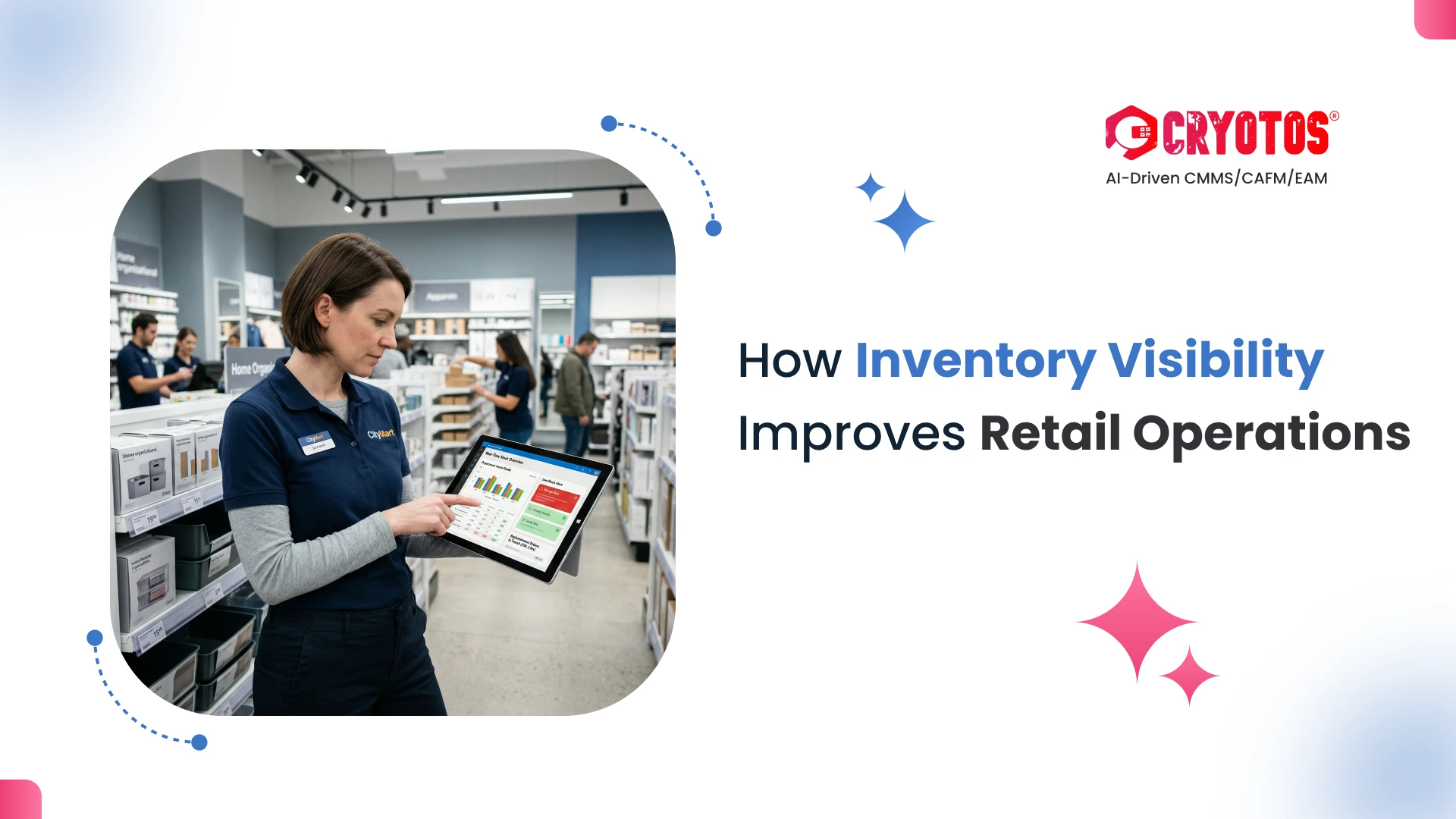
The same scenario occurs in every busy retail store during peak season when a customer requests a product and the associate checks the shelf which shows no product and someone disappears into the back to search for it. The answer which emerged after ten minutes of waiting time showed two possibilities: either “it’s out of stock” or “we had it but couldn’t find it.” The customer experiences frustration because both outcomes lead to leaving empty-handed.
Inventory visibility enables organizations to track their complete inventory by showing its exact location and status throughout all their locations.
Once retailers achieve this capability, their operations shift from handling emergencies to preventing possible problems through advanced planning. Restocking happens before shelves go empty.
The common usage of this term requires us to establish its exact definition. Inventory visibility requires more than knowing your current stock numbers. It has four distinct dimensions:
Most retailers have partial visibility. The current system shows you both the available stock count and the actual stock count, which becomes inaccurate through multiple factors including receiving errors, unprocessed returns, theft, and manual counting mistakes. The process produces a number that appears correct but should not be used for essential decision making.
True visibility requires all four dimensions working together.
Before exploring how visibility improves operations, it helps to quantify what its absence costs — because the losses are often scattered across departments and never totaled.
When inventory records are inaccurate, replenishment triggers fire too late — or not at all. A product shows “in stock” in the system while the physical shelf has been emptying for three days. The retailer loses more than just the sale; they lose the customer who would have bought it from them.
Research shows that stockouts are the primary reason customers permanently stop shopping at a store.
The opposite of stockouts occurs when products become overstocked, resulting in unnecessary inventory that occupies space in back rooms while blocking cash resources needed for other uses. Retailers tend to overstock because they lack confidence in actual demand signals, which results in excess inventory accumulation of some SKUs that cannot be sold within a reasonable timeframe.
Cycle counts fail to reveal theft, damage, and administrative errors because these incidents build up without being detected through the absence of real-time visibility. The quarterly count discovers the discrepancy at a point where the loss already exists, because the data trail needed to identify the loss path was never created.
When associates can’t trust the inventory system, they spend time on manual verification — physically checking shelves and back rooms instead of serving customers. That’s productive labor being consumed by a data quality problem.
When visibility is genuinely in place, the operational improvements aren’t theoretical — they’re systematic.
Real-time inventory visibility enables automatic restocking procedures to function without human input. When your system knows the exact quantity on hand at every location, it can trigger purchase orders or transfer requests the moment stock drops below a defined threshold — without waiting for a manual count or a stockout to make the problem obvious.
This shifts replenishment from a reactive scramble to a predictive rhythm. Buyers work from current data rather than aging reports, and minimum stock levels can be refined over time as the system accumulates accurate demand history.
What this requires: Inventory records that update in real time as items are sold, received, transferred, or returned — not on a batch schedule.
The challenge with omnichannel fulfillment isn’t just that inventory needs to be available across networks, but that it’s available at the right location, in sellable condition, and not already reserved for another order.
Retailers without this visibility routinely promise inventory they can’t deliver, which leads to order cancellations, customer service escalations, and refund costs that erode margin on what should have been a straightforward sale.
Retail networks have a predictable pattern: some locations sell a product faster than expected while others have surplus. Without visibility into what each location holds, redistribution happens slowly if at all — often based on intuition rather than data.
Real-time visibility across the entire store network enables intelligent stock transfers. The system achieves accurate visibility which enables it to send online orders to the closest stock location while reducing both fulfillment duration and shipping expenses.
This is particularly valuable for seasonal and trend-driven merchandise, where the window to sell at full margin is short.
Annual or quarterly physical counts do not provide enough frequency to detect ongoing shrinkage problems. The count discovers a discrepancy after the loss has already occurred, making it challenging to identify its origin.
Continuous inventory monitoring records every stock movement through scanning, RFID technology, and system transactions, which establishes an actual audit trail that remains active throughout the inventory process. Small discrepancies can be examined while the evidence is still available.
Shrinkage that would have accumulated unnoticed for months gets flagged within days.
What this requires: All inventory movements to be documented when they occur — receiving, transferring, selling, returning, and adjusting. The system should not accept bulk entry of inventory movements after the fact.
Purchasing in retail is a forward-looking problem: how much of what, for which locations, by when. Poor visibility forces buyers to work with lagging data, gut instinct, and safety stock buffers large enough to compensate for uncertainty.
When visibility is accurate, buyers can see true sell-through rates by SKU and location, identify which products are trending before they stock out, and make allocation decisions based on actual demand patterns rather than historical averages that may no longer reflect current reality.
The result is less excess inventory, fewer emergency orders, and better margin on every purchase cycle.
Receiving processes generate inventory inaccuracies because they form the primary method through which organizations obtain their stock. The manual check-in process for incoming shipments creates data errors through quantity mistakes, item mis-scanning, and incomplete entry records which lead to data corruption before items even reach the floor. The system records a product receipt with an incorrect quantity or fails to record the product entirely, resulting in an undetectable discrepancy that continues to affect all subsequent operational processes.
Barcode scanning, QR code, and RFID technology at the receipt stage update inventory levels while identifying differences between the order and what has been received. The system detects problems at the dock instead of waiting until the next cycle count period.
The customer experience improves through inventory tracking, which enables customers to find products within stores while staff members provide exact inventory information and online commitments for order delivery get fulfilled.
The ability of retail employees to tell customers about product locations creates a significant sales advantage — customers value specific aisle information which leads to more sales. The sales difference from that single customer interaction builds into a large revenue shortfall which affects thousands of customers every week.
Achieving true inventory visibility is not a software purchase alone — it’s a combination of the right systems and the right data capture processes.
The most accessible starting point. Every product movement — receiving, picking, transferring, returning — is recorded by scanning. Speed and accuracy of data entry improve dramatically compared to manual entry. Maintenance tools and equipment need to use QR codes because traditional barcodes do not work for non-sellable assets.
The system uses weight sensors that operate without scanning to detect stock levels when weight reaches its limit. The system then sends alerts about restocking needs while enabling ongoing theft and lost item tracking.
All the above processes create data. The organization needs a centralized system which consolidates inventory data from all locations and channels, tracks replenishment triggers, and displays analytics to guide purchase and allocation decisions.
The CMMS or inventory platform serves as the system of record — the single source of truth that every decision, from the store floor to the buying office, draws from.
Cryotos was built with the complexity of multi-location inventory management in mind. Its inventory and warehouse management capabilities address every layer of the visibility challenge.
Cryotos enables users to view real-time inventory information showing stock quantities, storage locations, and order progress for all distribution centers and retail outlets. The inventory system uses unique QR codes or barcodes to trace each item from its entry into stock until its final exit.
Warehouse structure mapping lets teams define precise physical locations down to the aisle, rack, shelf, and bin level — so “where is it?” has a specific, digital answer rather than a general one.
The system generates alerts for administrative staff when stock levels reach the established minimum threshold, helping to avoid stock shortages that could disrupt business activities. The alert system enables buyers to set up different restocking procedures for various inventory types — by location, product category, or individual SKU.
The CMMS monitors products near their end-of-life status, which organizations using retail operations need to manage for perishable items, dated goods, and warranty products. The system provides alerts to help evaluate products that need replacement or discounting through dedicated timing alerts.
Cryotos supports multiple inventory valuation methods — Average Cost, LIFO, and FIFO — and helps eliminate excessive ordering by providing accurate, current data that purchasing decisions can rely on. The result is tighter inventory turns and less capital tied up in excess stock.
Every inventory movement — opening stock entries, production orders, parts issued for work orders, and items consumed during maintenance — is tracked through Cryotos. The complete movement log establishes an audit trail which enables organizations to track ongoing inventory shrinkage and provides management complete visibility into inventory loss reasons.
Beyond product inventory, Cryotos manages the tools and equipment used across retail operations: tracking their status (available, lent out, damaged), lending history, and condition. This prevents loss of valuable assets and eliminates unnecessary replacement purchases driven by unknown whereabouts.
Complete inventory transparency requires time to develop. Retailers achieve this goal through multiple phases, beginning with their most impactful improvements and progressing into subsequent stages.
Stage 1 — Fix the data foundation. The system must record every inventory movement at the exact moment it occurs. Resolve data drift problems which occur due to incomplete product receiving, unprocessed return shipments, and unauthorized manual system changes.
Stage 2 — Automate replenishment triggers. Establish base stock levels which trigger automatic ordering. Eliminate all tasks requiring manual assessment and staff guessing.
Stage 3 — Extend visibility across locations. Link all warehouses and store inventory data into a unified database which operates as a single network view. Enable stock movement between locations based on current inventory information throughout the whole network.
Stage 4 — Add predictive capability. Use precise stock data to create demand predictions which help organizations prepare for upcoming sales patterns. Forecast seasonal demand, trend-driven sales, and promotional activities to prevent stock shortages and excessive inventory.
The process from stage one to stage four requires precise data verification which establishes trustworthy results. Stage 4 fails to produce reliable results without the data foundation provided by Stage 1. The order of operations is critically important.
Inventory visibility is among the most impactful investments retailers can make. The effects extend beyond the warehouse to impact all operational areas including purchasing, fulfillment, loss prevention, and customer experience — and ultimately affect the company’s financial results.
The retailers who get this right don’t just have better stock accuracy numbers. They make faster decisions, serve customers more reliably, and waste less capital on inventory that’s in the wrong place or on its way to a markdown.
The technology to achieve this is accessible. The challenge, for most operations, is connecting the right tools to the right processes and ensuring that every inventory movement gets captured accurately, every time.
Cryotos CMMS provides the infrastructure to make that happen — from real-time tracking and automated alerts to multi-location visibility and comprehensive reporting. It turns inventory management from a periodic reconciliation exercise into a continuous, operational advantage.
Ready to eliminate stockouts and optimize your retail operations? Book a free demo with Cryotos today.



Cryotos AI predicts failures, automates work orders, and simplifies maintenance—before problems slow you down.



