
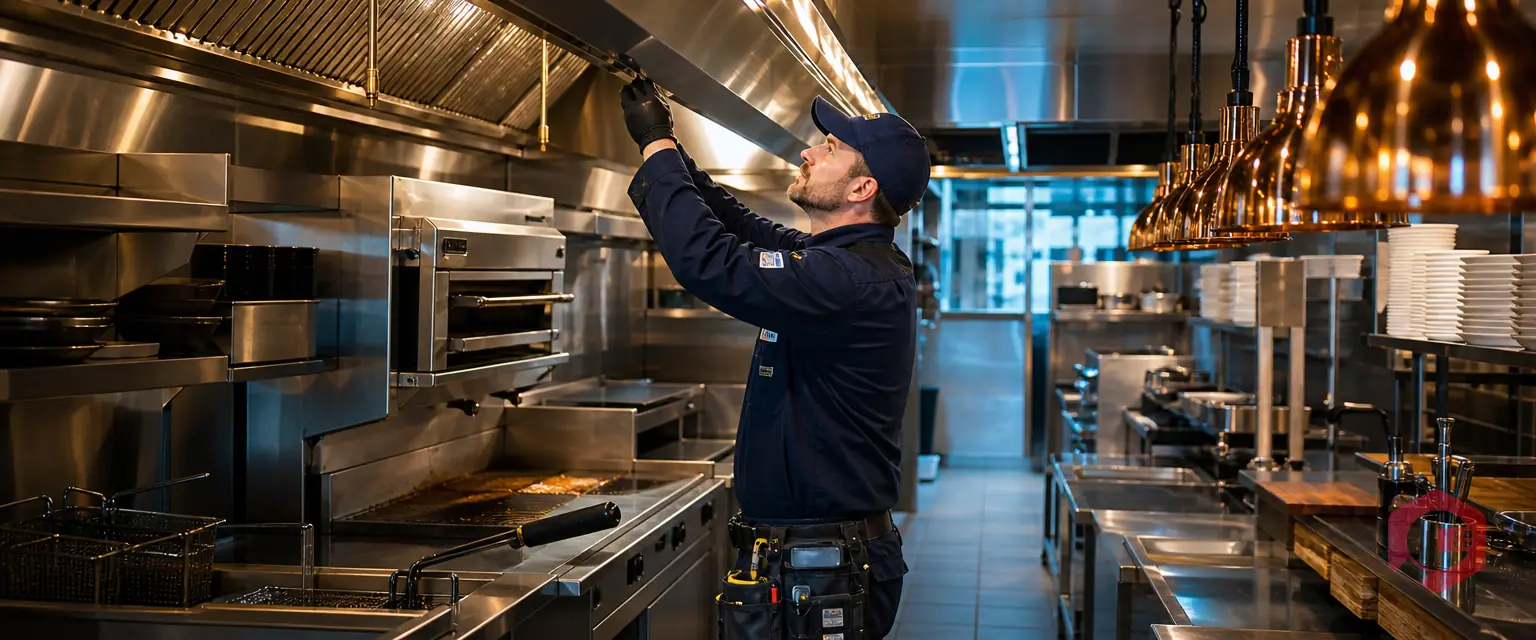
Restaurant health code compliance is the ongoing work of keeping food, equipment and records within the rules your local health department enforces. Most U.S. rules build on the FDA Food Code, and a failing cooler or a dish machine that never reaches sanitizing temperature can cost you points in minutes.
Restaurants stay compliant by servicing equipment on a schedule, logging temperatures every day, fixing faults fast and keeping dated records an inspector can read. A Computerized Maintenance Management System (CMMS) turns that routine into tracked work instead of memory and paper.
Key Takeaways

Restaurant health code compliance is the practice of meeting the food safety, sanitation and facility rules that state and local inspectors enforce. In the United States, the FDA publishes the FDA Food Code as a model, and each state or city adopts and enforces its own version.
Inspectors score what they can see and verify: food temperatures, handwashing, cross-contamination, pest control and whether equipment works. Operations that use specialized processes, such as curing or reduced-oxygen packaging, may also need a formal HACCP plan.
The Food Code requires equipment to be kept in good repair and properly adjusted. Food between its cold and hot limits sits in the temperature danger zone, where bacteria multiply fastest.
Rules differ by state and city, so confirm which Food Code edition your health department enforces. Whatever the edition, restaurant health code compliance depends on equipment that holds its settings every day.
Equipment tied to food temperature and sanitation gets the closest look during an inspection. The matrix below links each asset to the failure inspectors notice and the upkeep that protects restaurant health code compliance.
| Equipment | What inspectors check | Common failure | Maintenance that prevents it |
|---|---|---|---|
| Walk-in cooler and reach-in refrigerators | Food at 41°F (5°C) or below; a working thermometer | Worn door gaskets, dirty condenser coils, failing compressor | Gasket checks, coil cleaning, daily temperature log |
| Hot-holding units and steam tables | Food at 135°F (57°C) or above | Faulty thermostat or heating element | Thermostat calibration, element checks |
| Dish machine | Final rinse temperature or sanitizer concentration | Scaled heating element, clogged spray arms, empty chemical line | Descaling, spray arm cleaning, sanitizer checks |
| Hood, filters and exhaust | Grease buildup, airflow, clean surfaces | Clogged filters, grease-laden ducts | Filter cleaning, duct cleaning on a set interval |
| Grease trap or interceptor | Overflow, odor, pump-out records | Missed pump-outs | Scheduled pump-outs with dated records |
| Hand sinks and water heater | Hot water, soap and towels, drainage | Water heater failure, slow drains | Water heater service, drain clearing |
| Ice machine | Clean ice-contact surfaces | Mineral scale, biofilm | Clean-and-sanitize cycle per the manufacturer |
Pest control belongs on the same list. Broken door sweeps, cracked seals and open pipe chases give pests a way in, and a repair backlog is how most of those gaps stay open. Treat every inspection finding on this matrix as a maintenance task with an owner and a due date.
Refrigeration, hot holding and warewashing cause more equipment citations than any other group because each one has a number an inspector can measure. Keep all three inside their limits with small, repeatable checks, because restaurant health code compliance is won or lost on these numbers.
Cold holding is the practice of keeping perishable food at 41°F (5°C) or below until it is served. A cooler that drifts a few degrees can push a full shelf into the danger zone before anyone notices.
Most operators catch a failing cooler through the log trend before an alarm sounds. A slow upward drift over a week points to coils, gaskets or refrigerant, and it is cheaper to fix than a spoiled delivery.
Steam tables and holding cabinets should keep food at 135°F (57°C) or above, and they are not designed to reheat cold food. Calibrate thermostats on a set schedule and check heating elements when readings lag.
High-temperature machines usually need a final rinse near 180°F (82°C), while chemical machines need the sanitizer concentration printed on the data plate. Check your own machine's data plate and local code, then descale heating elements and clean spray arms on a regular cycle.
Unsure what one outage costs? Run the numbers with the Cryotos unplanned downtime calculator before the next breakdown does it for you.
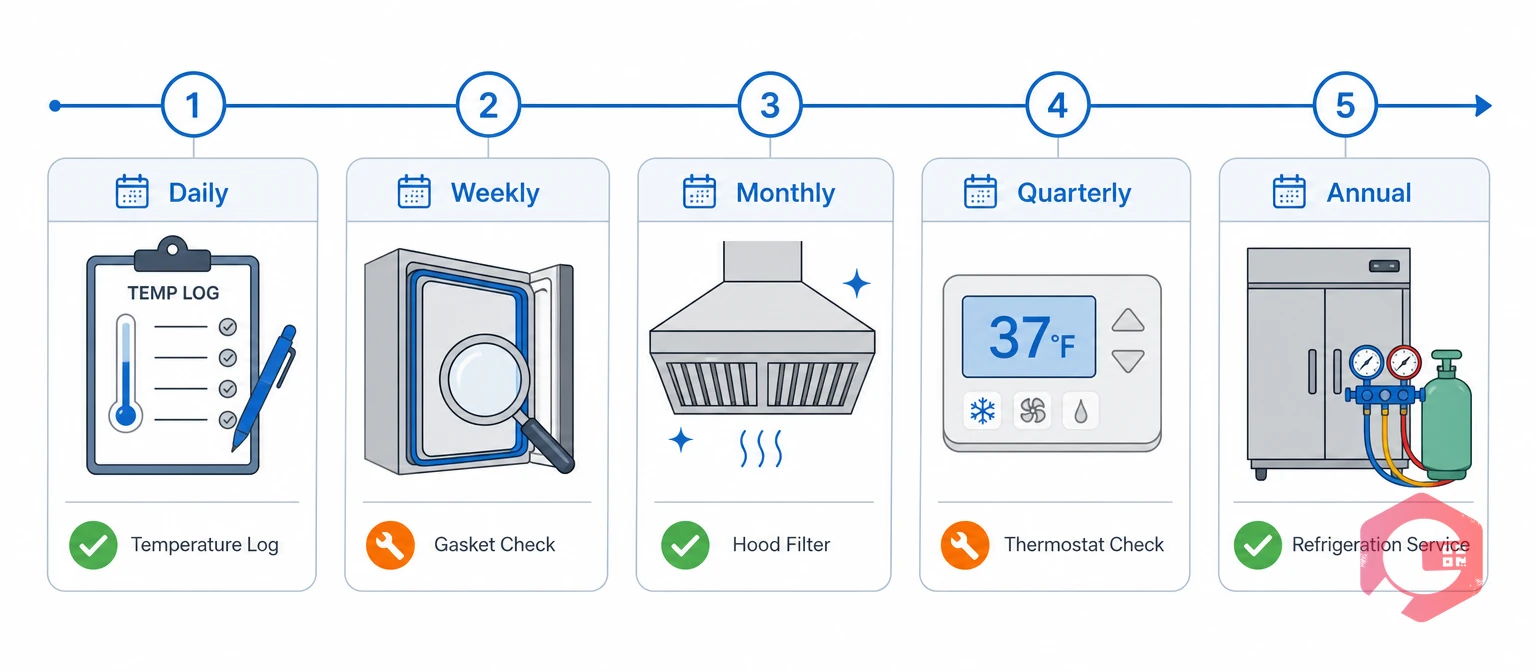
A restaurant maintenance schedule works when every task has a frequency, an owner and a record. The schedule below is a common starting point, and your manufacturer manuals and local code set the final intervals.
| Frequency | Key tasks | What it protects | Typical owner |
|---|---|---|---|
| Daily | Log cooler and freezer temperatures, check hot-hold readings, confirm dish machine rinse or sanitizer, wipe door gaskets | Food temperature compliance | Opening or closing lead |
| Weekly | Inspect gaskets, clear floor drains, test hand sink hot water, check thermometer accuracy | Sanitation and cross-contamination | Kitchen manager |
| Monthly | Clean hood filters, clean condenser coils where needed, descale the ice machine per the manufacturer, check pest entry points | Airflow, ice safety, pest control | Maintenance lead |
| Quarterly | Clean hoods and ducts on high-volume lines per NFPA 96, calibrate thermostats, service the dish machine | Fire safety and warewashing | Contractor |
| Semiannual to annual | Professional refrigeration service, grease trap pump-out per local rules, water heater service, fire suppression inspection | Equipment life and fire safety | Contractor |
NFPA 96 sets hood cleaning intervals by cooking volume, from monthly for solid-fuel cooking to annually for low-volume operations. Most facilities that miss these dates do so because nobody owned the reminder.
Preventive maintenance software removes that gap by turning each row into a recurring work order triggered by date or running hours. A schedule that raises its own tasks is what keeps restaurant health code compliance from depending on one person's memory.
Paper logs work for a single small kitchen, but digital records hold up better as soon as you run several shifts or locations. Health departments generally ask to see records, so confirm which formats yours accepts.
| Factor | Paper logs | Digital records |
|---|---|---|
| Retrieval time | Minutes to hours when binders are scattered | Seconds, searchable by date or asset |
| Completeness | Skipped lines are easy to miss | Mandatory fields can block closing a task |
| Timestamps | Handwritten, easy to backfill | System-stamped with user and time |
| Corrective action trail | Notes in margins, often lost | Work order links the fault, fix and sign-off |
| Storage and loss risk | Fades, tears, spills, gets misplaced | Stored in the cloud with backup |
| Cost to start | Low | Subscription plus setup time |
The deciding difference is the trail from problem to fix. An inspector who sees a 44°F reading wants to know what happened next, and a linked work order answers that in one screen.

An inspection-ready maintenance routine follows five repeating steps that turn equipment care into proof of restaurant health code compliance. Teams that run all five rarely scramble when an inspector walks in.
The Five-Step Inspection-Ready Maintenance Framework:
A cook logs 43°F on the walk-in cooler at opening and snaps a photo. The reading opens a work order for the maintenance lead, who finds iced condenser coils and clears them. The manager checks product temperatures, handles any affected food under the kitchen's food safety policy, and the work order stores the whole story.
That single record covers the fault, the fix and the food decision. It is the kind of evidence that makes an inspector's follow-up questions short.
When equipment fails during service, protect the food first and repair the unit second. A clear order of steps keeps restaurant health code compliance intact even on a busy Friday night.
Most kitchens lose control in the first hour of a breakdown, when nobody knows who owns the call. Writing the order of steps down, and attaching it to the asset record, removes that hesitation.
Cryotos gives restaurant teams one place for schedules, checklists, work orders, parts and history, so each step of the framework leaves a record. Setup starts with your most inspection-critical assets: coolers, hot-holding units, dish machines and hoods.
Maintenance teams using Cryotos have reported up to 30% reduction in unplanned downtime and 25% faster repair turnaround. For an industry view, read about hotels and restaurants maintenance software, and use the regulatory compliance checklist as a starting audit list.
A restaurant can reach inspection-ready records in about 30 days by starting with its most critical equipment. The plan below keeps the first month small enough to finish.
Teams that finish a mock inspection before the real one usually find two or three missing records, and those are easy to fix in week four.
Under the FDA Food Code, the danger zone sits between 41°F (5°C) and 135°F (57°C). Cold food must stay at or below 41°F and hot food at or above 135°F, because bacteria grow fastest in between.
State and local health departments inspect restaurants. The FDA publishes the model Food Code, but your city or county enforces its own adopted version, so follow the edition they use.
Check temperatures and sanitizer every day, inspect gaskets and drains weekly, and service coils, filters and ice machines monthly. Contractors usually handle hoods, refrigeration and grease traps on a quarterly to annual cycle.
Keep temperature logs, sanitizing checks, repair work orders, service reports and pest control visits. Requirements vary by jurisdiction, so ask your health department which records it expects to see.
Yes. A cooler above 41°F, a dish machine that fails to sanitize or a hand sink without hot water can each lead to a violation. Serious violations may require immediate correction or temporary closure, depending on your jurisdiction.
No. Maintenance software supports your food safety plan by scheduling equipment care and storing the records, but you still need trained staff, written procedures and any HACCP plan your menu requires.
It keeps schedules, checklists, work orders and repair history in one searchable place. A manager can pull dated records in seconds instead of hunting through binders while the inspector waits, which makes restaurant health code compliance far easier to demonstrate.
Inspectors rarely announce themselves, so restaurant health code compliance has to hold on every shift. Schedule a free demo to see how Cryotos turns your equipment schedule, checklists and repair history into records you can show on request.
Cryotos AI predicts failures, automates work orders, and simplifies maintenance—before problems slow you down.



