Meat and poultry facility maintenance is the planned inspection, repair, and calibration that keeps plant equipment sanitary and USDA-ready. Machine condition affects cleaning, temperature control, and foreign-material risk. That's why maintenance records often become your evidence in a review.
Most plants still track this work on paper, in spreadsheets, and from memory. Records are slow to find, and gaps are easy to miss. A Computerized Maintenance Management System (CMMS) turns that work into scheduled, signed, searchable records. This guide shows how meat and poultry facility maintenance fits USDA rules, which records matter, and how Cryotos supports each step.
Key Takeaways
Food-safety control: Worn gaskets, loose guards, and unchecked gauges can break sanitation and HACCP controls.
Release before restart: QA or sanitation should sign off every repair near product.
Evidence over memory: Work orders hold readings, photos, and signatures.
Start small: Digitize calibration, food-contact PM, and emergency repairs first.
What Is Meat and Poultry Facility Maintenance Under USDA Rules?
Under USDA rules, maintenance is part of how a plant proves it runs clean and in control. USDA FSIS rules in 9 CFR Part 416 require clean equipment, clean facilities, and written Sanitation SOPs. 9 CFR Part 417 covers Hazard Analysis and Critical Control Point (HACCP) systems. It requires monitoring, corrective action, verification, and records.
Maintenance supports each rule in practice:
Cleanable equipment: Equipment and utensils must stay sanitary and easy to clean.
Sanitation SOP records: Procedures need records of use and corrective action.
HACCP records: Monitoring and corrective actions need written proof.
Calibrated instruments: Gauges behind food-safety calls must stay accurate.
Safe repairs: Repairs must not leave debris, tools, or stray lubricant behind.
Your records must show a simple chain: find, fix, check, and prevent.
Maintenance Risks vs CMMS Controls in Meat and Poultry Plants
Six risks need a named control in every plant. Each one maps to a CMMS control.
Maintenance risk
Food-safety impact
CMMS control
Worn seals, gaskets, or guards
Leaks, harborage, hard-to-clean surfaces
Inspection routes, photos, planned replacement.
Wrong lubricant or chemical
Chemical or allergen contamination
Approved lubricant lists, task steps, sign-off.
Uncalibrated probes and gauges
Bad monitoring data
Calibration schedules, set limits, alerts when a check fails.
Emergency repair during production
Foreign material, unfinished cleaning
Checklists, QA release before restart.
Skipped PM
More breakdowns near control points
Risk-ranked PM, overdue alerts.
Repeat failures
Repeat contamination or control risk
Root cause steps, owners, due dates.
Rank assets by food-safety impact first, then by downtime cost. A gasket on a food-contact line outranks a bigger motor in dry storage.
Meat and poultry facility maintenance runs smoothest as a repeatable seven-step loop.
The Detect-to-Evidence Compliance Framework:
Detect: Start PM, inspection, calibration, or repair work from a schedule, audit finding, or operator request.
Classify: Mark food-contact status, HACCP link, and sanitation risk.
Plan: Attach approved parts, lubricants, check criteria, and lockout steps from OSHA lockout/tagout rules.
Execute: Record findings, readings, parts, photos, and deviations at the asset.
Verify: Require QA or sanitation approval before restart.
Correct: Open corrective action or root cause analysis when limits are missed.
Retain: Store records, approvals, and history for audits.
Most maintenance teams stall at the verify step. Sign-off lives on paper or in a hallway chat. Build it into the work order, and the loop holds.
Worked Example: A Loose Deboner Guard
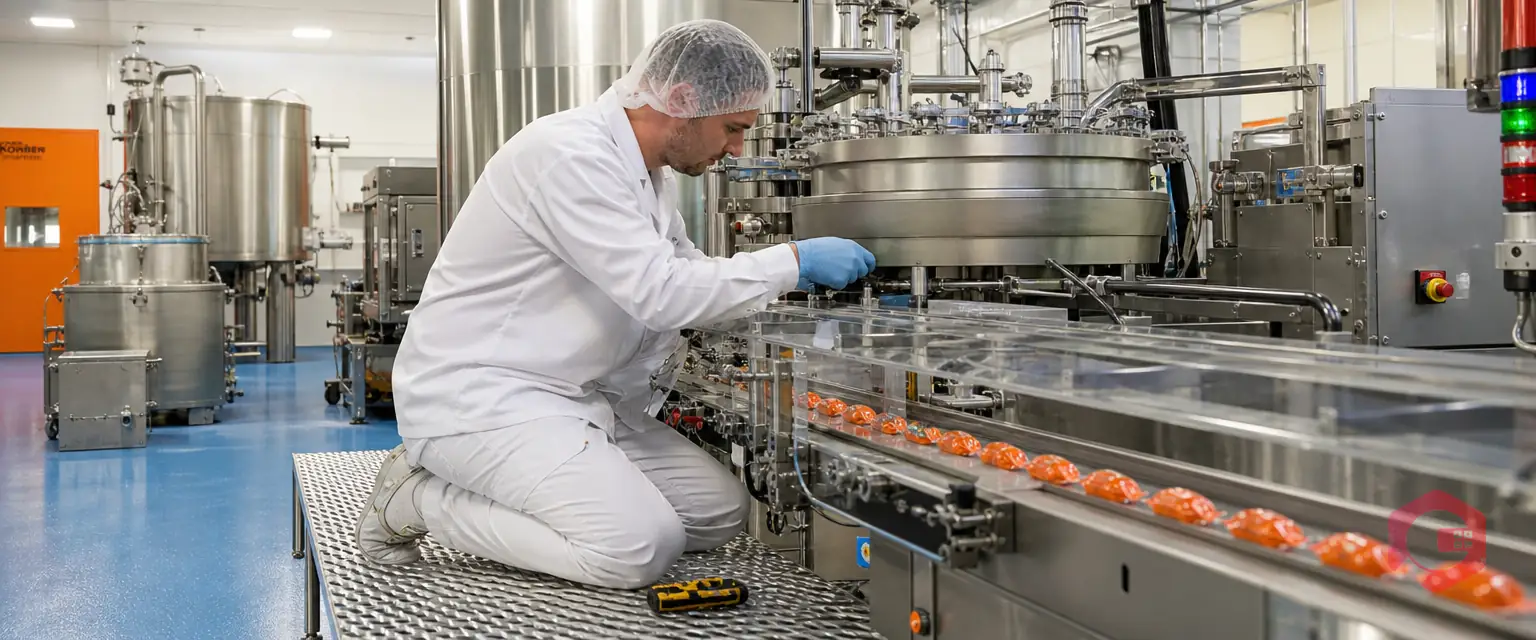
An operator reports a loose guard on deboner DB-12, with residue behind the bracket. The system opens a high-priority work order and flags sanitation impact. The technician replaces the bracket, torques the fasteners, and cleans the area. QA checks the area and releases the line. Reliability then reviews similar guards and updates the PM inspection.
Sanitation release is the QA or sanitation sign-off that returns repaired equipment to production. No sign-off means no restart.
Maintenance Records to Keep Audit-Ready
Meat and poultry facility maintenance records should be easy to find by asset, date, line, or task. Six record types matter most.
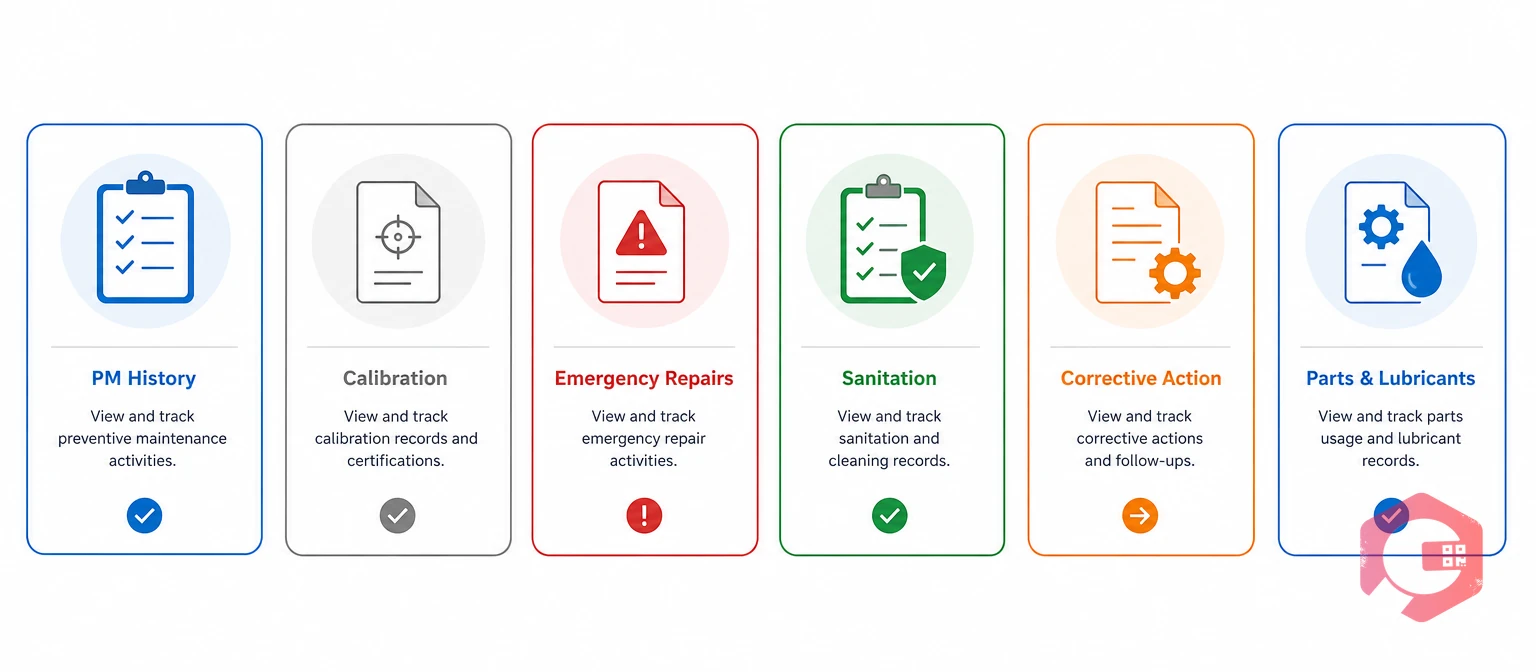
PM history: Task, dates, technician, findings, and parts.
Calibration history: Instrument, standard, as-found and as-left results, and approver.
Emergency repairs: Failure, precautions, cleanup, checks, and restart approval.
Sanitation-related maintenance: Defect, temporary control, repair, cleaning, and release.
Corrective action and root cause: Cause, containment, owner, and closure.
Parts and lubricant use: Approved item, quantity, food-grade status, and user.
A calibration record is the written proof that a monitoring device read accurately against a known standard. A failed result should open corrective action and a product-impact review.
Test your system with one question. Can you pull every repair and calibration for one asset and date range in minutes?
How Cryotos Supports Meat and Poultry Facility Maintenance
Cryotos turns each compliance task into a scheduled, signed, and searchable work order. Each capability below maps to a step in the workflow.
Asset records and QR codes: Tag each asset with a QR code. Record its zone, food-contact status, and criticality. Technicians scan to see history and open work.
Preventive maintenance: Cryotos preventive maintenance software runs schedules by calendar or run hours. One example is a weekly slicer inspection before sanitation release.
Calibration and checklists: Build maintenance checklists from Excel or OCR. Schedule calibration as recurring work that records as-found and as-left readings.
Work orders: Operators raise requests by QR code. Technicians create orders by voice or photo. Work order management sends updates by mobile, email, or WhatsApp, and 5 Whys analysis closes repeat failures.
Offline mobile and signatures: Technicians capture readings, photos, and digital signatures at the asset. Data syncs when coverage returns.
Release approvals and access: Workflow rules send repairs near product to QA or sanitation before closing. Role-level permissions limit who can close critical work.
Parts and lubricants: Track food-grade lubricants, gaskets, and key spares with QR or barcode scans and minimum-level alerts.
Dashboards and IoT: BI dashboards, 50+ reports, and scheduled emails flag overdue compliance work. IoT readings from SCADA, PLC, or edge devices can feed refrigeration data into work orders.
Worked Example: A Failed Thermometer Calibration
A thermometer tied to a HACCP step fails its scheduled calibration. The technician logs the as-found reading on the mobile app and signs the checklist. The failed result triggers a corrective action work order. QA reviews product impact, and the instrument is replaced. Cryotos keeps readings, signatures, and replacement history on one asset record.
What Plants Gain From Digital Maintenance Records
Audit readiness: Records are easy to find by asset, date, line, or task.
Fewer missed tasks: Critical PM and calibration work is scheduled. It escalates before it goes overdue.
Safer release: QA and sanitation checks can be required before restart.
Technician consistency: Digital steps cut variation in lubrication, reassembly, and evidence.
Faster investigations: One asset timeline links failures, repairs, calibration, and sanitation findings.
Maintenance teams using Cryotos have reported up to 30% reduction in unplanned downtime and 25% faster repair turnaround. Most plants start with their highest-risk assets, then expand.
How to Roll Out a CMMS for Meat and Poultry Facility Maintenance
Roll out a CMMS in eight steps, starting with assets that touch food safety.
List critical assets: Food-contact machines, coolers, thermometers, utilities, and cleaning gear.
Measure today: PM completion, calibration status, emergency repairs, repeat defects, and time to find records.
Rank the risk: Score assets by food-safety impact, cleaning zone, and required checks.
Start with high-risk work: Calibration, food-contact PM, emergency release, and temporary fixes.
Set required evidence: Readings, photos, signatures, parts, and QA approval.
Pilot one area: Review records with maintenance, QA, sanitation, and operations.
Check the records: Entries should match field practice. Overdue work should escalate.
Scale by line: Expand only when data quality and use meet audit needs.
A focused pilot proves your meat and poultry facility maintenance model before the whole plant depends on it.
Metrics That Show USDA Maintenance Compliance Is Working
Track compliance work and record quality next to reliability. Each one exposes gaps in the others.
Critical PM completion: Share of food-safety PM done on time.
Calibration rates: On-time and failure rates, plus days to close out-of-tolerance reviews.
Temporary fix age: Open temporary fixes past their expiry date.
Repeat-failure rate: Failures that return after corrective action.
QA release time: Minutes from repair finish to sanitation sign-off.
Record completeness: Share of critical work orders with full evidence.
Audit retrieval time: How long it takes to pull one asset's history.
Add MTBF, MTTR, and first-time fix rate to link compliance with reliability.
Risks to Control When Digitizing Maintenance Work
Incomplete entries: Make key fields mandatory. Review closed orders for quality.
Temporary repairs: Give every temporary repair an expiry date and a plan for a permanent fix. Otherwise it becomes permanent by default.
Badly timed PM: Review tasks near exposed product with food safety and sanitation teams.
Checklist fatigue: Keep tasks risk-based and drop low-value steps.
Cybersecurity: Limit access when the system links to PLCs, utilities, or cooling controls.
Frequently Asked Questions
How does meat and poultry facility maintenance connect to HACCP and Sanitation SOPs?
Maintenance keeps machines easy to clean and gauges accurate. Both programs depend on that. Its records also show corrective action and checks when something goes wrong.
What maintenance records should a plant keep ready for a USDA review?
Keep PM history, calibration history, emergency repairs, sanitation-related fixes, corrective actions, and parts or lubricant use. Check current FSIS guidance for your plant's needs.
Can a CMMS make a meat or poultry plant USDA compliant on its own?
No. A CMMS supports the work and the proof. HACCP plans, Sanitation SOPs, and regulatory judgment stay with the plant. Its value is making required work visible, repeatable, and provable.
How often should calibration and food-contact PM be scheduled?
There's no single interval. Set frequencies from OEM guidance, regulatory expectations, failure history, and food-safety risk. Review them as data builds.
Where should a plant start when digitizing maintenance?
Start with calibration, food-contact PM, emergency repair release, and temporary fix control. Pilot one area before scaling.
Strong USDA audits start with records that crews complete at the asset. Schedule a free demo to see how Cryotos turns meat and poultry facility maintenance into signed, auditable work.