CMMS software for leather manufacturing is a computerized maintenance management system built — or configured — to manage the specific equipment, compliance requirements, and operational rhythms of leather tanneries and finished goods factories. Choosing the right one is not straightforward: leather plants run a wide mix of wet-process machines, chemical drums, drying systems, and finishing lines, each with its own maintenance frequency, safety requirement, and regulatory exposure. The wrong CMMS creates more paperwork than it eliminates. The right one cuts unplanned downtime by 30%, keeps your effluent plant inspection-ready, and gives every shift supervisor a real-time view of machine health — all from a mobile phone.
Most CMMS platforms are built with discrete manufacturing in mind — stamping lines, assembly stations, single-shift operations. Leather manufacturing is a different world. Your production is continuous and chemical-intensive, your equipment degrades from both mechanical wear and aggressive tanning agents, and your regulatory obligations extend well beyond machinery into water discharge and hazardous chemical handling.
The result is a maintenance environment that generic CMMS tools struggle with. When a drum machine in the liming section goes down mid-batch, the entire hide lot is at risk of spoilage. When your effluent treatment plant pump fails, you face not just a repair bill but a potential CPCB stop-work order. These stakes make the choice of CMMS software far more consequential than it is for most industries.
Before evaluating software, you need to understand what you are actually solving for. Leather manufacturers consistently report these maintenance bottlenecks:
A useful mental model is to map your CMMS coverage to the three processing zones of a leather plant: the beam house, the tannery floor, and the finishing area. Each zone has different equipment criticality and different failure consequences.
This is your highest-risk zone from a maintenance standpoint. Drum motors, gearboxes, and bearings operate in constant contact with alkaline chemicals. Your CMMS should allow you to set usage-based PM triggers — for example, a gearbox inspection after every 200 hours of drum rotation — rather than fixed calendar intervals that ignore actual chemical exposure.
Chrome drums and retanning vessels need liner inspections, seal checks, and pH sensor calibration on a regular schedule. The CMMS should support calibration records linked to each asset, with digital sign-offs that hold up to ISO 14001 audit scrutiny.
Toggle drying frames, paste dryers, ironing machines, and embossing presses are production-critical. A single toggle machine failure during peak season can delay an entire order shipment. Your CMMS should support real-time temperature and pressure monitoring through IoT sensor integration, with automatic work order creation when readings exceed safe thresholds.
ETP is a regulatory asset, not just a utility. The CMMS should treat it with the same maintenance rigor as production equipment — scheduled inspections of aerators, filter presses, ATFD systems, and primary clarifiers, with compliance documentation attached to each work order.
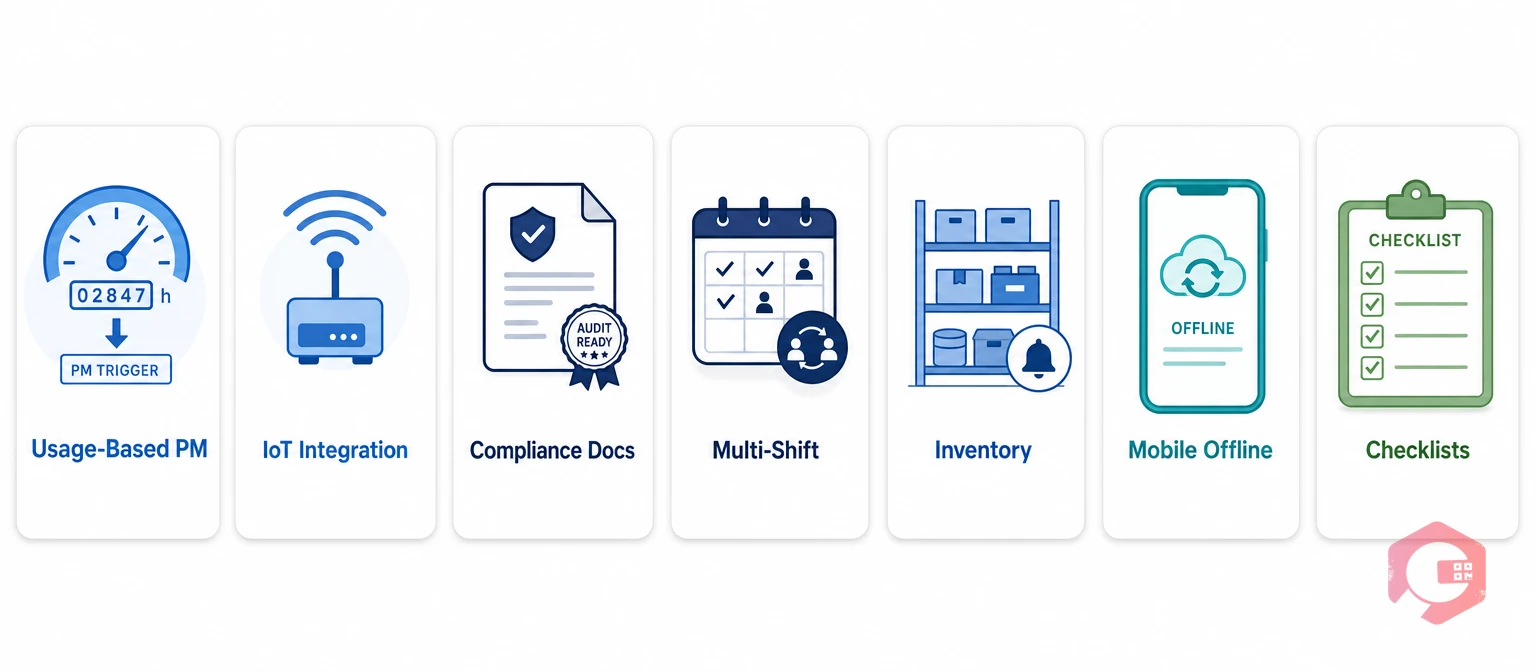
Most CMMS platforms advertise the same feature list. Here is how to filter that list for leather manufacturing specifics.
Calendar-based PM — "service every 30 days" — does not account for production intensity. A drum running three shifts a day degrades faster than one running one shift. Your CMMS should support dynamic PM scheduling based on actual usage hours, batch counts, or meter readings from the machine's control panel. This prevents both under-maintenance (failure) and over-maintenance (wasted labor).
Leather equipment operates in environments where manual inspection is difficult — drum interiors, chemical sumps, high-temperature drying chambers. A CMMS that integrates with IoT sensors allows you to monitor temperature, vibration, and pressure remotely, automatically triggering work orders when readings fall outside safe ranges. This is condition-based maintenance without requiring a technician to physically inspect the machine every shift.
Leather tanneries in India operate under CPCB and State Pollution Control Board guidelines. ISO 14001 certification, increasingly required by international buyers, demands verifiable records of equipment maintenance, calibration, and environmental compliance. The CMMS must generate timestamped, user-attributed records for every maintenance activity — records that can be exported and presented to an auditor in minutes, not hours.
In a three-shift tannery, a work order opened at 10 PM must be visible, trackable, and closeable by the next shift supervisor at 6 AM. The CMMS needs shift-aware notifications and a clear handover log — so that every shift starts with full knowledge of what was done, what is pending, and what is flagged as urgent.
Spare parts for leather equipment — chrome drum liners, toggle clips, specific seal types, fleshing machine blades — often come from specialized suppliers with 2–4 week lead times. The CMMS should allow you to set minimum stock thresholds for every critical part, with automatic alerts to procurement when stock falls below that level. This eliminates the stockout-induced downtime that costs more in spoiled production than the part itself.
Tannery environments are not office environments. Technicians work in wet areas, chemical storage zones, and equipment pits where network connectivity is unreliable. The mobile CMMS app must function offline — allowing technicians to view work orders, complete checklists, and log readings without a live connection, syncing data automatically when connectivity is restored.
A fleshing machine inspection checklist is nothing like a paste dryer inspection checklist. The CMMS must allow you to build and assign machine-specific checklists that technicians follow step-by-step before they can close a work order. This standardizes maintenance quality across shifts and makes sure no critical check is skipped under time pressure.
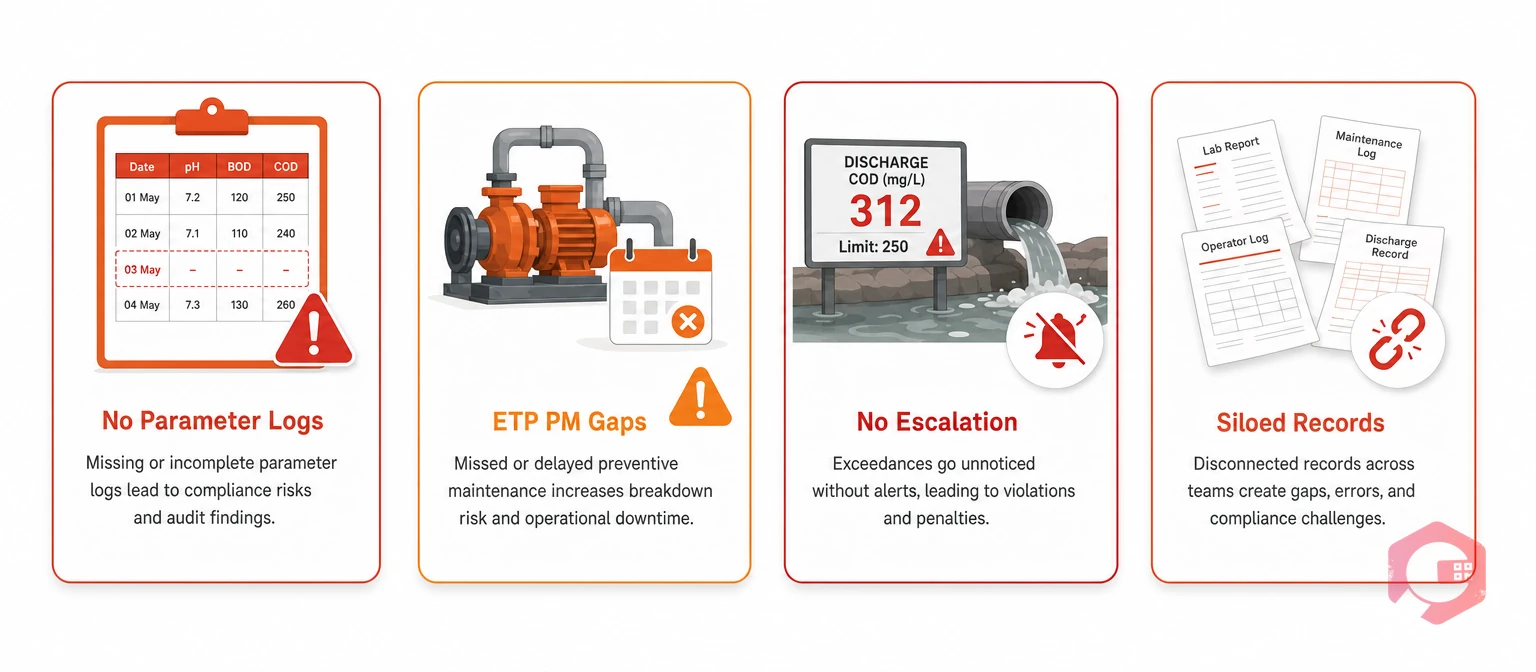
This is the feature set most CMMS vendors undersell, and most leather factory owners overlook until a regulatory event forces the issue. Your effluent treatment plant is not optional infrastructure — in India, it is a condition of your factory's operating license, and breakdowns in ETP equipment directly expose you to CPCB penalties, consent order violations, and in serious cases, production shutdowns.
A well-configured CMMS brings the ETP under the same preventive maintenance discipline as your production equipment. This means scheduled inspections of aerators on a weekly basis, filter press plate inspections monthly, clarifier de-sludging quarterly, and effluent quality meter calibration tied to specific compliance checkpoints. Every inspection generates a signed digital record. Every deviation from standard readings creates a corrective work order automatically.
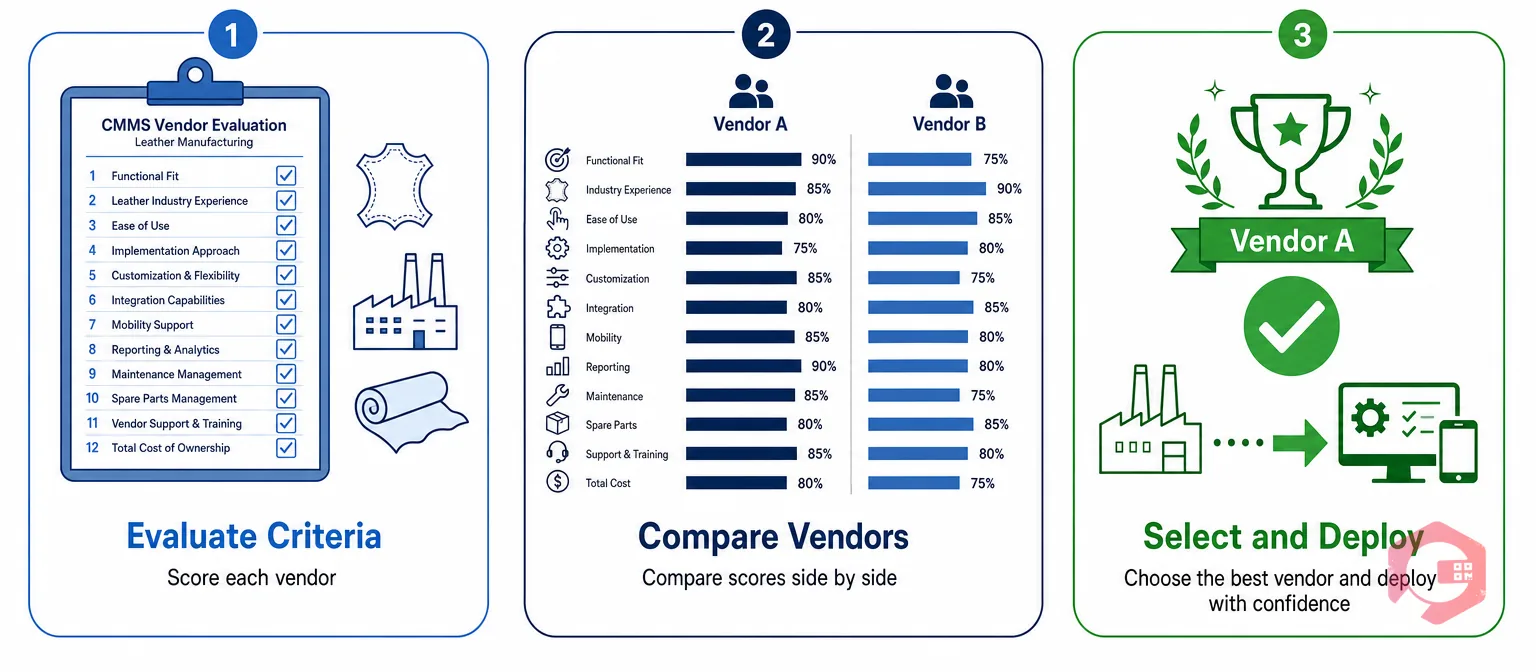
Use this checklist when you are evaluating CMMS vendors. Score each vendor on each item — it will quickly reveal which ones are genuinely suited for leather manufacturing versus generic manufacturing platforms being retrofitted to your requirements.
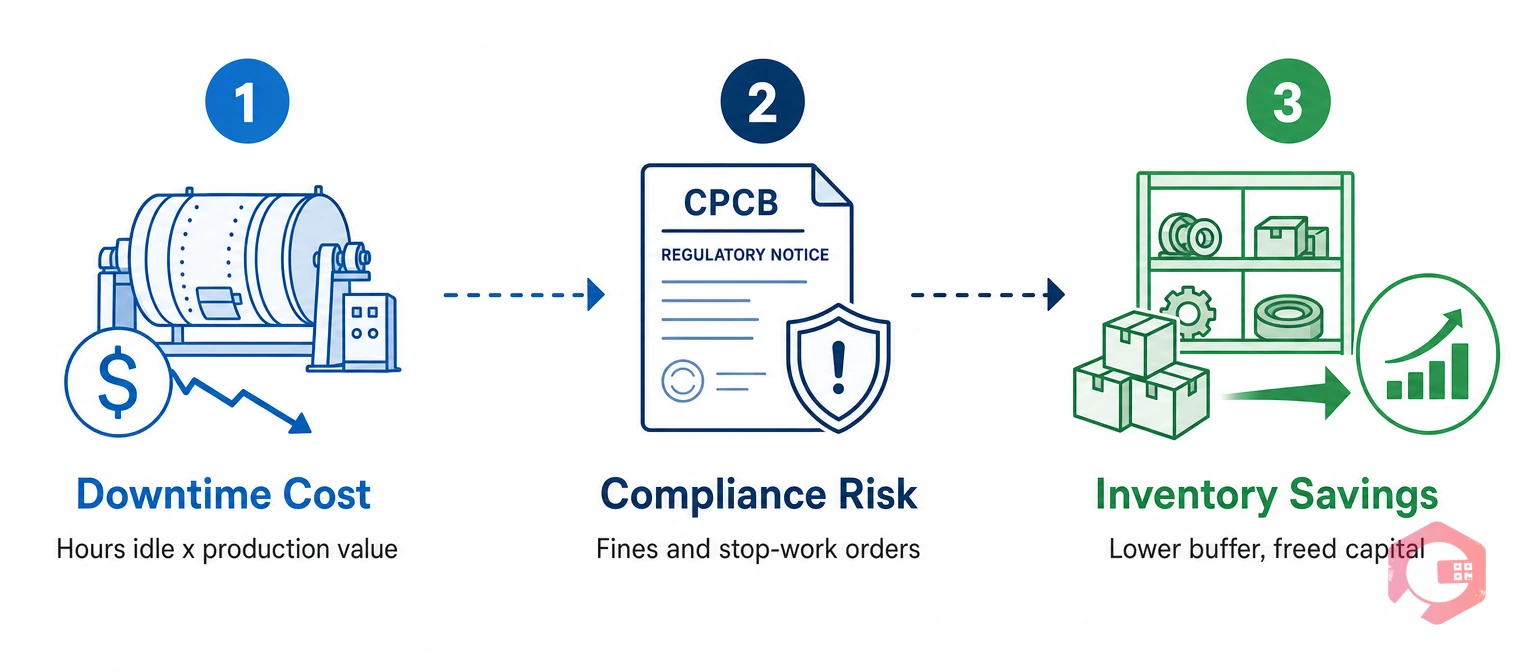
Factory owners in the leather industry are often skeptical of software investment. Here is how to build the business case using numbers that are specific to your operation — not generic manufacturing benchmarks.
Start with a simple calculation: how many hours per month do your production machines sit idle due to unplanned breakdowns? Multiply that by your production value per hour for the affected line. For a mid-size tannery processing 500 hides per shift, a single day of beam house downtime can represent 1,500 hides at risk — a direct cost that far exceeds a year of CMMS subscription fees.
A single CPCB violation notice, stop-work order, or ISO 14001 non-conformance during a buyer audit carries both direct costs (fines, legal fees) and indirect costs (lost export orders, brand damage). A CMMS that makes your ETP maintenance inspection-ready and your audit trail instantly accessible eliminates most of this risk category.
Leather factories typically carry 20–30% excess spare parts inventory as a buffer against stockouts — capital tied up in storage rather than working in the business. A CMMS with accurate min-max tracking and auto-reorder reduces this buffer requirement substantially, freeing working capital without increasing stockout risk.
Cryotos CMMS is a cloud-based, mobile-first maintenance management platform that leather manufacturers can configure to match the specific demands of tannery and finished goods production. Here is how its key features map to the requirements identified in this guide.
Leather manufacturers who implement Cryotos report an average 30% reduction in unplanned downtime and 25% faster repair times within the first six months of deployment. These are not generic manufacturing benchmarks — they reflect the impact of replacing reactive firefighting with scheduled, data-driven maintenance across a complex, multi-shift operation.
If you are evaluating CMMS options for your leather plant, the starting point is a structured needs assessment — mapping your machine inventory, your current maintenance gaps, and your compliance obligations before you open any vendor demo. Cryotos offers a guided onboarding process that begins with exactly that assessment, ensuring the system is configured to your specific operation rather than a generic manufacturing template.
Ready to see how Cryotos works in a leather manufacturing environment? Schedule a demo with our team and we'll walk through your specific machine inventory, compliance requirements, and maintenance pain points.
Usage-based preventive maintenance scheduling is the single most important feature for tanneries. Leather equipment degrades based on chemical exposure and operating hours, not calendar time. A CMMS that can trigger PM work orders based on drum rotation hours or batch counts — rather than fixed monthly intervals — prevents both over-maintenance and under-maintenance, which is the primary driver of unexpected breakdowns in beam house and tanning operations.
Yes, and this is one of the most underutilized applications of CMMS in leather manufacturing. A properly configured CMMS tracks ETP equipment — aerators, filter presses, clarifiers — on the same PM schedule as production machinery, with parameter readings (pH, BOD, COD) logged directly in work orders and automatically flagged when they exceed consent order limits. This creates an always-current compliance audit trail without any additional manual record-keeping.
A cloud-based CMMS like Cryotos can be operational within 4–8 weeks for a mid-size tannery. The critical path is asset registration — creating the digital inventory of all machines, ETP equipment, and utilities — which typically takes 2–3 weeks with a structured onboarding process. Full adoption across all shifts usually follows within 30 days of go-live.
A well-configured CMMS handles the maintenance-related documentation requirements of ISO 14001 effectively — equipment inspection records, calibration certificates, corrective action logs, and ETP maintenance history are all generated automatically as part of normal CMMS operation. You may still need a separate EHS management system for broader environmental aspects like chemical storage and waste disposal, but the CMMS eliminates the manual documentation burden for equipment maintenance compliance.
CMMS software for leather manufacturing is a computerized maintenance management system built — or configured — to manage the specific equipment, compliance requirements, and operational rhythms of leather tanneries and finished goods factories. Choosing the right one is not straightforward: leather plants run a wide mix of wet-process machines, chemical drums, drying systems, and finishing lines, each with its own maintenance frequency, safety requirement, and regulatory exposure. The wrong CMMS creates more paperwork than it eliminates. The right one cuts unplanned downtime by 30%, keeps your effluent plant inspection-ready, and gives every shift supervisor a real-time view of machine health — all from a mobile phone.
Most CMMS platforms are built with discrete manufacturing in mind — stamping lines, assembly stations, single-shift operations. Leather manufacturing is a different world. Your production is continuous and chemical-intensive, your equipment degrades from both mechanical wear and aggressive tanning agents, and your regulatory obligations extend well beyond machinery into water discharge and hazardous chemical handling.
The result is a maintenance environment that generic CMMS tools struggle with. When a drum machine in the liming section goes down mid-batch, the entire hide lot is at risk of spoilage. When your effluent treatment plant pump fails, you face not just a repair bill but a potential CPCB stop-work order. These stakes make the choice of CMMS software far more consequential than it is for most industries.
Before evaluating software, you need to understand what you are actually solving for. Leather manufacturers consistently report these maintenance bottlenecks:
A useful mental model is to map your CMMS coverage to the three processing zones of a leather plant: the beam house, the tannery floor, and the finishing area. Each zone has different equipment criticality and different failure consequences.
This is your highest-risk zone from a maintenance standpoint. Drum motors, gearboxes, and bearings operate in constant contact with alkaline chemicals. Your CMMS should allow you to set usage-based PM triggers — for example, a gearbox inspection after every 200 hours of drum rotation — rather than fixed calendar intervals that ignore actual chemical exposure.
Chrome drums and retanning vessels need liner inspections, seal checks, and pH sensor calibration on a regular schedule. The CMMS should support calibration records linked to each asset, with digital sign-offs that hold up to ISO 14001 audit scrutiny.
Toggle drying frames, paste dryers, ironing machines, and embossing presses are production-critical. A single toggle machine failure during peak season can delay an entire order shipment. Your CMMS should support real-time temperature and pressure monitoring through IoT sensor integration, with automatic work order creation when readings exceed safe thresholds.
ETP is a regulatory asset, not just a utility. The CMMS should treat it with the same maintenance rigor as production equipment — scheduled inspections of aerators, filter presses, ATFD systems, and primary clarifiers, with compliance documentation attached to each work order.
Most CMMS platforms advertise the same feature list. Here is how to filter that list for leather manufacturing specifics.
Calendar-based PM — "service every 30 days" — does not account for production intensity. A drum running three shifts a day degrades faster than one running one shift. Your CMMS should support dynamic PM scheduling based on actual usage hours, batch counts, or meter readings from the machine's control panel. This prevents both under-maintenance (failure) and over-maintenance (wasted labor).
Leather equipment operates in environments where manual inspection is difficult — drum interiors, chemical sumps, high-temperature drying chambers. A CMMS that integrates with IoT sensors allows you to monitor temperature, vibration, and pressure remotely, automatically triggering work orders when readings fall outside safe ranges. This is condition-based maintenance without requiring a technician to physically inspect the machine every shift.
Leather tanneries in India operate under CPCB and State Pollution Control Board guidelines. ISO 14001 certification, increasingly required by international buyers, demands verifiable records of equipment maintenance, calibration, and environmental compliance. The CMMS must generate timestamped, user-attributed records for every maintenance activity — records that can be exported and presented to an auditor in minutes, not hours.
In a three-shift tannery, a work order opened at 10 PM must be visible, trackable, and closeable by the next shift supervisor at 6 AM. The CMMS needs shift-aware notifications and a clear handover log — so that every shift starts with full knowledge of what was done, what is pending, and what is flagged as urgent.
Spare parts for leather equipment — chrome drum liners, toggle clips, specific seal types, fleshing machine blades — often come from specialized suppliers with 2–4 week lead times. The CMMS should allow you to set minimum stock thresholds for every critical part, with automatic alerts to procurement when stock falls below that level. This eliminates the stockout-induced downtime that costs more in spoiled production than the part itself.
Tannery environments are not office environments. Technicians work in wet areas, chemical storage zones, and equipment pits where network connectivity is unreliable. The mobile CMMS app must function offline — allowing technicians to view work orders, complete checklists, and log readings without a live connection, syncing data automatically when connectivity is restored.
A fleshing machine inspection checklist is nothing like a paste dryer inspection checklist. The CMMS must allow you to build and assign machine-specific checklists that technicians follow step-by-step before they can close a work order. This standardizes maintenance quality across shifts and makes sure no critical check is skipped under time pressure.
This is the feature set most CMMS vendors undersell, and most leather factory owners overlook until a regulatory event forces the issue. Your effluent treatment plant is not optional infrastructure — in India, it is a condition of your factory's operating license, and breakdowns in ETP equipment directly expose you to CPCB penalties, consent order violations, and in serious cases, production shutdowns.
A well-configured CMMS brings the ETP under the same preventive maintenance discipline as your production equipment. This means scheduled inspections of aerators on a weekly basis, filter press plate inspections monthly, clarifier de-sludging quarterly, and effluent quality meter calibration tied to specific compliance checkpoints. Every inspection generates a signed digital record. Every deviation from standard readings creates a corrective work order automatically.
Use this checklist when you are evaluating CMMS vendors. Score each vendor on each item — it will quickly reveal which ones are genuinely suited for leather manufacturing versus generic manufacturing platforms being retrofitted to your requirements.
Factory owners in the leather industry are often skeptical of software investment. Here is how to build the business case using numbers that are specific to your operation — not generic manufacturing benchmarks.
Start with a simple calculation: how many hours per month do your production machines sit idle due to unplanned breakdowns? Multiply that by your production value per hour for the affected line. For a mid-size tannery processing 500 hides per shift, a single day of beam house downtime can represent 1,500 hides at risk — a direct cost that far exceeds a year of CMMS subscription fees.
A single CPCB violation notice, stop-work order, or ISO 14001 non-conformance during a buyer audit carries both direct costs (fines, legal fees) and indirect costs (lost export orders, brand damage). A CMMS that makes your ETP maintenance inspection-ready and your audit trail instantly accessible eliminates most of this risk category.
Leather factories typically carry 20–30% excess spare parts inventory as a buffer against stockouts — capital tied up in storage rather than working in the business. A CMMS with accurate min-max tracking and auto-reorder reduces this buffer requirement substantially, freeing working capital without increasing stockout risk.
Cryotos CMMS is a cloud-based, mobile-first maintenance management platform that leather manufacturers can configure to match the specific demands of tannery and finished goods production. Here is how its key features map to the requirements identified in this guide.
Leather manufacturers who implement Cryotos report an average 30% reduction in unplanned downtime and 25% faster repair times within the first six months of deployment. These are not generic manufacturing benchmarks — they reflect the impact of replacing reactive firefighting with scheduled, data-driven maintenance across a complex, multi-shift operation.
If you are evaluating CMMS options for your leather plant, the starting point is a structured needs assessment — mapping your machine inventory, your current maintenance gaps, and your compliance obligations before you open any vendor demo. Cryotos offers a guided onboarding process that begins with exactly that assessment, ensuring the system is configured to your specific operation rather than a generic manufacturing template.
Ready to see how Cryotos works in a leather manufacturing environment? Schedule a demo with our team and we'll walk through your specific machine inventory, compliance requirements, and maintenance pain points.
Usage-based preventive maintenance scheduling is the single most important feature for tanneries. Leather equipment degrades based on chemical exposure and operating hours, not calendar time. A CMMS that can trigger PM work orders based on drum rotation hours or batch counts — rather than fixed monthly intervals — prevents both over-maintenance and under-maintenance, which is the primary driver of unexpected breakdowns in beam house and tanning operations.
Yes, and this is one of the most underutilized applications of CMMS in leather manufacturing. A properly configured CMMS tracks ETP equipment — aerators, filter presses, clarifiers — on the same PM schedule as production machinery, with parameter readings (pH, BOD, COD) logged directly in work orders and automatically flagged when they exceed consent order limits. This creates an always-current compliance audit trail without any additional manual record-keeping.
A cloud-based CMMS like Cryotos can be operational within 4–8 weeks for a mid-size tannery. The critical path is asset registration — creating the digital inventory of all machines, ETP equipment, and utilities — which typically takes 2–3 weeks with a structured onboarding process. Full adoption across all shifts usually follows within 30 days of go-live.
A well-configured CMMS handles the maintenance-related documentation requirements of ISO 14001 effectively — equipment inspection records, calibration certificates, corrective action logs, and ETP maintenance history are all generated automatically as part of normal CMMS operation. You may still need a separate EHS management system for broader environmental aspects like chemical storage and waste disposal, but the CMMS eliminates the manual documentation burden for equipment maintenance compliance.
Cryotos AI predicts failures, automates work orders, and simplifies maintenance—before problems slow you down.

