

A behavior-based safety observation is a short, planned watch of one worker doing one task. A trained observer records safe and at-risk actions and gives quick, mostly positive feedback. Unlike a safety audit, which checks equipment and paperwork, a BBS observation looks only at human behavior. Think of how someone lifts, positions their body near moving parts, or follows a lockout step. Done right, a behavior-based safety observation takes 5-15 minutes. It follows a repeatable sequence and feeds data straight into corrective action, not a drawer full of forms.
Key Takeaways

A behavior-based safety observation is a brief, planned watch of one worker doing one task. The focus is on what they do, not what a procedure says they should do. The observer checks specific behaviors — PPE use, body position, tool handling, communication — against a short list of critical behaviors for that task.
This differs from a safety audit in one key way. Audits inspect conditions and documents. Observations watch people in motion. Most maintenance teams run both, but the observation catches the gap between what a procedure says on paper and what actually happens on the shop floor.
Research on workplace incidents points to human behavior, not equipment failure, as the dominant factor. OSHA's hazard prevention and control guidance treats direct observation as a core method for spotting hazards before they cause harm. For background on BBS theory and how to sustain it, see our guide on how to sustain a behaviour-based safety culture.
A good observation starts before you approach the worker. Skipping preparation is the biggest reason observations feel random or produce weak data.
A checklist without a defined purpose produces data nobody trusts. Build the checklist into your existing maintenance checklists workflow so the form lives in the same system as your work orders, not a separate binder.

Most guides describe BBS as a program. Few describe the mechanics of one observation from start to finish. The approach traces back to applied behavioral psychology research on workplace safety, which found that feedback changes behavior more reliably than rules alone.
The Six-Step BBS Observation Cycle:
Each step matters. Skipping one is usually where accuracy or trust breaks down. The sections below walk through each step in detail.
Pick one task and 3-5 specific behaviors tied to it — not the whole job. Watching a technician change a filter means focusing on lockout/tagout, PPE, and tool positioning. It doesn't mean tracking everything they do that shift.
Base your selection on real risk data: past near misses, incident reports, or a task that recently changed. An observation with no defined behavior list turns into a vague impression instead of usable data.
Observe during normal working conditions, not right after a toolbox talk. Behavior looks "clean" right after a talk — that's not the real picture. Stand where you can see the task clearly without blocking the worker or hovering over their shoulder.
Timing matters too. A rushed five-minute window rarely captures the full sequence of steps that count. A digital checklist app lets an observer log notes on a phone in real time, instead of scribbling on paper and re-entering it later.
Watch the full task without stopping the worker unless there's immediate danger. Interrupting mid-task changes behavior and defeats the purpose. You're now watching a performance, not a habit.
Note both safe and at-risk behaviors as they happen. Observers who only write down mistakes create a policing dynamic that damages trust and drives inaccurate self-reporting.
Talk to the worker right after the task, not days later in a meeting. Lead with what they did safely. Raise any at-risk behavior as a question, not an accusation — "walk me through why you skipped the guard" opens a conversation; "you broke the rule" shuts it down.
Aim for a 4:1 ratio of positive to corrective comments. Programs that fall below this ratio see engagement drop within a few months, because workers start expecting criticism instead of coaching.
Log the observation the same day, ideally on the spot. Write specific, factual notes — "used both hands, maintained three points of contact" — instead of vague ratings like "good" or "needs improvement."
Accurate records depend on trust. Workers need to know the data won't be used to discipline them. Observation data used punitively dries up fast, because workers stop cooperating with observers.
This is the step most programs skip. If an observation flags a recurring at-risk behavior or a broken procedure, it needs to trigger something — a corrective work order, a checklist update, or a toolbox talk on the specific issue.
Publish results back to the team. Workers who never see what happened to their observation data stop taking the process seriously. OSHA's Voluntary Protection Programs point to this closed feedback loop as a hallmark of top-performing safety programs. It's what keeps a BBS program alive past the first few months.
A critical-behavior checklist doesn't need to be long. Here's an example built around a routine maintenance task — changing a machine guard filter. It shows how a few rows can capture the behaviors that matter most, including lockout/tagout steps required under OSHA's control of hazardous energy standard.
| Behavior Observed | Safe / At-Risk | Notes | Follow-Up Action |
|---|---|---|---|
| Lockout/tagout applied before opening guard | Safe | Locked and tagged correctly, verified zero energy | None |
| PPE worn (gloves, eye protection) | At-Risk | Safety glasses pushed up on forehead during task | Coach on the spot; note trend if repeated |
| Body position relative to pinch points | Safe | Maintained clearance from moving parts throughout | Recognize on the spot |
| Tools returned to designated storage | At-Risk | Left wrench on machine bed after task | Log for housekeeping trend review |
Each row captures a specific behavior, not a general impression. Every row leads to a defined next step — even "None" is a deliberate outcome, not a blank field.

Most behavior-based safety observation programs don't fail from bad intentions. They fail from a handful of repeatable, avoidable mistakes.
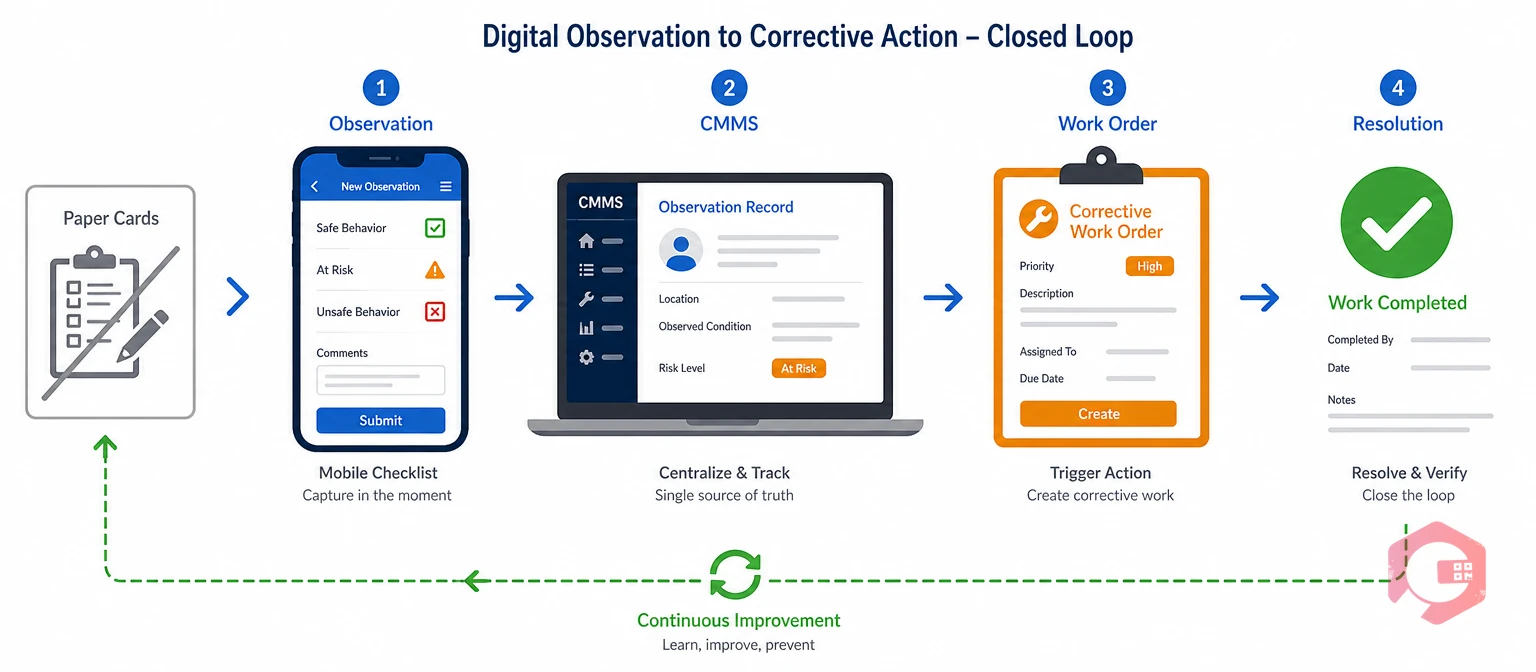
Paper observation cards create friction at every step — filling them out, submitting them, aggregating the data, and escalating findings to action. That friction is why so many BBS programs decay after a few months.
A Computerized Maintenance Management System fixes this by keeping observations, checklists, and corrective work orders in one place instead of a separate binder or spreadsheet. When an observer flags a missing guard during an observation, that finding can trigger a work order right away instead of sitting on a form until someone remembers it.
This also strengthens compliance documentation. A digital safety compliance checklist creates a time-stamped record of every observation. That record supports audit readiness and shows a documented hazard-identification process. Maintenance teams using Cryotos have reported up to 30% reduction in unplanned downtime and 25% faster repair turnaround when safety observations and maintenance work orders run through one connected platform.
Real-time dashboards also give safety leads visibility they wouldn't get from monthly paper summaries. A drop in observation rates or a spike in at-risk behavior shows up right away, not a month later.
Most observations take 5 to 15 minutes, depending on the task. Longer isn't better. A focused observation on 3-5 specific behaviors produces cleaner data than an unfocused 30-minute watch of everything a worker does.
Trained peer observers, supervisors, and safety officers can all conduct observations, as long as they've learned how to give non-judgmental feedback. Peer-led observations, where workers observe each other on a rotating basis, tend to produce the most honest data. They remove the "management is watching" dynamic.
A safety audit checks equipment, procedures, and documentation against a standard. A BBS observation watches a person perform a task and records their actual behavior. Most mature safety programs use both. Audits catch system gaps; observations catch behavior gaps.
Address immediate danger on the spot, calmly and without blame. Then log the finding and follow up with coaching or a procedure review. A single at-risk observation isn't a disciplinary event. It's a signal to investigate why the behavior happened, whether that's a training gap, a tooling issue, or time pressure from production.
Yes. Start with a short list of 5-8 critical behaviors, train two or three peer observers, and run one observation per shift. A fifteen-minute monthly review of the data is enough to keep the program moving. You don't need a full EHS department to get value from a well-run observation cycle.
Every behavior-based safety observation should end somewhere — in a coaching conversation, a corrective work order, or a trend report the whole team can see. Schedule a free demo to see how Cryotos connects safety observations directly to maintenance work orders and closes the loop in your facility.


Cryotos AI predicts failures, automates work orders, and simplifies maintenance—before problems slow you down.



