

Behaviour-based safety culture is a workplace approach that focuses on observing, reinforcing, and improving safe behaviours — rather than waiting for incidents to reveal gaps in your safety system. Research shows that 80–95% of workplace accidents involve unsafe human behaviour. This makes behaviour the most powerful lever for preventing incidents.
Most organisations launch a behaviour-based safety culture program with energy and intent — but struggle to sustain it past the first year. This guide breaks down why these programs decay, and gives you a clear framework for keeping yours alive and producing results.
Key Takeaways
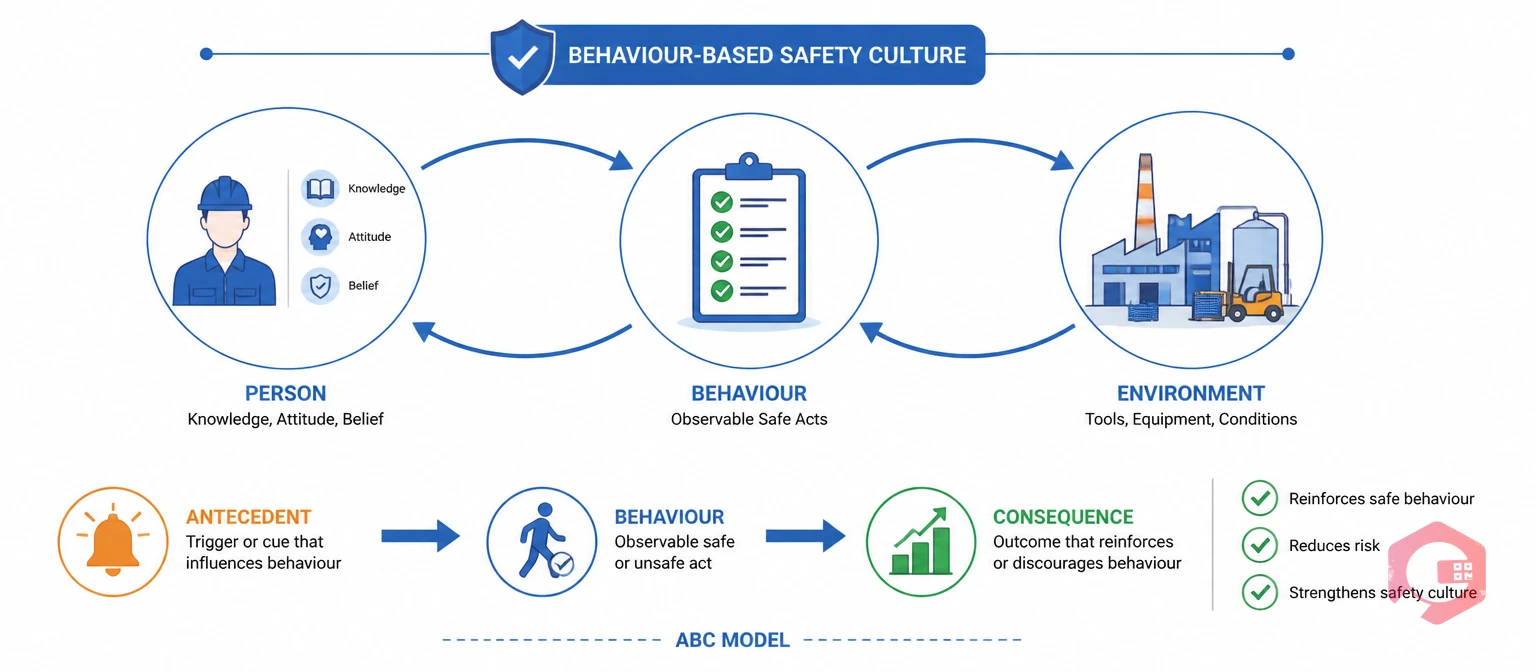
Behaviour-based safety is a proactive methodology that uses structured peer observation and positive feedback to make safe behaviour the norm rather than the exception. It is grounded in E. Scott Geller's Total Safety Culture model. This model defines safety culture as the product of three factors: the Person (knowledge, attitude, belief), their Behaviour (observable safe and unsafe acts), and the Environment (tools, equipment, physical conditions).
The key insight is simple: you cannot change culture directly. You change behaviour first, and culture follows. BBS programs create feedback loops that shift behaviour at scale.
Behaviour-based safety is not a compliance program. Compliance systems set rules and penalise violations — they create a "don't get caught" culture. BBS creates a "we genuinely look out for each other" culture. Both are necessary, but BBS sits on top of compliance, not instead of it.
The ABC Model:
Consequences drive behaviour far more than antecedents. A safety rule can be ignored if the consequence for ignoring it is "nothing happens and I save two minutes." BBS targets consequences — making safe behaviour the one that gets noticed and repeated.
Understanding what sets BBS apart helps maintenance teams make the case for investing in it. It also helps safety leads design a program that complements existing compliance systems.
| Dimension | Traditional Safety | Behaviour-Based Safety |
|---|---|---|
| Focus | Conditions, equipment, compliance | Human behaviour and habits |
| Trigger | Incident after it happens | Observation before incident occurs |
| Approach | Top-down rules and audits | Peer observation and feedback |
| Primary Metric | Lagging indicators (injury rates) | Leading indicators (safe behaviour %) |
| Cultural Signal | Don't get caught | We look out for each other |
Both approaches are necessary. Strong maintenance teams use compliance as the foundation and BBS as the layer that shifts culture beyond rule-following. OSHA's Voluntary Protection Program (VPP) identifies this integration as the hallmark of world-class safety performance.

Most BBS programs don't fail at launch — they fail between months six and twelve, when the novelty fades and the accountability structures that should hold the program in place are missing. Maintenance teams that lose BBS to decay waste both the investment and the goodwill of frontline workers.
The root causes of BBS decay are consistent across facilities:
Addressing these decay factors is not complicated — but it requires intentional design. The seven pillars below give you the operational structure to do it.
Cryotos maintenance checklists allow teams to embed BBS observation prompts directly into PM workflows — so observations happen as part of work, not instead of it.
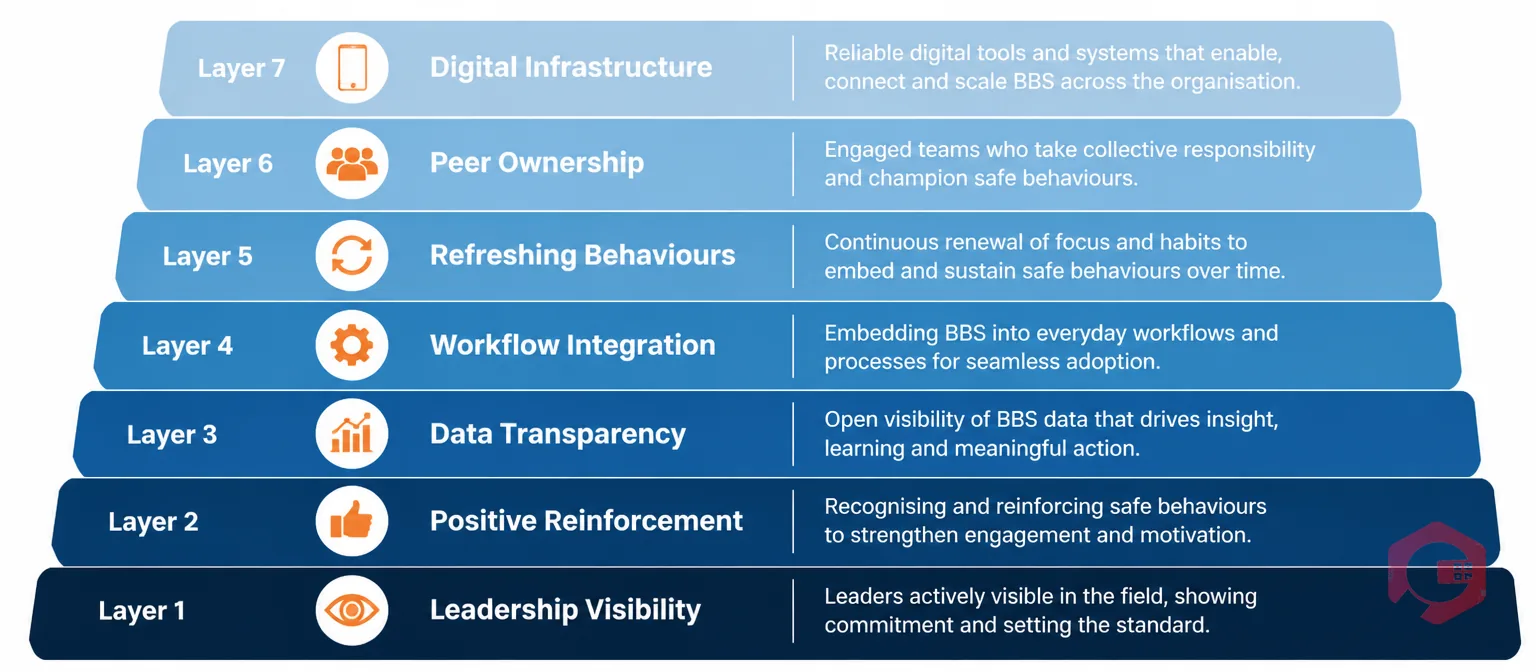
Sustaining a behaviour-based safety culture requires more than motivation — it requires a system. The seven pillars below form what we call The BBS Sustainability Stack: a layered set of operational practices that hold the program in place when novelty fades and production pressure rises.
The BBS Sustainability Stack:
The most sustainable BBS programs treat Layer 6 — peer ownership — as the anchor. When workers help design the program, participation becomes self-sustaining. Research identifies peer ownership as the strongest predictor of BBS longevity past the 24-month mark.

Knowing where your team sits on the BBS maturity curve helps you apply the right fix. Safety culture maturity runs across four stages, first described by DuPont's Bradley Curve model:
| Stage | Characteristics | Near-Miss Reporting | BBS Priority |
|---|---|---|---|
| Reactive | Safety is compliance; incidents drive action | Very low — culture of silence | Build psychological safety first |
| Dependent | Safety follows rules when supervised; audits drive behaviour | Low — fear of blame | Establish observation process and positive feedback ratio |
| Independent | Individuals take personal responsibility; proactive behaviour is common | Moderate and growing | Drive peer observation and data action loops |
| Interdependent | Peers observe and reinforce each other; safety is a shared value | High — psychological safety strong | Sustain through peer ownership and leadership visibility |
The goal of sustained BBS is to move your team from Dependent through Independent and toward Interdependent. Most teams start in the Dependent stage — they follow safety rules when someone is watching. Sustained BBS programs systematically shift this toward the Interdependent stage, where peers actively reinforce each other's safety behaviour without management prompting.
Leading indicators tell you where your behaviour-based safety culture is headed — before an incident tells you where it went. Tracking lagging indicators like injury rates is necessary for regulatory compliance, but they're rear-view mirrors. BBS programs generate leading indicators that are far more actionable.
Connecting these metrics to a root cause analysis workflow helps maintenance teams identify whether repeat unsafe behaviours stem from individual habits, poor tooling, inadequate procedures, or environmental factors — and act accordingly. Maintenance teams using Cryotos have reported up to 30% reduction in unplanned downtime and 25% faster repair turnaround when safety and maintenance workflows are integrated in a single platform.
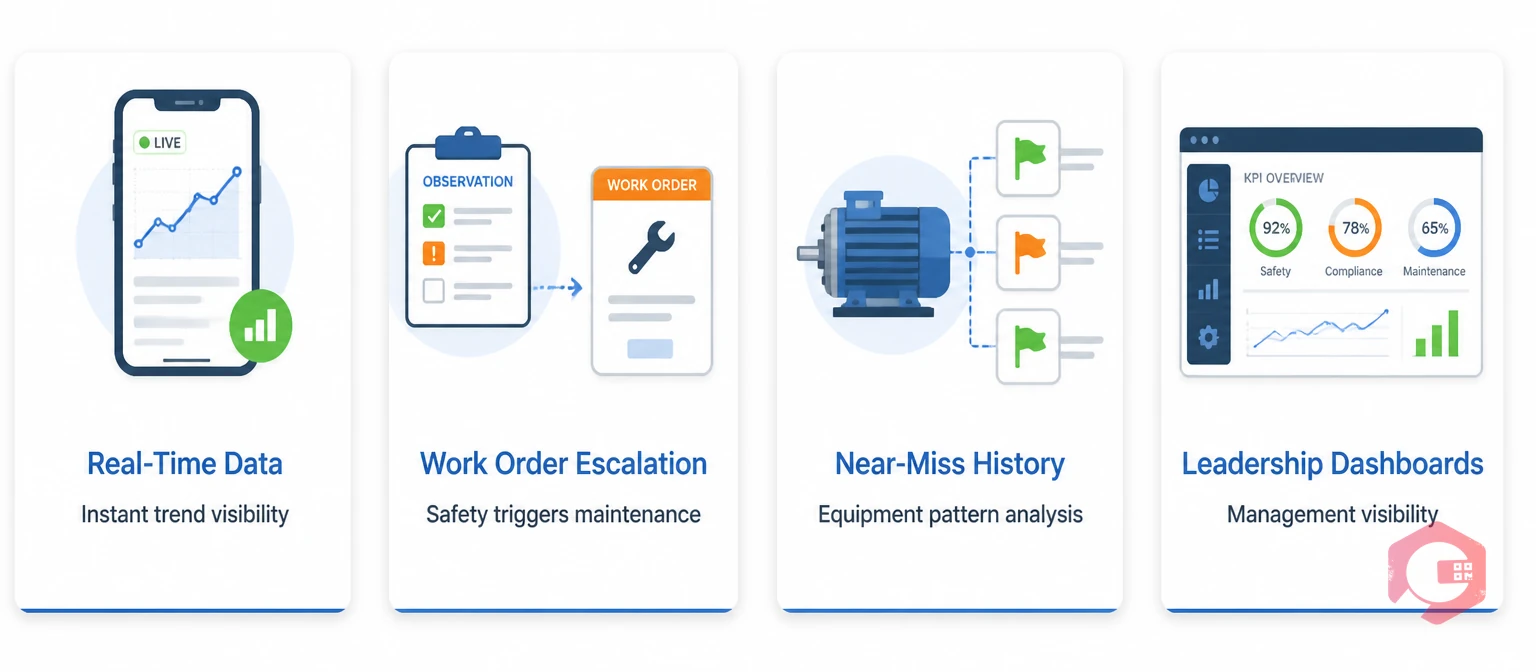
Paper observation cards are the single biggest operational barrier to sustaining a behaviour-based safety culture. They create friction at every step of the process — completing the card, submitting it, aggregating data, escalating to corrective action — and friction kills participation.
A digital observation pipeline removes this friction entirely and enables four capabilities that paper cannot deliver:
A safety compliance checklist in your CMMS keeps BBS observations and corrective actions in the same system as your maintenance operations. They are not siloed in a separate platform.
ISO 45001:2018 requires organisations to establish processes for hazard identification — including behaviours and human factors. Digitising your BBS pipeline supports ISO 45001 compliance by creating documented, time-stamped evidence.
Compliance programs set rules and penalise violations. They create a "don't get caught" culture where safe acts are driven by enforcement. Behaviour-based safety programs use peer observation and positive reinforcement to make safe behaviour habitual and intrinsically motivated. BBS does not replace compliance; it builds on top of it. The two together produce safety culture that holds even when supervisors are not present.
Most practitioners cite two to three years to see real culture change. The first six months cover the basics: training observers, building checklists, and setting up data systems. Months six to eighteen are the most critical: novelty fades, and the program either embeds or decays. By year two or three, if leading indicators like near-miss rate and safe observation ratio are improving consistently, culture is genuinely shifting.
Yes, with the right level of simplicity. Start with five to eight critical behaviours rather than forty. Train two or three peer observers per shift. Use a mobile digital form to log observations. Review data in a fifteen-minute monthly team meeting. A small team does not need a full EHS department. It needs a clear process, a digital tool, and management commitment.
Aubrey Daniels' research shows that lasting behaviour change needs about four positive reinforcements for every one corrective intervention. Corrective feedback is needed — but demotivating on its own. Programs that focus primarily on catching unsafe acts create resentment and drive participation underground. Maintaining a 4:1 ratio keeps workers engaged and keeps honest data flowing into your system.
Near-miss reporting is both a product of strong BBS culture — because psychological safety enables honest reporting — and a driver of it, because near-miss data reveals which behaviours need reinforcement. Near-miss rate is one of the strongest leading indicators of safety culture health. The National Safety Council reports that near misses go unreported at a 20:1 ratio in weak safety cultures. Low near-miss counts almost always signal underreporting — not a safe workplace.
Building a sustainable behaviour-based safety culture requires connecting every observation to a visible outcome. Schedule a free demo to see how Cryotos links safety observations to maintenance work orders, closing the loop between BBS data and corrective action in your facility.




Cryotos AI predicts failures, automates work orders, and simplifies maintenance—before problems slow you down.



