

Deciding whether to repair or replace equipment is one of the most consequential calls a maintenance manager makes. Repair a failing machine too long and you bleed budget through unplanned downtime. Replace it too early and you waste capital that could fund other priorities. The right repair or replace equipment decision comes from weighing seven key factors — age, repair cost threshold, breakdown history, downtime impact, parts availability, safety compliance, and operational efficiency — against your asset's full performance data.
Key Takeaways

The repair or replace equipment decision is the process of determining whether repairing a failing asset is more cost-effective than replacing it. It sits at the heart of asset lifecycle management — the practice of managing every phase of an asset's life, from purchase through disposal, to maximize value and minimize cost. The ISO 55000 asset management standards define this as part of an organization's obligation to balance cost, risk, and performance across that full lifecycle. Most maintenance teams make this call reactively — after a breakdown, under pressure. A structured framework changes that.
The R.E.P.A.I.R. Decision Framework:
Working through each element gives maintenance leaders a structured, defensible basis for their repair or replace equipment call. A Computerized Maintenance Management System centralizes the data needed to run this framework for every asset in your facility.
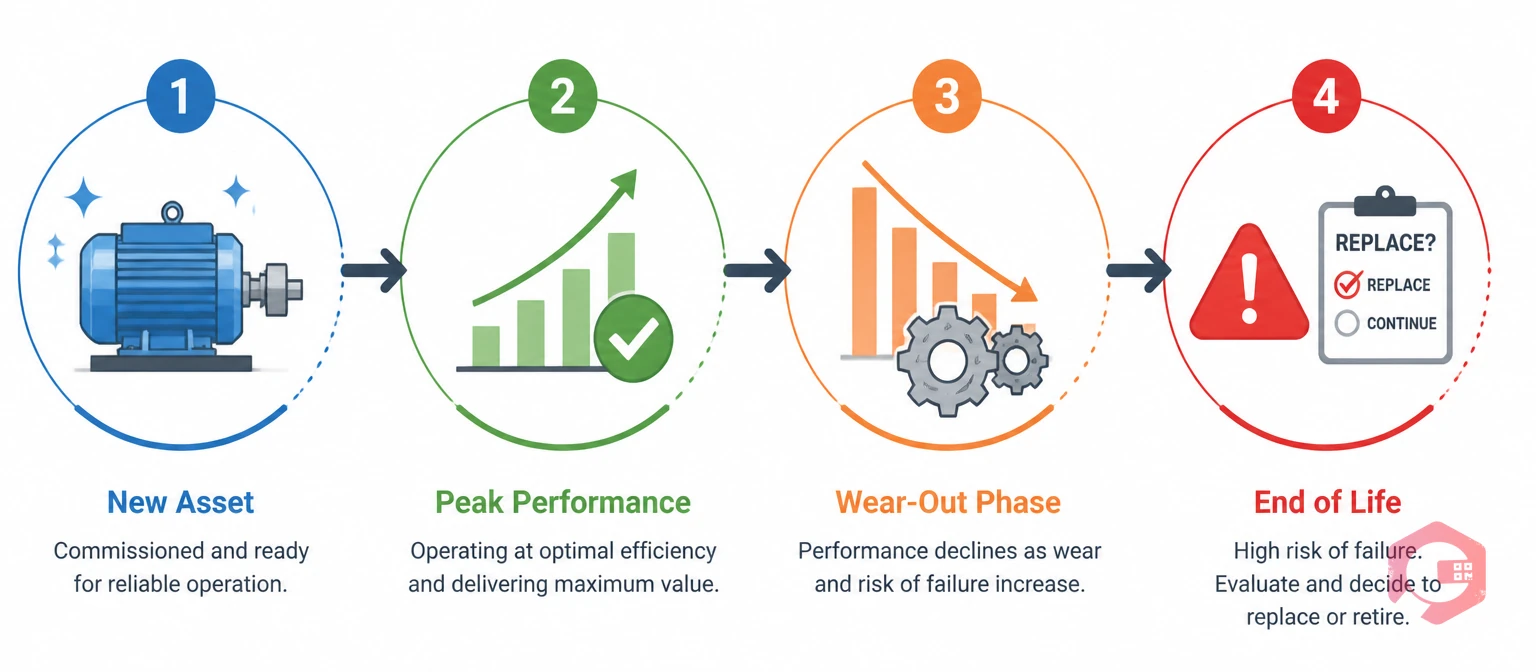
Age alone does not decide when equipment should go. But it is the starting point for any honest assessment. Most manufacturers publish a design life — the hours, cycles, or years the asset was built to perform reliably. Once an asset approaches or exceeds that figure, repair costs and breakdown frequency typically rise fast.
Remaining useful life (RUL) is the estimated operating time left before an asset can no longer perform its intended function at an acceptable cost. RUL shrinks faster for equipment running under heavy loads, in harsh conditions, or without consistent preventive maintenance.
A practical benchmark: if an asset has consumed more than 75% of its design life, every repair or replace equipment decision should include a replacement scenario in the cost comparison before a final call is made.
The most widely cited benchmark in maintenance is the 50% rule. If a single repair costs more than 50% of the asset's replacement value, the financial case for replacement is usually stronger. It is a starting point, not a hard rule. But it filters out the worst repair decisions quickly.
The total cost of ownership (TCO) approach goes further. Rather than comparing one repair against replacement cost, TCO calculates the full cost of keeping an asset in service — all past repairs, scheduled maintenance, energy waste, and downtime losses — against the projected cost of a new asset over the same period.
| Repair Cost (% of Replacement Value) | Typical Recommendation | Key Consideration |
|---|---|---|
| Below 25% | Repair | Economically sound if breakdown frequency is low |
| 25% to 50% | Evaluate carefully | Factor in breakdown history, age, and full downtime costs |
| Above 50% | Replace | Replacement typically delivers better ROI over 3 to 5 years |
| Above 75% | Replace immediately | Repair is financially indefensible in almost all scenarios |
Apply this table alongside the full TCO comparison — not as a standalone rule. An asset with a 45% repair cost ratio and three major breakdowns in the past year has a very different profile from one with the same ratio and a clean history. The numbers must be read together to make the right repair or replace equipment call.
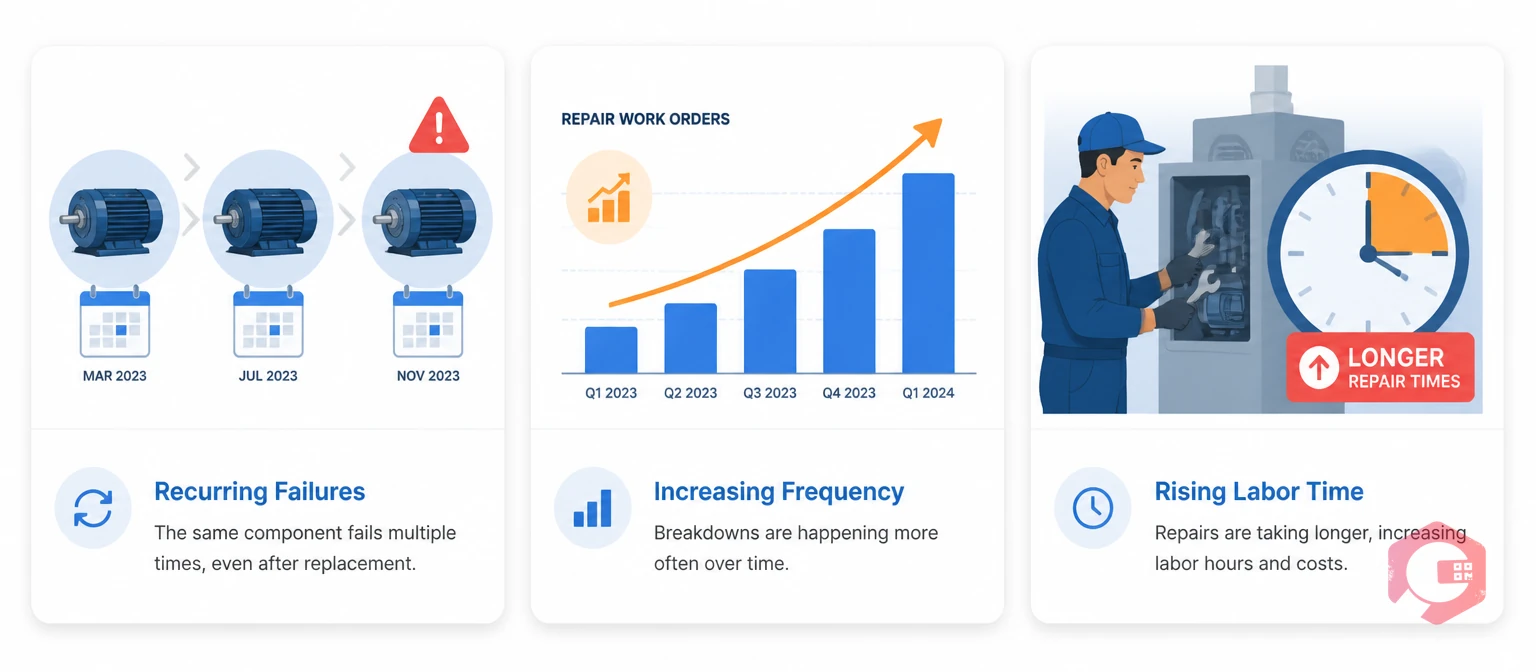
Repair cost is a snapshot. Breakdown frequency tells the story over time. An asset that fails once every three years at $5,000 per repair is a very different situation from one that fails four times per year at $2,000 each — even though the single-event cost looks lower on paper.
A declining MTBF trend is a statistical indicator that an asset is entering the end of its useful life. When MTBF drops by 20% or more over 12 months, the asset is failing faster than maintenance can compensate for. This pattern — the wear-out phase of the equipment reliability bathtub curve — rarely reverses without major overhaul.
Maintenance teams using Cryotos have reported up to 30% reduction in unplanned downtime and 25% faster repair turnaround when breakdown history is centralized and visible. These trends become identifiable early — before they force a crisis repair or replace equipment decision.
Downtime cost is the most underestimated factor in the repair or replace equipment equation. Most facilities calculate repair cost based on labor and parts alone. They miss the production losses, missed deliveries, overtime costs, and customer penalties that add up every hour an asset is offline.
Mean Time to Repair (MTTR) measures the average time required to restore a failed asset to operation. When MTTR on a critical asset consistently exceeds four to eight hours, the cumulative production impact often exceeds the repair cost within months. Tracking MTBF and MTTR together gives a full picture of the reliability-versus-cost trade-off.
For high-criticality assets — bottlenecks, single points of failure, or equipment with no backup — the downtime cost per hour often makes the 50% repair rule irrelevant. Reliability and recovery speed matter more than the repair invoice total.
Dedicated downtime tracking software captures breakdown hours, frequency, and MTBF automatically. Maintenance managers get real-time visibility into which assets generate the most operational cost — not just the highest repair bills. Use the free MTTR Calculator to quantify exactly how much each repair event costs your operation in lost production time.

An asset that is technically repairable becomes functionally irreplaceable when spare parts are no longer available. This risk — equipment obsolescence — can change the repair or replace equipment timeline regardless of cost thresholds or breakdown history.
Equipment obsolescence occurs when spare parts, manufacturer support, or the technical expertise needed to service an asset are no longer reliably available at a reasonable cost or lead time. When a critical component moves to a 16-week lead time — or is only available from third-party suppliers at triple the original price — the true cost of the next repair jumps significantly.
Facilities that wait for a parts shortage to force the replacement decision face emergency procurement and rushed capital planning. Proactive monitoring of OEM support status for aging assets gives teams the lead time to plan replacement on their own terms.
Cost analysis drives most repair or replace equipment decisions. But safety and compliance can override the numbers entirely. Equipment that fails to meet safety standards, or cannot be brought into compliance through repair, must be replaced — regardless of its repair cost ratio or remaining useful life on paper.
Safety-driven replacement decisions are the clearest-cut in the repair or replace equipment matrix. When regulatory compliance is at stake, escalate the call immediately to include safety, legal, and operations leadership — not just the maintenance budget.
Sometimes the strongest argument for replacement is not the cost of the old asset but the value the new one delivers. Modern equipment offers efficiency gains — through better energy use, faster cycle times, reduced scrap rates, and IoT connectivity — that aging machines cannot match regardless of maintenance quality.
The efficiency case for replacement is strongest when the existing asset is a production bottleneck, when energy costs are a major operating expense, or when the facility has invested in digital maintenance infrastructure that older equipment cannot support.
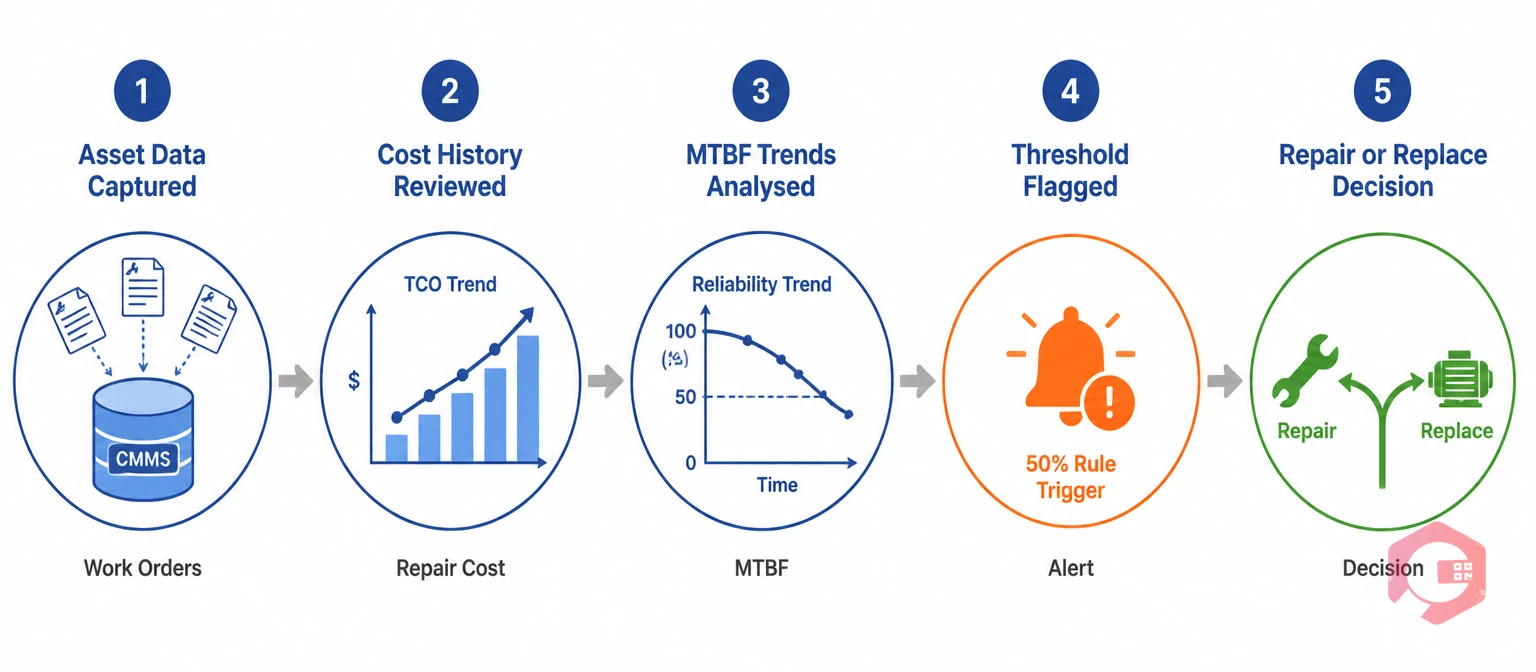
Every factor in the R.E.P.A.I.R. framework depends on data. Data is only useful if it is captured, organized, and accessible at the moment a decision must be made. A modern CMMS transforms the repair or replace equipment call from a gut decision into an evidence-based analysis that withstands financial and operational scrutiny.
A CMMS gives maintenance teams a complete history of every work order, spare part consumed, breakdown duration, and repair cost for each asset. Over time, this builds a real picture of total cost of ownership that no spreadsheet can replicate. When an asset flags for repair, the maintenance manager can pull 24 months of repair costs, compare them against replacement value, review the MTBF trend, and apply the 50% rule — all in minutes.
Sound asset lifecycle management depends on this kind of longitudinal, asset-level data. Without it, replacement decisions are reactive and anecdotal. With it, they are proactive and financially grounded.
Cryotos enterprise asset management software tracks downtime by asset, calculates MTBF and MTTR automatically, and surfaces assets whose repair-to-replacement cost ratio is approaching threshold. Procurement and capital planning teams get the lead time to act before a breakdown forces the repair or replace equipment decision under pressure.
The 50% rule states: if the cost of a single repair exceeds 50% of the asset's current replacement value, replacement is typically the more cost-effective option. It is a starting point, not a rigid threshold. Breakdown frequency, downtime impact, age, and parts availability should all be weighed alongside this figure before a final call is made.
Total cost of ownership includes every cost over the asset's operating life: purchase price, scheduled maintenance, unplanned repairs, energy consumption, downtime losses, and disposal. To compare repair versus replacement, project the TCO of keeping the current asset for another three to five years and compare it to a new asset's TCO over the same period. Most facilities find replacement delivers a lower three-year TCO once downtime costs are fully included.
Equipment is generally too old to repair when repair costs consistently exceed 50% of replacement value, when MTBF has declined by more than 20% over 12 months, when spare parts are no longer reliably available, or when the asset cannot meet current safety and regulatory standards. Age alone is not the deciding factor. A well-maintained asset can outlast its design life; a neglected one may need replacement long before reaching that point.
Yes. A CMMS captures the data every factor in the repair or replace equipment analysis requires: repair cost history, breakdown frequency, MTBF and MTTR trends, downtime hours, and spare parts consumption per asset. This makes the decision objective rather than reactive. Platforms like Cryotos can flag assets approaching repair cost thresholds automatically, giving maintenance managers the lead time to plan replacement before a breakdown forces the decision under pressure.
Making the right repair or replace equipment call protects your maintenance budget, keeps production reliable, and extends the value of your capital assets. Schedule a free demo to see how Cryotos tracks total cost of ownership, breakdown trends, and MTBF data for every asset in your facility — so you always have the numbers when the decision matters most.



Cryotos AI predicts failures, automates work orders, and simplifies maintenance—before problems slow you down.



