

Improving MTBF (Mean Time Between Failures) is the single most effective way for maintenance teams to cut unplanned downtime, lower repair costs, and extend asset life. MTBF measures the average operating time between unplanned failures on a repairable asset — and a higher MTBF means your equipment runs longer between breakdowns. According to SMRP Best Practices, organizations that actively track and improve MTBF see 20 to 40 percent drops in unplanned downtime within the first 12 months.
This guide walks through proven strategies that maintenance teams can use right now to improve MTBF — from stronger preventive maintenance programs to root cause analysis and CMMS-driven failure tracking. Use the Cryotos MTBF calculator to benchmark your current numbers before you start.
Key Takeaways
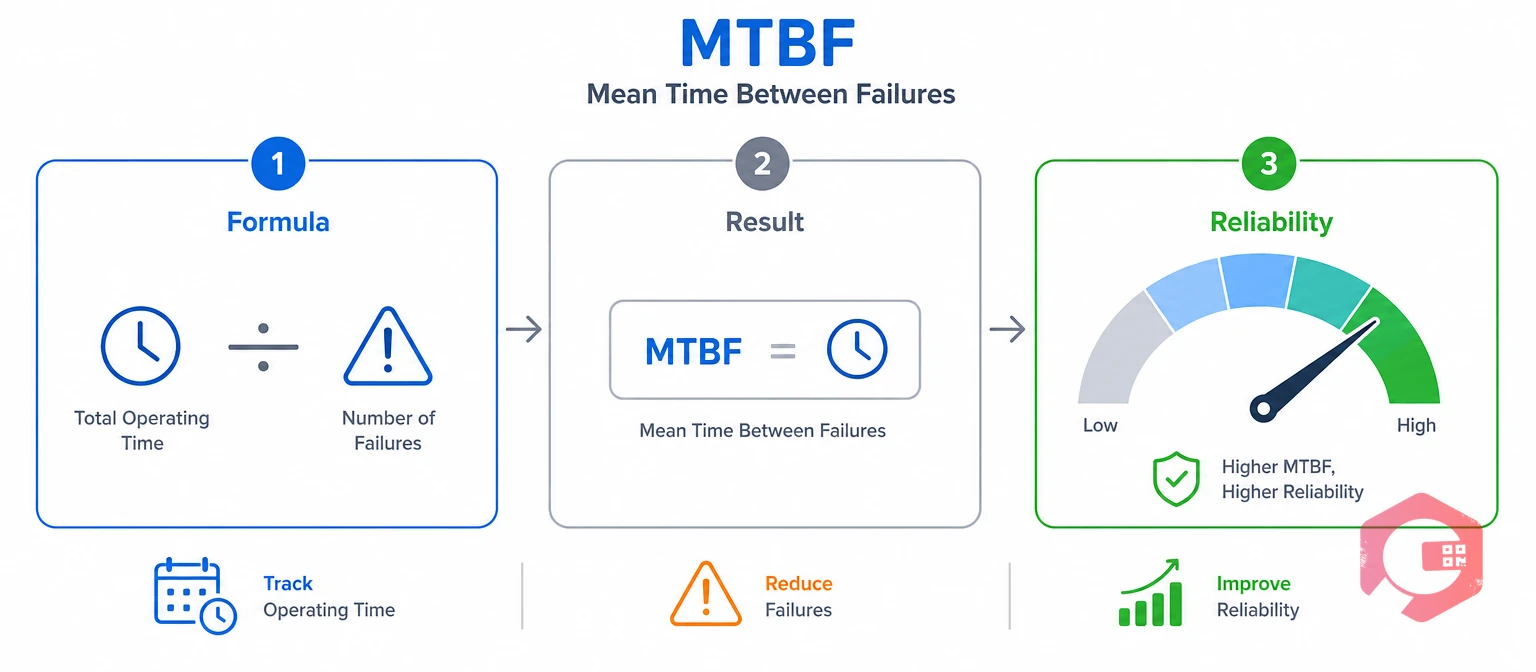
MTBF (Mean Time Between Failures) is the average operating time a repairable asset runs between unplanned failures, calculated as total operating time divided by the number of failures. A pump with 5,000 operating hours and 4 failures has an MTBF of 1,250 hours. The metric counts only unplanned breakdowns — scheduled maintenance stops do not count.
Every gain in MTBF delivers compounding benefits. Fewer breakdowns mean less emergency repair labor, fewer rush-ordered parts, less production loss, and lower safety risk. A 20 percent MTBF improvement on a critical line — moving from 500 to 600 hours between failures — can remove several unplanned downtime events per year. At $5,000 to $15,000 per hour of lost production, even one prevented failure pays for the effort many times over.
Preventive maintenance scheduling is the process of timing equipment service based on known failure intervals to prevent breakdowns before they occur. When you know a motor bearing typically fails every 2,000 hours, you schedule replacement at 1,800 hours. Without MTBF data, PM schedules rely on calendar time or OEM defaults that may not match your conditions. According to reliability engineering standards, MTBF-based scheduling beats fixed-interval methods because it adapts to real equipment behavior.
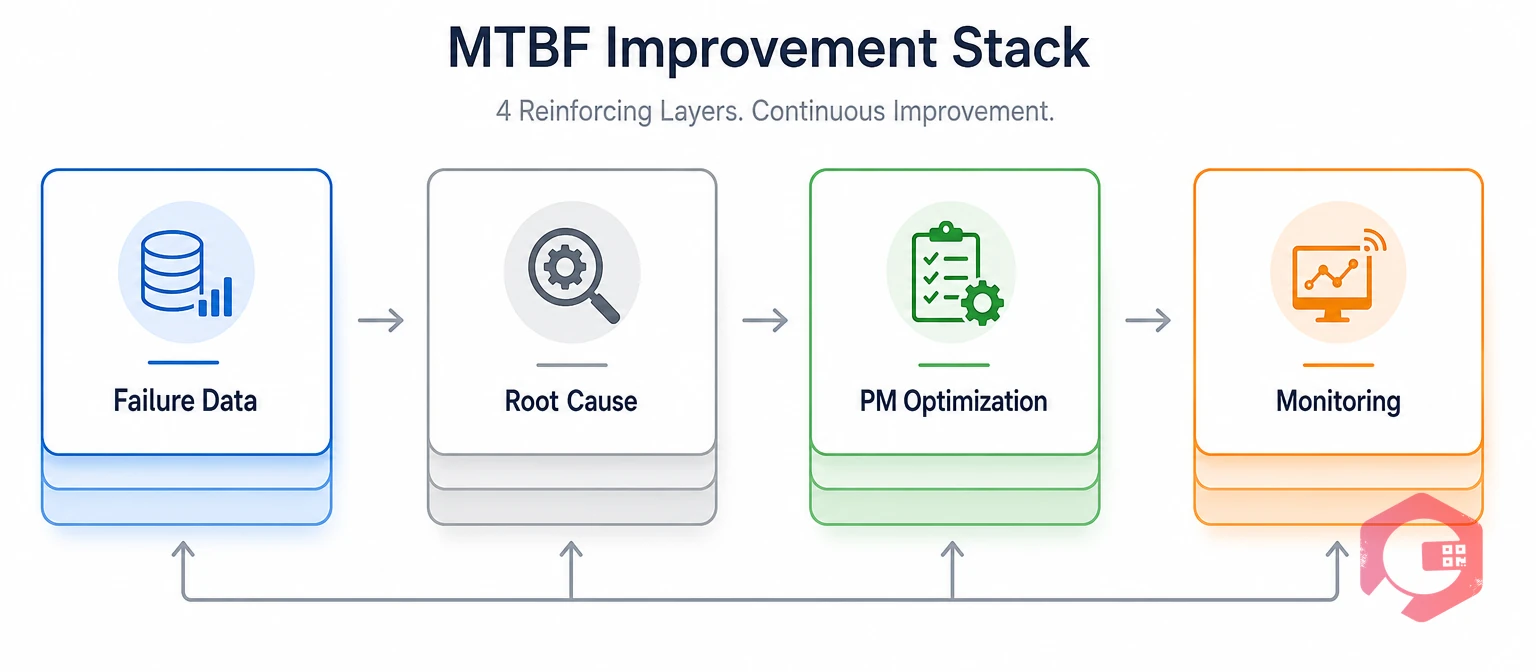
You cannot improve MTBF with a single action. It takes a structured approach that tackles several failure drivers at once. The MTBF Improvement Stack organizes the work into four layers that reinforce each other.
The MTBF Improvement Stack:
Clean failure data feeds accurate root cause analysis. Root cause fixes make PM schedules more effective. Continuous monitoring confirms that gains are holding and flags new problems early. Teams that skip Layer 1 and jump to PM changes often see their improvements fade — because they treat symptoms without knowing the real failure patterns.
A failure interval is the measured operating time between two consecutive unplanned breakdowns on the same asset. Preventive maintenance is the most direct lever to improve MTBF. A solid PM program catches wear, degradation, and early faults before they grow into unplanned failures — resetting the failure clock on each serviced asset.
Most teams inherit PM schedules from OEMs or industry defaults. These are starting points, not tuned intervals. Review your CMMS work order history for each critical asset: if a machine on a 90-day PM cycle keeps failing at 75 days, shorten the interval. If another asset on a 30-day cycle has never failed between services, the interval may be too tight — wasting labor and parts with no failure reduction.
Cryotos's preventive maintenance software supports both time-based and meter-based PM triggers. Intervals adjust based on actual equipment usage rather than calendar guesses — a direct path to higher MTBF on heavy-use assets.
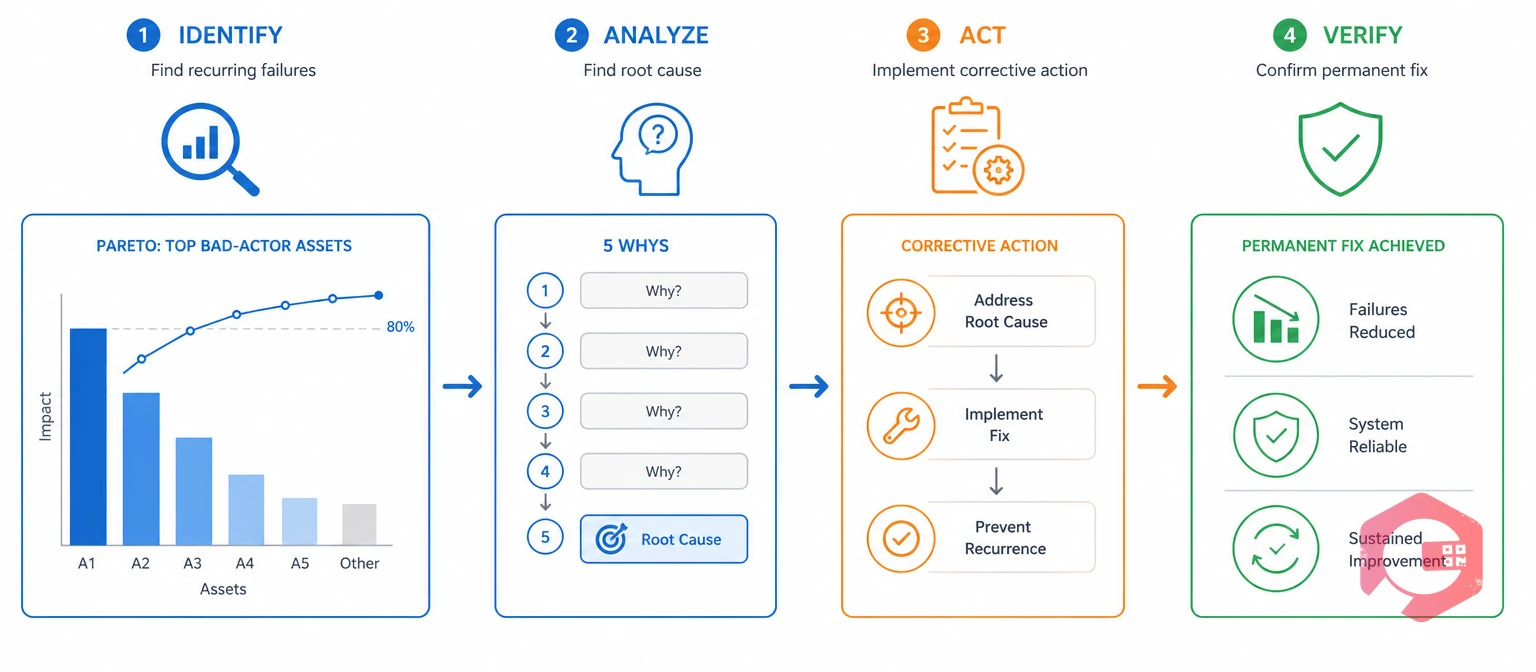
Every repeat failure is an MTBF anchor. An asset that fails for the same reason three times in six months drags the metric down far more than a one-time random event. To improve MTBF, you need to stop the repeat offenders.
Run a Pareto analysis on your failure data: sort assets by failure count over the last 12 months and find the top 10 percent. These "bad actors" generate most of your unplanned maintenance burden. Targeting RCA on these assets gives you the biggest MTBF gain per hour of effort.
For each top failure driver, apply 5 Whys to trace the chain from symptom to root cause. A motor failure might trace from "motor overheated" to "cooling fan blocked" to "debris on intake" to "no intake filter installed" to "filter removed during last service and not replaced." The fix is not another motor swap — it is a permanent intake filter guard plus a filter check on the PM checklist. That one root cause fix can remove an entire failure category and push MTBF up fast.
Maintenance teams using Cryotos have reported up to 30% reduction in unplanned downtime and 25% faster repair turnaround — results driven by structured RCA on high-frequency failure modes found through work order data.
Spare parts availability has a direct but often missed effect on MTBF. When the right part is not on hand during a repair, technicians face two bad options: wait for the part (longer downtime) or install a temporary fix that gets the asset running but does not fully resolve the issue.
Temporary fixes — an undersized bearing, a belt tensioned past spec, a bypassed safety switch — create conditions that speed up the next failure. Every "quick fix" that shortens the time to the next breakdown is quietly reducing your MTBF. To close these gaps:
Technician skill affects MTBF in two ways. First, poor repairs — wrong torque values, bad alignment, skipped steps — introduce new failure modes that would not exist with a proper repair. Second, less experienced technicians may misdiagnose root causes and apply fixes that address symptoms rather than the real problem, causing repeat failures.
Create fault code-to-procedure guides for your highest-failure assets. When a technician hits a specific fault, the guide gives diagnostic steps, the likely root cause, the correct fix, and the parts needed. This cuts both misdiagnosis and repair time — and keeps repair quality consistent no matter who responds.
Compare MTBF trends before and after any training or procedure change. If you rolled out a standard bearing installation process in March and MTBF on bearing failures rises from April on, the data confirms it worked. If MTBF stays flat, the root cause may lie elsewhere. Cryotos's downtime tracking module shows these trends by asset and failure mode, so you can measure the MTBF impact of every program change.
MTBF trending is the practice of tracking mean time between failures over rolling time windows to detect reliability degradation before it causes operational disruption. MTBF is not a set-and-forget number. Equipment ages, conditions change, and new failure modes show up over time. Ongoing MTBF monitoring turns a lagging metric into a leading indicator — a falling trend on a specific asset tells you reliability is slipping before the failures stack up enough to cause real disruption.
Track MTBF on rolling 90-day and 12-month windows. The 90-day window catches recent shifts fast — a new failure mode, a bad parts batch, or a maintenance error shows up within weeks. The 12-month window smooths out seasonal noise and shows the long-term path. When the 90-day MTBF drops below the 12-month average, dig in right away rather than waiting for more months of failures to confirm the trend.
According to ISO 55000 asset management principles, reliability-focused organizations treat MTBF as a continuous improvement metric — not a fixed target. The goal is to push MTBF higher through the ongoing cycle of data capture, root cause elimination, PM tuning, and monitoring that the MTBF Improvement Stack describes.
A good MTBF depends on asset type, age, and operating conditions. Critical production assets in well-maintained plants typically reach 1,000 to 3,000 operating hours. Rotating machinery with solid PM programs often exceeds 2,000 hours. The most useful comparison is your own asset's MTBF trend over time — a rising trend means your program is working, regardless of the absolute number.
Most teams see measurable gains within 3 to 6 months of starting structured RCA and PM optimization. The first wins come from fixing the highest-frequency repeat failures — the "bad actors" that account for most of the total failure count. Sustained improvement beyond year one requires ongoing CMMS analysis and PM refinement as conditions change.
Yes. Fewer unplanned failures mean less emergency labor, fewer rush parts orders, and less production downtime. Industry data shows reactive maintenance costs 3 to 10 times more per event than planned preventive work. When you improve MTBF, you shift work from reactive to planned — cutting total cost while raising equipment availability.
MTBF directly feeds the availability component of OEE (Overall Equipment Effectiveness). Higher MTBF means fewer unplanned stops, which raises the share of scheduled time the equipment is actually running. Improving MTBF is one of the fastest ways to lift OEE — along with reducing MTTR for quicker recovery when failures do happen.
Improving MTBF is a continuous process that starts with clean failure data and grows through root cause elimination, PM optimization, and ongoing monitoring. Schedule a free demo to see how Cryotos gives your maintenance team the work order analytics, downtime tracking, and BI dashboards needed to measure, trend, and improve MTBF across every asset in your operation.




Cryotos AI predicts failures, automates work orders, and simplifies maintenance—before problems slow you down.



