

Maximizing equipment lifespan with preventive maintenance means performing regular, scheduled care on your assets before failures occur - extending how long machinery runs reliably and reducing total ownership costs. According to a Plant Engineering study, facilities that shift from reactive to preventive maintenance reduce repair costs by 25% and extend asset life by 20-40%. The difference isn't luck - it's a system.
Most maintenance teams understand this in principle. In practice, PM schedules slip, checklists get skipped, and equipment runs far past its service intervals. The result is premature failure, unplanned downtime, and capital replacement budgets that grow every year. This post breaks down exactly what works - and how to build a process that actually sticks.
When a machine fails unexpectedly, the visible cost is the repair bill. The invisible cost - lost production, emergency labor rates, expedited parts shipping, secondary damage to connected components - is typically three to five times larger. A McKinsey analysis found that unplanned downtime costs industrial manufacturers up to $50 billion annually, with reactive maintenance strategies carrying the heaviest share of that burden.
Equipment lifespan is not fixed. Manufacturers publish design lifespans based on ideal operating conditions, but real-world conditions - variable loads, inconsistent lubrication, deferred inspections - compress that timeline significantly. A motor with a 20-year design life will fail in 8 years under poor maintenance. The same motor, properly maintained, may run for 25 years.
The math is straightforward. Replacing a $15,000 industrial motor costs $15,000 plus installation, downtime, and lost output. A PM schedule that catches bearing wear early - with a $200 bearing replacement - avoids that entire cost. Multiply that logic across a facility with hundreds of assets, and the ROI of a structured PM program becomes undeniable.
Downtime tracking data consistently shows that facilities with mature PM programs average 30% less unplanned downtime than those operating reactively. That gap widens as assets age - exactly when your most expensive equipment needs the most protection.
A complete PM program isn't just "check the machine every month." It covers five distinct areas that together drive maximum longevity. Skipping any one of them leaves gaps that shorten asset life and increase failure risk.
Friction is the leading cause of mechanical wear in rotating equipment. Proper lubrication reduces metal-on-metal contact, dissipates heat, and prevents corrosion. According to the Society of Tribologists and Lubrication Engineers, over-lubrication and under-lubrication together account for roughly 40% of preventable bearing failures.
Effective lubrication PM requires three things: using the correct lubricant type specified by the OEM, applying it at the right intervals (not just "when it looks dry"), and tracking application history so that the next technician has context. The same principle applies to hydraulic fluids, coolants, and gear oils - all need scheduled analysis and replacement based on condition, not calendar guesswork.
Scheduled inspections create a before-failure detection window. A technician doing a quarterly check on a conveyor drive might notice belt fraying, abnormal vibration, or unusual heat before any alarm fires. That observation, documented in a work order, creates the lead time needed to order parts and schedule a repair during planned downtime - not during a production run.
Inspections need to be systematic, not ad hoc. A checklist-based approach ensures nothing is skipped, that observations are recorded consistently, and that patterns across multiple inspections become visible over time. A machine that consistently runs warm in summer may need a cooling system upgrade before the next heat season - data only visible if inspections are recorded, not just performed.
Misalignment between coupled shafts is a primary driver of premature bearing and seal failure. A shaft misalignment of just 0.005 inches can reduce bearing life by 50%. The fix - laser alignment - takes 30 minutes and costs almost nothing compared to the bearing replacement it prevents.
Calibration applies to measurement instruments, sensors, and control systems. An uncalibrated pressure sensor may allow equipment to operate outside safe limits without triggering an alert - exactly the kind of slow damage that shortens equipment life without any single visible event.
Contamination is underestimated. Dust accumulation on motor windings reduces cooling efficiency and causes overheating. Debris in hydraulic systems causes valve and cylinder wear. Moisture intrusion into electrical enclosures leads to insulation breakdown. None of these are dramatic failures - they are gradual degradation that shortens equipment life by years.
A PM program that includes scheduled cleaning tasks - air-purging motors, cleaning filters, inspecting seals and enclosures - addresses these slow-burn causes before they accumulate into irreversible damage.
Wear items have predictable lifespans. Belts, seals, filters, and gaskets are designed to be replaced on a schedule - yet many facilities only replace them after they fail. Proactive parts replacement, scheduled before the end of a component's service life, prevents the cascade damage that occurs when a $30 belt snaps and destroys a $400 pulley and a $2,000 gearbox.
Effective spare parts management through an inventory management system ensures that replacement parts are available when scheduled PM work is due - eliminating the production delays that occur when a technician is ready to do the job but the part is on a three-week lead time.
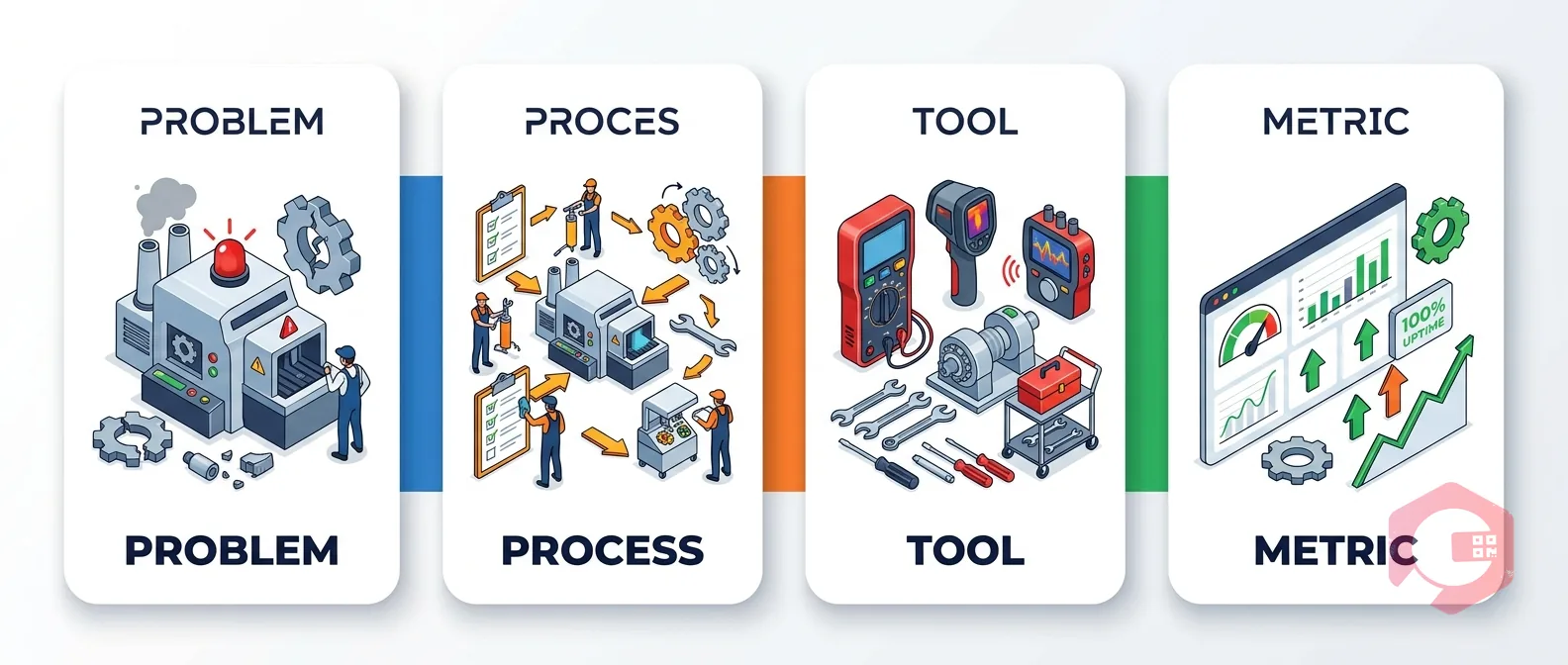
Calendar-based PM triggers maintenance at fixed time intervals - every 30 days, every quarter, annually. Usage-based PM triggers maintenance based on actual operating cycles: hours run, units produced, miles traveled. Both have a place in a mature program, but they serve different assets differently.
Calendar-based PM works well for time-sensitive items: safety checks, compliance inspections, and components with time-dependent degradation (gaskets, rubber seals). It is simple to schedule and easy to communicate to teams.
Usage-based PM is more precise for mechanical components where wear correlates with run time or cycles, not calendar time. A compressor running 24/7 needs maintenance far more frequently than one running 8 hours per day - calendar schedules miss this distinction entirely. By tying PM triggers to actual operating hours from equipment meters or IoT sensors, you service assets when they need it, not arbitrarily.
Modern preventive maintenance software supports both trigger types simultaneously - running calendar checks on safety-critical items while using meter-based triggers on production equipment. That combination produces the most effective lifespan extension of either approach alone.

A preventive maintenance strategy on paper is only as effective as its execution. The gap between "we have a PM program" and "our PM program actually runs" is where most facilities lose ground - and it's a gap that a CMMS closes directly.
A CMMS automates the creation and assignment of PM work orders, ensuring scheduled tasks generate automatically and reach the right technician without requiring a planner to manually create each ticket. When a PM is completed, the CMMS records it against the asset's history - creating the maintenance record that informs every future decision about that machine.
Cryotos CMMS supports both static and dynamic PM triggers - calendar-based and usage-based - with drag-and-drop scheduling, customizable checklists, and real-time technician notifications via mobile and WhatsApp. Facilities using Cryotos have reported 30% reductions in downtime and 25% faster repair times, directly translating to longer productive asset life.

Preventive maintenance, even when perfectly executed on a schedule, is still based on assumptions about when failure is likely. Predictive maintenance uses real-time data from IoT sensors to move beyond assumptions - detecting actual degradation as it happens, before any scheduled inspection would catch it.
Vibration sensors on motor bearings, temperature sensors on electrical panels, and ultrasonic sensors detecting compressed air leaks are examples of condition-monitoring tools that feed continuous data into a CMMS. When a parameter crosses a threshold - say, bearing vibration exceeding a defined limit - the system automatically creates a work order before the bearing reaches failure.
According to Deloitte research on Industry 4.0, companies implementing predictive maintenance achieve 10-25% reductions in maintenance costs and extend equipment life by an additional 20-40% compared to PM-only programs. The combination of structured preventive maintenance and condition-based predictive triggers creates the fullest possible protection for long-lived assets.

The most common reason PM programs fail isn't poor intent - it's poor execution infrastructure. When PM work orders compete with reactive repairs for the same technician time, reactive work always wins. When PM checklists are paper forms stored in a binder, they get skipped. When there's no visibility into whether PM was completed, nothing enforces accountability.
A PM schedule that gets followed requires four things:
A plant that runs an asset management system with full PM history, real-time compliance reporting, and mobile-first execution doesn't just extend equipment life - it builds the operational discipline that makes consistent performance possible at scale.
Protecting your assets is protecting your production capacity. Organizations that treat equipment maintenance as a strategic investment - not a reactive cost - consistently outperform those that don't on every maintenance metric that matters: downtime, repair cost, asset replacement frequency, and total cost of ownership. The equipment in your facility can last years longer than it currently does. A structured preventive maintenance program, supported by the right CMMS tools, is how you get there. Schedule a demo with Cryotos CMMS to see how automated PM scheduling, usage-based triggers, and real-time compliance tracking can extend the life of your critical assets.
Lubrication, regular inspections, alignment checks, and timely wear-part replacement have the greatest individual impact on extending equipment lifespan. Combined with a CMMS that automates scheduling and tracks asset history, these practices form a program that can extend machine life by 20-40% compared to reactive maintenance.
PM frequency depends on asset criticality, operating conditions, and OEM recommendations. Critical production assets may need weekly or monthly PM. Lower-criticality equipment may need quarterly or annual attention. Usage-based triggers - tied to operating hours rather than calendar dates - are more accurate for mechanical equipment than fixed intervals.
Preventive maintenance is scheduled at defined intervals regardless of current equipment condition. Predictive maintenance uses real-time sensor data to trigger maintenance only when actual degradation is detected. Both extend equipment life, but predictive maintenance adds precision that reduces unnecessary PM work and catches failures that scheduled PM might miss between service intervals.
A CMMS automates PM scheduling so work orders generate without manual intervention, records complete maintenance history per asset, integrates inventory to ensure parts are available when needed, and tracks MTBF to identify degrading equipment early. Together, these capabilities close the gap between PM strategy and consistent PM execution.
Industry benchmarks consider 85-95% PM compliance rate as world-class. Most facilities operating without a CMMS run significantly below 70%. Improving PM compliance to 90%+ through automated scheduling and mobile execution directly translates to longer asset lifespans and fewer unplanned breakdowns.


Cryotos AI predicts failures, automates work orders, and simplifies maintenance—before problems slow you down.



