Preventive Maintenance in the Tyre Industry: Equipment, Schedules & CMMS

Calendar
Duration:
21 min read
calendar today
Published on
April 30, 2026
Featured Image

Preventive maintenance in the tyre industry refers to a structured, schedule-driven approach to servicing equipment — curing presses, internal mixers, calenders, tyre building machines, and more — before failures occur rather than after them. In a sector where a single unplanned breakdown on a curing line can cost upwards of $15,000 per hour in lost production, shifting from reactive to preventive maintenance is one of the highest-ROI decisions a plant manager can make.


According to a Reliable Plant industry study, manufacturers that operate mature preventive maintenance programs reduce unplanned downtime by up to 45% and cut overall maintenance costs by 25–30%. Yet many tyre plants still rely on paper-based job cards, manual inspection rounds, and tribal knowledge to maintain equipment that runs 24 hours a day, six or seven days a week. The result: equipment that fails at the worst possible moments, scrambling for spare parts that aren't in stock, and technicians who spend more time firefighting than maintaining.


This guide covers how to build a solid preventive maintenance programme specifically for tyre manufacturing — the key equipment to prioritise, the right PM intervals, and how a modern preventive maintenance software like Cryotos CMMS automates the entire process so nothing slips through the cracks.


Why Preventive Maintenance Matters in Tyre Manufacturing

Tyre plants operate in one of the most demanding production environments in manufacturing. Equipment runs continuously under extreme heat, pressure, and mechanical stress. Curing presses cycle at temperatures above 170°C. Internal mixers process highly abrasive rubber compounds that tear through seals and blades. Calender rolls handle materials at precise tension settings that drift the moment a bearing wears beyond tolerance.


In this environment, breakdown maintenance isn't just expensive — it's dangerous. When a hydraulic press fails under load, or a calender nip roll jams unexpectedly, technicians face real safety risks. The OSHA lockout/tagout standard (29 CFR 1910.147) exists specifically because of these risks, requiring strict energy isolation procedures any time maintenance is performed on energised equipment.


Beyond safety, the financial case for preventive maintenance in tyre manufacturing is overwhelming. Consider these figures:


  • Reactive maintenance costs 3–5× more than planned maintenance for the same repair — because breakdown repairs require overtime labour, emergency spare part sourcing, and expedited shipping.
  • A single curing press line stoppage at a mid-size tyre plant can cost $8,000–$20,000 per hour in lost production, depending on the plant's output capacity.
  • Unplanned downtime affects OEE directly — every unplanned stoppage reduces Availability, one of the three OEE components, and cascades into quality and performance losses as well.
  • Customer penalties are real — OEM tyre supply contracts typically include delivery SLA penalties. A production stoppage that delays a shipment to an automotive manufacturer can trigger contractual penalty clauses.


Preventive maintenance breaks this cycle by replacing random, unpredictable failures with planned, controllable maintenance events that happen on your schedule — not the equipment's.


Critical Equipment in a Tyre Plant That Needs PM

Tyre manufacturing involves a complex sequence of production stages, each with specialised equipment that requires its own maintenance approach. Prioritise your PM programme around these asset categories:


Internal Mixers (Banbury Mixers)

The internal mixer is where rubber compounding happens — raw rubber, carbon black, and chemical agents are blended under heat and pressure. Rotor tips, chamber liners, drop doors, and ram seals all experience severe wear. A failed drop door seal mid-batch doesn't just stop the mixer; it contaminates the batch and forces a complete clean-out, adding hours of downtime.


Key PM tasks: rotor tip clearance checks, drop door seal replacements, hydraulic ram inspection, temperature sensor calibration, gearbox oil analysis.


Calenders

Calenders apply rubber compound to textile or steel cord fabrics at precise thicknesses. Roll bearing condition is critical — worn bearings cause gauge variation, which directly affects tyre uniformity and can trigger quality rejections downstream. Calender maintenance is high-skill work that requires precise roll alignment and gap setting after every major service.


Key PM tasks: bearing lubrication and clearance checks, roll surface inspection, hydraulic system pressure testing, nip roll alignment verification, speed synchronisation calibration.


Tyre Building Machines (TBMs)

TBMs assemble the tyre carcass layer by layer. Bladder condition, stitching roller wear, and bead setter alignment are the primary failure points. A worn bladder that bursts during the building cycle ruins the tyre being built and forces an unplanned machine stoppage for bladder replacement.


Key PM tasks: bladder inspection and replacement (cycle-count-based), stitching roller surface checks, servo motor calibration, bead gripper mechanism lubrication, pneumatic line leak checks.


Curing Presses

Curing presses are the most maintenance-intensive assets in a tyre plant. They operate at high temperature and pressure for thousands of cycles per year. Bladder life, mould condition, steam/hot water system integrity, and hydraulic cylinder seals are all critical to track. A curing press that drops out of service takes an entire mould set offline with it.


Key PM tasks: curing bladder inspection and replacement (cycle-based), steam system trap and valve checks, hydraulic seal replacement, mould cleaning and inspection, pressure gauge calibration, platen temperature uniformity testing.


Extruders and Bias Cutters

Extruders shape rubber profiles for treads, sidewalls, and apex strips. Screw wear, barrel liner condition, and die head alignment all affect output quality. Bias cutters cut fabric plies at precise angles — blade sharpness and guide rail alignment are the key PM items here.


Key PM tasks: screw and barrel clearance measurement, die head strip and clean, cooling system flow check, bias cutter blade replacement (cycle-based), guide rail alignment verification.


Building a Preventive Maintenance Schedule for Tyre Equipment

Preventive Maintenance in the Tyre Industry — scenario

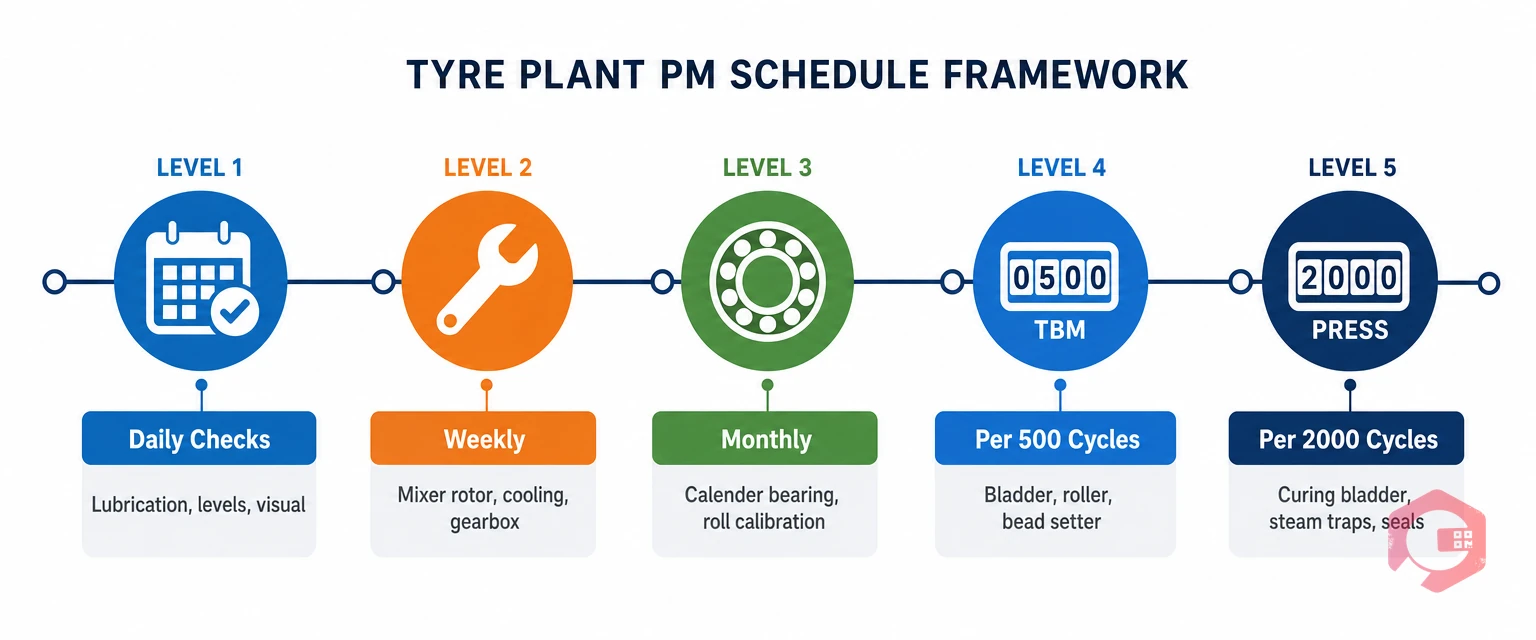
A well-designed PM schedule for a tyre plant balances two scheduling approaches: calendar-based PM (triggered by elapsed time — daily, weekly, monthly) and usage-based PM (triggered by machine cycles, operating hours, or output volume). The most effective programmes use both.


Sample PM Interval Framework by Equipment

Use this framework as a starting point and adjust based on your OEM equipment manuals and actual failure history:


  • Daily checks (all equipment): Lubrication points, hydraulic fluid levels, temperature readings, visual leak inspection, safety guard integrity, operator log review.
  • Weekly (Internal Mixer): Rotor tip clearance measurement, drop door seal visual inspection, cooling water flow check, gearbox oil level, motor bearing temperature.
  • Monthly (Calender): Full bearing lubrication service, roll gap calibration, hydraulic pressure check, drive belt tension inspection, roll surface defect mapping.
  • Every 500 cycles (TBM): Bladder dimensional check, stitching roller surface inspection, bead setter alignment verification, air line fitting check.
  • Every 2,000 cycles (Curing Press): Curing bladder replacement, steam trap replacement, hydraulic cylinder seal inspection, mould deep clean and release agent renewal.
  • Every 3,000 hours (Extruder): Screw and barrel measurement and clearance assessment, die head full strip and clean, gear reducer oil change and analysis, barrel liner inspection.


How to Set the Right Trigger for Each Asset

The right trigger type depends on whether the asset degrades primarily by time or by use. Curing press bladders wear by cycles — a press running three shifts degrades three times faster than one running one shift. A calendar-based schedule would either over-maintain the single-shift press or under-maintain the three-shift press. Cycle-based PM gets both right.


Conversely, gearbox oil degrades by time and temperature exposure even when the machine is idle. For gearboxes, a calendar-based schedule (quarterly oil change, annual analysis) is more appropriate than a cycle-based trigger.


A modern CMMS platform handles both trigger types simultaneously for the same asset — scheduling a quarterly gearbox oil change on the calendar while also tracking curing press cycles and auto-triggering a bladder inspection at the 2,000-cycle mark.


Common PM Failures in Tyre Plants — and How to Fix Them

Preventive Maintenance in the Tyre Industry — problems grid

Even plants with a PM programme in place often see it underperform. Here are the most common reasons why — and the fixes that actually work:


  • PM tasks completed on paper but not actually done. Technicians sign off on inspection checklists without performing the checks — especially on night shifts. Fix: require photo or video proof of completion attached to the work order, enforced through a mobile CMMS app that won't allow closure without the attachment.
  • PM intervals copied from OEM manuals without adjustment. OEM manuals are written for standard operating conditions. If your plant runs a mixer at higher-than-rated temperature or cycles a press twice as frequently as the manual assumes, the OEM intervals will under-maintain your equipment. Fix: track actual failure frequency per asset and use MTBF data to calibrate your PM intervals based on real plant conditions.
  • Spare parts not ready when PM is due. A technician arrives to perform a scheduled bearing replacement and finds the bearing isn't in stock. The PM gets skipped or deferred. Fix: link spare parts consumption to PM work orders in a spare parts inventory system that reserves the required parts when the PM is scheduled and alerts the storeroom to reorder if stock falls below minimum.
  • No visibility into PM backlog or compliance rate. Without data, plant managers don't know whether PM tasks are being completed on time or slipping. Fix: track PM compliance rate (PMs completed on schedule ÷ total PMs due) as a KPI and report it weekly. Target 90%+ compliance.
  • PM schedules built in spreadsheets that nobody maintains. Spreadsheet-based PM schedules become outdated quickly and don't send automatic reminders. Fix: migrate PM schedules into a CMMS that auto-generates work orders, assigns them to technicians, and tracks completion — no manual scheduling needed after initial setup.


How CMMS Software Powers Preventive Maintenance in Tyre Manufacturing

Preventive Maintenance in the Tyre Industry — workflow

A Computerized Maintenance Management System (CMMS) is the operational backbone of any mature PM programme. Here's what it does that spreadsheets, paper systems, and tribal knowledge cannot:


  • Auto-generates PM work orders based on calendar intervals or usage triggers — no manual scheduling after initial setup. When a curing press hits 2,000 cycles, the CMMS automatically creates a bladder inspection work order, assigns it to the next available qualified technician, and notifies them via mobile app and WhatsApp.
  • Stores complete asset history — every PM task, repair, part replacement, and failure event is logged against the asset. When a technician scans a curing press QR code before a PM task, they instantly see the asset's full service history, last bladder change date, and any open issues flagged by the previous shift.
  • Enforces PM checklists — customisable digital checklists ensure every inspection step is completed before a work order can be closed. Photo and video attachments provide proof of completion and create an audit trail for ISO and customer quality audits.
  • Links spare parts to PM work orders — the system knows which parts each PM task requires and checks stock availability automatically. If a required bearing isn't in stock when a PM is due, the system alerts the storeroom and can trigger a purchase request before the PM date arrives.
  • Tracks PM compliance and maintenance KPIs — real-time dashboards show PM completion rates, overdue tasks, MTBF trends by asset, and maintenance cost per machine. Plant managers can see at a glance whether the maintenance programme is running on plan or falling behind.
  • Integrates with IoT sensors and SCADA systems — for condition-based maintenance, the CMMS receives real-time data from vibration sensors, temperature probes, and pressure gauges. When a bearing vibration reading exceeds the threshold, the CMMS creates a predictive maintenance work order before the bearing fails — extending equipment life and eliminating the unplanned breakdown entirely.


According to a Plant Engineering maintenance benchmarking study, plants using CMMS software achieve 28% higher PM completion rates and 23% lower maintenance costs per asset compared to plants using manual or spreadsheet-based systems.


Key Maintenance KPIs Every Tyre Plant Should Track

Preventive Maintenance in the Tyre Industry — lifecycle

Preventive maintenance only improves if you measure it. These are the KPIs that matter most in tyre manufacturing maintenance:


  • PM Compliance Rate: The percentage of scheduled PM tasks completed on time. Target: 90% or higher. Anything below 80% signals that your PM programme is understaffed or that tasks are being skipped.
  • Mean Time Between Failures (MTBF): The average operating time between unplanned failures for a given asset. A rising MTBF means your PM programme is working. A declining MTBF means you're under-maintaining the asset or the PM interval needs adjustment.
  • Mean Time to Repair (MTTR): The average time from failure detection to full restoration of service. A high MTTR usually points to spare parts availability issues, skills gaps, or unclear maintenance procedures.
  • Planned vs. Unplanned Maintenance Ratio: The proportion of total maintenance hours spent on planned work vs. reactive breakdowns. World-class plants achieve 80–85% planned maintenance. If your ratio is below 60%, your PM programme needs strengthening.
  • Overall Equipment Effectiveness (OEE): The composite metric of Availability × Performance × Quality. Preventive maintenance directly improves the Availability component by reducing unplanned downtime frequency and duration. Downtime tracking software that feeds into OEE calculations is essential for tyre plants targeting 75%+ OEE.
  • Maintenance Cost as % of Asset Replacement Value (ARV): Industry benchmark for manufacturing is 2–5% of ARV annually. If your tyre plant spends significantly more, it's a signal that reactive maintenance costs are inflating the total.


How Cryotos CMMS Helps Tyre Manufacturers Go Preventive

Cryotos CMMS is built for heavy industrial environments where equipment complexity, continuous production schedules, and compliance requirements demand more than a basic work order system. Here's how it addresses the specific needs of tyre manufacturers:


  • Dual-trigger PM scheduling: Set calendar-based PMs (daily lubrication rounds, monthly bearing services) and usage-based PMs (curing press bladder checks every 2,000 cycles) side by side for the same asset. The system handles both automatically and escalates overdue tasks before they become breakdowns.
  • Mobile work order management with QR code scanning: Technicians on the plant floor scan an asset's QR code to pull up its full history, pending PMs, required spare parts, and step-by-step checklists — all on their phone. Work orders are created, updated, and closed on mobile, eliminating paper job cards and end-of-shift data entry delays.
  • AI-assisted work order creation: Maintenance supervisors can log a breakdown by uploading a photo of the failed component. Cryotos uses generative AI to analyse the image and suggest the likely failure cause, required parts, and recommended repair steps — cutting diagnosis time significantly.
  • IoT and SCADA integration: Connect Cryotos to your plant's sensors and control systems. When a mixer bearing temperature sensor reads above the safe threshold, Cryotos automatically creates a condition-based maintenance work order and alerts the responsible technician via WhatsApp — before the bearing seizes.
  • Spare parts inventory with PM-linked reservations: Cryotos' inventory management module tracks spare parts in real time, sets minimum stock alerts, and links part consumption directly to work orders. When a PM work order is created for a curing press bladder replacement, the system checks stock and reserves the bladder automatically.
  • Compliance-ready audit trails: Every PM task, safety check, LOTO procedure, and technician sign-off is recorded with a timestamp and stored in a searchable audit trail. When an ISO 45001 auditor or OEM customer auditor arrives, your maintenance records are ready in seconds — not buried in filing cabinets.
  • Reported results: Tyre manufacturers using Cryotos have reported a 30% reduction in unplanned downtime and 25% faster repair times within the first year of implementation — directly attributable to the shift from reactive to preventive maintenance enabled by the platform.


If your tyre plant is still running maintenance on spreadsheets, paper job cards, or an outdated system that technicians have to visit a desktop to update — it's worth seeing what a purpose-built CMMS can do for your operation. Book a free Cryotos demo and we'll walk you through how other tyre manufacturers have set up their PM programmes on the platform.


Frequently Asked Questions


What is preventive maintenance in the tyre industry?

Preventive maintenance in the tyre industry is a structured programme of scheduled inspections, servicing, and part replacements performed on manufacturing equipment — curing presses, internal mixers, calenders, tyre building machines, and extruders — at regular intervals or usage milestones, before failures occur. The goal is to extend equipment life, reduce unplanned downtime, improve product quality, and keep the plant running safely and efficiently.


What equipment needs the most attention in a tyre plant maintenance programme?

Curing presses, internal mixers, and calenders are the three highest-priority asset categories in a tyre plant because they are the most equipment-intensive, most failure-prone under continuous operation, and have the highest cost of unplanned downtime. Tyre building machines and extruders are the next tier. A mature PM programme maintains all five categories on documented schedules with both calendar and cycle-based triggers.


How does CMMS software improve preventive maintenance in tyre manufacturing?

A CMMS automates PM scheduling, generates work orders automatically when PM triggers are reached, enforces digital checklists with photo proof of completion, links spare parts to PM tasks to prevent stockouts, and tracks KPIs like PM compliance rate, MTBF, and MTTR in real time. Plants that use CMMS software consistently outperform those using manual or spreadsheet systems — achieving higher PM completion rates, lower maintenance costs, and better equipment availability.


What is a good PM compliance rate target for a tyre manufacturing plant?

Industry best practice is 90% or higher PM compliance — meaning 9 out of every 10 scheduled preventive maintenance tasks are completed on time. A rate below 80% is a warning sign that the PM programme is understaffed, that tasks are being skipped, or that the scheduling system is not sending adequate reminders and escalations. CMMS software with automated alerts and escalation workflows is the most reliable way to sustain a 90%+ compliance rate at scale.


What is the difference between preventive and predictive maintenance in tyre plants?

Preventive maintenance is schedule-driven — tasks happen at set time or cycle intervals regardless of the actual condition of the equipment. Predictive maintenance is condition-driven — IoT sensors continuously monitor equipment parameters (vibration, temperature, pressure) and trigger maintenance only when a reading indicates that a failure is approaching. Both approaches are valuable in tyre plants: preventive maintenance handles routine servicing reliably, while predictive maintenance is particularly valuable for high-cost assets like curing presses and internal mixers where early warning of impending failure can prevent catastrophic breakdowns.

Want to Try Cryotos CMMS Today?

Get Free Demo

Let AI Take Control of Your Maintenance

Cryotos AI predicts failures, automates work orders, and simplifies maintenance—before problems slow you down.

Try AI-Powered CMMS
🡢