
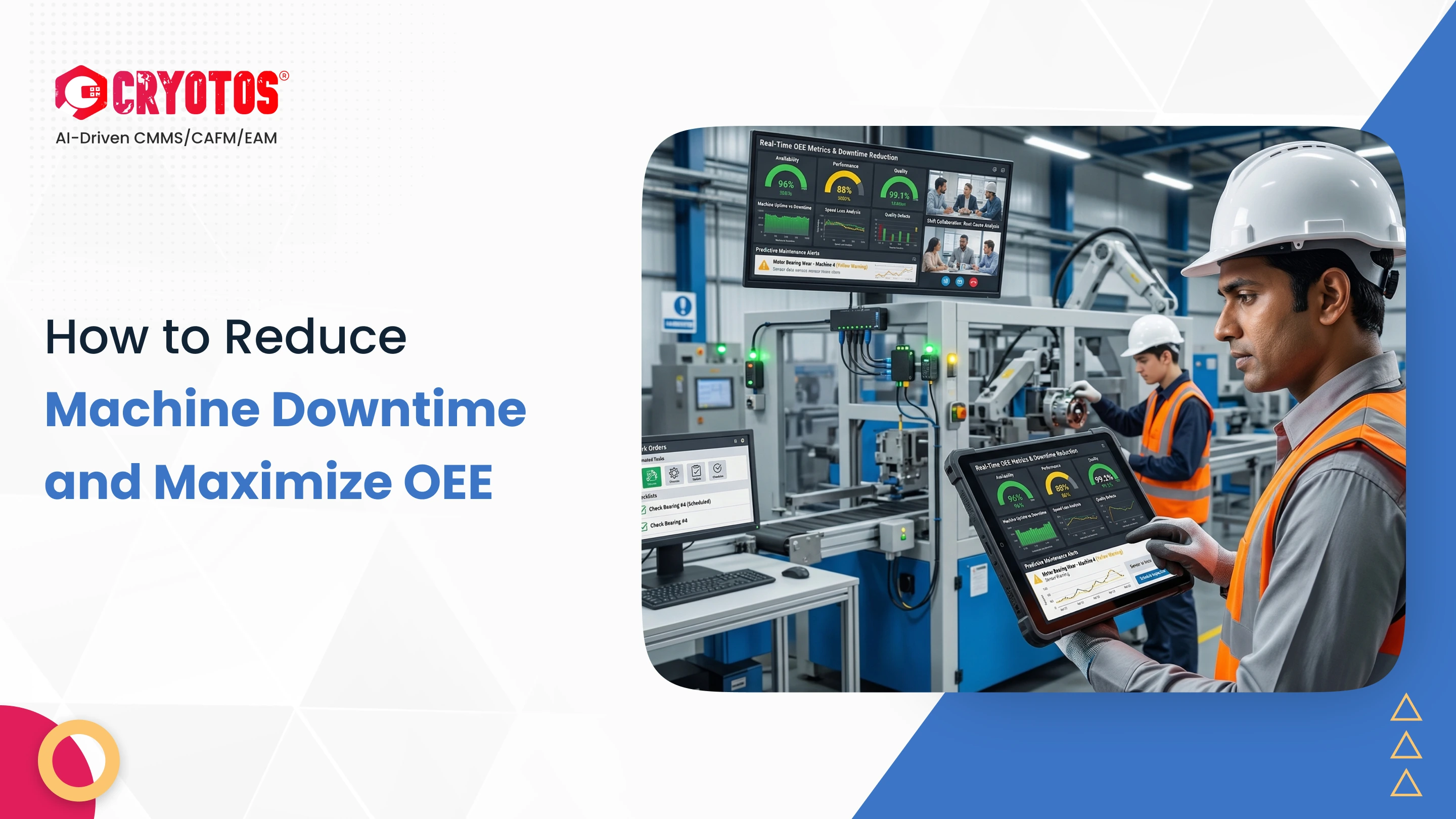
Unscheduled machine failures are a ruthless killer of manufacturing profitability, consuming profit margins every minute a machine is offline. Plant heads and maintenance professionals are under constant stress to maintain production schedules despite unforeseen failures and complex asset management challenges.
To regain control of operations, manufacturers must drop the reactive firefighting approach and shift to a data-driven strategy. Through Industry 4.0 approaches and rigorous optimization of Overall Equipment Effectiveness (OEE), plants can predict failures and unlock hidden production potential.
This transition becomes seamless with platforms like Cryotos CMMS, which automates workflows, integrates real-time IoT data, and provides a complete picture of asset performance. In this guide, we cover the cornerstones of OEE, proven strategies to eliminate machine bottlenecks, and how smart maintenance drives long-term manufacturing excellence.
Overall Equipment Effectiveness (OEE) is the ultimate gauge of your manufacturing process's health and productivity. Rooted in lean manufacturing and Total Productive Maintenance (TPM), OEE compares your machine's real performance against its actual potential.
Tracking OEE reveals the hidden factory — the inflexible processes quietly eroding profitability. An OEE score of 85% or more is considered world-class, yet only approximately 10% of manufacturing organizations achieve this benchmark, indicating enormous room for improvement across the industry.
To truly master OEE, you need to break it down into its three primary pillars and the Six Big Losses they represent.
You can calculate OEE with a basic formula: (Good Count × Ideal Cycle Time) / Planned Production Time.
The industry-preferred method, offering much deeper operational insight, is:
OEE = Availability × Performance × Quality
This calculation isolates the exact root causes of lost productivity, preventing false wins where high machine availability simply masks a surge in defective scrap. With this foundation in place, let's explore the actionable strategies you can implement now to eliminate chronic mechanical failures and reduce your largest OEE threat: unplanned machine downtime.
Achieving high OEE means minimizing downtime at every opportunity. Here is how top-tier facilities do it.
You cannot fix what you cannot measure. Guessing at downtime root causes leads to poorly allocated resources. Automated tracking solutions capture precise machine data, and displaying real-time information on the shop floor empowers operators to act immediately. Visibility alone can increase OEE by up to 105%.
Unplanned downtime typically splits between one-time failures (30%) and chronic recurring failures (70%). World-class operations do not accept minor leaks, loose fasteners, or worn components as normal. Identify the most frequent failure patterns through daily stand-ups and root cause analysis techniques like the 5 Whys.
Preventive maintenance based on fixed time intervals is a good start, but critical assets demand more. By adding wireless sensors that monitor vibration, temperature, and acoustics, you can anticipate failure points before they occur — maintaining equipment only when necessary and avoiding costly unplanned breakdowns.
Improving performance requires systematically isolating the exact losses dragging down your efficiency.
Sustainable OEE improvement demands both the right culture and the right technology.
Nearly 23% of unplanned downtime is caused by human error. Invest in intensive frontline training on safe operations and minor repairs. Assign a Maintenance Champion who ensures teams rigorously follow planned maintenance programs.
Predictive maintenance must be grounded in Return on Investment (ROI). This means making strategic decisions — such as deferring a minor maintenance task to complete an exceptionally profitable production run, or proactively taking an asset offline before the financial cost of failure becomes unmanageable.
Once you have addressed the most accessible issues, you will encounter more complex machinery problems. Move beyond basic troubleshooting and implement structured frameworks like A3 Problem-Solving, Root Cause Analysis (RCA), and Lean Six Sigma to establish lasting remedies.
Optimizing OEE fundamentally transforms production economics. Reducing downtime immediately unlocks existing factory capacity — without purchasing new equipment or expanding your facility.
Higher performance translates directly into faster time-to-market and improved on-time delivery rates. Improved quality reduces material waste and costly labor rework. Ultimately, every percentage point gain in OEE flows directly to the bottom line, transforming the maintenance department from a cost center into a profit center.
Executing these strategies at scale demands a powerful system behind them. Cryotos CMMS is built for Industry 4.0 maintenance management, giving you the precise tools to maximize OEE.
Maximizing OEE and minimizing machine downtime is not a one-time project — it is a relentless pursuit of operational excellence. By focusing on data visibility, transitioning to predictive maintenance, and empowering your team with the right tools, you can transform your shop floor from reactive to resilient.
Pairing these proven methodologies with an intelligent platform like Cryotos CMMS bridges the gap between strategy and execution, giving you the real-time control needed to reach the 85% world-class OEE benchmark.


Cryotos AI predicts failures, automates work orders, and simplifies maintenance—before problems slow you down.



