

BBS vs traditional safety audits is really a question of speed versus scope. Behavior-Based Safety (BBS) cuts incident rates faster over time by changing how people act every day. Traditional safety audits catch physical and compliance risks right away, but they don't change behavior. Studies on BBS programs show injury rates drop 29% in the first year and up to 79% after seven or more years of steady observation. Traditional audits fix the exact hazard they find, but they don't stop the next unsafe action from happening.
Key Takeaways
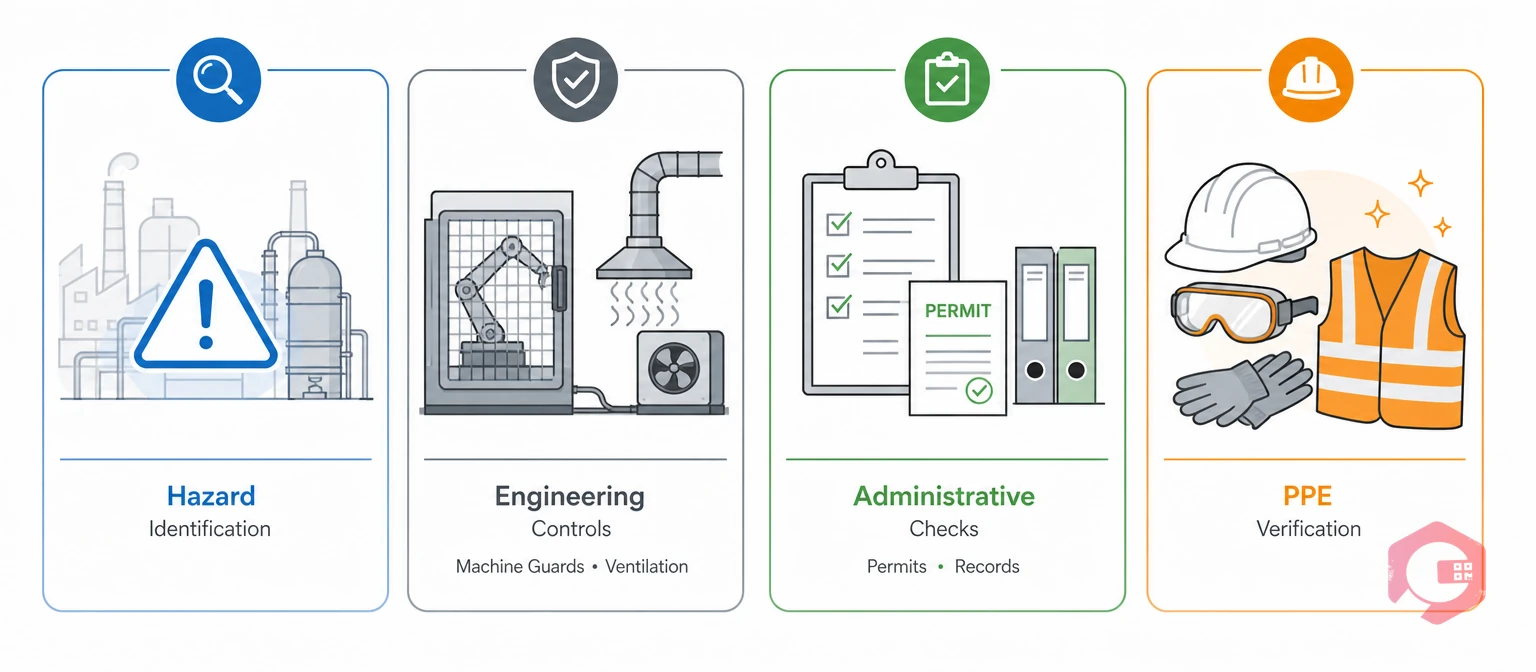
A traditional safety audit is a planned, structured check of equipment, paperwork, and site conditions against a compliance checklist or safety standard. Auditors walk the floor, check permits, and confirm PPE is on hand. They also check that machine guards, ventilation, and signs meet rules like OSHA's safety management guidelines or ISO 45001.
Traditional audits rely on lagging indicators. These are things like incident counts, near-miss logs, and lost-time injury rates. Teams measure these only after something has already gone wrong, or nearly gone wrong. That makes audits reactive by nature, even on a set schedule. A good audit program still adds real value — it just works best as one layer of protection, not the whole system.
Most maintenance teams run these checks through a maintenance audit checklist. This keeps the process the same across shifts and sites, so nothing gets skipped.
Audit frequency matters too. Some sites run a full audit once a quarter. Others run smaller spot checks weekly and save the full review for once a year. Either way, the audit only sees what's happening at that exact moment. A guard that's missing on Tuesday but gets bolted back on by Wednesday's audit will pass clean, even if a worker got hurt in between.
Behavior-Based Safety (BBS) is a proactive safety approach that watches, coaches, and reinforces the exact actions workers take on the job to stop incidents before they happen. Instead of checking conditions, trained observers watch how people work. They look at tool handling, body position, PPE use, and whether workers follow the right steps. Then they give feedback right away.
BBS treats unsafe behavior as the real early warning sign. Research reviewed by the National Institutes of Health found that behavior-based safety programs led to a real, measurable drop in workplace accidents and injuries across many industries. That's the core argument for watching people, not just equipment.
Many sites running mature BBS programs pair it with permit-to-work software. This gives high-risk tasks both behavior checks and formal sign-off before work starts.

The clearest way to compare BBS vs traditional safety audits is side by side. Each one targets a different weak point in the same safety system.
| Aspect | Traditional Safety Audit | Behavior-Based Safety (BBS) |
|---|---|---|
| Focus | Physical conditions, equipment, compliance | Human behavior and daily decisions |
| Approach | Reactive — scheduled or post-incident | Proactive — continuous observation |
| Primary Metric | Lagging indicators (incident rate) | Leading indicators (safe behaviors observed) |
| Time to Measurable Impact | Immediate on the specific hazard found | 6-12 months for a measurable rate drop |
| Employee Role | Passive — subject to inspection | Active — observer and participant |
| Tools Used | Checklists, inspections, risk assessments | Observation cards, coaching, feedback loops |
Neither column wins on its own. Each one closes a different gap in the same safety system, which is why so many sites end up running both.
The honest answer to BBS vs traditional safety audits depends on the timeframe you measure. A traditional audit fixes the exact hazard it finds the same day. A missing guard gets replaced. A blocked exit gets cleared. That's fast, but it's narrow — it only fixes what the auditor happened to see.
BBS works on a longer curve, but it delivers a bigger total drop in incidents. Research on BBS programs shows a clear pattern over time:
| Timeframe | Average Injury Rate Reduction |
|---|---|
| Year 1 of BBS | 29% |
| Year 5 of BBS | 72% |
| Year 7+ of BBS | 79% |
| Manufacturing sites, first 12 months | 40-75% |
These figures line up with the broader picture summarized on behavior-based safety programs across manufacturing, construction, and other industrial sectors.
Maintenance teams that track both audit findings and behavior notes side by side tend to see the fastest overall drop in incidents. Behavior data catches root causes that a one-time equipment check can't reach. This fits a core idea behind reliability-centered maintenance: fix the failure mode, not just the symptom on the surface.
Think about a forklift near-miss. A traditional audit might confirm the forklift's brakes and mirrors pass inspection. That check is real and useful, but it says nothing about why the driver took a blind corner too fast three shifts in a row. A BBS observer would catch that pattern directly, then coach the driver before it turns into a collision. Neither check replaces the other — they're looking at two different failure points in the same incident chain.
Traditional audits and BBS aren't really solving the same problem, so a straight speed race between them misses the point. An audit that finds a frayed cable stops an electrical incident today. A BBS program that corrects bad lifting technique can prevent dozens of back injuries over a year, but not on day one. Judging BBS vs traditional safety audits on speed alone hides what each one is actually built to do.

Most sites that report the fastest overall drop in incidents don't pick one method. They run both, tied together through one shared system for tracking fixes. That structure is worth naming on its own.
The Three-Layer Incident Prevention Model:
Without that third layer, audit findings and BBS notes sit in separate spreadsheets. Nobody links a repeat unsafe behavior to the worn-out equipment that's making it worse. Teams that build this connection tend to report fewer repeat incidents than teams running either program alone.
Picture a site running both programs but keeping the data apart. The audit team logs a slippery floor near a filling station three months running. The BBS observers separately log workers rushing that same station during peak hours. Neither team sees the other's notes, so nobody connects the rushing behavior to the spill risk. A shared system would flag both issues together and point straight at the real fix: better drainage plus a coaching conversation about pacing during rush periods.

A maintenance checklist system turns a paper audit into a digital, trackable process. But the real gain comes from what happens after the checklist is done. When an audit or a BBS observation flags a risk, it needs to turn into a tracked fix, not a note that gets lost in a binder.
This is where a CMMS earns its spot in a safety program:
Maintenance teams using Cryotos have reported up to 30% reduction in unplanned downtime and 25% faster repair turnaround. These gains come straight from closing the loop between what an audit or observation finds and when a technician actually fixes it. That single change is often what decides who wins the real BBS vs traditional safety audits race: not the method itself, but how fast a finding turns into a completed repair.
BBS tends to lower overall incident rates more over time because it targets the behavioral root cause of most accidents. Traditional audits are still needed, though, to catch physical and equipment hazards that behavior observation alone would miss. Most safety leaders find the two work best as partners rather than competitors, each covering a gap the other one leaves open.
Most sites see a real drop in injury rates within the first year. Research shows an average 29% reduction in year one, with much larger gains after five to seven years of steady observation and coaching. Results build gradually because behavior change takes repetition — a single observation rarely fixes a habit, but consistent coaching over months usually does.
No. BBS and traditional audits cover different risk types. Removing audits would leave physical and compliance hazards unchecked, even if worker behavior keeps improving.
Published data shows injury rates dropping an average of 29% in year one, 72% after five years, and 79% after seven or more years of a sustained BBS program.
Audits catch and fix physical hazards right away. BBS observation corrects the unsafe behaviors that cause most accidents in the first place. Routing both into one system for tracking fixes closes the gap between finding a risk and actually fixing it.
Running BBS vs traditional safety audits as two separate, disconnected programs leaves safety data scattered across checklists and spreadsheets nobody has time to compare. Schedule a free demo to see how Cryotos connects safety audits, behavior observations, and repair work orders in one system your whole team can see.



Cryotos AI predicts failures, automates work orders, and simplifies maintenance—before problems slow you down.



