

Inventory management for regulated industries means keeping records that an auditor can trust. It's not just tracking stock levels. In pharma, medical devices, food and beverage, and healthcare, you must prove who touched a part, when, and under what signature. If you can't prove it, that's a compliance finding waiting to happen. This guide covers what auditors check, where manual tracking fails, and which system capabilities close the gap.
Key Takeaways
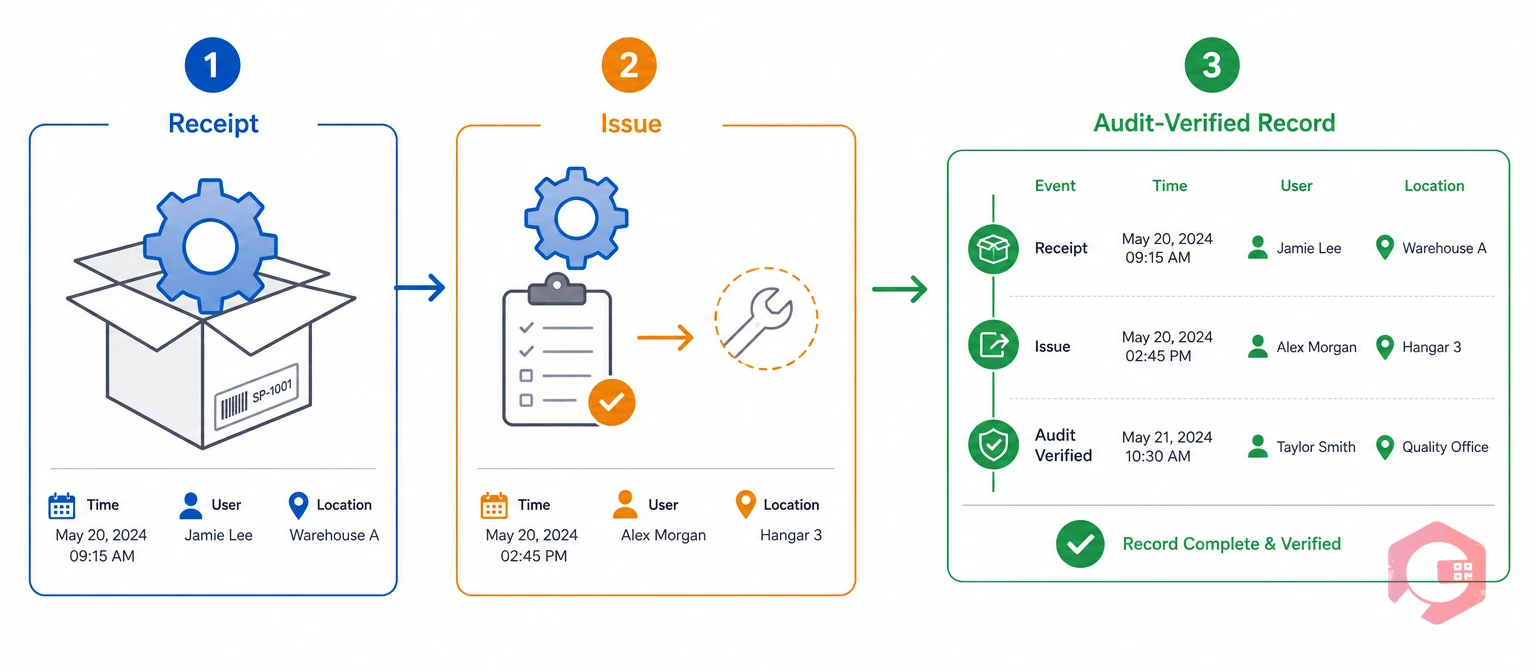
Compliance-ready inventory management is a record of every part receipt, issue, and disposal. An outside auditor must be able to check that record on their own. It's more than knowing what's on the shelf. You need to prove, months later, who removed a part and which asset it went into.
An audit trail is a time-stamped record of who created, changed, or deleted a system entry. Rules like Good Manufacturing Practice (GMP) treat this record as evidence, not paperwork. A Computerized Maintenance Management System that logs inventory the same way it logs work orders gives that evidence a permanent home.
That's what auditors mean when they ask if your inventory management for regulated industries can hold up. They're not asking if you know your stock count. They're asking if you can pull up any single transaction on demand.
Picture a technician who pulls a calibrated gauge from the stockroom. He signs it out on paper. The paper gets lost during a shift change. Six months later, an inspector asks who used that gauge on a specific date. No one can answer. That single missing signature is enough to trigger a finding, even if the gauge itself worked fine.
Auditors reviewing inventory management for regulated industries check five things. This holds true no matter which regulation applies.
Miss any one of these and the finding isn't a stockout. It's a gap in inventory management that regulators treat as a quality failure, not a logistics one.
See the regulatory compliance checklist to check these five points against your own audit prep.
Most facilities don't fail an inspection because they lack a process. They fail because their process lives in a spreadsheet. No one can prove that sheet wasn't edited after the fact.
Chain of custody is a documented record of everyone who received, moved, or issued a part. A spreadsheet cell only shows the latest value. It doesn't show who changed it, when, or what the value was before. Maintenance teams that rely on shared spreadsheets usually can't answer "who used this part" without digging through a separate paper work order.
Most facilities that drop spreadsheets find the real gap wasn't effort. No tool was recording the history auditors actually want to see.
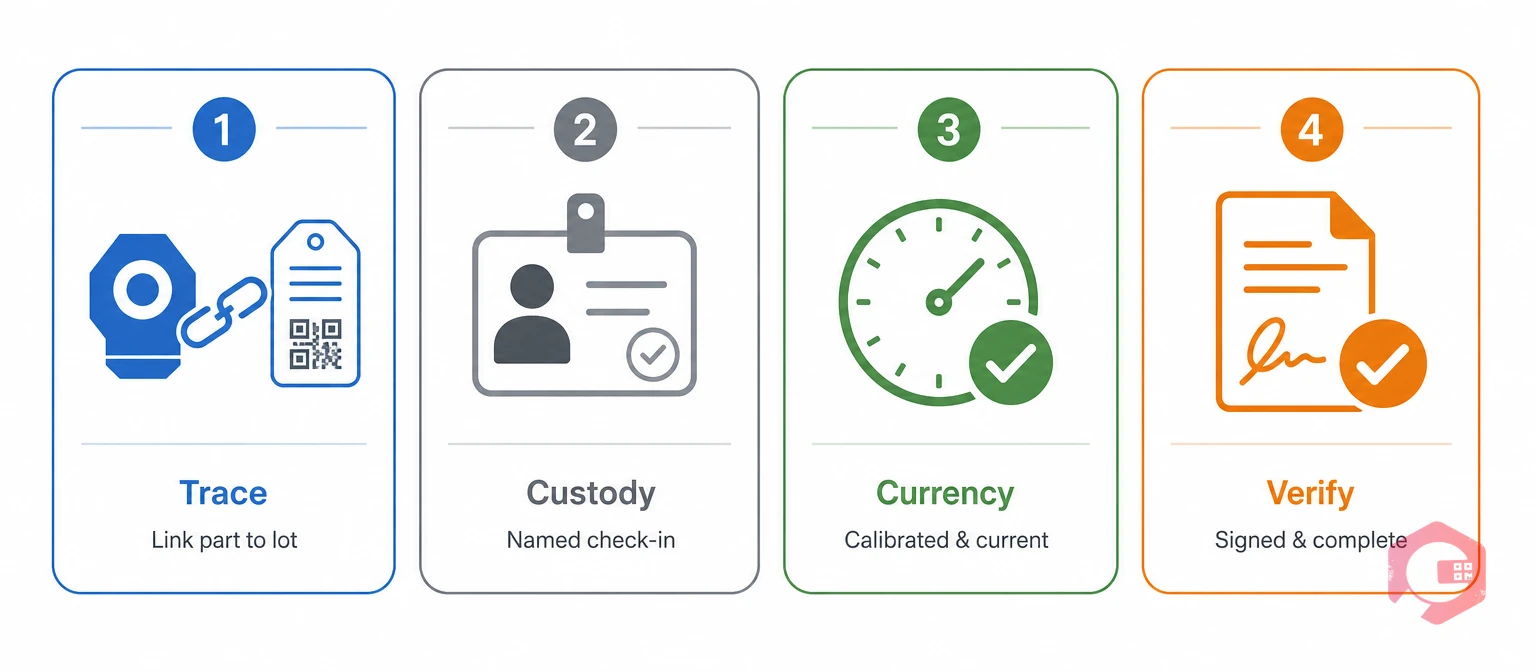
A defensible inventory process rests on four pillars. Each one maps to something auditors check. The Audit-Ready Inventory Framework:
A facility that can show all four pillars for any part has already passed the inventory part of most inspections. That's the shape inventory management for regulated industries needs to take to survive an audit.
Here's exactly which module handles each part of inventory management for regulated industries. No generic feature names — just the specific tool that does the work.
| Compliance Requirement | Cryotos Module | What It Does |
|---|---|---|
| Lot and cost traceability | Inventory & Spare Parts — Parts History Tab | Links purchase dates, suppliers, and cost to every part used on a work order |
| Chain of custody | Inventory & Spare Parts | Barcode/QR check-in and check-out tied to a named user, across every warehouse |
| Calibration and expiry status | Asset Calibration Tracking + Expiration Reminder Dashboard | Flags parts or instruments past their valid window before use |
| Tamper-evident sign-off | Configurable Signature Fields (No Auto Fill) | Forces a live signature at the point of action, not a pre-filled default |
| Physical-to-system reconciliation | Asset Reconciliation report | Records verification data, location checks, and a reconciliation timeline |
| Who touched a record, and when | User Audit Tracker | Logs every system action by user for direct audit review |
These are not six separate tools bolted together. They form one spare parts inventory record with compliance controls built into every step.
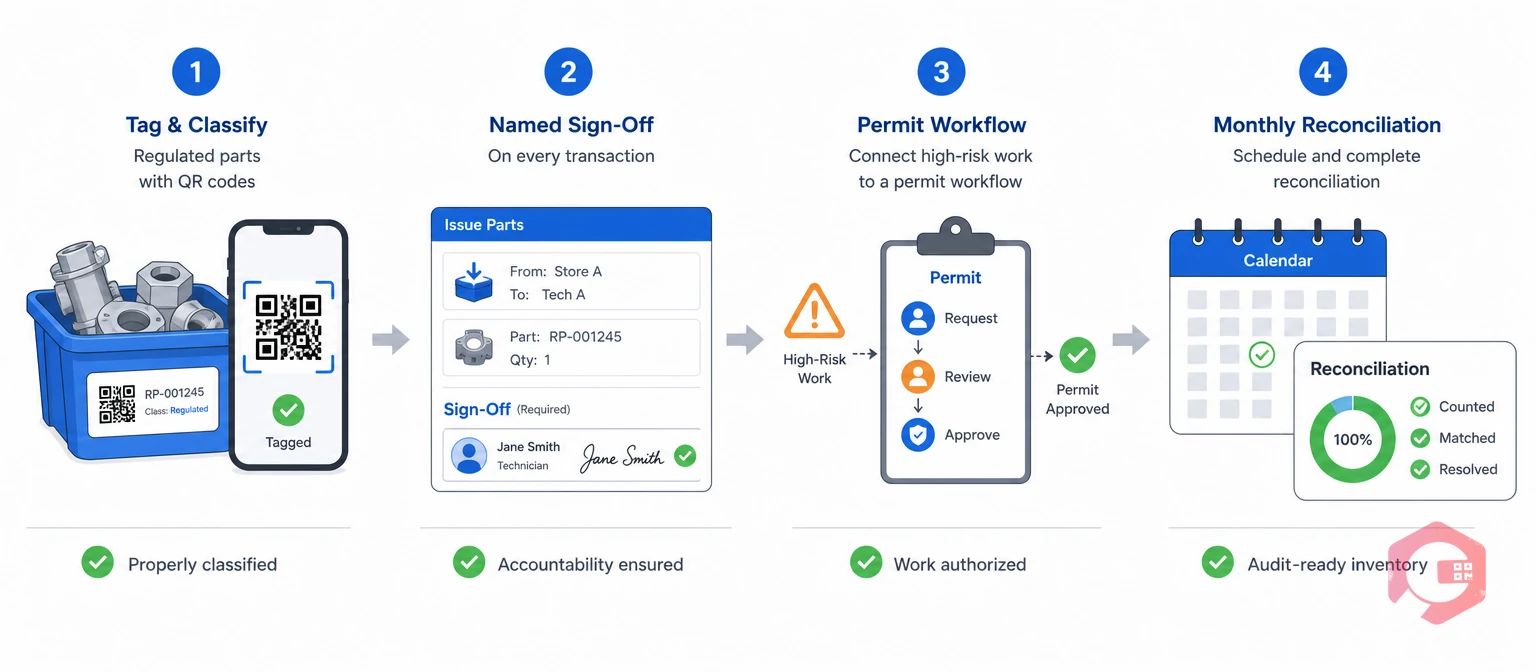
Most facilities can move from spreadsheets to an audit-ready process in four steps. You don't need to replace your whole software stack.
Start with parts tied to safety, calibration, or shelf-life rules. Give each one a QR code and a set reorder point before you touch anything else.
Turn on configurable signature fields for any check-out involving a regulated part. Remove shared logins from the stockroom workflow entirely.
Work involving hazardous materials or regulated parts should route through a permit-to-work approval chain. That adds its own signature trail on top of the inventory record.
Run reconciliation every month, not once a year. A gap found in month one is a footnote. The same gap found a year later is an audit finding.
Attach SOPs, certificates of analysis, and calibration certificates to the part record through document management, with version control, instead of keeping loose copies in a shared drive.
It's the practice of tracking spare parts and materials in a way that produces records an auditor can verify. That covers traceability, custody, calibration and expiry status, and signed sign-off. It's not just tracking how much stock is on hand.
Rules vary by sector. GMP covers pharma and food manufacturing. FDA quality system rules cover medical devices. FDA guidance on electronic records and signatures applies to any facility that replaces paper logs with digital ones. These rules don't all use the same name or the same checklist. But they share one core expectation: a tamper-evident, time-stamped record of who did what.
A missing signature, an unexplained stock gap, or an expired part with no flag usually gets logged as a real finding, not a minor note. Repeated gaps can lead to warning letters or a delayed sign-off, depending on the regulator.
Yes. Regulators usually apply the same recordkeeping rules no matter the facility size. This lines up with general guidance from bodies like OSHA on documented safety records. A smaller facility just has fewer transactions to manage.
Retention periods follow whichever rule applies to the record. Pharma and medical device parts often need several years. The safer default is to keep inventory audit trails as long as the asset they're tied to stays in service.
Inventory management for regulated industries only holds up under audit when traceability, custody, calibration, and sign-off live in one system, not scattered logs. Schedule a free demo to see how Cryotos keeps your inventory audit trail complete from the moment a part arrives to the moment it's used.




Cryotos AI predicts failures, automates work orders, and simplifies maintenance—before problems slow you down.



