

A cross-functional TPM committee collapses within six months because it depends entirely on a recurring meeting for alignment, and meetings are the first thing every department cuts when its own numbers are under pressure. Production, maintenance, quality, and engineering start strong at kickoff, then attendance and follow-through decay once no shared system keeps findings, actions, and metrics visible between sessions. A cross-functional TPM (Total Productive Maintenance) committee is a standing group — usually production, maintenance, quality, engineering, and EHS — that jointly owns the eight TPM pillars: autonomous maintenance, planned maintenance, focused improvement, quality maintenance, early equipment management, training, safety/environment, and administrative TPM. This guide covers why these committees stall around the six-month mark, the two root causes behind the pattern, and the operating structure that keeps a committee producing results well past its first year.
Key Takeaways
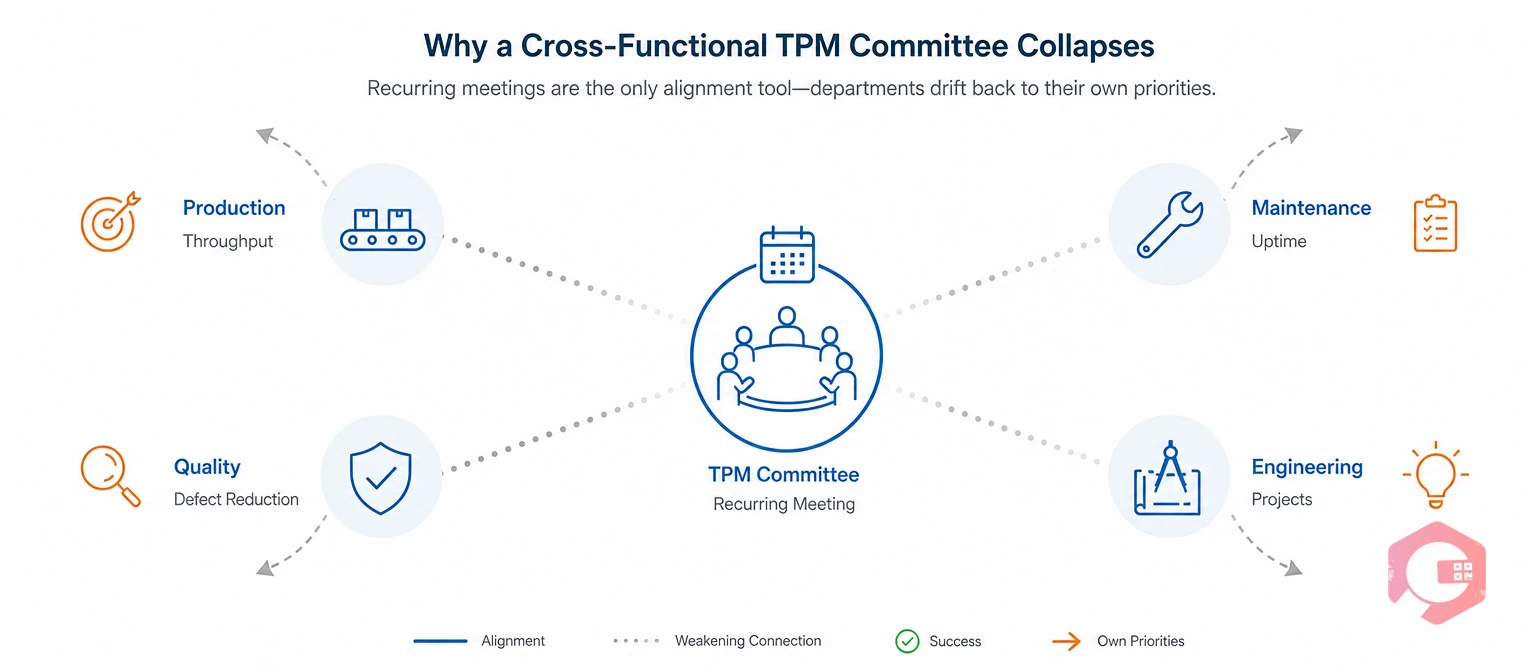
Cross-functional TPM committees collapse because the only mechanism holding four or five departments in alignment is a weekly or biweekly meeting, and that meeting is the first casualty of any production crisis. The pattern shows up the same way across plants and industries: cadence slips from weekly to "when we can," the action-item spreadsheet stops getting opened between sessions, and one function after another quietly drifts back to its own priorities.
Maintenance usually keeps showing up because compliance tracking holds them accountable. Production, engineering, and quality don't have that same external pressure, so they're the first to deprioritize the meeting once their own schedules get tight. The committee rarely disbands on paper — it just stops producing anything a plant manager would call progress.
This isn't a commitment problem at kickoff. Maintenance teams that study the pattern across sites consistently find the same structural gap: no shared, always-current record connecting autonomous-maintenance findings, planned-maintenance schedules, and cost or downtime data across functions. The eight-pillar TPM framework was designed around continuous cross-functional ownership from the start, which is exactly the part that erodes first when a plant's only coordination tool is a calendar invite.
A strong launch — leadership sponsorship, a kickoff event, a wall of red-tag findings — says nothing about whether a committee will still be functioning in month six. Launch energy runs on visibility and novelty. Neither survives a busy quarter unless something other than enthusiasm is holding the group together. The plants that keep their committees running past month six are rarely the ones with the most impressive kickoff — they're the ones that put a shared record in place before the launch energy had a chance to fade.
A TPM committee heading toward collapse shows a consistent set of warning signs well before month six, and catching them early is the difference between a course correction and a restart from scratch.
Most facilities that track these signals notice the same order of decline: production first, engineering and quality soon after, maintenance last — because maintenance is usually the only function with compliance tracking tied directly to the committee's output. Tracking attendance, action-item closure rate, and escalation volume over time gives leadership an early warning that a committee is stalling — data to act on before month six instead of an explanation for why it already failed.

Two structural gaps explain most cross-functional TPM committee failures: a missing shared record between meetings, and a reporting model that doesn't connect to every function's own KPIs.
Most plants have no system that shows autonomous-maintenance findings, planned-maintenance schedules, and cost or downtime data in one place that every function can check on its own. Without that shared record, the meeting itself becomes the committee's only mechanism for alignment — and alignment resets to zero every time someone misses a session.
This gap compounds over time. Each missed meeting doesn't just cost that week's discussion — it erases whatever shared understanding existed, so the next session starts by re-establishing what happened instead of deciding what to do next. Committees stuck in this loop rarely notice they've stopped making progress; they just notice the meetings feel less useful.
Metric mismatch is what happens when a cross-functional committee reports on only one function's numbers, leaving the other functions with no direct stake in the meeting. Production answers for OEE and output. Maintenance answers for downtime and PM compliance. Quality answers for defect rate. A committee that reports only autonomous-maintenance completion gives three of its four functions no reason to prioritize Tuesday's meeting over their own KPIs — so attendance decays first in whichever department feels the least ownership over the one metric being tracked.
Manufacturing teams running structured TPM programs consistently report that the moment shared data disappears between sessions, the committee's authority disappears with it — no one function feels obligated to defend a number nobody outside the meeting can see.
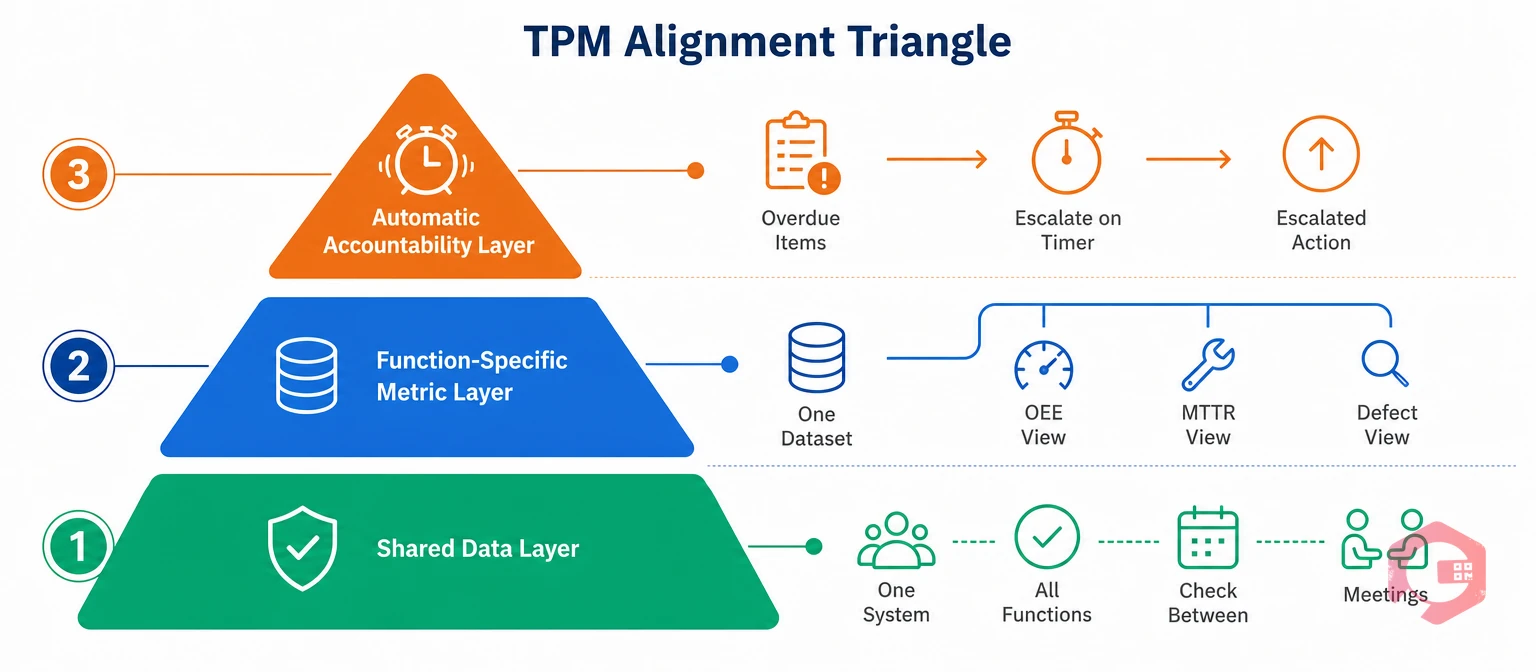
Cross-functional TPM committees that survive past six months consistently build three structural layers instead of relying on meeting discipline alone. Call it the TPM Alignment Triangle:
A committee missing any one of these three layers tends to drift back toward meeting-dependence within a few months, even with strong sponsorship at launch. The three layers reinforce each other: the shared data layer feeds the function-specific dashboards, and the automatic accountability layer keeps the data current enough for those dashboards to mean anything.
A plant doesn't need to rebuild its entire maintenance stack to put the triangle in place. Most sites start with the shared data layer — moving autonomous-maintenance findings and planned-maintenance schedules into one system everyone can check — because it's the layer that immediately stops the "what happened since last time" problem. The function-specific dashboards and automatic escalation typically follow within a quarter, once the underlying data is reliable enough to build views on top of.
Most facilities that keep downtime tracking and planned-maintenance data in a single system report that committee discussions shift from "what happened since last time" to "what we're deciding next" — the single biggest driver of the mid-life stall most committees hit. Schedule a free demo to see how a shared operating picture fits your plant's existing TPM structure.
A shared system of record removes a cross-functional TPM committee's dependence on the meeting itself by keeping every pillar's data visible and current between sessions.
Computerized Maintenance Management System platforms bring autonomous-maintenance checklists, planned-maintenance schedules, focused-improvement tickets, quality-defect linkages, and training records into one instance instead of scattered spreadsheets and paper logs. Every function sees the same data between meetings, so alignment doesn't reset to zero every time the committee reconvenes.
Autonomous maintenance is the TPM pillar where operators handle routine cleaning, inspection, and lubrication (CIL) on the equipment they run every day. Operators log findings and abnormality tags directly from the shop floor with photo attachments, so maintenance and engineering see new issues the moment they're flagged instead of waiting for a monthly readout.
Overdue action items and stalled kaizen tickets route to the responsible owner automatically, with escalation to a manager past a defined threshold. Follow-through no longer depends on someone remembering to bring it up next time — the system carries the item forward on its own.
The same underlying data can feed separate views: OEE and downtime for production, PM compliance and MTTR for maintenance, defect-to-failure linkage for quality. Each function sees the committee's work reflected in the metric it already answers for — a reason to keep showing up that doesn't depend on goodwill toward maintenance.
Improvement ideas raised in committee meetings become tracked tickets with a named owner, a due date, and a status, rather than a bullet point in a summary nobody revisits. Flagging stale kaizen items surfaces exactly the follow-through gap that erodes a committee's credibility over time.
A standing pillar-by-pillar report — cost avoidance, downtime trend, and open action items — can be generated on demand for leadership, so momentum doesn't depend on one executive's personal attention. When sponsorship changes hands, the incoming sponsor inherits a data trail instead of a blank slate. Maintenance teams using Cryotos have reported up to 30% reduction in unplanned downtime and 25% faster repair turnaround once shared visibility replaced meeting-only tracking.
In a cross-functional TPM committee, members rotate, sponsors change roles, and plants lose people to attrition — a TPM committee structure built around any single person's memory doesn't survive that turnover. Early equipment management is the TPM pillar that captures maintainability and reliability issues at the moment new equipment is commissioned, and it depends more than any other pillar on data outliving the people who logged it. Maintainability issues found during commissioning and logged straight against the asset give the committee real evidence to work from years later, instead of relying on whoever happened to be in the room when the equipment arrived.
Quality maintenance (Hinshitsu Hozen) is the TPM pillar that links specific equipment conditions to specific defect types, so a committee can trace a recurring quality issue back to the machine setting or maintenance gap causing it rather than treating each defect as a one-off. Safety and environment (the seventh pillar) works the same way — logged near-misses and red-tag findings only build a useful safety record if they persist past the meeting where they were first raised.
Training and skill-matrix tracking linked to PM and autonomous-maintenance assignments keeps the training pillar visible as a running gap analysis instead of a once-a-year audit exercise. Facilities that track which operators are certified for which tasks catch certification gaps before they cause a missed assignment, not after.
Administrative and office TPM — the eighth pillar — often gets treated as an afterthought, but it's where the committee's own paperwork lives: charters, meeting minutes, budget requests, and the reporting templates everyone else depends on. A committee that lets this pillar slide usually notices it first as "nobody can find last quarter's numbers," which is the same institutional-memory gap showing up in the committee's own operations rather than on the shop floor.
A clear signal for when the committee structure itself needs to change comes from the same data: attendance trend, action-item closure rate, and escalation volume, reviewed quarterly against the committee's original charter. Committees that revisit their own structure against this data tend to catch a stall in month three or four, well before the point most committees quietly stop meeting.
Linking autonomous-maintenance findings, planned-maintenance history, and quality-defect data in one place lets a cross-functional TPM committee spot recurring failure patterns across shifts and functions much earlier than a monthly meeting cadence would surface them. A defect that shows up on the night shift, a maintenance note logged three weeks earlier, and a quality rejection from a different line can look unrelated in three separate systems and obviously connected in one.
Operations that successfully sustain a cross-functional TPM committee past the first year describe this as the difference between reacting to the same failure every quarter and actually closing it out. Cross-functional buy-in follows the same logic: once every function sees its own metric move when the committee closes an action item, participation stops being a favor done for maintenance and becomes something every function has a direct stake in maintaining.
The same linked data also shortens the investigation itself. Instead of pulling three people into a room to reconstruct a timeline from memory and separate logs, a committee working from one record can trace a failure back through the equipment's maintenance history, its most recent autonomous-maintenance findings, and any related quality rejections in the time it used to take just to schedule that meeting. That speed compounds — each root cause closed properly is one less recurring failure competing for the committee's attention next quarter.

A cadence built around the pillar's natural rhythm — not a single all-hands meeting — keeps each function engaged at the frequency its own data actually changes.
| Pillar / Activity | Review Frequency | Escalation Threshold | Owner |
|---|---|---|---|
| Autonomous maintenance findings | Daily (system), weekly (committee) | 48 hours unresolved | Production supervisor |
| Planned maintenance schedule | Weekly | Missed scheduled date | Maintenance lead |
| Kaizen / focused improvement tickets | Biweekly | 14 days no update | Assigned owner |
| Cross-functional KPI rollup | Monthly | Metric off-target 2 cycles | Committee sponsor |
| Executive rollup report | Quarterly | N/A | Plant manager |
Notice that the committee-wide meeting only needs to happen monthly once daily and weekly reviews are handled inside a shared system — the meeting shifts from status-gathering to decision-making. Plants that try to run every pillar on the same weekly cadence tend to overload the meeting with status updates and leave no time for the decisions the committee actually exists to make.
Cost avoidance, downtime reduction, and defect-rate correlation reports give a cross-functional TPM committee a data-backed case to bring to leadership at the six-month and twelve-month marks, replacing anecdote with a trend line when budget or headcount decisions come up.
Reliability programs built around the ISO 55000 asset management standard consistently show that programs with a documented cost-avoidance trail survive budget reviews that programs relying only on anecdote don't. A BI dashboard that pulls pillar-by-pillar completion, cost avoidance, and open action items on demand turns that case from a once-a-year slide deck into something the committee can generate the moment leadership asks for it.
This matters most at the exact moments a committee is most vulnerable: a budget cycle, a leadership change, or a plant-wide priority shift that puts every standing meeting under review. A committee that can produce a cost-avoidance number in minutes has a fundamentally different conversation with leadership than one that has to reconstruct its case from memory and old meeting notes.
Plants that try to revive a stalled cross-functional TPM committee often repeat the same launch-only mistakes that caused the first stall, just with a new kickoff date.
Committees that restart successfully usually change the underlying structure first — shared data, function-specific reporting, automatic escalation — and treat the relaunch meeting as a formality rather than the fix itself.
They fail because the committee's only alignment mechanism is the recurring meeting, and every function deprioritizes that meeting the first time its own schedule gets tight. Without a shared system showing findings and metrics between sessions, momentum depends entirely on attendance. Six months is roughly how long launch enthusiasm lasts before the first real scheduling conflict tests whether the committee has anything else holding it together.
Metric mismatch — when the committee reports only one function's numbers, the other functions have no direct stake in showing up. Production, quality, and engineering each need to see their own KPI reflected in the committee's work. When that link is missing, attendance decays first in whichever function feels least ownership over the single metric being reported.
Most committees that sustain momentum handle daily and weekly reviews inside a shared system and reserve the full cross-functional meeting for a monthly cadence, with quarterly executive rollups. That keeps the meeting focused on decisions rather than status updates. Trying to run every pillar on the same weekly all-hands schedule tends to overload the meeting and push out the decisions it exists to make.
Yes, if the committee's history — findings, actions, and cost data — lives in a system of record rather than in the sponsor's personal notes or memory. An incoming sponsor can review the data trail directly instead of starting from a blank slate. Committees that depend on one sponsor's personal attention tend to stall within a quarter of that person moving on.
Meeting attendance by function, action-item closure rate, and escalation volume over time. A drop in any of these gives leadership a warning signal months before the committee would visibly stop meeting. Reviewing this data on a fixed quarterly schedule, rather than only when someone raises a concern, catches the stall while it's still a course correction rather than a restart.
Not strictly, but plants that sustain committees past a year almost always have some shared system replacing spreadsheets and paper logs. The specific tool matters less than whether every function can check the same data without waiting for a meeting. A shared spreadsheet with disciplined update habits can work at very small sites, but it tends to break down as soon as more than two or three people are supposed to keep it current.
A cross-functional TPM committee is scoped specifically to the eight TPM pillars — autonomous maintenance, planned maintenance, and the rest — with production and maintenance holding joint ownership. A broader continuous-improvement committee usually covers more ground but with less pillar-specific structure. The narrower scope is part of why TPM committees can build deeper, more specific shared data than a general-purpose improvement group.
Cross-functional TPM committees don't usually fail because people stop caring — they fail because a recurring meeting is the only thing holding the collaboration together, and meetings are the first casualty of a busy production schedule. Schedule a free demo to see how Cryotos gives your committee a shared, always-current record that keeps every function aligned whether or not this week's meeting happens.


Cryotos AI predicts failures, automates work orders, and simplifies maintenance—before problems slow you down.



