

The difference between a Quick Kaizen and a Focused Improvement Project comes down to scale, not effort. A Quick Kaizen fixes a small, visible problem in hours or a single shift, using the team already on hand. A Focused Improvement Project, known in Lean and Total Productive Maintenance circles as Kobetsu Kaizen, works through weeks of root cause analysis and cross-functional data to remove a chronic, recurring loss for good.
Most maintenance teams already run both activities without naming them. That's exactly why the wrong one gets picked so often: a five-minute fix gets escalated into a full project charter, or a repeat failure gets logged as routine instead of investigated. Knowing which approach a problem calls for protects your team's time, your maintenance budget, and your uptime.
Key Takeaways

Continuous improvement is the ongoing habit of finding and locking in better ways of working, instead of treating any process as finished. Lean manufacturing and Total Productive Maintenance both lean on it to cut waste, improve equipment reliability, and lift Overall Equipment Effectiveness (OEE).
Not every improvement needs the same amount of effort. A loose safety rail and a furnace that trips its breaker three times a month are both "problems," but they call for very different responses. That gap is exactly what kaizen practice splits into two tools: the Quick Kaizen and the Focused Improvement Project.
Most plants running a Computerized Maintenance Management System already have the work order history and reporting structure both approaches need. What changes is how that structure gets used.
Teams get this wrong in two directions. Some launch a multi-week project charter for a mislabeled valve or a missing lockout tag, a fix any technician could close before lunch. Others treat a recurring pump failure as bad luck and open a fresh work order every time, without asking why it keeps happening.
Maintenance teams that sort a problem by scale first, before picking a method, spend far less time fixing the same thing twice.
A Quick Kaizen is a small, low-cost fix a maintenance team completes in hours or a single shift. It targets one visible, standalone issue: a mislabeled valve, a missing tool shadow board, an awkward reach on a routine task.
A worn label on a lubrication point, a missing guard clip, or a five-minute change to a maintenance checklist are all textbook Quick Kaizen examples. Each one closes before the next shift starts.
Not sure whether a problem is a five-minute fix or a bigger chronic loss? Cryotos's OEE calculator scores the real cost of a recurring loss in minutes, before you commit a team to it.
A Focused Improvement Project, also called Kobetsu Kaizen, is a structured initiative that removes a chronic, recurring loss. It relies on root cause analysis, cross-functional teamwork, and measurable results, not a quick patch. It's formally one of the eight pillars of Total Productive Maintenance, built for losses a fast fix can't touch.
Where a Quick Kaizen closes in hours, a Focused Improvement Project runs for weeks. It pulls maintenance, operations, and quality staff into the same room. It leans on failure history to find the pattern behind repeat downtime, not just the latest symptom. The output is a documented, measurable fix, not a one-off repair.

The difference between a Quick Kaizen and a Focused Improvement Project comes down to nine practical factors: objective, complexity, duration, team size, cost, data needs, documentation, business impact, and sustainability. Teams that mix these up either burn a project charter on a five-minute fix, or let a chronic loss slide by treating it as routine.
| Aspect | Quick Kaizen | Focused Improvement Project |
|---|---|---|
| Objective | Fix a visible, standalone issue | Eliminate a chronic, recurring loss |
| Complexity | Low — one clear, visible cause | High — multiple contributing factors |
| Duration | Hours to a few days | Several weeks to a few months |
| Team Size | 1-3 people, same department | Cross-functional: maintenance, operations, quality |
| Cost | Minimal, usually labor only | Budgeted, may include parts or redesign |
| Data Requirement | Observation is enough | Failure history, downtime logs, trend data |
| Documentation | Updated checklist or SOP note | Formal report with root cause and CAPA |
| Business Impact | Local, immediate convenience or safety gain | Measurable OEE, MTBF, or cost improvement |
| Sustainability | Holds if the fix stays on the checklist | Holds through a monitored CAPA and KPI review |
The pattern holds across every row. A Quick Kaizen trades depth for speed. A Focused Improvement Project trades speed for a permanent fix. Neither approach is better on its own; they solve different sizes of problem.
A Quick Kaizen fits any problem a technician can see, understand, and fix using nothing more than their own eyes and hands.
Most facilities log these through a mobile app, so the fix and a photo land in the same work order, with no separate paperwork and no lost context.
A Focused Improvement Project earns its cost when a problem keeps returning despite repeated quick fixes.
Teams that successfully tell these two situations apart usually launch a Focused Improvement Project only after a Quick Kaizen has already failed to hold.
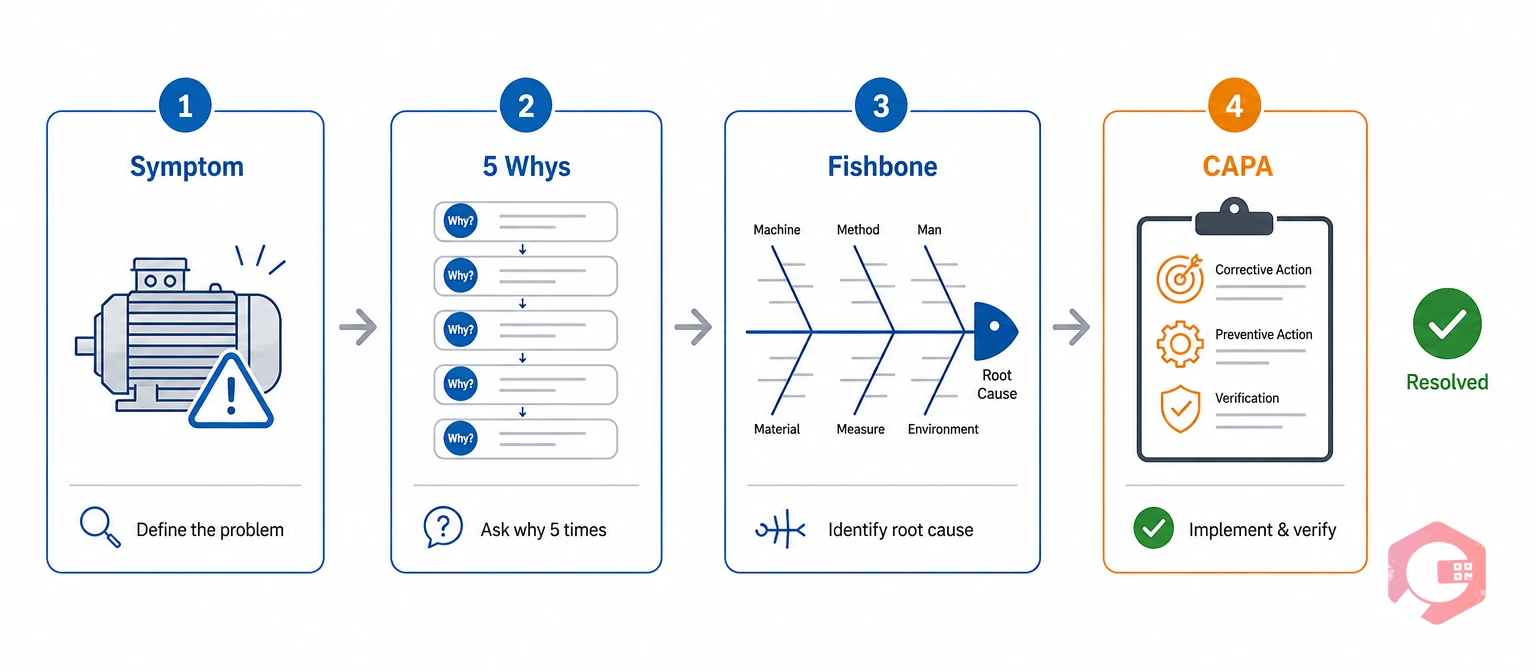
Root cause analysis is the practice of tracing a symptom back to the actual failure behind it, instead of stopping at the first visible fault. A Quick Kaizen usually treats the symptom in front of you. A Focused Improvement Project digs underneath it, using tools like 5 Whys, Fishbone diagrams, Pareto analysis, failure trend analysis, and a formal CAPA (Corrective and Preventive Action) record.
The Four-Factor Improvement Fit Method:
A narrow scope, an obvious cause, a single-person fix, and a local impact all point to a Quick Kaizen. Two or more "no" answers point to a Focused Improvement Project instead. The American Society for Quality makes the same case: skip root cause analysis on a recurring failure, and the same fix just gets repeated next month.
OEE combines an asset's availability, performance, and quality into one score. It's the anchor metric for judging whether either kind of kaizen actually worked, but it's rarely the only number worth tracking.
A dashboard that already tracks these numbers turns "did that fix actually work?" into a five-minute check instead of a guessing game.
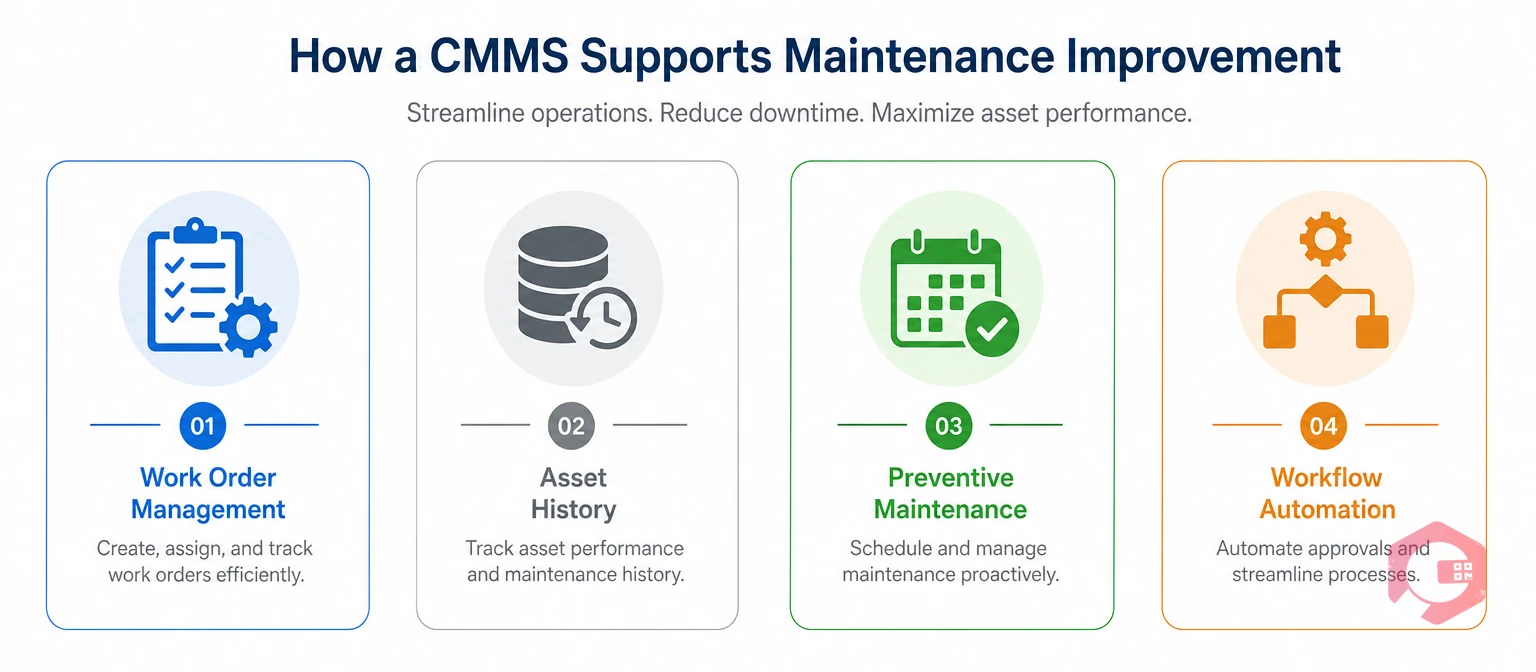
A CMMS gives Quick Kaizen and Focused Improvement Projects the same backbone. It captures the opportunity, tracks the fix, and measures whether it stuck. For a Quick Kaizen, that means a mobile work request, a checklist update, and a closed ticket. For a Focused Improvement Project, it means pulling asset history, running a 5 Whys plus CAPA record, and watching the KPI trend afterward.
Maintenance teams using Cryotos report up to 30% less unplanned downtime and 25% faster repair turnaround. Much of that gain comes from tracking small fixes and chronic-loss projects in one system, instead of scattered notebooks and spreadsheets.
A Quick Kaizen is a small, immediate fix completed in hours or days by one person or a small team. A Focused Improvement Project is a structured, weeks-long initiative that uses root cause analysis and cross-functional data to remove a chronic loss.
Yes. If the same issue keeps returning after a Quick Kaizen fix, that recurrence is the signal to open a Focused Improvement Project instead of repeating the quick fix again.
Not strictly, but a CMMS makes the project far easier to justify and track, since asset history, downtime logs, and CAPA records already live in one place.
Most run four to twelve weeks. The timeline depends on how much data collection and cross-functional coordination the root cause analysis requires.
Yes. Kobetsu Kaizen is the original Japanese TPM term for what English-language maintenance and lean literature commonly calls a Focused Improvement Project.
Knowing whether a problem needs a Quick Kaizen or a Focused Improvement Project keeps a team from wasting a project charter on a five-minute fix, or wasting a five-minute fix on a problem that keeps coming back. Schedule a free demo to see how Cryotos tracks both, from the smallest checklist tweak to a full root-cause CAPA project.




Cryotos AI predicts failures, automates work orders, and simplifies maintenance—before problems slow you down.



