
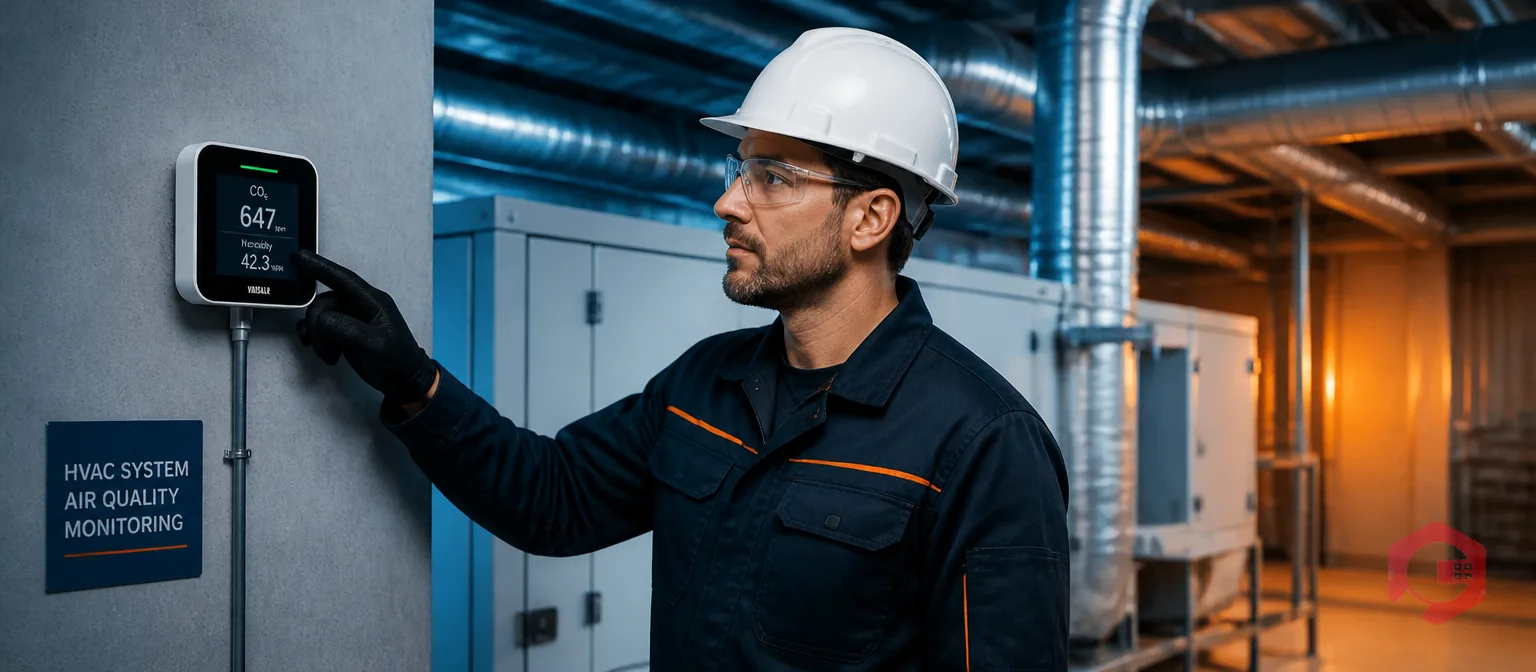
Indoor air quality (IAQ) monitoring and HVAC maintenance are two operations that facility management teams typically run in separate systems — sensors reporting to a building management system, HVAC maintenance tracked in a spreadsheet or CMMS with no data connection between them. That separation is the problem. When a CO2 sensor trips at 1,200 ppm, the BMS logs it. But if that alert doesn't automatically generate an HVAC inspection work order, the underlying cause — a failed fresh air damper, a blocked duct, an undersized air change rate — stays unaddressed until the next scheduled PM visit weeks or months later. According to the US Environmental Protection Agency, Americans spend approximately 90% of their time indoors, where concentrations of some pollutants are often 2–5 times higher than typical outdoor levels.
A CMMS that connects sensor alerts to work orders closes this gap. This guide covers the six IAQ parameters that matter for HVAC maintenance, the thresholds at which each should trigger a work order, and the end-to-end workflow that takes a sensor alert from detection to verified resolution.
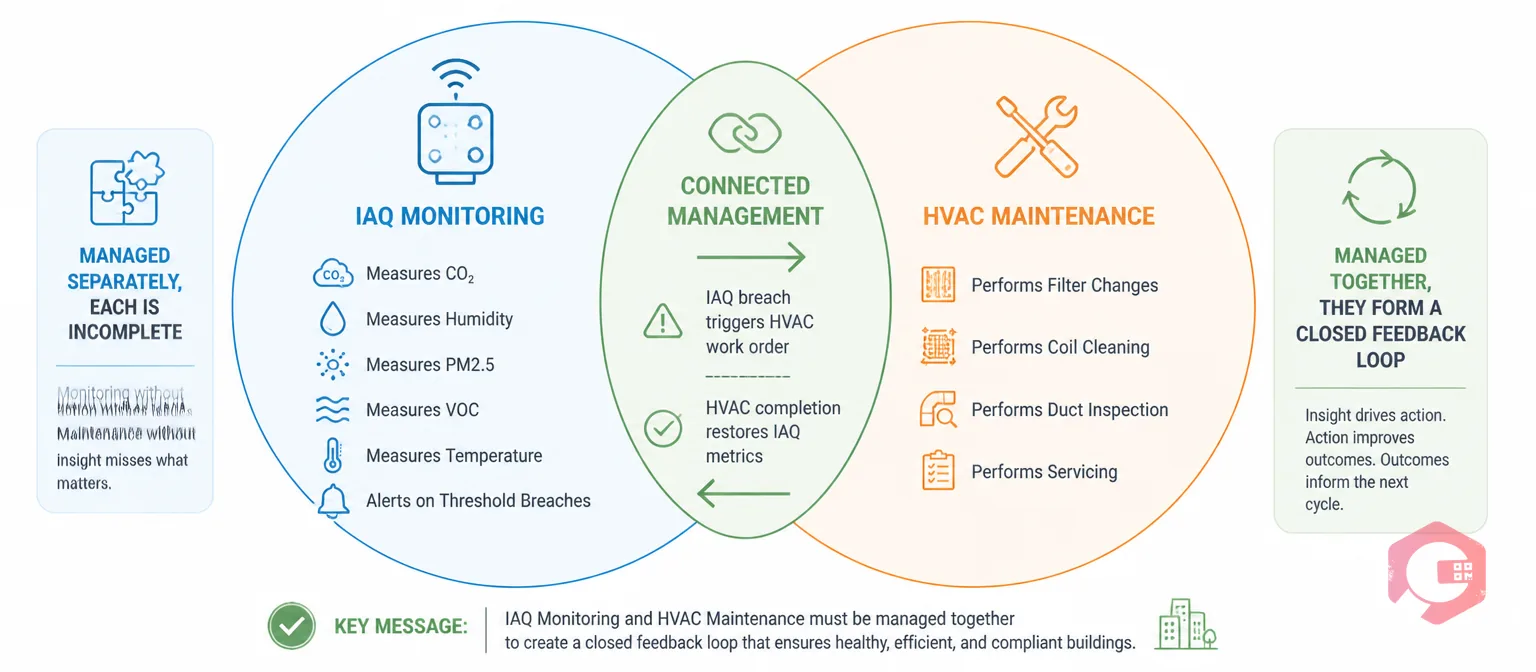
IAQ deteriorates when HVAC systems fail to perform as designed — and HVAC systems fail gradually, not suddenly. A filter reaches saturation over weeks. A damper actuator drifts out of calibration over months. A cooling coil develops biofilm growth over a season. None of these failures announce themselves loudly, but every one of them shows up in IAQ sensor data before they show up as a system breakdown or an occupant complaint.
Treating IAQ monitoring and HVAC maintenance as connected operations means using sensor data as a continuous diagnostic signal for the HVAC system's condition — not just as a comfort indicator. When a particulate reading rises above its baseline on a floor that was fine last week, the question isn't "is the air quality bad?" — it's "which filter is saturated, which damper is stuck, or which AHU is bypassing filtration?" The CMMS work order is the mechanism that turns that question into an investigation and a resolution.
This approach also satisfies the documentation requirements of standards like ASHRAE 62.1 (Ventilation for Acceptable Indoor Air Quality) and the WELL Building Standard, both of which require evidence that IAQ parameters are actively monitored and that maintenance responses are documented when thresholds are breached.
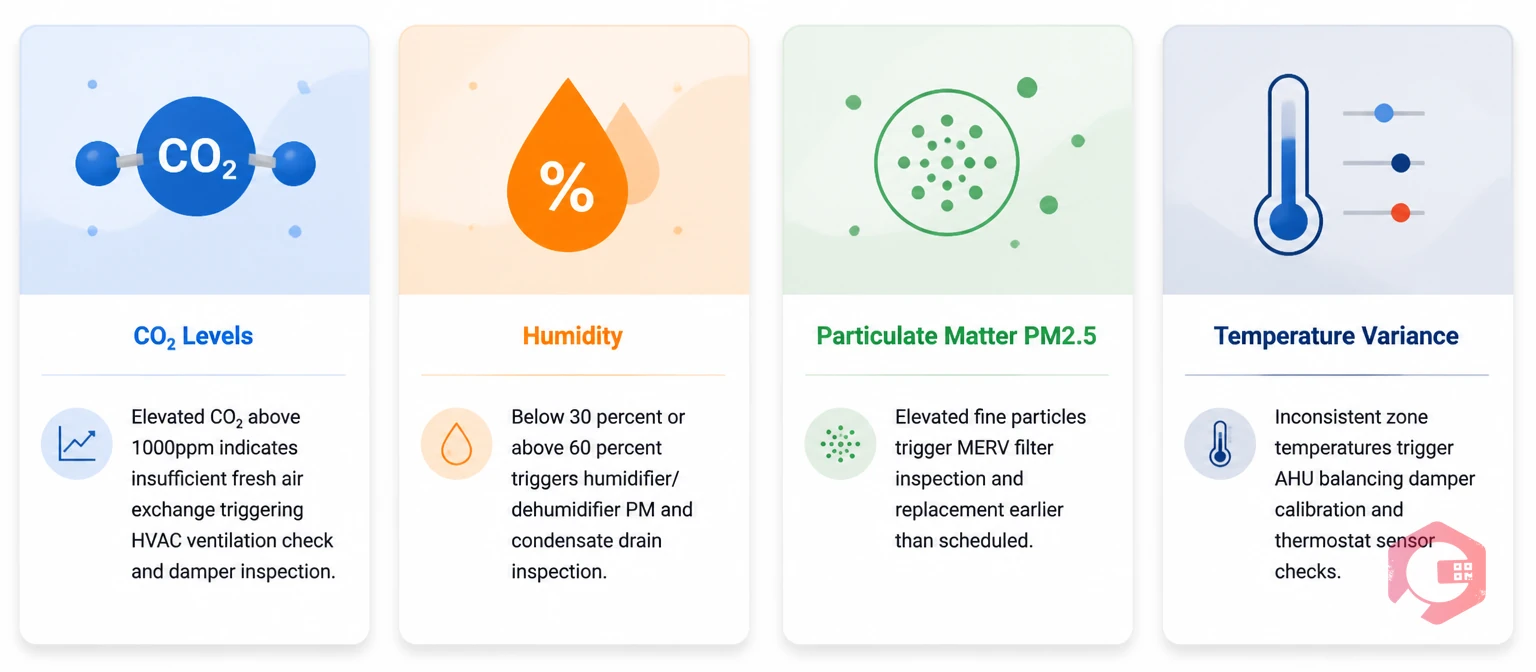
Not every IAQ parameter has a direct HVAC maintenance implication. These six do — each one signals a specific failure mode in the HVAC system that a maintenance technician can diagnose and correct.
CO2 levels above 1,000 ppm in occupied spaces typically indicate inadequate fresh air supply relative to occupancy. The HVAC root cause is usually a fresh air damper that is stuck closed, undersized, or failing to respond to occupancy signals, or an air change rate that was calibrated for lower occupancy than the space is currently carrying. Persistently elevated CO2 is one of the most reliable leading indicators of ventilation system underperformance and one of the most actionable HVAC maintenance triggers.
Rising PM2.5 or PM10 concentrations inside a building typically indicate filter saturation, filter bypass (where air routes around a damaged or improperly seated filter), or duct contamination. PM readings that spike and stabilise at a higher baseline after remaining constant for weeks are a strong indicator that a filter bank has reached the end of its useful life. PM2.5 readings above 12 µg/m³ — the WHO annual mean guideline — in an occupied commercial building signal a filtration maintenance response.
TVOC spikes can originate from occupant activities (cleaning products, new furniture off-gassing) or from within the HVAC system itself — biological growth on cooling coils or drain pans releasing microbial VOCs, or contaminated ductwork distributing odour-causing compounds. When TVOC readings are elevated and not explained by occupant activity, an HVAC inspection of coil condition, drain pan cleanliness, and duct surfaces is the appropriate maintenance response.
Relative humidity outside the 40–60% band — the ASHRAE-recommended range for occupied commercial spaces — indicates a failure in the HVAC system's humidification or dehumidification function. Low humidity (below 30%) in winter can point to a humidifier failure or inadequate humidification capacity. High humidity (above 65%) in summer indicates a cooling coil or dehumidification system underperforming, creating condensation risk and conditions favourable for mould growth on duct surfaces and within AHU components.
Temperature deviation from setpoint — particularly consistent undershoot or overshoot that persists after HVAC system stabilisation — indicates a controls issue (sensor failure, thermostat miscalibration, valve actuator fault) or a capacity issue (undersized cooling, refrigerant loss, blocked heat exchanger). While temperature is often managed through BMS automation, persistent deviation that the BMS cannot correct without manual intervention should generate an HVAC maintenance work order rather than continuous auto-compensation that masks an underlying problem.
CO detection in an occupied building is a safety emergency, not a maintenance trigger in the conventional sense. However, low-level CO readings (below the alarm threshold but above background) in spaces served by gas-fired HVAC equipment — boilers, gas heaters, make-up air units — indicate a combustion or heat exchanger fault that requires immediate inspection. Any CO reading above background in a mechanically ventilated space should generate a priority work order with an immediate response SLA, even if the reading has not reached the alarm threshold.
The following thresholds and maintenance task mappings provide a practical starting point for configuring CMMS alert rules. Adjust based on your occupancy type, local regulatory requirements, and certification targets (WELL, LEED, ASHRAE 241):
| IAQ Parameter | Breach Threshold | Likely HVAC Root Cause | CMMS Task Generated |
|---|---|---|---|
| CO2 | >1,000 ppm (sustained 15+ min) | Fresh air damper fault; AHU air change rate insufficient | AHU inspection — damper actuation, fresh air volume check |
| PM2.5 | >12 µg/m³ (indoor baseline rise) | Filter saturation or bypass; duct contamination | Filter inspection and replacement; duct integrity check |
| PM10 | >50 µg/m³ | Pre-filter failure; supply air contamination | Pre-filter replacement; supply duct inspection |
| TVOC | >500 µg/m³ (unexplained by occupant activity) | Cooling coil biofilm; drain pan contamination | Coil inspection and clean; drain pan service |
| Relative Humidity | <30% or >65% | Humidifier/dehumidifier fault; controls failure | Humidifier/cooling coil inspection; controls calibration |
| Temperature | ±3°C from setpoint (sustained 30+ min) | Sensor fault; actuator failure; refrigerant loss | Controls inspection; refrigerant level check; actuator test |
| Carbon Monoxide | >5 ppm (low-level above background) | Combustion fault; heat exchanger crack in gas-fired units | Priority inspection — gas-fired HVAC equipment; flue check |
Each row in this table should map to a predefined corrective work order template in the CMMS — so when the alert fires, the work order is generated with the correct task description, skill requirement, priority level, and SLA already populated, rather than requiring the FM operator to build it from scratch at the moment of alert.
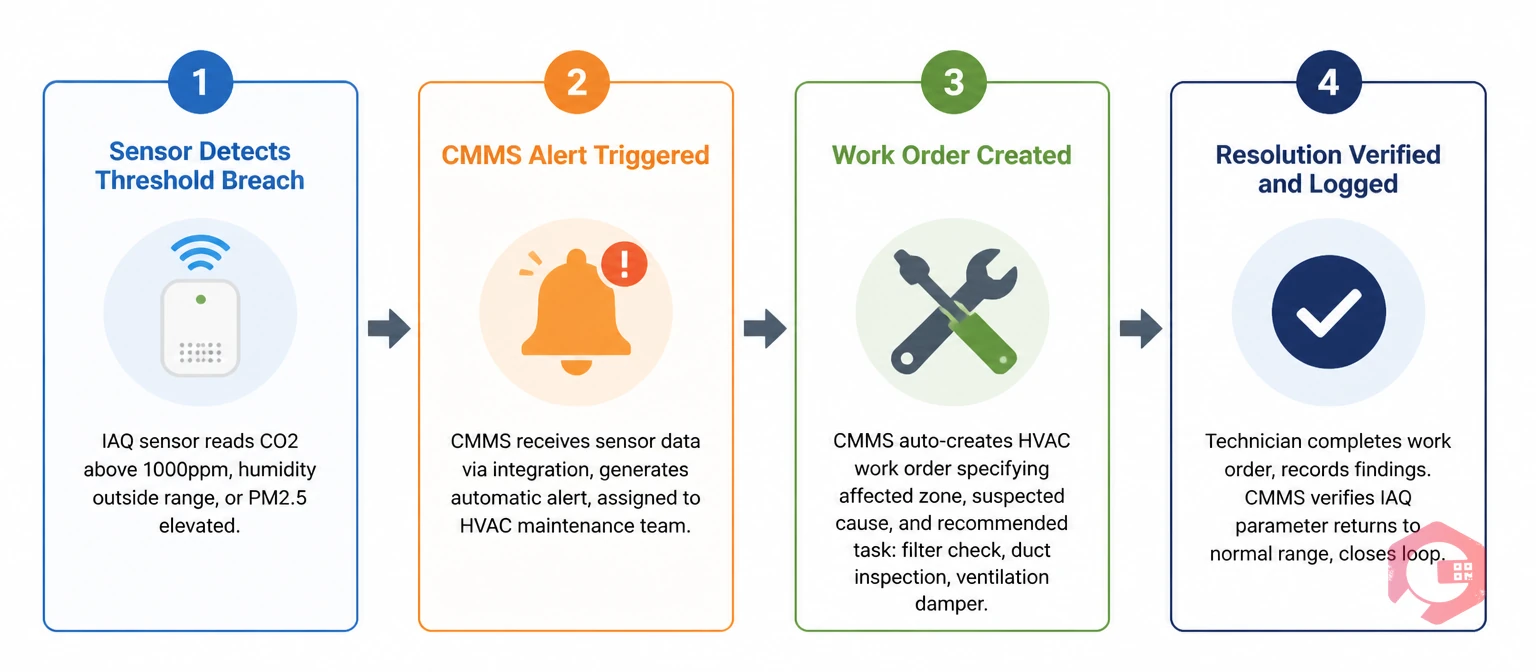
The integration between IAQ sensor data and CMMS work orders follows a four-step sequence. The steps are the same whether the alert-to-work-order trigger is automated (via API or IoT gateway) or semi-automated (FM operator reviews the alert and initiates the work order from a dashboard).
The IAQ sensor or building management system detects a parameter breach and generates an alert. In a connected setup, that alert is transmitted to the CMMS via an API integration, an IoT gateway, or a direct BMS-to-CMMS data feed. In a semi-automated setup, the alert appears on the FM operator's CMMS dashboard alongside live IAQ readings, and the operator initiates the work order manually from the alert record. Either way, the alert is the trigger — not a scheduled PM date, not an occupant complaint, not a technician walkabout.
The CMMS creates a corrective work order pre-populated with the alert details: the parameter that breached, the sensor location, the reading at breach, the timestamp, and the predefined task template for that parameter type. The work order is assigned to a qualified HVAC technician based on skill mapping, given a priority level that reflects the severity and occupancy risk of the parameter breached, and an SLA is applied — 4 hours for CO elevation, 24 hours for a filter PM2.5 exceedance, 8 hours for a humidity breach. The work order management software module handles this pre-population automatically once the alert-to-template mapping is configured.
The HVAC technician receives the work order on mobile, travels to the AHU or zone indicated by the sensor location, and begins diagnosis using the task checklist attached to the work order. The checklist guides the investigation in the order most likely to identify the root cause quickly — for a CO2 breach, that means checking fresh air damper position, actuator response, and air change rate against the design spec before checking anything else.
The technician logs findings, replaces or repairs the identified component, photographs the before and after condition, and closes the work order with a root cause category selected from a predefined list. This root cause data accumulates in the CMMS and feeds directly into the trend analysis that identifies which HVAC components are generating repeated sensor-triggered work orders — signalling that a component is approaching end-of-life and should be replaced proactively rather than reactively. The preventive maintenance software module uses this failure frequency data to adjust PM intervals for high-frequency failure components.
The work order isn't complete until the IAQ reading has returned to within acceptable bounds. After the maintenance action is taken, the technician — or the FM operator from the dashboard — confirms that the sensor reading for the breached parameter has normalised. This post-resolution reading is logged against the work order, creating a documented chain from alert → work order → resolution → verified IAQ improvement. For WELL certification and ASHRAE 62.1 compliance, this complete event log is the evidence that demonstrates active monitoring and responsive maintenance — not just the existence of sensors and a CMMS in the same building.
Sensor-triggered work orders and time-based preventive maintenance schedules are complementary, not competing approaches. Time-based PM handles the predictable maintenance cycle — annual coil cleaning, quarterly belt inspections, monthly drain pan flush, semi-annual filter bank replacement on a calendar schedule calibrated to the building's air quality baseline and filter specifications. Sensor-triggered work orders handle the unpredictable deviations — the filter that saturates early because of a construction project on an adjacent site, the damper that fails between PM visits, the coil that develops biofilm growth faster than the scheduled cleaning cycle anticipated.
Buildings that rely only on time-based PM will miss the condition-driven failures that sensors surface between scheduled visits. Buildings that rely only on sensor alerts will miss the degradation that occurs gradually below the alert threshold — the filter at 80% saturation that hasn't triggered a PM2.5 alert yet but is measurably restricting airflow and increasing fan energy consumption. The optimal configuration runs both in the same CMMS, with sensor-triggered corrective work orders and time-based PM schedules both contributing to the same asset maintenance history and driving the same feedback loop that improves scheduling over time.
Cryotos CMMS connects IAQ sensor data to HVAC maintenance workflows through its workflow automation software and IoT integration layer. When a sensor alert is received — either via direct API integration with a BMS or IoT gateway, or via manual alert entry by an FM operator — a corrective work order is generated automatically using the pre-configured alert-to-task mapping. The work order arrives on the assigned technician's mobile within seconds of the alert firing, with the sensor location, the breached parameter, the reading, and the checklist already populated.
The BI Dashboard gives FM operators a real-time view of active IAQ alerts, open sensor-triggered work orders, and the time-to-resolution for each open breach — so the operator can see at a glance whether every active alert has a work order in progress and whether any are approaching SLA breach. For multi-zone facilities, the dashboard maps alerts to floor plans, making it immediately clear which zones are in breach and which are within bounds without navigating through individual sensor records.
Historical sensor alert data and the work orders they generated are stored together in the asset maintenance history for each AHU or HVAC zone. The Report Builder generates monthly IAQ compliance reports — parameter breach frequency, mean time to work order creation, mean time to resolution, and root cause distribution — formatted for FM review meetings, WELL certification audits, or ASHRAE compliance documentation, without any manual data compilation. Teams using Cryotos report a 30% reduction in unplanned downtime and measurable improvement in response time for sensor-triggered maintenance events within the first quarter of implementation.
For facilities pursuing WELL certification or operating under ASHRAE 241 compliance requirements, the complete event log — sensor alert, work order, resolution, post-resolution reading — is retrievable for any zone, any parameter, and any date range from the CMMS audit history at any time.
At minimum: CO2 sustained above 1,000 ppm, PM2.5 above 12 µg/m³ (indoor baseline rise), TVOC above 500 µg/m³ where occupant activity doesn't explain the elevation, relative humidity below 30% or above 65%, and any CO reading above background in a space served by gas-fired HVAC equipment. For facilities pursuing WELL certification, trigger thresholds are defined by the WELL Air concept parameters and should be implemented directly in the CMMS alert configuration. For ASHRAE 62.1 compliance, CO2 monitoring with corrective action documentation is a standard requirement for most commercial occupancy types.
Yes — through API integration between the CMMS and the building management system or IoT sensor platform. The integration passes sensor readings and alert events to the CMMS, which matches the alert to a predefined corrective work order template and creates the work order automatically. The FM operator is notified that a work order has been created and can monitor progress on the dashboard without manual intervention. In facilities without direct API integration, the FM operator can create the work order manually from the alert record within the CMMS, with the sensor data pre-populated from the dashboard view.
IAQ monitoring reduces HVAC maintenance costs through two mechanisms. First, it enables condition-based maintenance — filters are replaced when saturation evidence appears in PM2.5 data, not on a fixed calendar interval that may over-service low-load periods and under-service high-load periods. Second, it detects developing failures early — a damper that is gradually losing its range of motion shows up in CO2 trends weeks before it causes a full ventilation failure, and a work order at that stage costs significantly less than emergency repair after complete failure. According to US Department of Energy research, fault detection and diagnostics in HVAC systems can reduce HVAC energy use by 5–30% and maintenance costs by similar margins when integrated with responsive maintenance workflows.
In order of frequency across commercial building types: air filters (saturation, bypass, or incorrect specification for the application), fresh air dampers (actuator failure, mechanical seizure, or controls drift causing reduced fresh air supply), cooling coils and drain pans (biofilm growth causing TVOC and humidity issues), and supply duct integrity (contamination ingress or bypass points causing PM elevation). Humidity-related breaches are most frequently traced to humidifier scale buildup or cooling coil condition rather than controls failures, though controls calibration issues are the second most common cause. A CMMS root cause log across 12 months of sensor-triggered work orders will reveal which components dominate in your specific facility — and that data is the input to your next PM schedule optimisation cycle.
IAQ monitoring without a connected maintenance response is a data collection exercise. HVAC maintenance without IAQ data is schedule-driven guesswork. The combination — sensor alerts that automatically generate CMMS work orders, drive technician response, and create a verified resolution record — is what turns both into an active, evidence-based air quality management system.
For facility teams ready to connect their IAQ sensor data to their HVAC maintenance workflow, Cryotos CMMS provides the IoT integration, workflow automation, and real-time dashboard needed to make every sensor alert count. Book a free demo today and see how your HVAC maintenance programme looks when it's driven by live air quality data.



Cryotos AI predicts failures, automates work orders, and simplifies maintenance—before problems slow you down.



